I always believed in free education. I made a decision to never monetise my popular UBC and Oxford lectures. I’ve lived my life by working to bring knowledge to everyone on Earth: the pioneering lectures, the startups past and new, and my AI research. This desire came as the result of witnessing and experiencing a lot of suffering in my childhood. This course is part of my legacy and I’m very proud of it, and thankful to Oxford, the TAs and my students then.
I’ve seen a lot of conversations around @Aluta_ke
app lately, and I genuinely love what they’re building for Kenyan entertainment. It got me curious about what their brand could look and feel like.
Here’s how I envision Aluta, starting with the brand Identity.
@mbiti_mwondi
Six copies of my book has sold. I am not upset it was only released on Saturday. I feel happy and proud. Of course I would love to sell more, BUT, if I only sell 6. It still counts and I am still a published Author. I hope my Author Grandfather is looking down on me and proud.
He should develop his own platform and go all the way, time is on his side and in building is how he will learn , make early mistakes and develop a solid ride or die team that learns what the ground looks like. Burden of united opposition is not his to bear.
Life is kicking my ass. My oldest turns 18 tomorrow and barely wants me around beyond what I can provide. My mom’s dementia is getting worse. I feel crushingly alone, exhausted from surviving each day, and honestly can’t see what I’m supposed to look forward to anymore.
In August 2022, the head of security and investigations at NCBA Bank (the financial backer of the Fuliza loan platform) flagged a severe financial risk.
Data analysts noticed an unprecedented, highly localized spike in outstanding, un-repaid mobile money loans. Over 123,000 brand-new Safaricom SIM cards, all activated at roughly the same time (mostly in January 2022), had simultaneously opted into Fuliza, borrowed out their loan limits, and vanished.
When the bank tried to initiate routine debt collection, they discovered every single line had been permanently turned off or discarded, leaving behind a massive 449 million shillings loss. NCBA formally requested the DCI Banking Fraud Investigation Unit (BFIU) to intervene.
BFIU detectives tracked the digital trail and realized the fraudsters were exploiting a vulnerability at the root level. The mastermind had managed to generate over 19,000 completely falsified National Registration Bureau ID numbers.
Instead of just altering existing names, the cybercriminals manipulated the root database protocols to generate over 123,000 completely falsified, valid-format National ID numbers directly into the system registries. The fraudsters injected completely fictional identities (names, photos, and biometric data templates) directly into the National Registration Bureau (NRB) systems.
Because the manipulation happened at the root database level, the system treated these entries as legitimate and generated official, valid National ID numbers for people who never existed, "ghost Kenyan citizens".
By using compromised root access, the mastermind skipped the mandatory physical vetting steps, local chief verification letters, and fingerprint validation queues.
Because these 123,000+ numbers were successfully injected at the foundation level, they bypassed regular database audits and verification algorithms, appearing to external financial institutions as authentic registrations.
When financial systems or mobile networks pinged the government database to check if an ID was real, the database replied with a "Yes." This allowed the syndicate to bypass strict Know-Your-Customer (KYC) security checks effortlessly.
Armed with thousands of genuine-looking but completely fictional ID profiles, the syndicate opened hundreds of "ghost" bank accounts, registered fraudulent SIM cards, and bypassed automated Know-Your-Customer (e-KYC) parameters. These 123,000+ fake identities were used to register thousands of fraudulent SIM cards (lines) and open bank accounts.
The When the DCI tracked the stolen money, channeled by the syndicate through these "ghost" accounts, the trail led to an ID number and a name belonging to a person who did not exist in the real world, a "ghost", making early investigations incredibly difficult.
Over time, these fake IDs were used to mass-register the 123,000 Safaricom SIM lines.
The syndicate cleverly spent months executing a "borrow-and-repay" loop on each card. By taking small overdrafts and paying them back immediately, they tricked Safaricom’s automated algorithm into aggressively raising each line's limit.
Once the limits peaked, the syndicate maxed out the Fuliza overdrafts in a single, one sweeping, pre-planned window. These sweeping runs simultaneously triggered maximum Fuliza overdraft loans across thousands of lines, instantly generating millions in artificial debt that would never be repaid.
To wash the funds, they routed the millions through a complex web. The instantly borrowed millions were not withdrawn directly from the primary fake accounts. Instead, the cash was rapidly transferred through a secondary layer of thousands of disposable "burner" SIM cards to fragment the transactions and break any direct digital link to the original root-level fake IDs.
Must be hard being Sifuna. The old guard want him to wait for them to get power first. His compatriots want his popularity but they want him to fail. His juniors see him as a stumbling block to their 2032 dream. Huyu jamaa itabidi tumuombee sana. God has a good plan for him
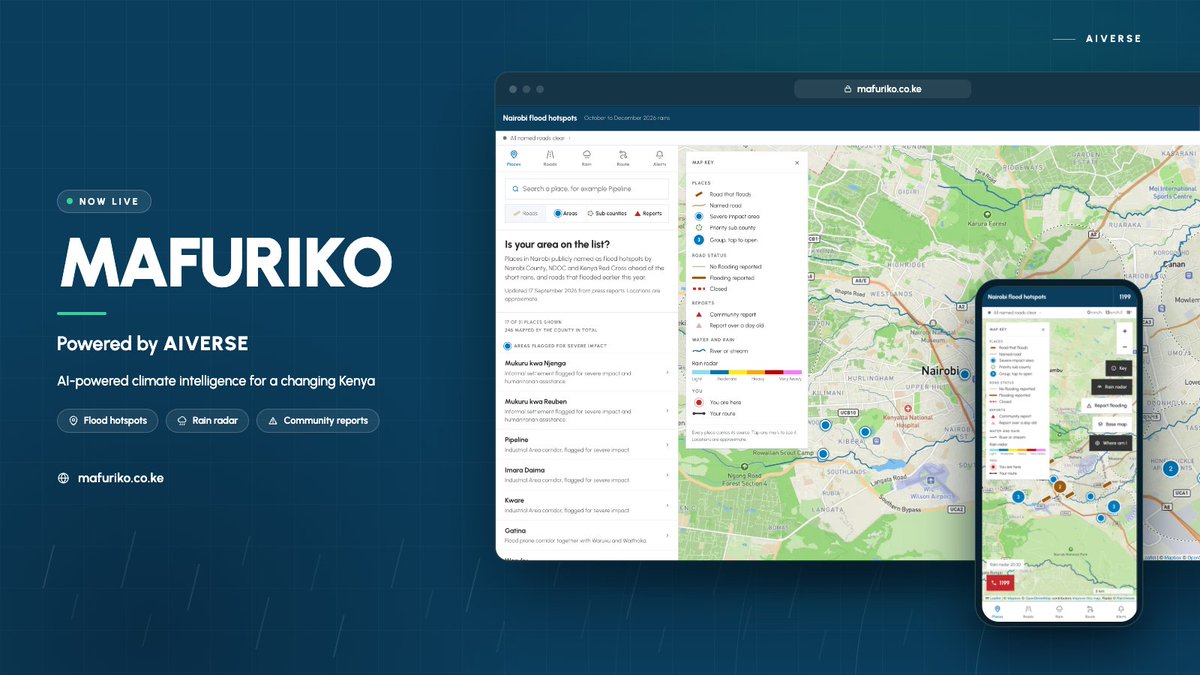
Ahead of El Niño 🌧️, we knew we needed better ways to prepare and respond. So we built https://t.co/pG5V0HC3cI
Mafuriko is a community-powered early warning system for flooding.
Built from the ground up by @EsotericStrats , powered by @aiverseafrica , it brings together flood hotspots, rainfall data, affected roads and community reports
And anyone can report flooding, helping build a real-time picture of what’s happening on the ground.
🌐 https://t.co/HcixhpIIRq
#Elniño
Babu Owino knows there is a much bigger room for mischief under a Ruto presidency than there would be under a Sifuna presidency.
He has watched how Sifuna grills governors in Senate committees.
He knows a Sifuna presidency would leave very little room for mischief.
PRESS STATEMENT
WHY KENYA'S ELECTORAL SYSTEM MUST PASS THE CONSTITUTIONAL TEST
Fellow Kenyans,
Yesterday, I appeared before the High Court in a constitutional case concerning the Independent Electoral and Boundaries Commission (@IEBCKenya) and the integrity of Kenya's electoral system.
The petition asks the Court to test the entire chain of our elections - how Kenyans register, how they are identified at the polling station, how their votes are cast and counted, and how results are transmitted, verified and declared - against the standards the Constitution itself sets.
That question is simple to state: Does Kenya's electoral system meet the constitutional test?
Article 81 requires that elections be administered in a manner that is impartial, neutral, efficient, accurate and accountable. Article 86 requires that, whatever method is used to cast, count and transmit votes, that method be simple, accurate, verifiable, secure, accountable and transparent. The Elections Act sets the same standard for the technology IEBC deploys.
The Constitution anticipates an electoral process that is not just free and fair, but one that is also tamper-proof. Free and fair speaks to conduct on the day; tamper-proof speaks to the design of the system itself - whether it can withstand interference at any point in the chain, and whether that can be proven, not merely assumed.
To be clear, this case is not just simply about paper versus electronics.
Kenya's system already combines both - paper ballots, electronic voter identification, and electronic transmission of results. Technology, properly designed and independently verifiable, can be a powerful ally of electoral integrity: it can reduce unnecessary human discretion, create reliable audit trails, make results easier, not harder, to verify, and significantly reduce the cost of elections.
But technology is not self-certifying. It does not become trustworthy simply because it is technology. Like every other part of the electoral chain, it must be shown to satisfy the Constitution's own tests of transparency, verifiability, security and accountability - and, ultimately, to be tamper-proof.
That is the real question before the Court: does the entire electoral chain - registration, identification, casting, counting, tallying, transmission, verification and declaration - give Kenyans sufficient safeguards that their vote, once cast, cannot be manipulated, mishandled, or rendered impossible to verify?
This is not a personal quarrel with @IEBCKenya. It is a constitutional and public-interest matter.
Sovereignty in this country belongs to the people, and the vote is the sole instrument by which that sovereignty is exercised. An electoral system that cannot be meaningfully verified is not one the Constitution permits us to accept on faith.
I want to be precise about where this matter stands. The High Court has not ruled on the merits. The parties were heard, and the constitutional questions remain before the Court. I respect that process fully and will abide by whatever directions and determination the Court makes.
My role as a citizen, a public representative, and the petitioner in this matter is to ensure these questions are placed squarely before the Court and answered according to the Constitution and the law, not according to convenience or assumption.
Kenyans should not have to be told their votes were counted correctly. They should be able to verify it. That is the standard the Constitution sets, and it is the standard we are asking the Court to enforce.
The vote belongs to the people. The Constitution protects it. Our electoral system must do the same - free, fair, and tamper-proof.
We proceed, firmly and within the law.
God bless Kenya.
Okiya Omtatah Okoiti