If you're interested in joining us as we continue to scale, submit an application here: https://t.co/q8kqZuihQf
We're hiring across all roles, including pretraining data!
At MAI, we're hiring across all of our roles, including pretraining data! Send your application along here if you're interested: https://t.co/q8kqZuihQf
Had a fun time working on pretraining data for this, especially holding ourselves to not distilling from other models.
Also really glad with how much detail we are able to share in the tech report. If you want to see how to climb “organically,” check it out!
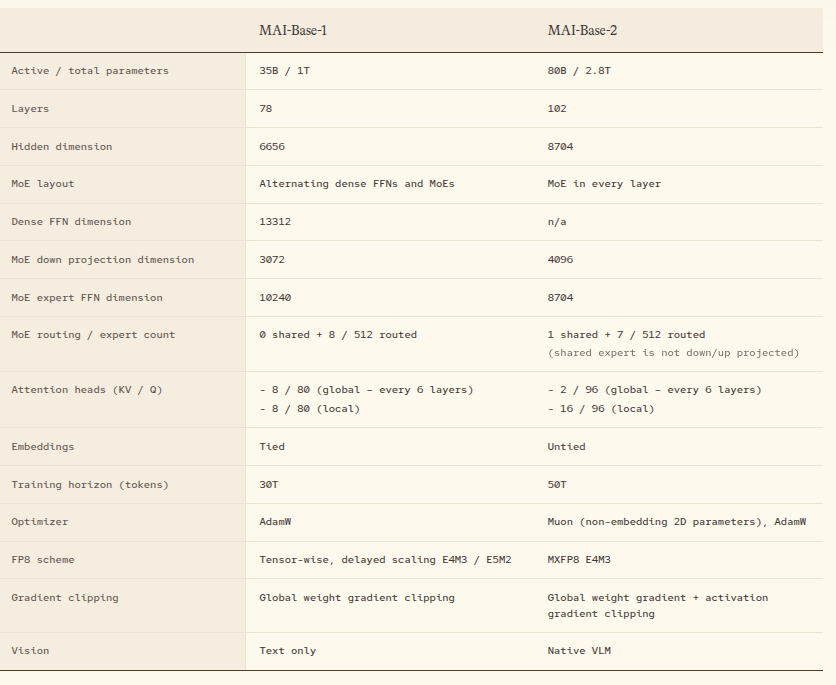
Super excited to announce seven new world-class MAI models today. They represent what we consider a new era in AI designed to keep you in control and on the frontier.
First is our text foundation model, MAI-Thinking-1, exceptionally strong on reasoning and SWE tasks.
- It’s a 35B active parameter MoE with a 256K context window. Independent human raters on Surge prefer it for overall quality in blind side-by-sides versus Sonnet 4.6, and it’s achieved 97% on AIME 2025, the key measure of its general-purpose reasoning abilities.
- It's at 53% on SWE Bench Pro, placing it right alongside Opus 4.6 on one of the toughest coding benchmarks.
- And since we co-designed our models with our own silicon, MAI-Thinking-1 is optimized on our MAIA 200 chip. Benchmarking head-to-head against the GB200, we see 30% better performance per dollar as well as a 1.4x performance-per-watt gain when running our MAI models on the MAIA 200 end-to-end.
Next is MAI-Image-2.5 and its Flash variant. Two super strong models now at #2 on the leaderboards, surpassing the score of Nano Banana 2 on image editing.
Last for now is MAI-Code-1-Flash, our new inference efficient coding model, especially tuned for VS Code and GitHub Copilot CLI.
- Code-1-Flash achieves 51% on SWE Bench Pro, despite having just 5B parameters, putting it closer to Haiku in size but cheaper in cost.
All of this is the foundation for Microsoft Frontier Tuning. It lets you customize our models to create custom, company-specific agents that only you control. You can make our model, your model. Your data. Your agents. Your moat.
Early adopters are already seeing a difference. When we tuned our models for McKinsey’s tasks, MAI delivered the highest win rate, outperforming GPT-5.5 on quality, while being 10x lower on cost.
Also really excited to be collaborating with the amazing team at Mayo Clinic to jointly train a new frontier AI model for healthcare.
Our announcements today mark another milestone on the road to humanist superintelligence. You can learn more and about our other new models in our latest blog: https://t.co/v65eop5Ixq
After almost 12 years in Brain/DeepMind, I’ve finally decided to take the leap. My cofounders: @yinfeiy, Seth and I have kicked-off @ElorianAI. The first multimodal reasoning lab founded and led by former LLM pretraining, data and multimodal leads. https://t.co/XHcEtvl9F9 (1/n)
We are excited to share Reka Flash ✨, a new state-of-the-art 21B multimodal model that rivals Gemini Pro and GPT 3.5 on key language & vision benchmarks 📈.
We've trained this model from scratch and ground zero with a small (but amazingly capable team 🧙♂️) and relatively finite resources. We're amazed at how strong it is 🦾. I'm proud of our financially optimal LLM team.
Abandoning one's comfort zone is surely difficult and having to redo things from scratch is often scary & daunting. Many things in the wilderness don't work from the get go and it was often a huge pain in the neck 😢.
I should write a separate post someday of how much we have we've had to rebuilt (and suffered 🤣). Everything from robust training infra, proper (human) evaluation pipelines and proper RLHF setups. I am thankful of the crazy talented team we have here ☺️.
Meanwhile, our largest most capable model Reka-Core is finishing soon and we're already very excited by early results 📈. More to come very soon!
9 months in. Excited to be back at the frontier 🔥.
Check out our blogpost here: https://t.co/sJGIgp5CkW
Congrats, @YiTayML and the rest of the @RekaAILabs team for this amazing milestone! It's truly astounding to see so much progress in such little time -- especially on the multimodality front. Can't wait to see what comes next when all that extra compute comes online 😁
It’s been a short 6 months since I left Google Brain and it has been a uniquely challenging yet interesting experience to build everything from the ground up in an entirely new environment (e.g., the wilderness)
Today, we’re excited to announce the first version of the multimodal LLM we trained from scratch at @RekaAILabs ⭐️. I’m proud of what the team has achieved, going from an empty canvas to an actual full fledged product in under 6 months.. Check out the thread for more details and cool examples in this blogpost: https://t.co/sa1HdfrGjL
Yasa-1 is not just a text assistant, it also understands images, short videos and audio (yes, sounds 🎶 too). We also spent substantial time natively optimizing for retrieval, adding a code interpreter, investing in multilinguality and supporting live data via search engine integration!
We also built out our data, training and serving infrastructure and spent significant time investing in our own internal evaluation framework (which imo is amazing! 😋)
Year 0.5 was about laying the groundwork and paving the way for the game changing research that we’re excited about. More exciting stuff to come!
Retrospectively, the journey was also definitely not a bed of roses. From the developer experience perspective, transitioning from Googley environment to “code in the wild '' was excruciatingly painful. Having to re-implement UL2 from scratch outside Google was tougher than I expected as well 😧.
It was also a very interesting experience having to think beyond just “requesting for more chips” but having to actually procure and source your own chips and training them on your own runway 😂.
If training models at Google was like fine dining 🍷, doing it at your own startup is like a picnic in the jungle 🧺🌿. Fascinating, but in a different way 😃.
On a happier note, our 2.4K H100 cluster is about to come online very soon and I’m very excited about how much better our models are going to get and all the exciting research that we’re gonna be able to pursue! 🔥
Do also check out our main twitter account and do follow for more updates!
New paper w/ @dmdohan and @david_r_so! Can LMs be used to design novel model architectures? We propose EvoPrompting, which evolves few-shot prompts to enable a code-pretrained LM to generate novel state-of-the-art architectures.
https://t.co/ELX0awDzcr (1/4)
New paper w/ @dmdohan and @david_r_so! Can LMs be used to design novel model architectures? We propose EvoPrompting, which evolves few-shot prompts to enable a code-pretrained LM to generate novel state-of-the-art architectures.
https://t.co/ELX0awDzcr (1/4)
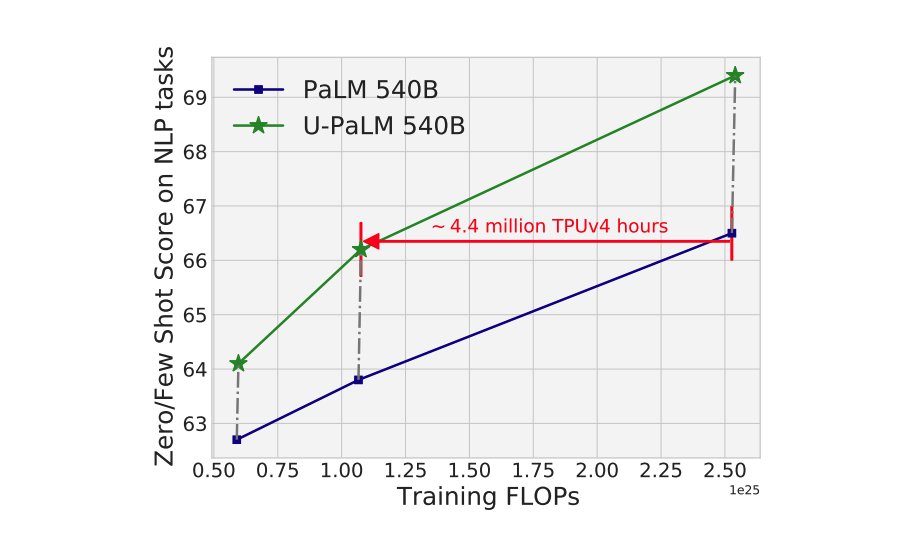
Introducing U-PaLM 540B! @GoogleAI
Training PaLM w UL2's mixture-of-denoisers with only 0.1% more compute unlocks:
- Much better scaling 📈
- Emergent abilities on BIGBench 😎
- Saving 2x compute (4.4 million TPU hours!) 🔥
- New prompting ability
link:https://t.co/rucgLWHgGR
Introducing U-PaLM 540B! @GoogleAI
Training PaLM w UL2's mixture-of-denoisers with only 0.1% more compute unlocks:
- Much better scaling 📈
- Emergent abilities on BIGBench 😎
- Saving 2x compute (4.4 million TPU hours!) 🔥
- New prompting ability
link:https://t.co/rucgLWHgGR
Can searching over low-level TensorFlow primitives improve the efficiency of language models?
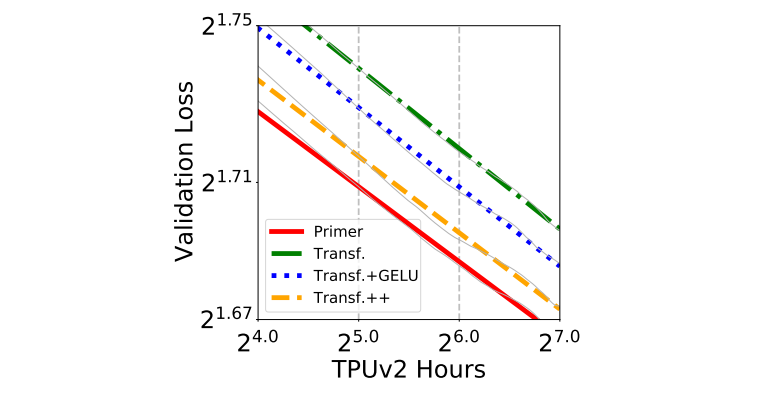
Yes! Check out Primer, our new work on searching for efficient Transformers: https://t.co/njKhb63Nd2
Primer: Searching for Efficient Transformers for Language Modeling
https://t.co/RJ7IfdBvKo
We use evolution to design a new Transformer variant, called Primer. Primer has a better scaling law, and is 3X to 4X faster for training than Transformer for language modeling.
Primer: Searching for Efficient Transformers for Language Modeling
https://t.co/RJ7IfdBvKo
We use evolution to design a new Transformer variant, called Primer. Primer has a better scaling law, and is 3X to 4X faster for training than Transformer for language modeling.
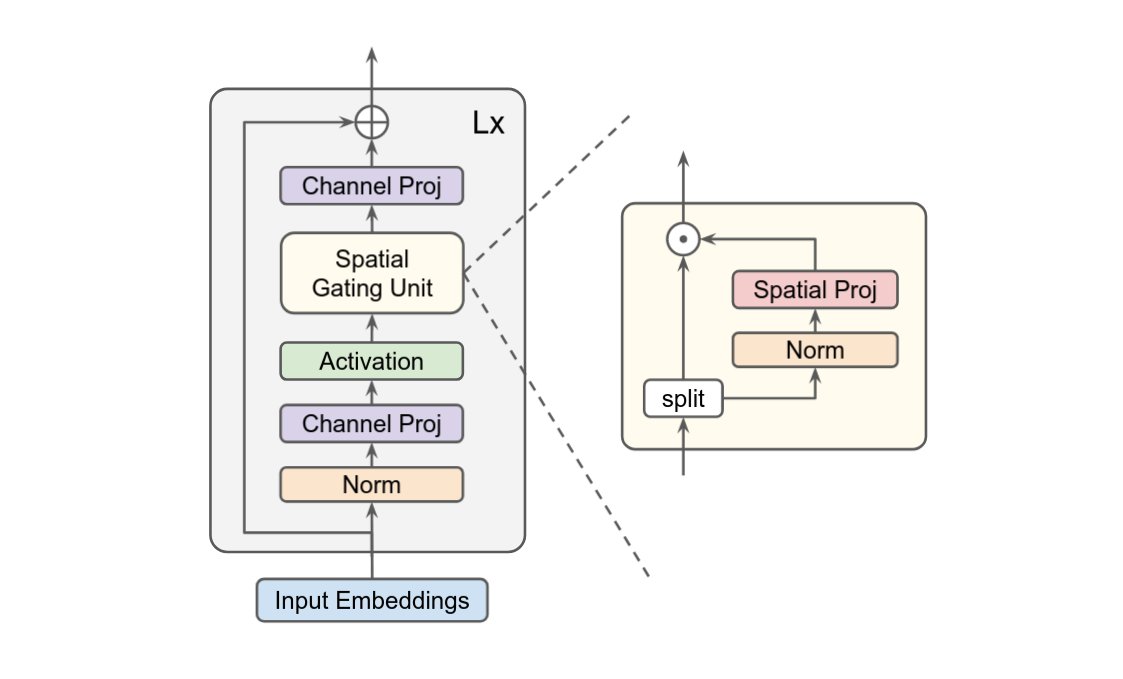
Pay attention to MLPs: https://t.co/6kx1fx4FEf
We show that MLPs with gating work well for key applications that Transformers are good at: BERT for NLP and ViT for vision.
Is MLP all you need?
Fun AutoML-Zero experiments: Evolutionary search discovers fundamental ML algorithms from scratch, e.g., small neural nets with backprop.
Can evolution be the “Master Algorithm”? ;)
Paper: https://t.co/lhW3qtxCTM
Code: https://t.co/v1eouPxPHv