@ben_j_todd@stalmico You really think it's top GiveWell charities vs economic growth policy, private sector (Wave, Wasoko) or innovation (GLP's, Starlink, solar panels)?
This is part 1 of 2 on Nigeria's 2nd stint at civilian rule (1979-1983). Sadly, it was more corrupt than Nigeria's first democratic government after independence. Once oil prices collapsed in the 1980s, Nigeria entered calamity mode.
https://t.co/BOsN9PTN0l
@michael_nielsen There are doubts about the population figures, the last DRC census was over 40 years ago, was likely flawed, and extrapolated from ever since. - https://t.co/4AEjLfzJv7
@ryancbriggs@leilavclark@mattyglesias Seconding Ryan, there's a fair amount of global development work that doesn't get the same visibility. I write a newsletter covering development economics, aid, innovation, effective giving etc if that's of interest - https://t.co/uU8ZztPu6P
@GjMcGowan@BernoulliDefect@mattyglesias I think MPs could argue they were held back by what could get a majority in parliament. So it's not necessarily inconsistent if they join Reform and have a different mandate.
The 2024 Revision of World Population Prospects from the UN Population Division (2024 WPP) has serious credibility problems, both in data accuracy and in projection plausibility. This matters because it undermines rational demographic discussion.
Here’s the pattern: I present recent data from national statistical institutes, and someone counters with 2024 WPP figures, either directly or via websites and AI tools that draw from it. The disconnect has become impossible to ignore.
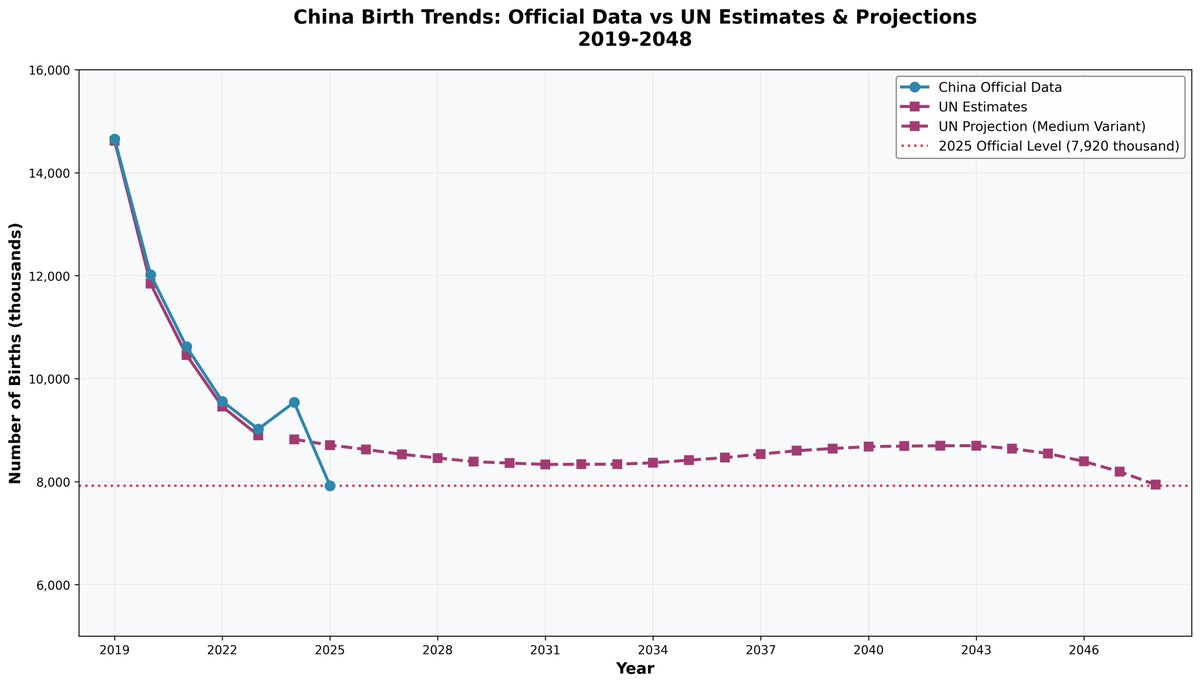
Let me illustrate with China’s birth data from 2019 to 2025, plotted against the 2024 WPP estimates and projections.
In 2024, China’s births rose modestly by around 520,000, thanks to the Year of the Dragon, traditionally considered auspicious for childbearing. What's revealing isn’t the increase itself, but how small it was.
Then came 2025: births plummeted by 1.62 million to just 7.92 million. Even accounting for the dragon year bump, this represents a 1.1 million drop from 2023.
The scale of this decline is staggering. The 2024 WPP didn’t project China would reach this birth level until 2048. Reality has arrived 23 years ahead of the 2024 WPP.
Why the massive discrepancy? The 2024 WPP assumes China’s fertility rate, after years of nearly uninterrupted decline, would suddenly reverse course starting in 2024 (births would increase a bit later because of smaller cohort sizes of women in their fertile ages; recall the difference between fertility and birth rates).
This assumption rests on a statistical mechanism called “reversion to the mean,” built into the model for mathematical convenience rather than empirical evidence.
To be fair, China’s fertility (like global fertility) is entering uncharted territory. We’re witnessing demographic dynamics we’ve never seen before. I’m not demanding perfect projections. I can’t predict the future either.
But I am asking for intellectual honesty about these models’ limitations. The 2024 WPP doesn’t provide it.
So, when you cite the 2024 WPP to challenge demographic data, consider: you’re probably working with flawed assumptions.
For a deeper look at the WPP's implausibility, see my slides at
https://t.co/geZQFXwN8h
particularly slide 18.
@mattsclancy@arpitrage I think the previous declines were due to wealth/health/education. But this has recently accelerated beyond those trends, especially when you look at countries that have had a much faster change in smartphone access compared to GDP/health increases.
📢 International migration is one of the most powerful tools available for poverty reduction and economic development.
At our VoxDevLit launch event on January 14, @deanyang will summarise evidence on international migration.
Register➡️ https://t.co/wfwONRfCMt
Everyone blames Islamic fundamentalism for Pakistan falling behind. I disagree. Many fundamentalist states are doing better.
Indians need to understand Pakistan’s economy better than that.
<link below>
My DMs are open, and if someone wants to give me and my team $10-50M to go and invest in a post-Maduro Venezuela we have already done some preliminary work.
The Venezuela debate is bizarrely shallow. Everyone’s arguing about international law and what this means for Russia & China. Hello?? The West’s enemies don’t give a crap about international law!!!
What actually matters is will this make life better for Venezuelans? Idk ... but we shouldn't immediately be optimistic.
US-backed interventions in Latin America (Guatemala '54, Brazil '64, Chile '73, Argentina '76) didn’t produce stable, humane outcomes. They often removed, like Maduro, a Bad Guy. Just to allow another Bad Guy to rise to power.
I wonder how many people in DC are thinking about building up Venezuelan legitimacy, incentives, and state capacity.
I just really hope someone has a good plan because regime change without institutions doesn’t give you freedom, it just changes who’s holding the whip.
GiveWell excels at finding high-certainty interventions. But for donors with higher risk tolerance the landscape is far less mapped.
I've compiled 50+ funding opportunities across economic growth, health, migration, advocacy and meta-infrastructure.
https://t.co/0OaEYAkgdY