Assistant Professor of Political Science at Florida State University. Berkeley PhD. I study American political institutions, esp. presidential unilateralism.
Come work with me! FSU is hiring an assistant professor in American Political Behavior, broadly defined. I'm the search chair and can answer any questions you might have, so please reach out. Applications due Sep 15, apply here: https://t.co/dFEX7iByPx (Job ID: 63220)
A lot of people saying this is 63%, but that's wrong. You wouldn't try the 100th time if you were successful in some previous attempt. So conditional on getting to the 100th attempt, your probability of success is 1/100.
Some NIMBYs are unreasonable fanatics. But most are not: they just want what's best for their neighbourhood. Separating that majority from the minority might be how we can dismantle the vetocracy that has taken hold across most of the Western world.
https://t.co/7ECxEehovD
There are big strides being made towards upzoning in most developed countries. The mood has shifted decisively and nearly all sensible people now agree that we need many more homes in prosperous cities.
But even the biggest successes can falter if the NIMBY coalition can regroup and create new barriers to development after pro-housing reforms have happened.
• Ambitious upzoning reforms have happened in Oregon, Minneapolis, California and Montana but still haven't delivered significantly higher housebuilding because of other barriers that NIMBYs have resorted to instead.
• After passing parliament with bipartisan support, New Zealand’s Medium Density Residential Standards were reversed following public backlash, political infighting, and a change of government.
• New South Wales Premier Chris Minns abandoned a sweeping transit-oriented development plan after pushback from local governments and the Greens.
• The Tories not only retreated from a major pro-development planning reform – which I predicted would fail in advance – but left land use rules *stricter* than they had been before.
Unpicking the NIMBY coalition can help to make sure these efforts succeed and stick.
New at Works in Progress, how new developments that enhance the places they happen in can give the reasonable majority safe, liveable and stable neighbourhoods – and 'drain the swamp' around the fanatics who will never be happy.
Rather than expand the NIMBY coalition, reformers should try to divide it. Most objectors are self-interested and support development near them if they benefit from it. New in Works in Progress, by @davidrfoster0 and Joseph Warren.
@JohnHolbein1 The design of the submission system is the problem. The question of volunteering isn't asked in the course of submitting a proposal. You have to go out of your way to click on a different link.
Works in Progress is now available as a print magazine. I think it's the most beautiful and readable magazine I've ever seen.
Subscribe today for $100/£75 to receive six beautiful, 120-page issues a year.
https://t.co/sCOVnY1mf1
Of course, all I am doing here is spelling out the logic of @davidrfoster0 & Joseph Warren's 'The NIMBY Problem'. Some good examples of it here https://t.co/mimynDRM8D
Helen Mirren says she feels “sad” that Kurt Cobain is no longer alive because he never got the chance to experience GPS and its “magical” functionality.
“I always say, it’s so sad that Kurt Cobain died when he did, because he never saw GPS,” Mirren said. “GPS is the most wonderful thing, to watch my little blue spot walking down the street. I just find it completely magical and unbelievable.”
Read more here: https://t.co/85CfOMEOmK
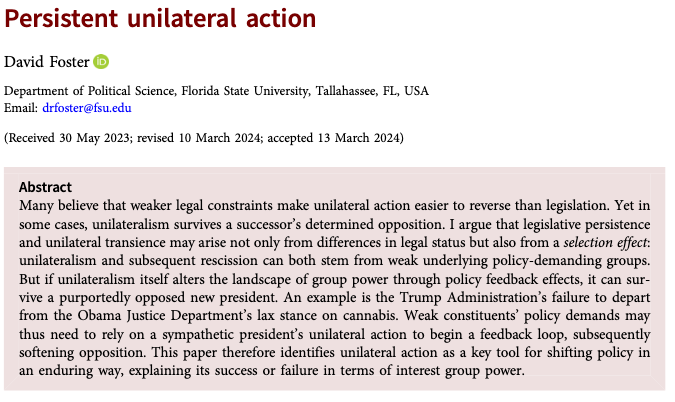
⚖️Using a formal model, @davidrfoster0 shows unilateralism can alter the landscape of group power through policy feedback effects, and survive a purportedly opposed new president https://t.co/zSllyX8mM0 #FirstView#OpenAccess
Excited that my article on presidential executive orders and policy feedback effects is finally available on @PSRMJournal FirstView. Everyone usually assumes that legislation is sticky, while unilateral action can be immediately reversed by a successor. 1/7
Interesting model. It might not be that executive orders are any less durable than congressional legislation, just that legislation (as opposed to executive orders) is correlated with stronger support from the interest group environment.
Future work needs to contend with the normative implications of this for democratic accountability in the United States.
Open-access article here: https://t.co/HNdnMu3tJG 7/7
In some cases then, unilateral action can be politically impossible to undo, even if it is narrowly legally permitted. Thus, presidential unilateralism can be a key means of achieving durable policy shifts. 6/7