Bland 🤝 @Muse
With the agent phone plan you can:
- Make appointments
- Book reservations
- Text your agent
Connecting Muse with the Bland API is the fastest way to give Muse its own Phone Number
https://t.co/HYBWCj9OGc
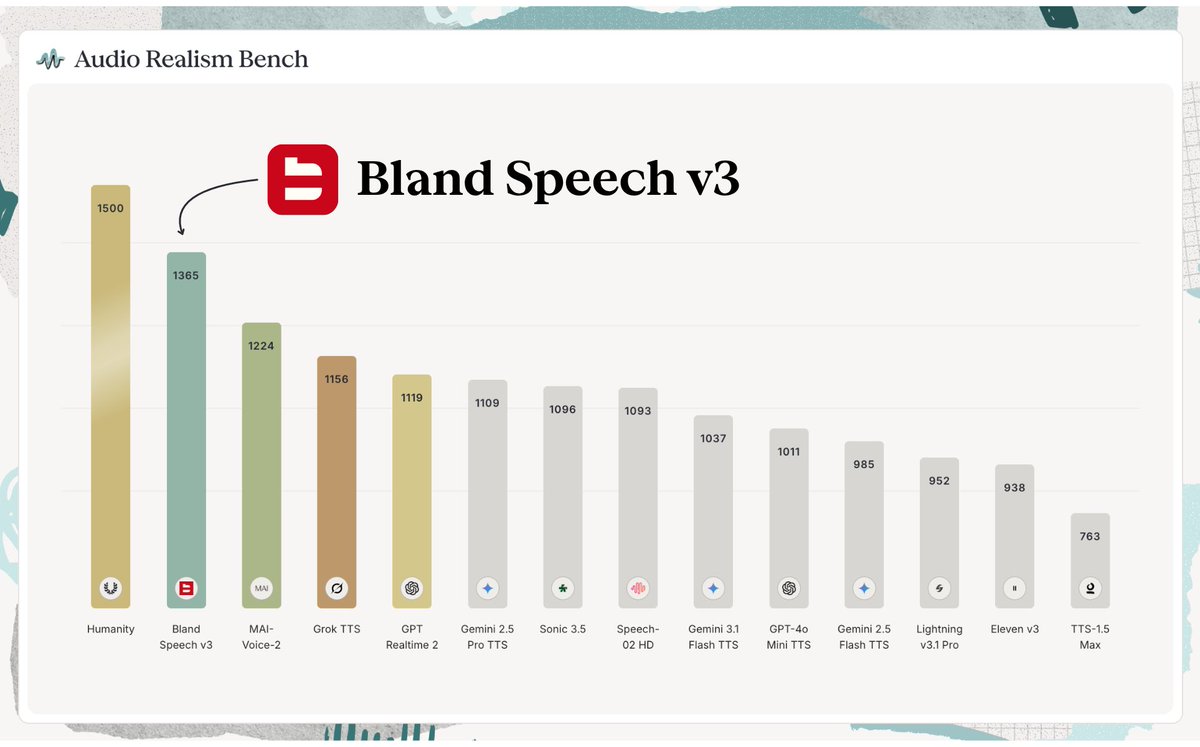
BREAKING: Bland Speech v3 by @usebland debuts as the most human-sounding TTS model on our newest evaluation: Audio Realism Bench.
Traditional speech benchmarks increasingly struggle to separate frontier systems that all sound clean, fluent, and intelligible.
Audio Realism Bench instead asks a harder question: when two voices read the same transcript, which one sounds more like a real person?
Vetted native speakers evaluate recordings blindly across phone agents, conversational assistants, and spoken explainers, judging the subtle qualities that define human-like speech.
We also place real human recordings directly into the evaluation pool, testing whether evaluators can distinguish TTS models from actual human speech.
Bland Speech v3 takes the top spot in our initial rankings, followed by MAI-Voice-2 by @MicrosoftAI and Grok TTS by @spacexai, all demonstrating important steps toward voice systems capable of sustaining genuinely human-feeling interactions.
Congratulations to the @usebland team!
Last year, when the Trump Administration launched its tariff campaign, I was amazed at how hard it was to find good information about what was really happening.
I would read one thing in the Wall Street Journal, and then go to a tax conference in Canada and hear the exact opposite from OECD officials and practitioners.
So when @rossmatican suggested that we should publish a magazine for Commenda, it was a no brainer. Doubly-so when he introduced me to @freeshreeda, our Editor-in-Chief
In this issue, we cover a lot of topics, but one thing Shreeda did an excellent job of is covering some macro themes the world is facing today.
Competitive Governance – now more than ever, jurisdictions are competing for trade, capital, and talent. From SEZs, to European corporate law, to AI and maritime governance, this is a recurring theme throughout the magazine that is deeply relevant to everyone reading it. Gone are the days when wasteful governments have large captive tax bases, and where anti-business politicians can bully corporations without risking their tax base.
The Great Game of the 21st Century – the U.S. and China are locked in a Not Cold War, and the implications of that touch every corner of the globe today. The Chinese model is predicated on centralized direction of capital towards strategic aims – a Capitalist-Marxist fusion offering of sorts, and the American model is still deciding what it wants to be.
The West has lost its understanding of its own prosperity. Industrial policy is the antithesis of what made the West great. The chaotic, bottom-up nature of markets and capitalism is exactly why we are so much more prosperous than even the most successful non-market economies. Yet we seem to have lost that.
Will Europe join the game? Will India? These are players with the capacity to play, but that have not taken the policy decisions required to do so. I explore this in my article on EU Inc, and we will be developing it more in future issues.
I had a ton of fun working with Shreeda and the writers, @JeffJMason@CalebDPetitt@Michael_J_Hil and @rjkarmayogi and am excited to share more in the coming weeks of the process and ideas that went into this first magazine
Read more below!
Announcing our manifesto, Lex et Libertas.
The history of commerce is a history of The People writing their own rules.
When a merchant in thirteenth-century Venice wanted to trade across the Mediterranean, he signed a commenda — a private contract that split the risk between an investor and the merchant who sailed, and held up wherever the ship made port. It was not issued by a king. No parliament approved it.
Merchants wrote it because it was machinery for their economic freedom. This was the precursor to the modern corporation.
This set of norms, jus gentium, grew out of how foreign traders actually dealt with one another, not out of a sovereign's decree. The merchant law was customary, portable, and enforced in the merchants' own courts.
It still works that way, when we let it. In 2013 a startup accelerator, not a legislature, wrote the SAFE, and it now governs a huge share of how companies get funded. That is the spirit of merchant law. Yet despite all of this fantastic success, we’ve lost that spirit.
The civilization that invented the corporation is now strangling it.
The US Code of Federal Regulations ran 9,745 pages in 1950 and runs more than 190,000 today. The average large multinational holds 549 subsidiaries across 56 countries. The rules merchants once wrote for themselves now arrive from thousands of jurisdictions at once. It is impossible for it to be owned by anyone, and the price is paid after midnight by people no one is paying attention to.
Lex et Libertas is our argument for the future we are building. It is the manifesto for my life’s work.
The merchants built their own freedom technology. In dedication to these giants, we are building the only managed entity platform, enabling businesses to seamlessly operate across 100+ countries. 500+ firms including TRX, Remote, Exa AI, Seismic, and Composio have already joined us.
As we enter into the agentic era, software will form the backbone of global industry. A new legal order will emerge to facilitate the future of commerce across our planet, and beyond.
And Commenda is where it will be built. Jus agentium.
Our recent $100M Series C means we can continue training our models to handle the urgent, high-risk, 45-minute phone calls that matter most.
We brought Paul back to explain what this means and why he might be headed back to Costa Rica…
@tracewoodgrains@SecretaryPete Does the bigger loss of safety stem from the reduced workforce size, or from a number of subpar individuals in that workforce? To be clear, both are/would be a problem.
I’m not seeing anything in the analysis that says individuals failing the AT-SAT were allowed through.
@Sailing_LaVaga You’d think with your clout and reach as influencers you could bring more attention to the invention of the “calm seas” button.
Seems irresponsible not to, really. Do better.
France is having a national debate over causality and counterfactuals.
Macron said he would not sign the immigration bill if it passed « only thanks to the vote of RN [Le Pen’s party]».
The bill passed with 349 votes (including 88 RN MPs) out of 535. (1/2)