I’ll be posting
- excerpts from books i’m reading or revisiting
- good advice and wisdom
- price predictions and investment thesis
- questions
I’ll be reposting
- high signal stuff relevant to crypto
- good advice and wisdom
- cool shit generally speaking
- things I am interested in promoting like good writing, businesses, accounts, tools, etc
I don’t accept payment for tweets.
📊 The descent of crypto prices, particularly Bitcoin’s -13% drop in the past week, can be attributed primarily to the dumping by key stakeholders:
🐳🦈 Bitcoin whales and sharks (holding 10-10K $BTC) have dumped -24,602 coins (-18%) in the past week.
🐟🦐 Bitcoin micro traders (holding under 0.01 $BTC) have accumulated +61 coins (+12%) in the past week.
👀 Look for these two groups to reverse course as a solid signal for the optimal dip buy spot.
🔖 Bookmark our key stakeholders dashboard to check out whether whales and retails are accumulating or dumping here! https://t.co/AA2zFPyVJ7
Today a crazy quantum story just got wilder.
On March 31, the Google Quantum AI team published a landmark result on Shor's algorithm for elliptic curve cryptography. Technically, the paper was a bombshell: a dramatic 10x improvement over the state-of-the-art. As a stunt and wakeup call to the blockchain space, those optimisations were illustrated on secp256k1, the elliptic curve underlying Bitcoin and Ethereum signatures.
But perhaps the most striking part of the paper was sociological, not technical. Instead of following standard academic process, the optimisations were kept secret, hidden behind a zero-knowledge (ZK) proof. Google's accompanying blog post mentions they "engaged with the U.S. government". The ZK proof demonstrates the existence of algorithmic improvements without leaking details. Academic censorship with ZK, a historic first!
As a co-author of the Google paper I witnessed some of the context surrounding this censorship. To be honest, multiple aspects of that context don't sit well with me. As much as I believe the general public ought to know more, I am limited in my ability to whistleblow. Though let me be clear about one thing: the Google team's professionalism has been absolutely exemplary, and they deserve nothing but praise.
Censorship has a way of backfiring. The Streisand effect, where an attempt to bury something only draws more attention to it, is exactly what's unfolding today. First, Google's key optimisation has been rediscovered by the French. And in a thrilling turn of events, a collaborative Shor-at-home challenge just launched. The initiative, available at ecdsa[.]fail, breached a new Shor world record in a matter of hours.
Let's start with the rediscovery. Just two months after Google's paper, French quantum expert André Schrottenloher cracks the main secret optimisation. His paper, titled "Optimized Point Addition Circuits for Elliptic Curve Discrete Logarithms", landed on the arXiv today. Big congrats to André, who beat several other nerdsnipped experts to it. In a blog post also published today, Craig Gidney, the world expert on Shor optimisations, revealed that he'd been sitting on this very optimisation for a whole year under censorship pressure.
Interestingly, André missed a handful of minor optimisations, both from Google's original publication and from improvements found since. It's plausible there's still plenty of juice left to squeeze out of Shor, and this is exactly what the ecdsa[.]fail challenge is about. The verifier program developed for the ZK proof does double duty, automatically filtering for valid submissions. Dozens of compounding small and micro improvements are rolling in. As of the time of writing there's an 8.4% improvement to Google's circuit, as measured by the product of logical qubit count and Toffoli gate count. Nice!
The nerdsnipping ran deeper than anyone expected. Over the last few weeks it became clear it extended well beyond Andr�� and other quantum experts. Behind the scenes, a small army of amateurs quietly got to work. Inspired by Karpathy-style autoresearch, they turned AI on Shor. Ironically, the verifier program for the ZK proof makes an ideal reward function for AIs. The barrier to entry for this modern style of research is refreshingly low, with several non-experts, even a teenager, finding nice optimisations. Get in touch if you'd like to join a Telegram group with fellow autoresearchers :)
Part 2: neutral atoms and qday
The story doesn't end with Google. On the same day Google went public, a stealthy startup called Oratomic published its own Shor paper in a coordinated release. It made a splash, ultimately becoming the most upvoted paper on scirate[.]com, a website ranking arXiv papers.
Oratomic's claim was wild. By building on Google's logical optimisations and applying custom physical optimisations for neutral atoms, they claimed just 10K physical qubits were sufficient to run Shor's algorithm on secp256k1. That number is mind-bogglingly low.
Knowing essentially nothing about neutral atoms when Oratomic's paper landed, I was intrigued and decided to learn more about the tech. I fell straight down the rabbit hole and spent a couple hundred hours on the topic. I got a little obsessed and watched every YouTube video I could find and spoke to a bunch of experts.
My conclusion? The tech is real, very real. Even Google recently decided to start a neutral atom lab, a notable pivot from their sole focus on superconducting qubits. If you care about qday, i.e. the day a quantum computer will break the first piece of cryptography in production, neutral atoms demand your attention. I shared some of my learnings on Shor and neutral atoms in a 30min talk at the ZKProof cryptography conference. You can find it on YouTube by searching "zkproof neutral atom".
Here's an interesting observation about this duo of breakthrough papers: neither Google nor Oratomic say a word about what their results mean for qday. No timelines. Zero. Nada. That is especially baffling given that the whole point of whitehat quantum cryptanalysis is to inform qday estimations and help the general public make good decisions.
So let me attempt to partially fill the silence, similarly to what Scott Aaronson did in his April 29 post. Given everything I know, including scary non-public information, I now put the odds of qday by 2032 at 50%. 10% by 2030.
Anecdotally, the US government has its own date: 2035. Originating at the NSA and later adopted by NIST, it's when branches of the US government will be disallowed from using quantum-vulnerable cryptography. In plain language: with hindsight, that date is a joke and should be discounted entirely. I don't see how NIST avoids being forced to pull it forward by years.
Part 3: post-quantum cryptography
There are good reasons to sound the alarm today, but please do not panic. Rushing carelessly towards immature post-quantum cryptography is a recipe for disaster. IMO a good target date for migration is 2029, roughly 3.5 years out. 2029 happens to be the date selected by Google, Cloudflare, and the Ethereum Foundation.
These days most of my time goes to safely migrating Ethereum towards post-quantum cryptography as part of the broader lean Ethereum effort. There's a lot to do. We need to rip out and replace BLS signatures at the consensus layer, KZG commitments at the data layer, and ECDSA signatures at the execution layer.
The plan to get there is compelling, and is based on hash-based cryptography. Within the Ethereum Foundation we've developed a Swiss army knife called leanVM (github[.]com/leanEthereum/leanVM) powered by the magic of hash-based SNARKs. Thanks to truly exceptional work by Emile, Thomas, and others, its performance is derisked. Regarding security, leanVM is a jewel, a minimal zkVM crafted for end-to-end formal verification and maximum security.
Want to help? There are two $1M initiatives. First, the Proximity Prize (proximityprize[.]org). Solve a long-standing mathematical conjecture in coding theory, improve hash-based SNARKs, and go home a millionaire. Second, the Poseidon Initiative (poseidon-initiative[.]info), offers $1M for breaking Poseidon, the SNARK-friendly hash function.
I lean more towards John’s argument than David’s. Though the real missing piece, for me, is a quantitative analysis that can show how value will accrue to ETH in the best case scenarios.
For ETH to be repriced, what does it have to show in terms of numbers and adoption. How will that adoption result in more fees on L1s and L2s, and how will that impact the value flows in and out of ETH. Does it need more fees? more deflation? What would convince a wave of investors of all sizes to decide to take long term positions in the asset? What will make the IRA accounts invest? What will make the boring money manager invest? Safety and consistent business, and consistent growth right?
Right now adoption is low, even with institutions coming in—will it have a substantial impact? I consider hyperliquid a great example of the sort of adoption I expect in the coming years, but i dont see many other use cases. Now imagine if most asset trading moves on-chain — is that enough to move the needle for ETH?
At the moment I think ETH is a solid yield bearing long term investment because
- on-chain financial activity will increase dramatically with the rise of AI agents and automated money management services.
- ETH is a global asset by nature and the globe is becoming more and more digitized when it comes to money.
- bearer assets are powerful because globally people have low trust in their governments and in institutions that provide money services.
- it’s not being debased like fiat and offers a similar level of yield, so at a minimum it’s better than holding Fiat on average.
Moreso I think the style of investing that is “buy sp500 and retire at 60 because it’s diversified and compounds” will have to be convinced to expand their activity beyond sp500 perhaps to include commodities in the basket too. I think that will happen after the next bubble pops. It’s no secret how concentrated sp500 has become. The diversification argument is being invalidated. This class of investor will feel the shock and pain when it happens and maybe, just maybe we will see a new popular investment vehicle that captured inflow to ETH, BTC, and perhaps other successful crypto assets.
But yes, things have to go exactly right for that to happen. I’m not even banking on that. For the reasons I listed already I think ETH is a solid investment long term. Happy to see my balance compound with my yield. I just hope I don’t get fucked by some unjustified volatility and extended bear market. Wouldn’t be the first time though! haha
just thoughts of a long time ETH holder and optimist. ETH is currently 30% of my net worth — I think that’s a reasonable balance given my “thesis”.
The era of Wartime Ethereum is here.
That's the call from our lead macro researcher (and eternal $ETH bull) John Gillen - who just published a full response to David Hoffman's "Why I Sold My ETH" piece.
Here's the short version of where John lands:
David's argument is that the "ETH is money" thesis already played out.
Ethereum got the price it deserves, and there's no rerating coming (up or down).
John's view: it's way too early to call that.
The CLARITY Act isn't law yet... Roman Storm is still on trial... We're not even past the prologue of digital asset adoption.
Calling the game over right now is like declaring American self-governance a failure in 1781 because the Articles of Confederation were messy.
Big things take time.
On the valuation question, John pushes back hard on the idea that $ETH should be priced off L1 fees alone.
Ethereum is not a lemonade stand.
You can't value it like a business.
The market is assigning a monetary premium to $ETH for a reason, and that premium reflects properties the DCF model doesn't capture.
On the "crypto has become a vassal of TradFi" concern - John takes it seriously.
He spent six years at BlackRock.
He's seen how BNY Mellon and the rest plan to absorb this industry.
But the response to that capture attempt isn't to sell $ETH. It's to hold it and stake it.
That's how you vote with your capital against a future where the banks own the rails.
His core point: this asset class is going to dozens or hundreds of trillions of dollars in value, or it's worthless.
$ETH won't tread water at a $300B market cap forever.
The direction of travel is one or the other.
A lot of the current bearishness is just bear market fatigue.
$ETH has underperformed for a long stretch, so people are reaching for reasons to walk away.
Meanwhile network usage is at all-time highs, fees are at all-time lows, the staking queue keeps growing, and the EF is still shipping.
John still likes $ETH. He's not selling.
And he thinks the next chapter is one you're not going to want to miss.
This is only scratching the surface though.
John's a smart cookie - you need to read his full piece below to fully understand what the era of Wartime Ethereum holds. 👇
🐳 On-chain data indicates that Dogecoin's whales have just hit a 6-month high in activity, with 739 $100K+ transfers in just a 1-day span.
Additionally, of the 149 whale wallets holding at least 100M Dogecoin, they now collectively hold an all-time high of 108.52B $DOGE (worth $11.6B).
The memecoin's +14% price rise over the past 10 days is very likely not just a coincidence. Follow along with this Santiment chart here to see if their accumulation continues: https://t.co/qy5Qg5MBdR
Elon Musk avait dit un truc qui m'avait marqué sur l'allocation de ressources. En substance : passé un certain niveau de richesse, l'argent n'est plus de la consommation, c'est de l'allocation de capital.
Cette phrase change tout.
L'économie, dans le fond, c'est juste un problème d'allocation. Tu as des ressources finies et des usages infinis. Qui décide où va quoi ?
Imagine une cour de récré. 100 enfants, des paquets de cartes Pokémon distribués au hasard. Tu laisses faire. Très vite, un ordre émerge. Les bons joueurs accumulent les cartes rares, les collectionneurs trient, les négociateurs trouvent des deals. Personne n'a planifié. Et pourtant chaque carte finit dans les mains de celui qui en tire le plus de valeur. Le système maximise le bonheur total de la cour. C'est ça, la main invisible.
Maintenant fais entrer la maîtresse. Elle trouve ça injuste. Léo a 50 cartes, Tom en a 3. Elle confisque, redistribue, impose l'égalité. Trois effets immédiats. Les bons joueurs arrêtent de jouer, à quoi bon. Les mauvais n'ont plus de raison de progresser, ils auront leur part. Les échanges s'effondrent. La cour est égale, et morte. Elle a maximisé l'égalité, elle a détruit le bonheur.
Le problème de la maîtresse, c'est qu'elle ne peut pas avoir l'information que la cour avait collectivement. C'est le problème du calcul économique de Mises, formulé en 1920. L'URSS a essayé de le résoudre pendant 70 ans avec le Gosplan. Résultat : pénuries, queues, effondrement. Pas parce que les Soviétiques étaient bêtes, parce que le problème est mathématiquement insoluble en mode centralisé.
Quand Musk a 200 milliards, il ne les consomme pas, il les alloue. SpaceX, Starlink, Neuralink, xAI. Chaque dollar est un pari sur le futur. Et lui a un track record. PayPal, Tesla, SpaceX. Il a démontré qu'il sait identifier des problèmes immenses et y allouer des ressources avec un rendement spectaculaire.
L'État aussi a un track record. Hôpitaux qui s'effondrent, éducation qui décline, dette qui explose, services publics qui se dégradent malgré des budgets en hausse constante. Le marché identifie les bons allocateurs, la politique identifie les bons communicants.
Le profit n'est pas une finalité, c'est un signal. Il dit : tu as alloué des ressources rares vers un usage que les gens valorisent suffisamment pour payer. Plus le profit est gros, plus la création de valeur est grande. Quand Starlink est rentable, ça veut dire que des millions de gens dans des zones rurales ont enfin internet. Quand un ministère est en déficit, ça veut dire qu'il consomme plus qu'il ne produit. L'un crée, l'autre détruit, et on appelle ça redistribution.
Dans nos sociétés il y a deux catégories d'acteurs. Les entrepreneurs et les bureaucrates. L'entrepreneur prend un risque personnel pour identifier un problème, mobiliser des ressources, créer une solution. S'il se trompe il perd. S'il a raison, ses clients gagnent, ses employés gagnent, ses fournisseurs gagnent, l'État collecte des impôts. Il est la cellule de base du progrès humain.
Le bureaucrate ne prend aucun risque personnel. Son salaire est garanti. Au mieux il maintient une rente existante. Au pire il la détruit par excès de réglementation, mauvaise allocation forcée, incitations perverses qui découragent ceux qui produisent. Mais dans aucun cas il ne crée.
Regarde les 50 dernières années. iPhone, internet civil, SpaceX, Tesla, Google, Amazon, Stripe, mRNA, ChatGPT. Toutes des inventions privées, portées par des entrepreneurs, financées par du capital risque. Pas un seul ministère n'a inventé quoi que ce soit qui ait changé ta vie au quotidien.
La France est devenue le laboratoire mondial de la dérive bureaucratique. 57% du PIB en dépenses publiques, record absolu. Une administration tentaculaire, une fiscalité qui pénalise la création de richesse. Résultat : décrochage face aux États-Unis, à l'Allemagne, à la Suisse. Fuite des cerveaux. Désindustrialisation. Dette qui explose.
Et le pire c'est que la mauvaise allocation s'auto-renforce. Plus l'État prélève, moins les entrepreneurs créent. Moins ils créent, moins il y a de base fiscale. Plus l'État s'endette et taxe. Boucle de rétroaction négative parfaite. La maîtresse pense qu'elle aide, et chaque année la cour produit moins.
Dans nos sociétés, ce sont les entrepreneurs, toujours, qui font avancer la civilisation. Les bureaucrates au mieux maintiennent une rente, au pire la détruisent. Aucune société n'a jamais progressé en taxant ses créateurs pour subventionner ses gestionnaires.
La question n'est jamais qui a combien. C'est qui alloue le mieux la prochaine unité de ressource pour maximiser le futur de l'humanité. La réponse depuis 200 ans n'a jamais changé. Ce ne sont pas les fonctionnaires.
With recent deposits, Santiment has put over $5M total into @aave to signal confidence and support of DeFi and its amazing community.
DeFi is all about building together, and that includes building a better future when times get tough.
https://t.co/f6vAVHDRYh ✊
Aave is my life's work and we're working nonstop to find the best possible outcome for users.
I’m personally contributing 5000 ETH to DeFi United as we continue working together with partners on formalizing more commitments. I’m working to see this resolved and market conditions normalized as soon as possible.
DeFi United.
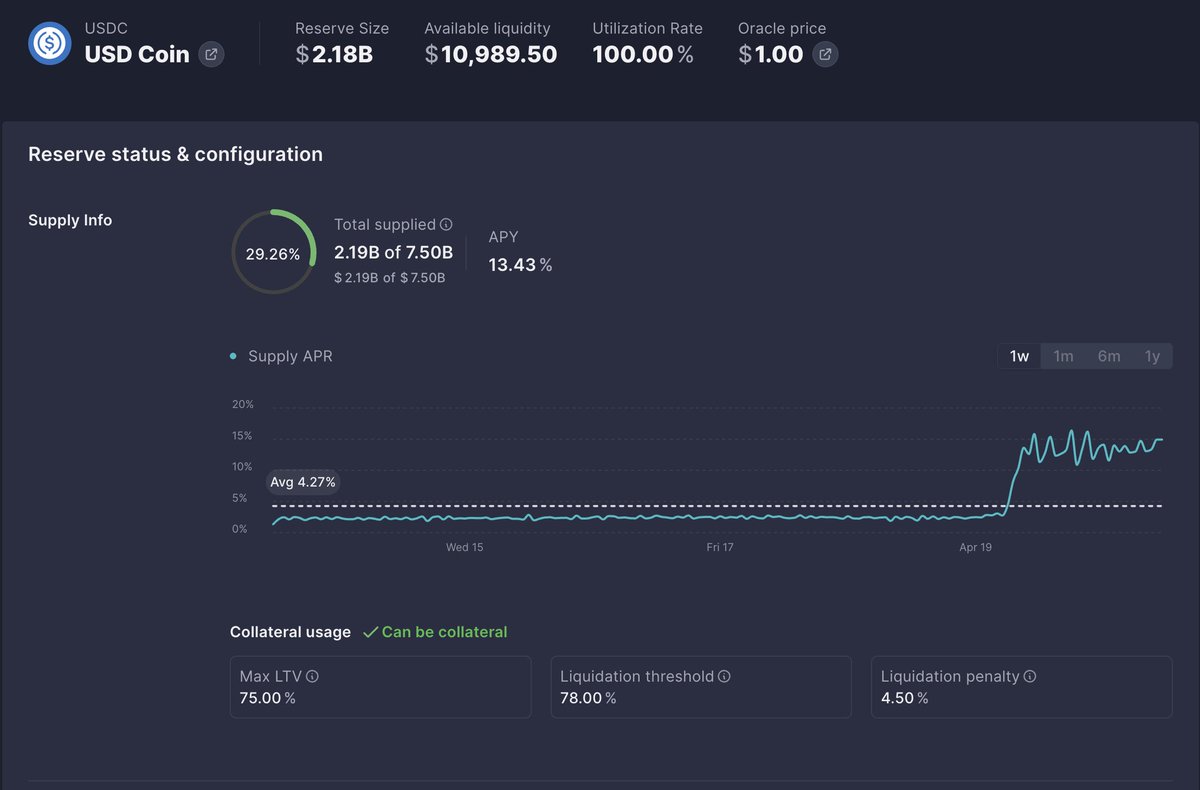
USDC and USDT on Aave are pinned at 100% utilization.
Lenders can't withdraw.
So why is the yield only 13.5%?
Under the old model, a pool hitting 100% utilization would send supply APY to 40%, 60%, sometimes 80%+ within minutes. That's what everyone remembers from the 2022 USDT squeeze on Aave V2. Rate goes vertical. Borrowers get liquidated. Suppliers feast.
That's not happening this time. Here's why.
Aave rolled out something called the Slope2 Risk Oracle earlier this year. Instead of rates spiking instantly when utilization pins, the curve escalates GRADUALLY based on how long the pool stays stressed.
A 1-hour spike barely moves the rate.
A 24-hour spike moves it some.
A 72-hour spike starts to hurt.
The ceiling is also lower. Stablecoin slope2 now targets 10-12%. Used to be 22-35%.
So instead of a panic rate explosion, you get a slow burn.
Who wins from this design?
Borrowers. Including the attacker still sitting on $236M in WETH debt, paying a fraction of what they'd be paying under the old curve.
Who loses?
Lenders. The "your pool is frozen but at least you're earning 40% APY" trade is dead. Now it's "your pool is frozen and you're earning 13.5%."
This was meant to prevent deleveraging cascades during stress events. It's doing that.
It's also suppressing the market signal that usually tells lenders to supply more liquidity and borrowers to repay fast.
Every design choice is a tradeoff.
This one just got tested live, with $200M of bad debt on the line.
(1/2 ) $AAVE signals around the Kelp exploit discovered with Claude via Santiment MCP:
☝️ Whale transactions (>$100K) spiked from 2–6 per hour to 43 within ~90 min of the exploit.
☝️ Exchange inflows went from ~$38K to $3M within ~90 min, peaking at $8.5M on Sat afternoon.
☝️ Sentiment balance dropped to -15, 10x worse than the previous monthly low.
The whales didn’t wait for press releases. The on-chain panic started inside 90 min of the 17:35 UTC exploit tx.
I think someone smart with a lot of ETH will see a real opportunity to buy aWETH off people. My math suggests worst case is low-single-digit impairment and willing to wait for liquidity (but you get paid while you wait).
Feels a lot like the USDC depeg weekend where you knew all users could exit 1:1 after you backed out what MakerDAO held (and they had no fast path to redeem)
Not to minimize contagion, because RIP many other specific stakeholders (e.g. Umbrella), but aWETH looks like it gets either par or few hundred bps cut.
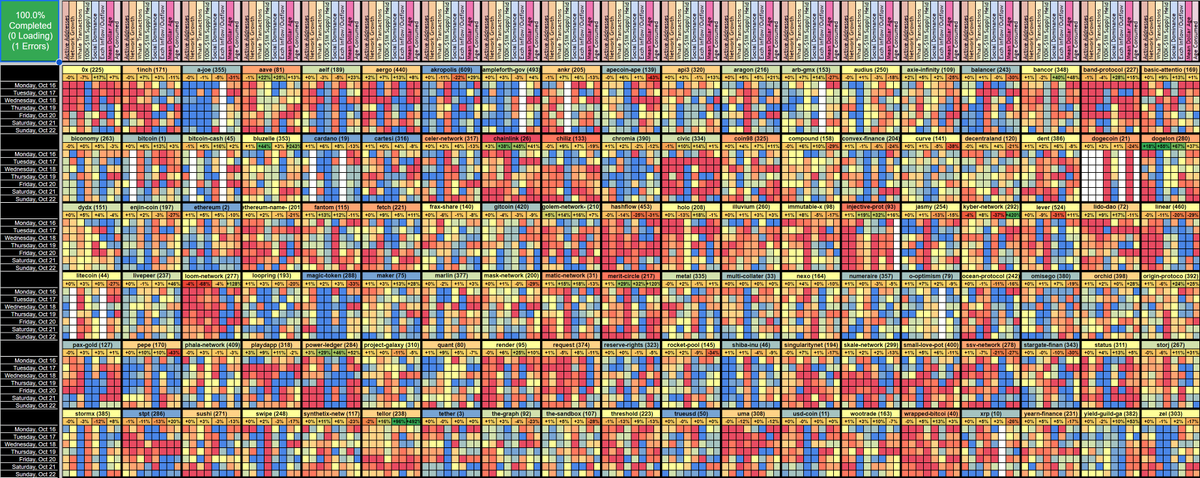
What if you could absorb all of your daily crypto analytic research on one page? No tab changing, no switching between individual assets one after another, and no scrolling between different metrics to see which are pointing to valuable future tops and bottoms forming.
Well, @santimentfeed has just the thing for you. Integrated with Google Sheets, this powerful tool provides the past week of data for 114 of crypto's most well known assets, displaying how the top 8 metrics currently stand compared to each asset's respective 3-month averages.
https://t.co/85FJxxX1Hi
There’s still time to fix it. But what keeps me up at night is that DAI failing could end up being one of the biggest mistakes this industry ever made
We had a decentralized stablecoin with network effects, something that could have really mattered to the world, and we blew it
Chaos Labs take on Aave V4 is worth reading in this adiós señores post.
They say it's a completely new protocol that shares nothing with V3 except the name.
New codebase, new architecture, and new liquidation logic.
'Second-order failure modes will only surface once real capital moves through the system.'
In degen language -> nobody knows how the V4 can break until real money is in it.
All the risk tooling Chaos built in 3 years was designed for how the V3 works.
V4 is totally different so all of that tooling is useless.
They would have needed to rebuild everything from zero for a codebase that hasn't been battle tested yet.
They asked for $8M to cover both V3 and V4 risk. That's 5.6% of Aave's $142M revenue.
Banks spend 6-10% on risk but Aave offered $5M.
And they say that V3 and V4 will need to run both together for months or years.
But because the teams who operated V3 (BGD, ACI, TokenLogic now Chaos) are all gone, the weight of responsibility is on Aave Labs shoulders.
"I've stopped thinking about post-quantum as a hurdle that we have to overcome, and I think of it more as an opportunity. It's an opportunity for Ethereum to stand out as the very first global financial system that is post-quantum secure"
hell yea
Ethereum Researcher Justin Drake, who co-authored Google's recent quantum paper:
"I've stopped thinking about post-quantum as a hurdle that we have to overcome, and I think of it more as an opportunity. It's an opportunity for Ethereum to stand out as the very first global financial system that is post-quantum secure — not just relative to its competitors, but also relative to fiat and tradfi."
Justin also believes quantum presents an opportunity for Ethereum to become the best version of itself: “The move to post-quantum is essentially a rewrite, and that’s a massive opportunity to start with a clean slate and wipe our technical debt.”
The rewrite bundles post-quantum security with a new ZK virtual machine (LeanVM) that can snarkify the entire consensus layer in real time. The result is that the Ethereum L1 can scale to 10,000 TPS at 1 gigagas/second — while simultaneously becoming quantum-secure.
Source: @Bankless (Mar 2026)
rates in DeFi are too low for the level of risk
$11.7B sitting in Morpho vaults today at 2-4% APY. retail is funding these markets via exchanges thinking it's a savings account. it's not. they're taking real credit risk on crypto-collateralized lending
no institution accepts near risk-free rates to come on-chain
not all vaults are created equal. same 2-4% yield but completely different risk profile (different curators, collateral, LLTVs). retail picks the highest number. farmers will farm
back in the day >100% APYs in DeFi made sense. you were compensated for the risk you were taking.
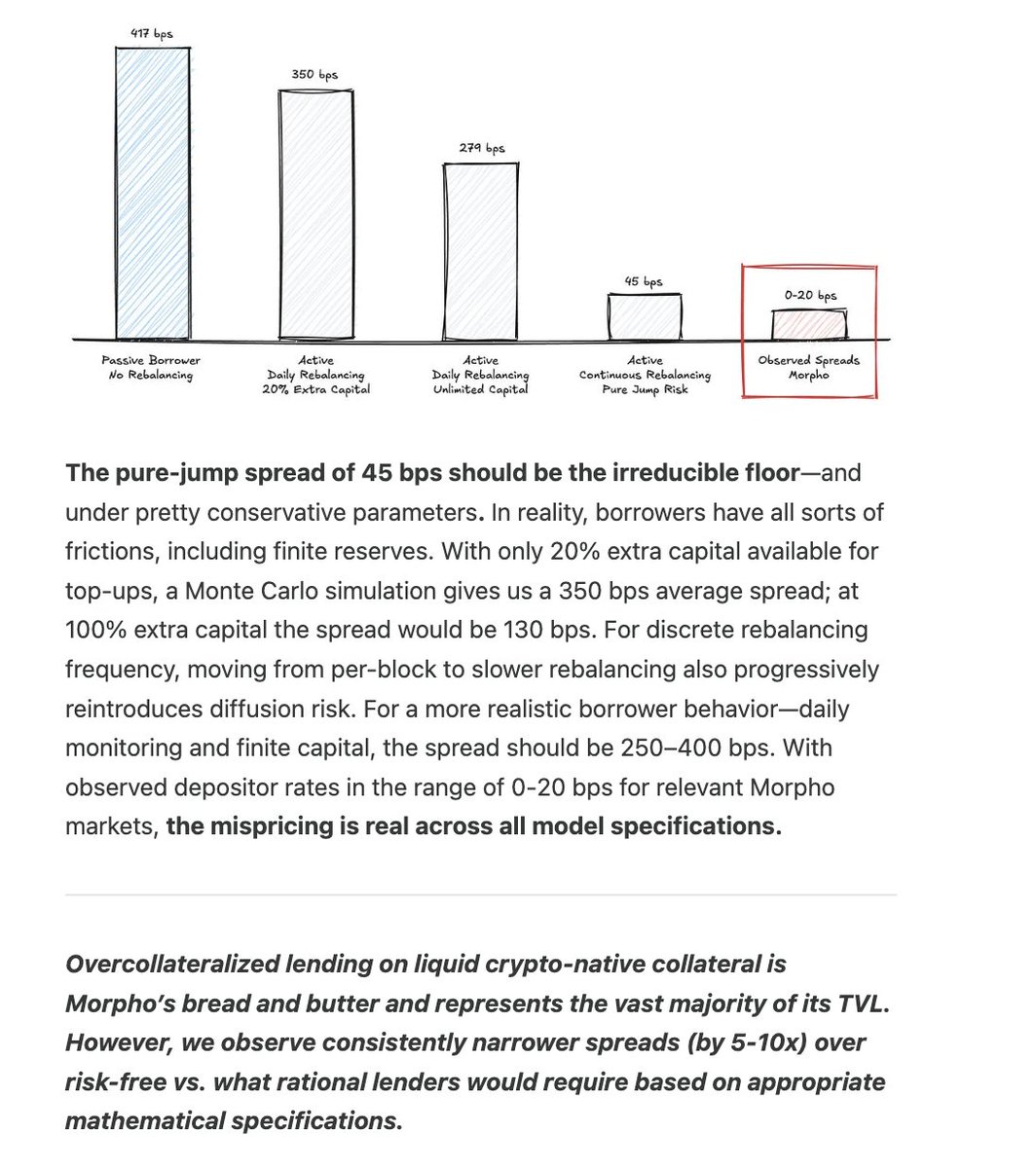
DeFi is a different animal today but vol, historical dislocations, and looping strategies on crypto collateral still demand at least 300-400 bps above risk-free. we're nowhere near that.
@LucaProsperi ran the math (see below). tldr - fair value spread on ETH/BTC-collateralized lending is 250-400 bps above risk-free. observed rates are a fraction of that
last cycle we saw a lot of retail pour savings into algo stablecoins promising "risk free" yield. this cycle vaults have a lot of demand but they are mispriced for the level of risk. you're trusting someone to LP into vaults and trust the manager will manage position
at least private credit earned you 12-16%
go read this: https://t.co/sDVYmWkqqu
Why the fuck does Jeff Bezos have to give you 7 billion dollars?
The American people give the government around 7 TRILLION dollars every year and you fuckin retards haven’t fixed shit with it.
You think if the creepy bald Amazon dude adds another 0.1% to that figure you’re finally gonna figure out how to stop blowing our fuckin money?
Better idea, how about you give the other 99.9% to the private sector and see if they can figure out how to cure diabetes or make a sandwich for 4th graders. I bet they’ll have change left over.