FRB ATL Economist from MN, NM, IL. Simplistic rhythms and vocals that span all the hope and hopelessness of the human condition. My views and not my employer
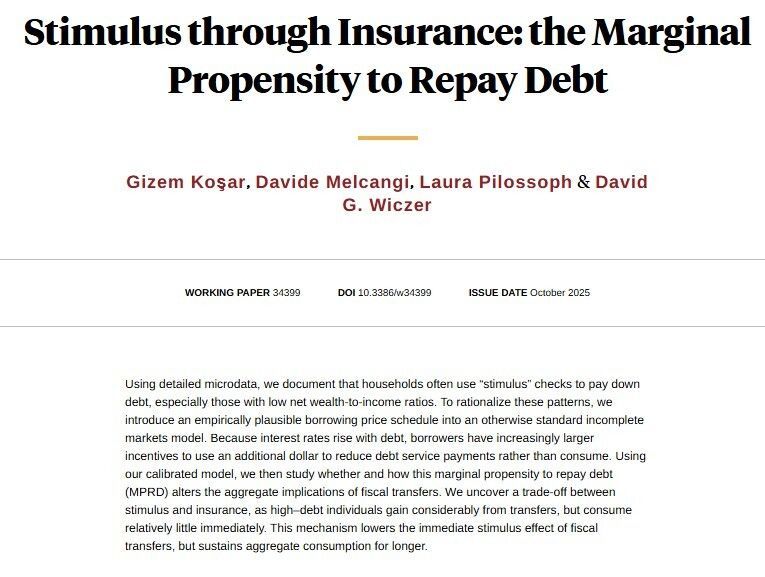
Low net wealth-to-income households repay debt with stimulus checks rather than consume. Debt-price schedules rising with debt explain this, altering the nature of fiscal stimulus, from @gizemkosar, Davide Melcangi, @pilossopher, and @david.wiczer https://t.co/1u1ThI3KiP
@economoser@socampdi@LpVisschers We actually have this: it was a suggestion by @serdarozkanEN to do this linear decomposition and it's in the appendix (coming forward in the next iteration). Occupation switchers are about 60% of skewness though they're only about 5% of observations
Sorry for the slow response!
@Simon_Mongey EXACTLY!! I mean, we're being a bit noisy/ham-handed in how we define a market (an industry) because the data isn't huge, but basically that paper's the whole story: tariffs pass through because of pricing to market.
A fun/important little piece with @AtlantaFed colleagues. Our survey center asked firms how exposed their supply chain was to imports. More import-intensive firms expect to raise prices more *and* the more their competitors import,the more they'll raise
https://t.co/rbFKt4ASQb
My co-authors making our work sound sooo good. To quote the video, "in our data, we find that households who are more indebted, instead of spending it immediately they use the stimulus to pay down debt."
Many households used stimulus checks to repay their debts. How does this affect the effectiveness and design of fiscal policy?
We discuss our research on the latest @FacultiNet video, based on work with @gizemkosar@DavidWiczer@pilossopher
https://t.co/1gCAa7DnnD
Many households used stimulus checks to repay their debts. How does this affect the effectiveness and design of fiscal policy?
We discuss our research on the latest @FacultiNet video, based on work with @gizemkosar@DavidWiczer@pilossopher
https://t.co/1gCAa7DnnD
Households often use stimulus checks to repay their debt. How does this fact change the effectiveness and design of fiscal policy?
Check out the @FacultiNet video where we discuss our joint work with @davide_melc, @pilossopher, and @DavidWiczer:
https://t.co/j3HLALjORP
13/N We are in good company: @ShibataEcon has found similar results on mismatch, and @DavidWiczer - @ElizaForsythe - @ProfLisaBKahn - @fabolange on reallocation.
Software substitutes for labor, while equipment complements labor. The rise of software explains higher markups and lower labor share, from Sangmin Aum and Yongseok Shin https://t.co/H580COe6a3