The world wants Canadian energy—and billions of dollars of investment could soon start flowing again
International interest in Canadian energy is showing early signs of life again. After a decade of retreat, the deep-pocketed companies may be coming back https://t.co/DYgs0Ss5a5
“Newfoundland and Labrador needs to seize every single opportunity that it can, whether it’s with our offshore (oil and gas) or mining resources.
If we’re going to make this a better place for all of us, part of that includes industry sector processing and the ability to get long-term sustainable jobs where people want to live here, and not just fly in, fly out.”
https://t.co/HNoEcKV3AB
Ottawa vient d’imposer de nouveaux tarifs de 10 % sur les légumes en conserve importés. Pourtant, les Canadiens font déjà face à une hausse importante du coût de la vie. Les prix des aliments ont augmenté de 4,3 % en un an. En taxant davantage des produits alimentaires parmi les plus abordables, le gouvernement risque d’alourdir encore la facture des ménages. Si l’objectif est de rendre la vie plus abordable, il faut cesser d’augmenter le prix des aliments à l’épicerie. #tarifs #épicerie
The projects themselves are a proposed highway across the Northwest Territories that seeks to reduce travel time, a new road in Nunavut that would connect to a future port in hopes of enabling better shipping access and critical mineral development, plus a geological repository in northwestern Ontario that proposes trapping used nuclear fuel from reactors.
Following a project being given the “national interest” designation, a secondary process would follow where federal officials across varying departments would work to establish a set of binding conditions that a proponent would need to meet in order to be approved for construction.
Wednesday’s announcement comes as the Alberta government is preparing its own proposal that could see a new million-barrel-a-day pipeline built from the oilsands to the West Coast, to be submitted by July 1.
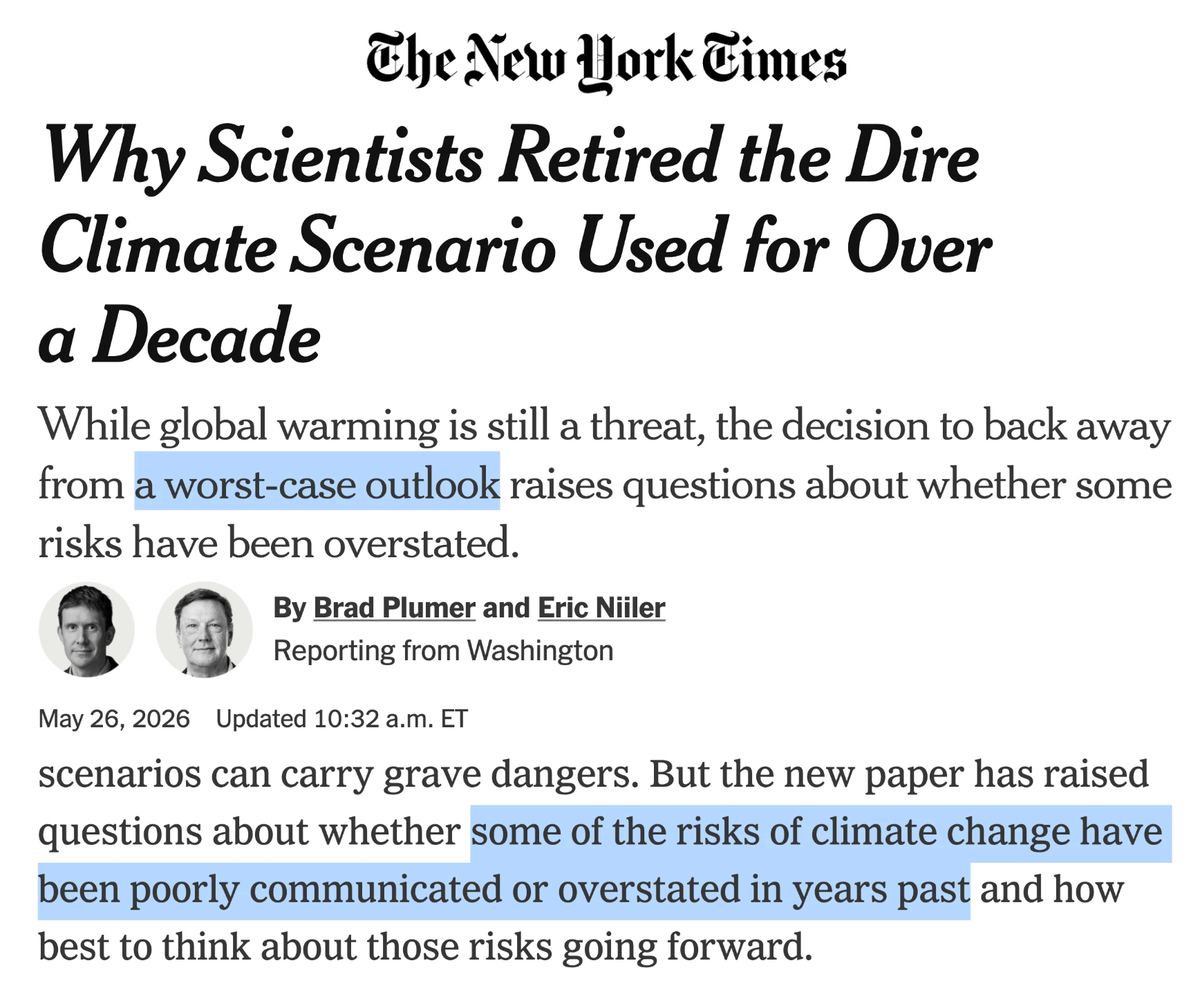
It's good to see the @nytimes acknowledge, however begrudgingly, that the most extreme climate projections of the past decade were wrong.
Next step: Acknowledge that we're in a climate renaissance thanks to affordable, reliable, and abundant fossil fuel energy!
By far the biggest surprise and bit of a mystery this year has been China. Imports fell a staggering 4.4MM Bbl/d from January to June, yet visible inventories are FLAT year-to-date. No signs yet, but reasonable with price selloff to expect a buying resumption given SPR goals.
The vegetation is marching back into the world’s most hostile environments.
Earth's biosphere is quietly demonstrating a profound, measurable benefit from higher CO₂. It's becoming a more resilient, greener and more water-efficient world. Fresh green cover is actively reclaiming the arid fringes of the Sahel, the Middle East, and the Australian Outback.
An 8% expansion of vegetation into the Sahara Desert's expanse since the 1980s alone means 700,000 square kilometres of formerly barren sand wastes have turned green. This is a literal reincarnation of Earth's living deserts—nature fighting back.
Since 1960, global food production has increased by over 250% to 390% (depending on the index). Most of this is a triumph of the Green Revolution—the arrival of fertilisers, tractors and genetics. But atmospheric CO₂—rising from 315 ppm to 430 ppm—is the silent force behind every new hectare being harvested.
It's the ultimate irony: a climate agenda that treats CO₂ as an agent of starvation, when it is actually the primary engine of agricultural abundance and drought resilience. As captured in the striking resilience of the sprout bursting into life, the real-world results are spectacular:
* C3 plants (95% of plant species): Rice, wheat, soybeans, and potatoes have increased yields by 30% to over 50%. Their photosynthetic mechanisms are structurally starved at lower levels; extra CO₂ accelerates their growth directly.
* C4 plants: Maize (corn), sorghum, and sugarcane have increased yields by up to 10%, alongside massive efficiency gains during dry spells.
* Root and tuber crops: Potatoes and sweet potatoes show explosive growth, utilising their massive subterranean storage capacity to maximise the carbon windfall.
Studies compiled by organisations like the USDA Agricultural Research Service show potato yields increasing by 50% to over 100% under elevated CO₂ when water is abundant. Across almost all major crop varieties, this atmospheric enrichment triggers a 10% to 40% reduction in plant water loss because leaf stomata don't need to open as wide to take in carbon.
CO₂ is no pollutant; it is a massive boost for future global food security.
Climate change doesn’t “drive” extreme heat events.
Climate is not fuel.
Climate is a statistical description of the mean and variability of the climate system, which includes weather. Climate change is a change in climate, which can be quantified. Change is an outcome, not a force that causes things to happen or be exacerbated.
Only 5% of French nuclear capacity curtailed for environmental reasons
Several media outlets, including The Guardian, Yahoo/Weather News and GB News, have covered the heatwave’s impact on French nuclear power and how this affects European electricity prices. Some of the framing makes it sound as if the reactors cannot technically cool themselves when river temperatures rise. This is misleading.
Under French environmental regulation, nuclear plants must comply with water discharge thresholds designed to protect the rivers downstream of the plants. The threshold is about the river, downstream environmental limits and protection of aquatic life. That is a different issue from whether the reactor can physically cool itself.
I pulled the production unavailability data from the French transmission system operator Réseau de Transport d'Électricité and filtered for nuclear records linked to environmental issues.
Up to 24 June at 12:00 CEST, the curtailments are concentrated in three units: Golfech 2, Bugey 3 and Nogent 2, with the maximum simultaneous unavailable capacity in this window around 3 GW. That corresponds to around 5% of France’s installed nuclear capacity of around 61 GW.
According to press releases by EDF, the reactors were stopped to comply with environmental regulation because river temperatures were expected to reach regulatory limits. EDF also explains that water used by the plant is returned to the river at a slightly higher temperature, around +0.2°C on average depending on the power level.
The latest RTE updates also suggest that other units, including Nogent 1 and St Alban 2, could be affected later in the period depending on weather forecasts. That is worth following, but it also shows why these numbers should be handled carefully as the situation develops.
A few GW of curtailed nuclear capacity will only explain a small part of the price spikes in the power markets during a heatwave. It should be put in proportion before it becomes the main explanation for high electricity prices across Europe.
During the same 22–24 June window, France was also still a net electricity exporter on average. A country that normally supplies large volumes of electricity to neighbouring systems is now being presented mainly as a source of weakness because a few reactors are temporarily constrained by river-temperature rules.
By 2050, the world is forecast to face 43 million tons of decommissioned wind turbine blades.
These blades are built from high-strength composites made to survive years of weathering.
Still, every single turbine standing today will age out before 2050. Most are difficult to recycle, so most are likely to be buried. But Europe now has a landfill ban for blades coming into force. Nations like Germany, Finland and the Netherlands are already blocking landfills. But they still have blades to dispose of. So the waste is pushed elsewhere. Blades are exported to countries where burial is still allowed, such as the UK.
Net zero creates a mountain of composite waste. And then has the audacity to call it green.
Several of Europe's all-time national heat records were set long before modern CO₂ concentrations reached current levels, including Poland (1921), Romania (1951), Bulgaria (1916), Ireland (1887), Sweden (1947), Norway (1970), and Greece (1977). At the same time, a large cluster of Western European records were set during the major heatwaves of 2003, 2019, 2021, and 2022.
Does CO2 only work in Western Europe?