Today marks 16 years since I defended my PhD thesis—a day that launched an incredible journey! Huge thanks to all collabs and my mentors @vdlorenzo_CNB JillBanfield and @kyrpides who guided me! Excited for what’s next with my amazing team at #AnciliaBio@CRISPRchef & AlexSakatos
📢Excited to introduce NanoCas -our new mini CRISPR system that can reach tissues previously out of reach!
By shrinking CRISPR to 1/3 its normal size, we can now edit genes in muscle, heart & brain that were difficult to access before. Summary & link to paper:
A microbial version of Pavlov’s dog 🤔? Environmental bacteria (eg Pseudomonas putida) that were exposed to two simultaneous cues can encrypt this memory in the architecture of their regulatory devices https://t.co/WlWatCiRSk by @DaviPaez@Gonnyita @ManuCarmonaP & Elena Alonsoj
A mind-blowing paper has come out today in @Nature
In 2016, JC Venter Institute scientists trimmed a bacterial genome to its barest minimum required for life to synthesize what they called a "minimal genome" (https://t.co/Rk8oZJ0bUj).
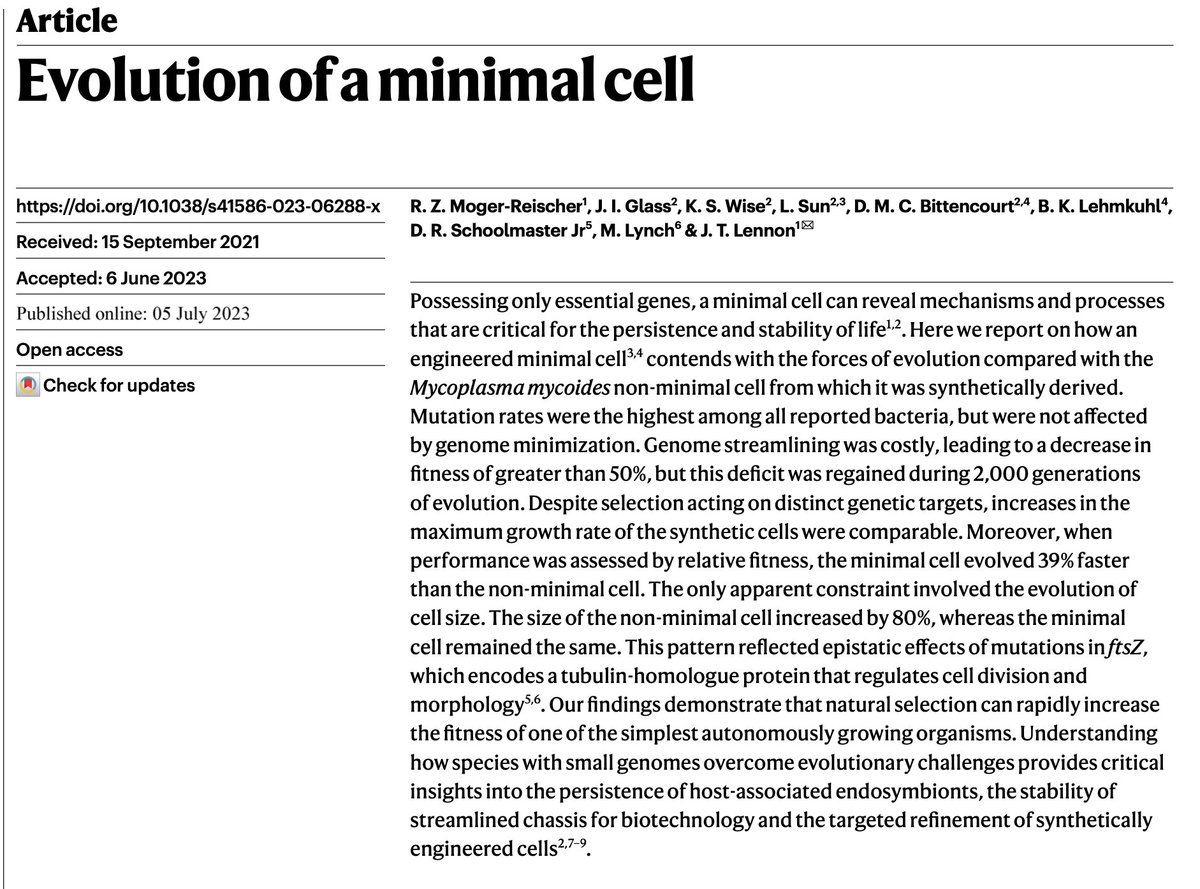
Today, a group of scientists from Indiana University reports how that minimal genome evolved over 2000 generations in comparison to the non-minimal genome.
The authors found that even when you reduce a bacterial genome to its absolute minimum where every nucleotide matters, the genome undergoes mutational events generation after generation as much as the non-minimal genome. One simply cannot stop the evolution.
Just over 300 days of evolution (equivalent to 40,000 years in humans) the minimal cell has gained everything it lacked in fitness on day one in comparison to the non-minimal cell.
When comparing the evolved traits between the minimal and non-minimal cells, the scientists found something striking. The evolutionary process increased the cell size of non-minimal cells but not that of the minimal cell. But that is not the striking part.
The scientists were able to identify the key mutation that resulted in cell size evolution. And it turned out that the mutation that helped the non-minimal cells to grow bigger is the same that helped the minimal cells to stay smaller. Growing bigger had a survival advantage for non-minimal cells and not growing bigger had a survival advantage for minimal cells. So, the mutation had a context-dependent effect. This just demonstrates that the evolutionary effects on traits have no absolute direction. All that matter is what is beneficial for the organism's survival.
The conclusion of the paper is metaphorically a quote from the Jurassic Park movie:
“Listen, if there’s one thing the history of evolution has taught us is that life will not be contained. Life breaks free. It expands to new territories, and it crashes through barriers painfully, maybe even dangerously, but . . . life finds a way". (https://t.co/UlxRlb86CT)
https://t.co/zA9OAqSoAu
Always great sharing science with our @GVAfisabio folks in #valencia. Thanks @mpfrancino for having me. Also, so good to have seen and caught up w/ former @jgi #colleagues Rekha/Natalia and meet our #anciliabio partners M.Jose/Reem. Superb day/night!
What an inspiring and wonderful conversation with 2 of our super top #Spanish#scientist working in #virus
Thanks so much for your time Ana (@SesmaLab) and Adolfo GS! We’ll meet soon again 👏🏼
#ILNY
📅☀️ ¡Todavía estás a tiempo de inscribirte en la Summer School en Investigación Biomédica y Salud Pública de #Fisabio!
🔬 Consta de 3 módulos donde se realizarán lecturas, seminarios y sesiones prácticas.
📝Más información e inscripciones aquí:
🔗https://t.co/VVLNaltDJj