The world's entropy is swelling and volatile narratives are defying the laws of gravity. Fear falling behind?
Join the ride to upgrade your modelling toolbox. Think in stories and games. Forecast. Recognise complexity. Adapt. Weekly in your inbox https://t.co/tgNqdL8G9Y
The Greatest $ Trade Ever: the Digital EuroStack Migration.
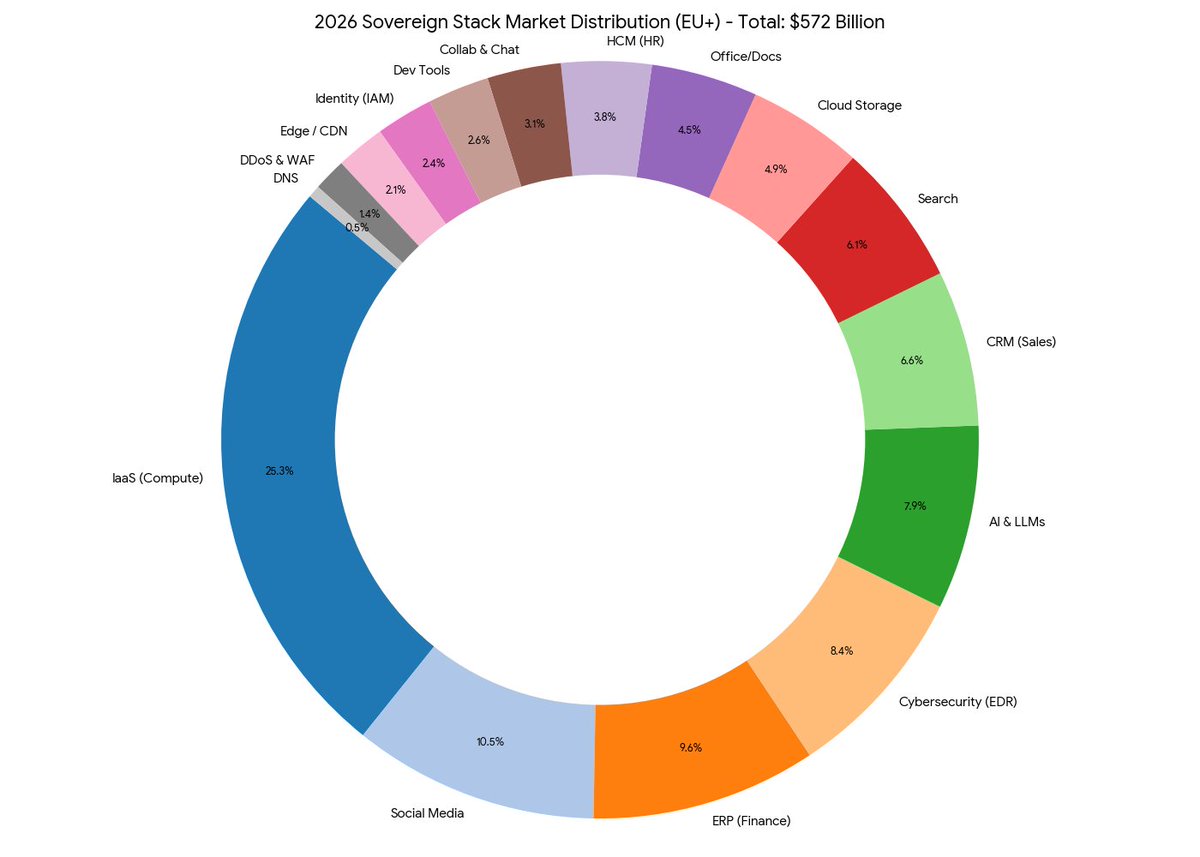
People here will tell you that Euro digital sovereignty is just a 🇪🇺Eurocrat meme or buzzword. The truth is that Europe is already running at light speed to disrupt US dominance over the continent and build its own “digital” EuroStack, with emerging players spanning across the whole continent, from Norway to Romania, from France to Estonia. Governments and enterprises first. Consumers to follow.
At stake, there is a whopping $1.4 trillion European market (and growing). Europe has the talent, players, and, above all, the capital to pull off this massive trade. And as the size of the deal grows, it is going to attract even more talent and capital spooked by US geopolitical tantrums. Expect the EU to become the hottest VC market very quickly.
US tech giants have been complacently relying on their monopolistic practices for years. Ripe for disruption. Fueled by open source, regulatory pressure and EU public financing, this is more than just about digital sovereignty. The opportunity is to build a cheaper, more efficient and secure digital economy and society. Just better for all.
Here comes a breakdown of how Europe is playing this massive trade across the whole “digital” stack, focusing on its core components (a ca. $600 Billion opportunity).
1/12🧵👇
We are far from uncensorable communications, but low-orbit satellites offer some hope
Networks break at topology, not throughput
The geometry of the problem makes complete denial asymptotically expensive while partial denial remains achievable but strategically inadequate
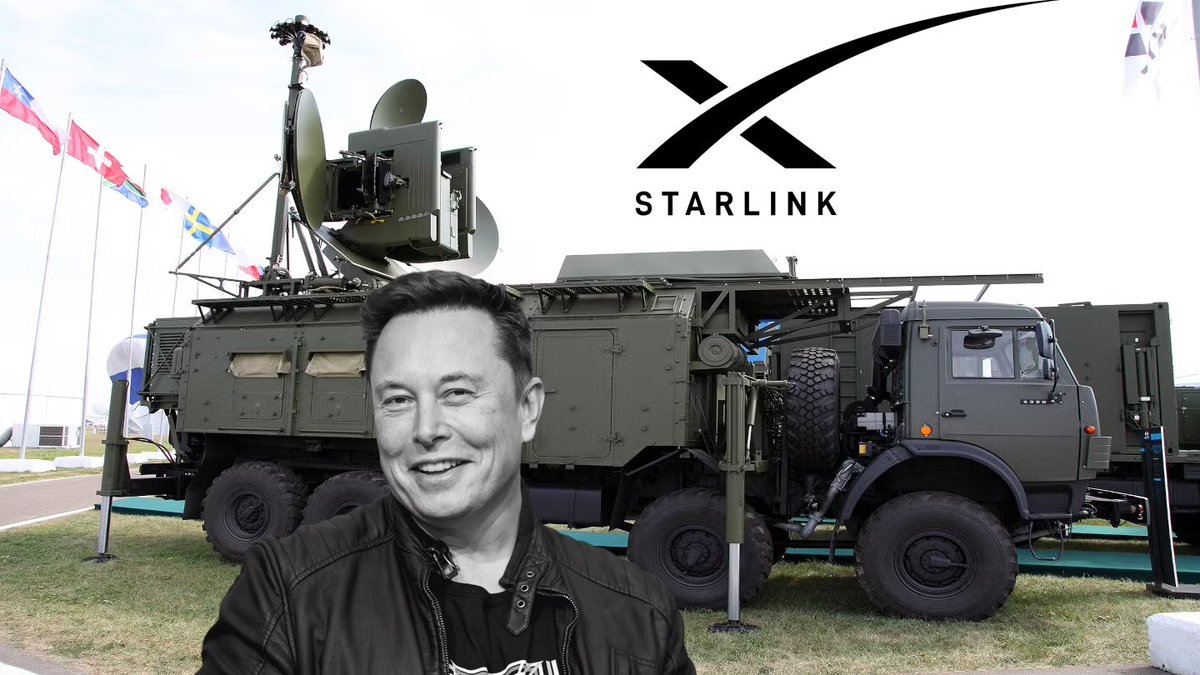
Iran just ran the most sophisticated electronic warfare campaign ever deployed against a commercial satellite constellation.
They succeeded.
And it didn't matter.
Here's the physics they missed:
The regime spent $300 million on Russian Krasukha-4 jammers. Achieved 30-80% packet loss nationwide. Made video calls impossible. Made streaming unwatchable. Made commercial internet useless.
On January 8, Crown Prince Pahlavi said: "8 PM tonight. Chant together. Wherever you are."
At 8 PM, neighborhoods across Tehran erupted simultaneously. 31 provinces. 185 cities. The most coordinated uprising in 45 years.
The generals optimized for the wrong variable.
Netflix requires 5-25 megabits per second of continuous throughput.
Revolution requires 1.3 kilobits. Once.
A single protest instruction compresses to less storage than one pixel of video. It doesn't need real-time delivery. It can queue, retry, relay through whatever windows the jamming leaves open.
TCP/IP guarantees eventual delivery. At 80% packet loss, messages take 5 attempts instead of 1.
The message still arrives.
Iran built a $300 million system to deny Netflix.
They couldn't deny revolution.
This is the hard floor of the digital age: the bandwidth required for coordination is 10,000x smaller than the bandwidth required for commerce.
Autocracy has a throughput problem that physics cannot solve.
The night they tried to kill the sky, they discovered the sky had already won.
Read the full deep dive story how it happened..
https://t.co/VkhGEC6ANx
@nope_its_lily Could it be you were quite contrarian on a few leader / laggard tech pairs? Today was down Nvidia up Intel, down Microsoft, down Broadcom up IBM, down Figma up Adobe, down Cloudflare up Fastly, down IonQ up Rigetti, down Coreweave up DigitalOcean …
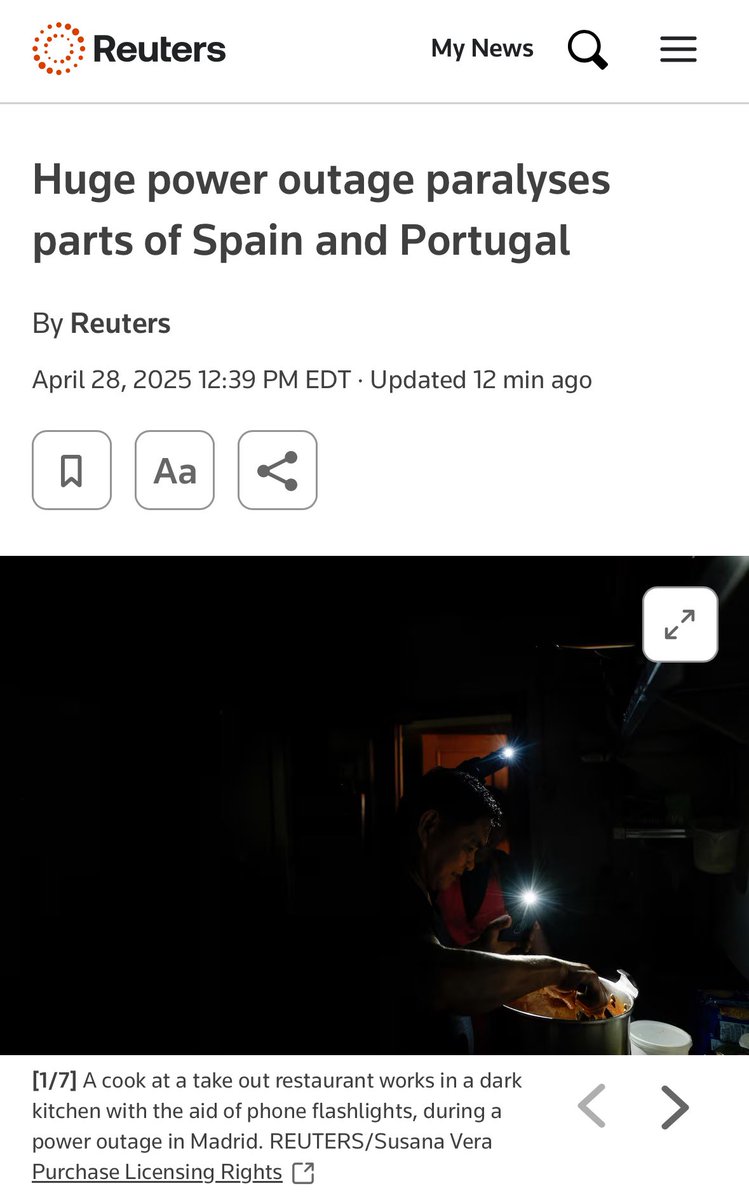
Spain and Portugal just found out the fragility of the centralized power grid the hard way
A decentralized network of homes producing and storing energy is the way forward
Agree with @connorking, the investable liquid token landscape in DePIN *today* is pretty sparse, for for main reasons.
That said, we @EV3ventures believe these issues are all fixable and indeed are on track to being fixed on a 6-12 month time frame. While not every DePIN will adapt to the new environment, you want to be buying the ones that will adapt *today* to benefit from the re-rating that happens as the market structure for DePINs matures.
So why are most DePIN tokens uninvestable today for a long-term investor?
1. "Buyback-and-burn" tokens lack transparency as to 1) what % of offchain revenues are burned and 2) whether the burned tokens are coming from insider allocations. This means most DePINs are realistically building *Token-Enabled Companies"—not protocols. In other words, if the centralized/Labs company disappeared tomorrow, so would the onchain revenues for virtually every DePIN (maybe 1-2 exceptions). See the recent a16z post https://t.co/xWtNvoBBPD
>> SOLUTION: We have been shipping transparency updates to @DepinNinja to educate the market about the nature/quality of onchain revenues for various DePINs, to create better-informed market participants and incentivize more revenue transparency from projects https://t.co/iaNtaJybRY
2. Most DePIN onchain revenue is directly tied to the physical traffic carried over the network. Physical traffic will always grow ~linearly vs the ~exponential
growth crypto investors are used to seeing in token issuance/trading related businses models. Today, DePIN "leaks" all the value from financing/trading to other layers of the stack (e.g. CEXs and mienrs).
>> SOLUTION: Next-gen DePIN tokenomics are finding ways to internalize the value/liquidity that would traditionally leak to other layers of the stack. For example, @opentensor and @GlowFND launching zero-fee DEX pools paired against their native tokens, or @dawninternet and @daylightenergy using staking/medallion markets to allocate incentives across different regions/markets
3. Single-token DePINs face sell pressure from miners, because the same token is used to reward miners as to purchase services from the network.
>> SOLUTION: DePIN miners should earn convertible debt - i wrote more about this here: https://t.co/HEY3xsnOOF. The biggest roadblock here is lack of CEX appetite for listing novel token mechanisms, but i'm confident this will change over the next 6-12 months. By doing so, DePINs reduce sell pressure on their core token and lower their blended cost of capital by ~30% or more.
4. Insider vesting is time-based, ie on a multi-year time horizon you get dumped on by insiders regardless of well network fundamentals actually perform.
>> SOLUTION: performance-based vesting for insiders. @dawninternet will be the first DePIN we're aware of where insiders vest IF AND ONLY IF certain growth milestones are met for the network. This is how DePIN bootstrapping should work: miners (the community) are responsible for building capacity, and insiders (the team) are responsible for coordinating and monetizing it. If the team doesn't hold up their end, then they shouldn't earn any tokens and miners shouldn't be diluted. We believe crypto markets will follow equity markets and demand performance-based unlocks for insiders starting in 2025/2026.
someone needs to download all these models and project them onto a 2D manifold
it's only a matter of time until we develop the tools to gaze directly into model weightspace
@DAnconia_Crypto yup accurate real-time data is ultimately valuable only to underwriters to adjust their pricing... pretty mind-bending math, I had a similar feeling reading this Endcoin white paper https://t.co/JdArSApjym
Caved and got o1 Pro.
I asked it my favorite question to ask these models, and it gave much more interesting answers than either o1 preview or Claude 3.5 Sonnet.
They're not quite as mind-bending as I'd want -- I've seen a version of all of them except #7 -- but still better: