I WORK HARD!!! in total silence. The gap btn the life u living and life u want is choices. Take ur financial life SERIOUSLY. money is defense, it stops nonsense
@codewiddan Fill 13kg can. Empty the 13kg can into the 5kg can. You are left with 8kg. Repeat this process, You are left with 3 kg in the 13kg can. Transfer the 3kg into a packet. Do this twice such that the packet has 6kg. Fill the packet with 5kg can. That makes it 11kg!!
Hard times create strong men.
Strong men create C.
C creates good times.
Good times create Python programmers.
Python programmers create AI.
AI creates vibe coders.
Vibe coders create weak men.
Weak men create hard times.
@_adityaa21 Instead, master Mathematics.
Then the Fundamentals of Computer Science like Operating System, Networking, Algorithms, Database, Programming in any one language
This will let you grab any other skill on a need basis.
Without good fundamentals everything feels like a burden
Day 2
Still on Linux fundamentals: I covered file navigations, permissions and permissions types (octal/ numerical and symbolic), what each numbers and symbols represents, process management (controlling running processes with - ps aux, kill, kill -9, top etc).
Nairobi Job hunters, I know you are many. Listen very carefully...
Ukitaka casual jobs anytime hauna kitu ya kufanya, always visit the following places : 🧵
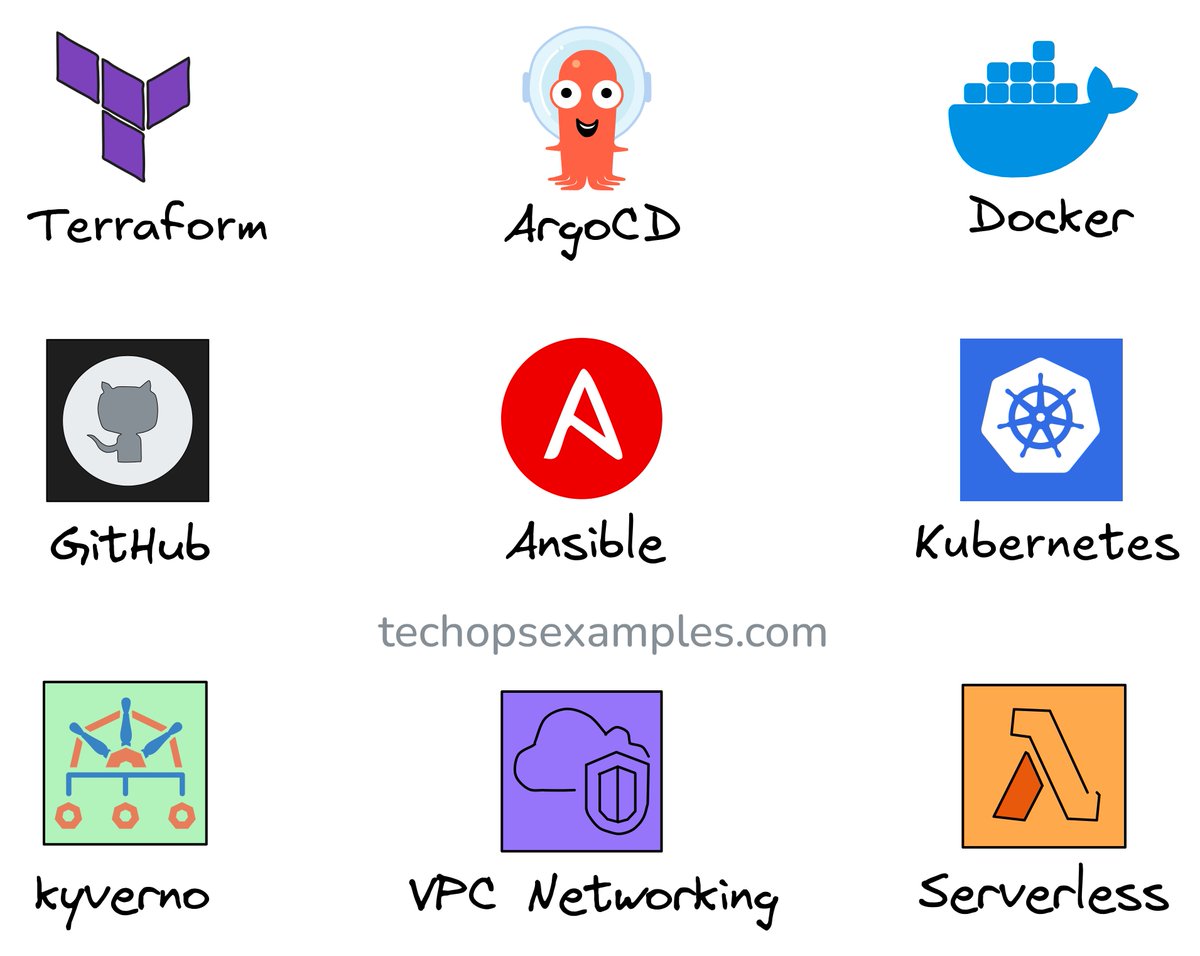
Build These Projects → Become a DevOps Engineer in 2026
→ Build a Linux troubleshooting lab
→ Build log rotation & cleanup jobs
→ Build a CI pipeline that fails correctly
→ Build a deployment with rollback
→ Build Docker image optimization
→ Build image scanning & policy enforcement
→ Build reverse proxy rules
→ Build TLS certificate rotation
→ Build metrics that trigger actionable alerts
→ Build alert fatigue reduction
→ Build a log correlation flow
→ Build readiness & liveness checks
→ Build autoscaling thresholds
→ Build a blue-green or canary release
→ Build a backup restore test (not just backups)
→ Build a DR runbook
→ Build Terraform modules used more than once
→ Build a GitOps deployment
→ Build Kubernetes RBAC boundaries
→ Build network policies that actually block traffic
→ Build secrets rotation without downtime
→ Build environment parity (dev ≈ prod)
→ Build cost alerts before the bill arrives
→ Build an incident response checklist
→ Build a blameless postmortem
→ Build an on-call simulation
→ Build a controlled outage
🎯 Roadmaps show the way.
Building these makes you the Engineer.
Which one are you starting with in 2026 👇
(If this helps, follow for more practical DevOps paths.)
Drop your additions below 👇
As someone who has been in the AI Automation space for about a year now and is currently running an AI Agency in Nigeria, this is what I have learnt and this is what they won’t tell you. So please take note before entering 2026.
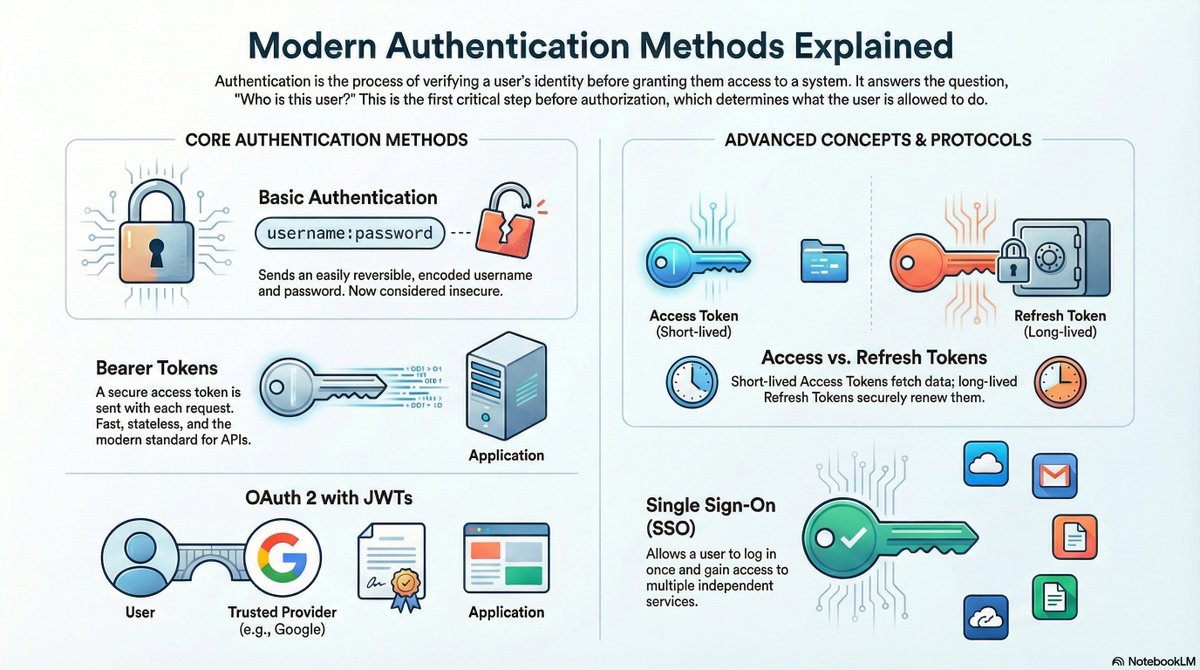
Every authentication method explained in one picture !!
1. Basic Authentication
Basic Authentication sends the username and password in every request, encoded using Base64.
The encoding is reversible, so it must always be used over HTTPS. While simple, it lacks features like token expiry or fine-grained access control.
Today, it’s mostly used in internal tools, scripts, and service-to-service communication.
---------------
2. Bearer Tokens
Bearer tokens are opaque strings sent with each request (usually in the Authorization header).
The server validates the token and grants access if it’s valid.
They are not tied to a specific protocol anyone holding the token can use it, which makes HTTPS mandatory.
Their stateless nature makes them easy to scale and common in modern APIs.
---------------
3. OAuth 2 (Authorization Framework)
OAuth 2 is not an authentication mechanism it is an authorization framework that allows applications to access resources on a user’s behalf without sharing passwords.
When you “log in with Google or GitHub,” the authentication part is typically handled by OpenID Connect (OIDC), which is built on top of OAuth 2.
---------------
4. JWT (JSON Web Token)
JWT is a token format, not an authentication system.
A JWT is usually signed (not encrypted) and contains claims such as user ID, issuer, audience, and expiry.
Because the token is self-contained, servers can validate it without storing session state.
A common mistake is putting too much user data into JWTs, which increases security risk and makes token rotation harder.
---------------
5. Access Tokens and Refresh Tokens
Modern systems typically use two tokens:
-- Access Tokens: Short-lived tokens used to call APIs.
-- Refresh Tokens: Long-lived tokens used to obtain new access tokens.
This improves both security and user experience. Refresh token storage depends on the client:
Backend services → stored securely server-side
Web/SPAs → often stored in HTTP-only cookies
Mobile apps → stored in secure OS keychains
---------------
6. Single Sign-On (SSO)
SSO allows users to authenticate once and access multiple related applications without re-logging in.
SSO is implemented using protocols such as:
SAML (XML-based, common in enterprises and legacy systems)
OAuth 2 + OpenID Connect (modern, JSON-based, common for web and mobile apps)
The protocol defines how identity and trust are exchanged between systems.
If you want to master System Design, nothing accelerates your learning faster than studying how real-world products operate at massive scale.
Here’s a guide that brings together 15 practical, high-impact case studies from companies that handle billions of users, messages, payments, queries, and media assets every single day.
Each case study shows how real engineering teams solve problems like latency, consistency, sharding, caching, replication, load balancing, and global distribution - in production.
Here are all 15 examples with direct sources so you can explore each one in depth:
1. How Google Search Works
https://t.co/Kv817nC8yz
2. How Netflix Streams to 250+ Million Users
https://t.co/eSIphuR2jH
3. How WhatsApp Handles Billions of Messages Daily
https://t.co/YvJs8J859j
4. How Instagram Manages Photos, Reels & Stories at Scale
https://t.co/1VePq4AhxP
5. How Uber Matches Riders & Drivers in Real Time
https://t.co/E4vSzhB91c
6. How Amazon Handles Millions of Orders Per Minute
https://t.co/A3jsbozmtz
7. How TikTok Recommendation Engine Works
https://t.co/dv6OPTNHwq
8. How Airbnb Manages Global Listings & Bookings
https://t.co/CIsUOwdl0C
9. How Dropbox Handles File Sync Across Devices
https://t.co/UamykICVQC
10. How Spotify Streams Music with Ultra-Low Latency
https://t.co/hdZ9wQujaU
11. How LinkedIn Feed Ranking Works
https://t.co/BNnLu7qgVN
12. How PayPal Processes Global Payments Reliably
https://t.co/OlUiARJzPr
13. How Zoom Enables Low-Latency Video Calls
https://t.co/IUBpgK5Cwb
14. How Pinterest Stores & Serves Billions of Images
https://t.co/1ZyOlGxikL
15. How ChatGPT Handles Massive Concurrent Queries
https://t.co/50Q9sRyo5R
Studying these systems gives you real insight into how large-scale architectures are designed, optimized, and evolved.