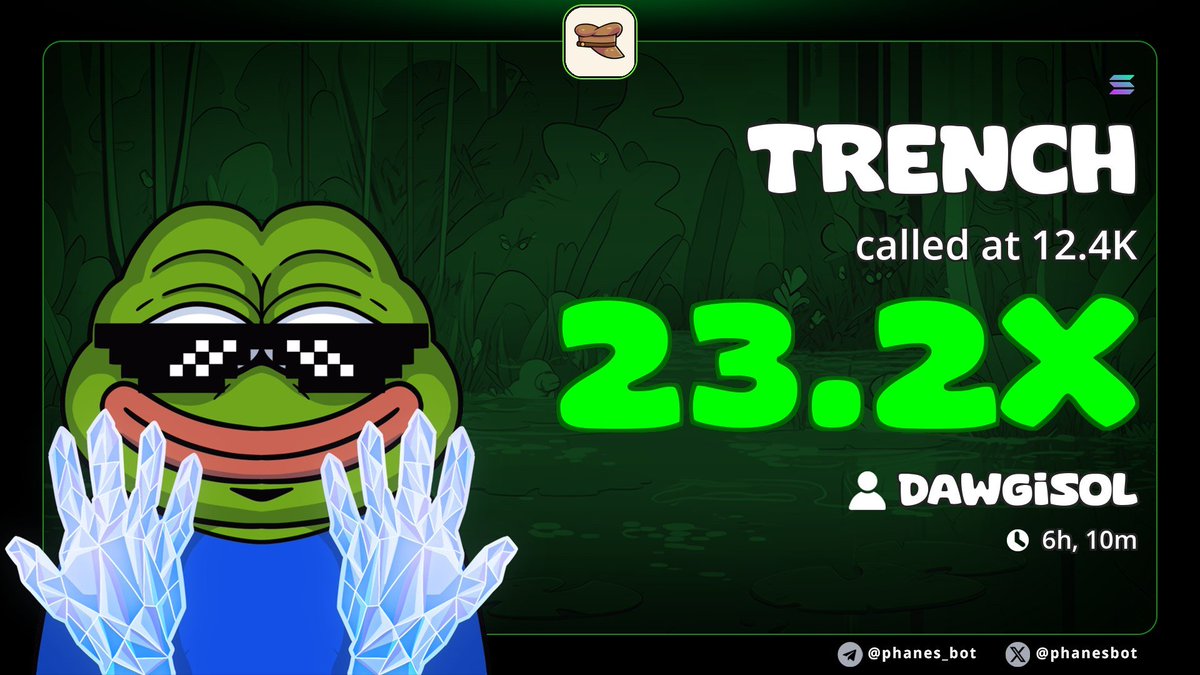
I called $TRENCH at 12.4k mc so 23.2x since call.
Join us in https://t.co/ozbUptp4VH unofficial chat:
https://t.co/tfVJLCJUCf
8LFTmtdqQKHk7xJxSgFiPMdn2cRgxyinGv61M6Z5pump
#trench
Guys i called this when it was 12k mc. I created unofficial chat for $trench holders.
I created a whale group too for 1% - 3% supply holders.
Let me know if you want to hop in.
The next three updates to SeekSpeed Terminal are going to change how teams ship AI agents.
We're bringing load & soak testing, public shareable reports, and a golden-dataset correctness harness — so you can prove speed and accuracy before every deploy.
No more "works on my machine."
Built with DeepSeek. Battle-tested against DSpark.
→ https://t.co/zmUu1VAUis
This is exactly why we built SeekSpeed Terminal.
Marketing says 60–85% faster. Our Spec Lab says: prove it on your own endpoint.
We probe DSpark deployments, pull real acceptance rates + tokens-per-step from vLLM metrics, and run the same prompt against both speculative and vanilla baselines. No hand-waving. Just Welch's t-test on actual latency distributions.
The scheduler trimming low-confidence drafts before verification is the smart bit — but it only wins when (a) your draft/target alignment is tight, (b) batch pressure stays below the saturation knee, and (c) prefill doesn't dominate your latency budget. Miss any of those and the headline number collapses.
Want to see what DSpark actually does on your stack? → https://t.co/IB6i3cEggc
Your AI agent reads one word at a time, then writes one word at a time. It's slow because it keeps stopping to think. DSpark is a cheat code: a tiny "draft" model guesses the next few words in advance, and the big smart model only checks if the guesses are good. If they are, you skip ahead. If not, you correct and keep going.
I wired this into SeekSpeed so you can actually see if the draft is helping or just adding noise. Probe your endpoint, run real prompts against it, and watch the acceptance rate. No marketing numbers. Just "is my agent actually faster or did I install a draft model that wastes GPU cycles?"
https://t.co/Dah0PTdDWW
Your AI agent reads one word at a time, then writes one word at a time. It's slow because it keeps stopping to think. DSpark is a cheat code: a tiny "draft" model guesses the next few words in advance, and the big smart model only checks if the guesses are good. If they are, you skip ahead. If not, you correct and keep going.
I wired this into SeekSpeed so you can actually see if the draft is helping or just adding noise. Probe your endpoint, run real prompts against it, and watch the acceptance rate. No marketing numbers. Just "is my agent actually faster or did I install a draft model that wastes GPU cycles?"
https://t.co/Dah0PTdDWW
SeekSpeed Terminal
ca: 3pcyHwoo61bQCfjRZpZugXNu1XB8A7KMEWPyiHsqpump
I spent months building AI agents for real-time work and kept losing to latency I couldn't see. Bloated prompts. Wrong model routing. Zero visibility into TTFT vs throughput vs speculative decoding overhead. I was flying blind while the clock ticked.
So I went deep. Hooked up vLLM, TGI, and DeepSeek's DSpark speculative decoding endpoints. Started measuring what actually matters — not marketing tok/s numbers, but real milliseconds to first token, acceptance rates, draft overhead, cache behavior. The gaps were brutal. Same workload, 3x swings just from routing wrong.
I realised the agents themselves could be trained on speed — not just bigger models, but smarter routing, slimmer prompts, and speculative decoding that actually wins in production. But you can't optimise what you can't measure.
SeekSpeed is what I wish existed: a terminal that benchmarks any OpenAI-compatible stack with statistical rigor (p50/p95/p99, Welch's t-test), applies optimization variants, re-runs until it proves speedup, and tells you exactly where DSpark wins or loses. Honest numbers only where closed-weight marketing fails. No slides, just milliseconds and proof.
Built end-to-end with DeepSeek.
Docs: https://t.co/Dah0PTd67o
I spent a week in the DSpark speculative-decoding internals and it rewired how I think about speed.
I started by pulling raw vLLM metrics: spec_decode_num_accepted_tokens_total vs draft_tokens_total. The numbers were brutal—most production configs I tested had acceptance rates below 40%. That means the draft model is guessing wrong more than half the time, and every miss is wasted compute + cache pressure.
The deeper I went, the clearer the pattern became: speculative decoding isn't a speed switch. It's a conditional accelerator that wins only when (a) your draft model is tightly aligned to the target distribution, (b) batch pressure is low enough to absorb the overhead, and (c) your prefill share doesn't dominate the latency budget. Violate any one of those and your "2× speedup" turns into a 0.8× regression.
The inspiring part? DSpark exposes the metrics to prove it. Acceptance rate, tokens-per-step, draft overhead—it's all there in the Prometheus counters if you know where to look. You can't optimise what you can't measure, and most people are flying blind while claiming speed they never hit.
So I built SeekSpeed to surface those numbers honestly. No marketing tok/s. Just milliseconds, acceptance curves, and the truth about where speculative decoding actually wins.
Built end-to-end with DeepSeek.