I usually focus on Land rent.
But there's rent seeking in other places.
That's why I call myself Geomutualist. I got introduced to it in books by Margrit Kennedy, Bernard Lietaer and Silvio Gesell. They proposed something similar to the Land value tax, but for currency: Demurrage
Even the simplest weight edit, a deletion, can teach an LLM new skills!
Meet Deletion Tuning (#NeurIPS2026): just zeroing <0.1% of weights matches full fine-tuning's accuracy at scale. It's thousands of times smaller and avoids forgetting, a step toward continual learning. 🧵👇
@___Reader____@kvartalet Vilka kostnader tänker du på? Jag hittar väldigt lite som sväller år för år de senaste 20 åren då riksdagen haft högermajoritet.
@gonzaloruizutri@AlpacaAurelius The same vasodilation created by glycine can be achieved with Photobiomodulation (Red light therapy). Also results in better sleep.
@PeterGazdik@Yuchenj_UW They get Export controlled if they try to release the internal models to the public. Nowadays they only release heavily limited versions.
@JustinAngel Could we do it in reverse? Translate blocks of weights into compact mathematical expressions? This could open up the possibility to calculate it more efficiently, or at least with less RAM.
763B parameters, compressed to 1 bit per weight.
Introducing DeepSeek-V4.1-Flash-1017 GSQ-RCO Coder, a frontier-scale model tailored for coding and agentic workflows.
Benchmarks, demos and download link below. Follow us for updates.
Yann LeCun was right & nobody in this industry wants to say it out loud.
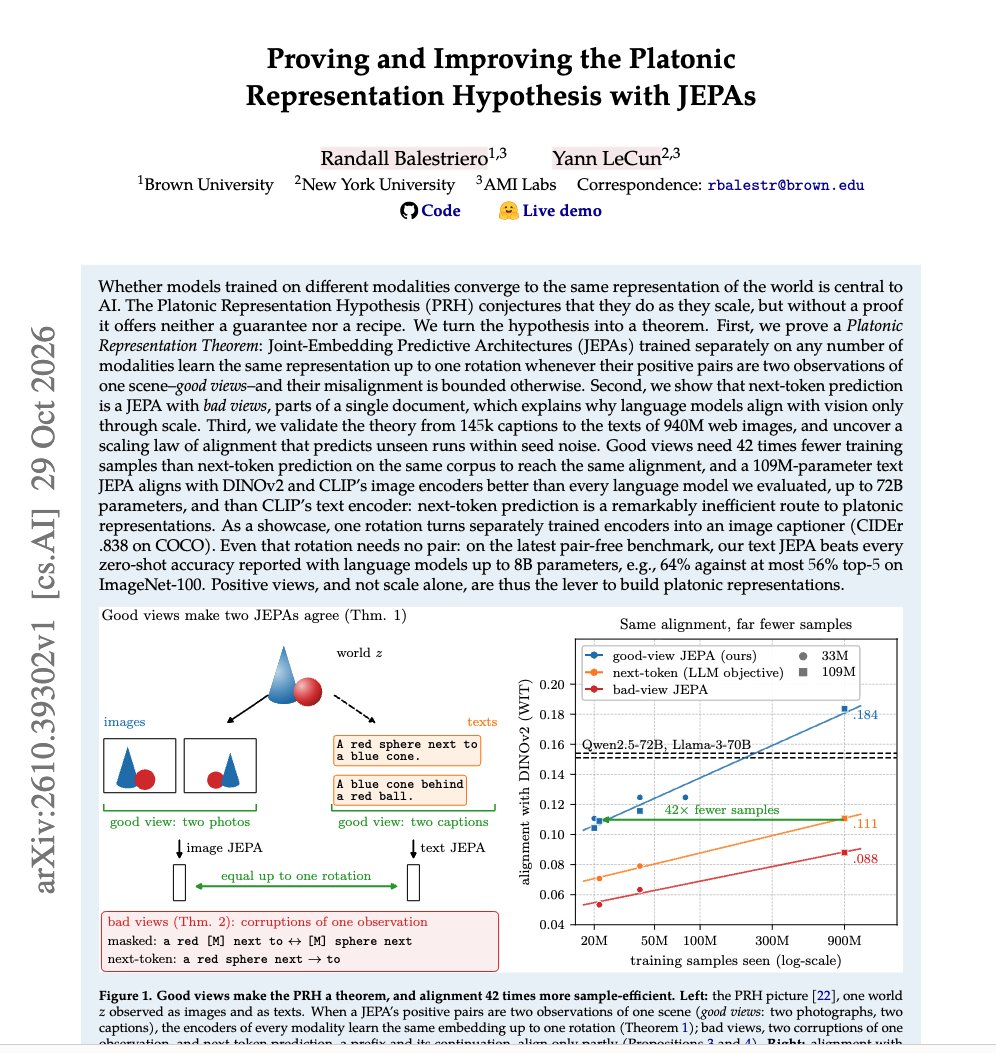
109 million parameters beat 72 billion.
He has spent years saying scale is not the thing that makes a model understand the world. Meta bet the other way. He left in November and started his own lab in Paris.
Last Thursday he published the proof.
The theory everyone has been running on since 2024 is that if you train models big enough, on text, on images, on sound, they all end up with the same picture of reality inside them. Size does it. Nobody ever proved that part.
Randall Balestriero and LeCun proved it. And the proof says size was never doing the work.
What does the work is which two things you show a model together.
A photo and the caption of that photo are two views of one thing. Models trained on pairs like that get there fast.
Two paragraphs pulled from the same document are not two views of one thing. Models trained on those get there slowly and expensively.
Next word prediction is the second kind. That is what every chatbot in the world runs on.
In their tests the first method reached the same understanding after 21.6 million examples. Next word prediction needed 900 million.
And a 109 million parameter text model ended up closer to an image model's view of the world than a 72 billion parameter language model was.
660 times smaller.
Zyphra is an awesome lab.
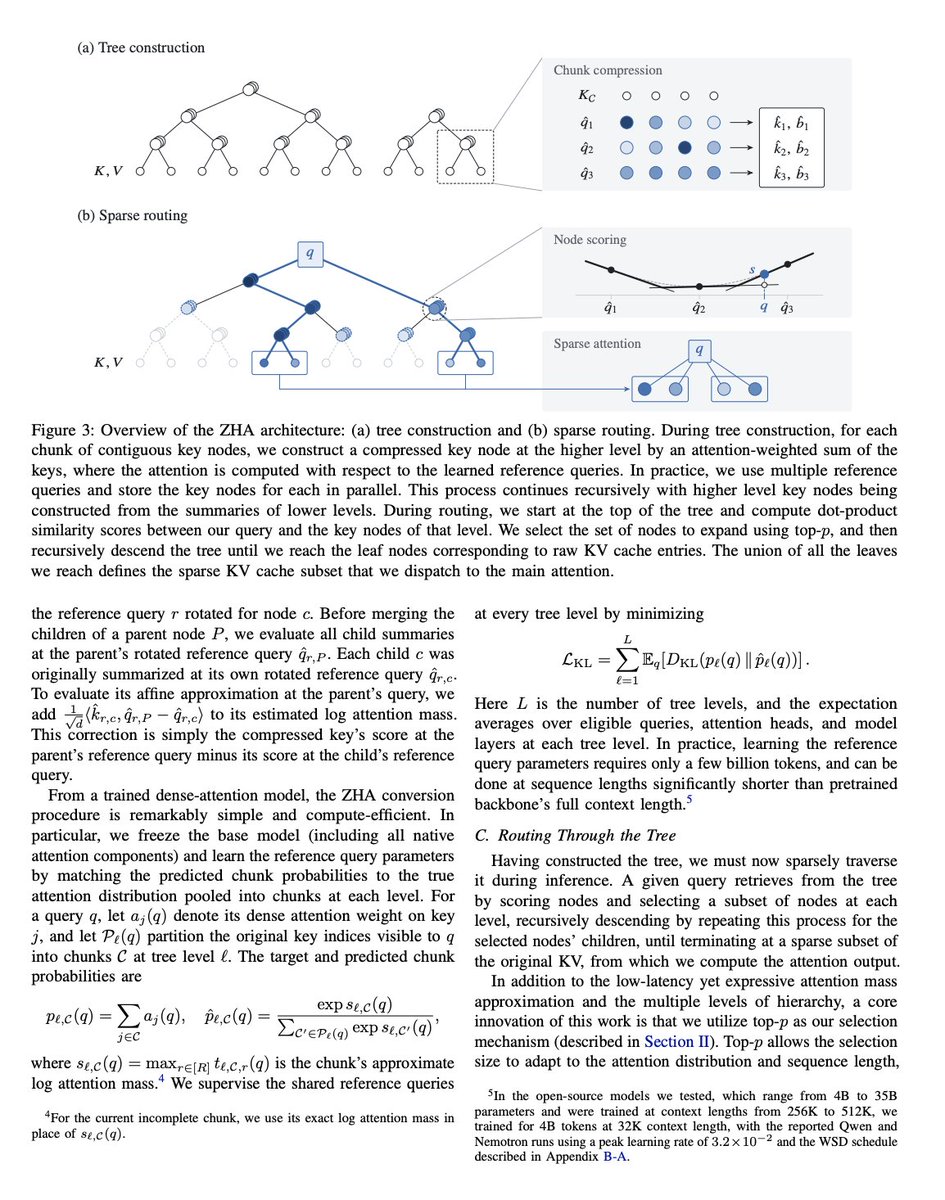
True subquadratic attention via hierarchical trees. Makes sense, obviously, we've already been going in this direction, but – principled, strong. I hope to see a lot of discourse about this. VAST if true, blows secret "subquadratic" labs outta the water.
Today we are happy to share one of our first open research releases: Latent Sparse Attention (LSA), a step towards subquadratic attention that matches accuracy of full attention at ultra-long context.
Sparse attention attends to only a few tokens per query, but it has to find the right ones. At 10M tokens, that search takes 98% of the attention layer's time. LSA makes sparse attention up to 22.7× faster and full attention 72.4x faster.
With @kubicek_ales@caciolai@PengLiangzu@SukritSumant@Ben_Hoov@FraserGreenlee@RMBattleday@radim_urban@thoefler@jcrwhittington
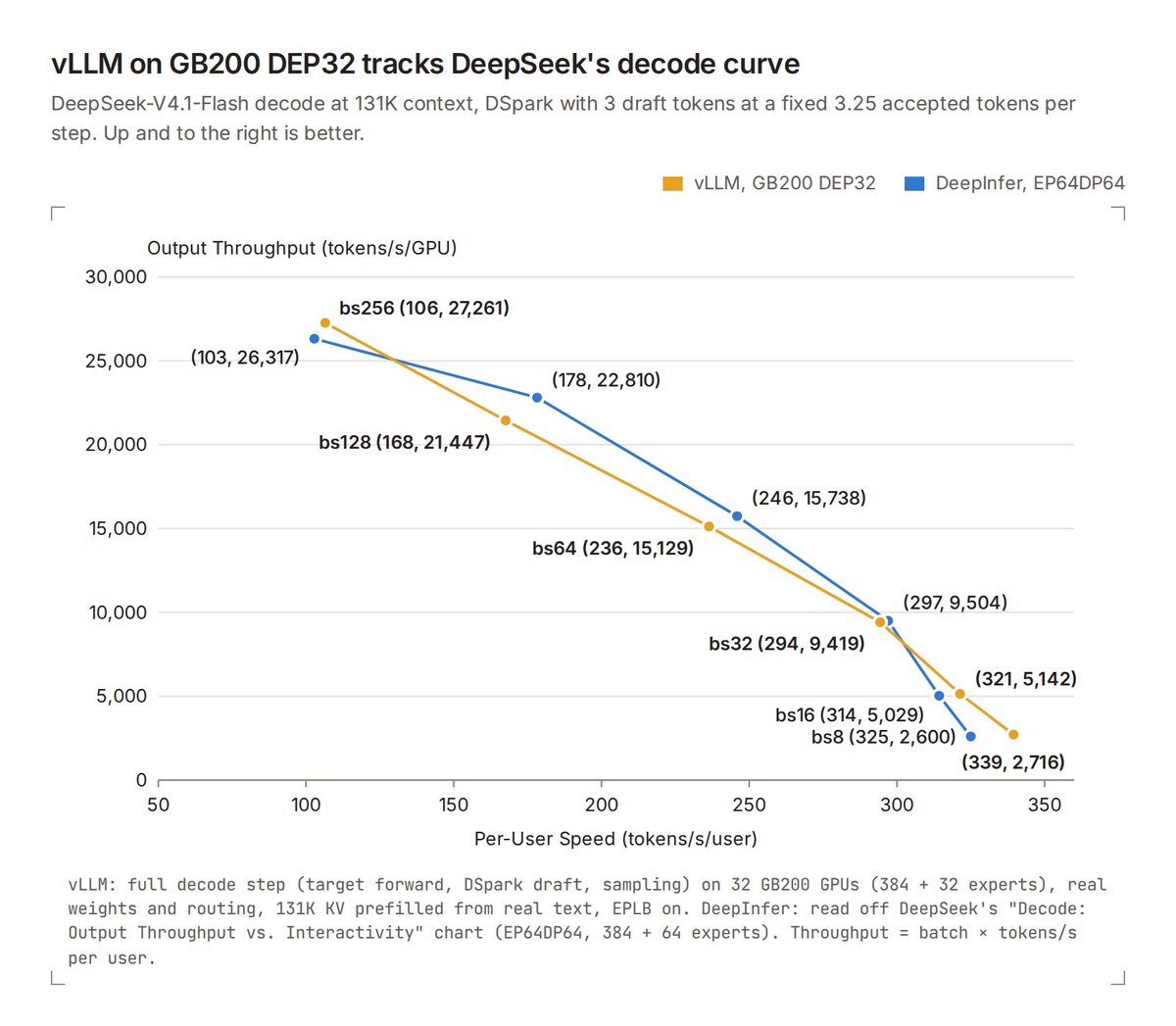
🚨🚨🚨 vLLM is all you need to reproduce DeepSeek’s performance.
With Wide-EP and EPLB, vLLM can match DeepInfer’s decode performance within 6% and generate $39/gpu/hr in revenue at DeepSeek’s off-peak pricing, at 200 P90 TPS on the AgentX workload.
Specifically:
• Under DeepSeek’s decode configuration (DeepSeek-V4.1-Flash, 131K context, nextn=3), vLLM on GB200 achieves throughput within 6% of DeepInfer’s published results across batch sizes 8–256.
• On AgentX, vLLM pushes the Pareto frontier further on GB300, reaching up to 1M tokens/s/GPU and generating $38.96/gpu/hr in revenue at 196 P90 TPS, based on DeepSeek’s off-peak API pricing.
• Also, vLLM extended low-latency kernel support for DeepSeek-V4.1-Flash, achieving up to 826 TPS per user on AgentX.
The same energy now generates more and smarter tokens! We do not need most of the planned data centers if we optimize the energy efficiency.
Very interesting times ahead!
@IntelligenceNa2@NTFabiano It is most likely about how well mitochondrias work. This is improved in daylight. A blind person sitting in the sun would get the same benefits.
@ORC_Killer@XiaomiMiMo We can not get DS 4.1 flash to work in vLLM on Nvidia B200 cards. GLM 5.3 flash loops and aborts in the middle of the generation. We have concluded MiMo is the best model.