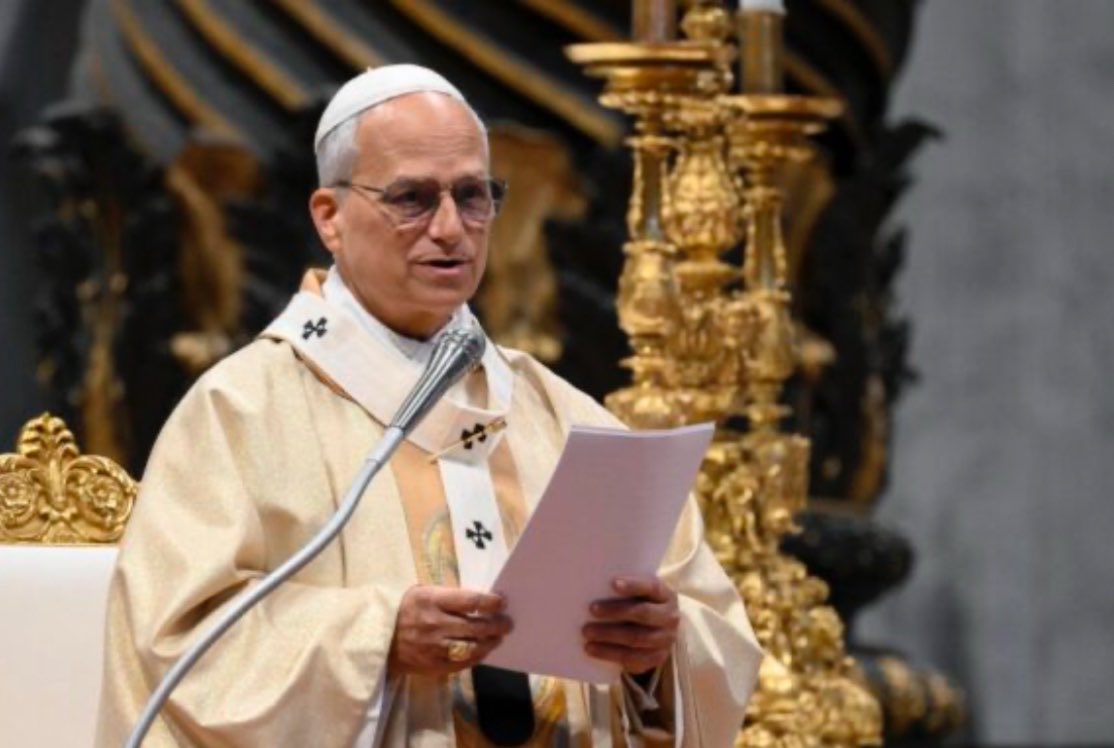
Superannuated as of 7/6/2026 (metropolitan archdioceses are in bold):
Blase Cupich, Chicago (77.29)
Glen Provost, Lake Charles (76.90)
David Kagan, Bismarck (76.65)
George Thomas, Las Vegas (76.13)
Francis Malone, Shreveport (75.84)
David Talley, Memphis (75.81)
Joseph Kopacz, Jackson (75.80)
Timothy Doherty, Lafayette in Indiana (75.77)
Thomas Wenski, Miami (75.71)
John Wester, Sante Fe (75.66)
Lawrence Persico, Erie (75.62)
John Noonan, Orlando (75.36)
Stephen Berg, Pueblo (75.34)
Earl Boyea, Jr., Lansing (75.23)
William Lori, Baltimore (75.16)
Robert Vasa, Santa Rosa (75.16)
Kevin Vann, Orange in California (75.15)
Robert McManus, Worcester (75.00)
As America marks 250 years of independence, we look back on the ways U-M has turned knowledge into progress for the nation through medicinal breakthroughs, public service rooted in common good and discoveries that explore new frontiers. https://t.co/e9MeAnPABD #LookToMichigan
Michigan is the first Big Ten team EVER to have 3 lottery picks in the same draft during the modern lottery era.
Big Ten basketball runs through Ann Arbor 〽️‼️
This box is very special to me and has a lot of family ties... It's the FREEMONT ROSS LITTLE GIANTS!
My dad got his first ever coaching job here back in the 50s and I was born just right down the road.
Thank you to @FRHS_Athletics for this great box, always rooting for you!
Friday Fish Fry in the form of fish & chips at Scotty Simpson’s. An all time favorite stop on the Roadfood circuit. The cod comes from Nova Scotia and the batter cracks when you take a fork to it. Great fries too. The best chippy on the U.S. side of the Detroit River. Since 1950.
My own personal thoughts on the Cantwell and Cruz athletics bill.
Catastrophic for the Big Ten: loses control of its own media product and sees revenue siphoned away. This is the core poison pill. The Big Ten’s media revenue is driven by its brand, markets, and dedicated network, not national pooling
1: It is an anti American bill. It blows my mind that they are trying to control, through the federal government, the ability for schools not in the P2 the ability to grow as universities for upward movement. In order to get into the Big Ten you need to fit the Big Ten profile and schools that didn't fit that profile 20 years ago that want Big Ten membership can work their way into becoming a Big Ten profile school. But now you have the government wanting to block that from happening in order to cut off the money flow to the P2.
That is not following what made America as great as it is. That is trying to choke off the growth of the rich and powerful universities.
2: Big Ten does not need or want Congress dictating “protections” that punish success. The Big Ten has repeatedly emphasized self-governance and conference-specific innovation (e.g., Big Ten Network, expanded media deals post-realignment). Federal intervention locks in rules that favor smaller FBS
3: SEC. 100. Definitions (key ones: “associated entity,” “collective,” “compensation”)Verbatim highlights: “Associated entity” includes any individual/entity “known, or should have been known” to act for the benefit of an institution’s athletics program, or anyone who contributed >$50,000 lifetime to the school/collective, or assisted in recruitment/retention. “Collective” = booster/tax-exempt org providing support to athletes or the program. “Compensation” = any payment/benefit (excludes only grants-in-aid, Pell, insurance, legitimate wages, etc.).
These definitions are deliberately broad to criminalize/regulate that conferences like the Big Ten rely on. Any major donor or NIL facilitator gets swept in as “associated,” creating massive legal risk.
4: Turns voluntary best practices into expensive, one-size-fits-all federal mandates. The Big Ten already provides medical/facilities/academic support and has invested heavily in player welfare. Mandating federal standards + ombudsman + 5-year (or longer) medical liability shifts costs and control to Washington. It creates new litigation risks and forces uniform rules that ignore conference-specific investments
5: Prevents natural market evolution that rewards strong conferences. The Big Ten has grown through realignment and would benefit from further strategic consolidation if markets dictate it. Banning mergers locks in the current (disadvantaged for some) structure and prevents future efficiency gains.
6: SEC. 201–203 + SEC. 5 requirements for the “covered entity”Creates a “covered entity” (joint venture of institutions/conferences) that gets antitrust exemption only if it includes ≥75% of FBS schools, invites all Division I, gives athletes voting power on revenue distributions, and follows strict revenue allocation formulas.
Forcing (or strongly incentivizing) media rights into a single national seller with mandatory redistribution (minimum guarantees + 15% equal share to FBS football schools + performance-based but still diluted) means the Big Ten subsidizes Group of 5 and lower-tier programs.
In his first encyclical, Pope Leo XIV quotes J.R.R. Tolkien's "Lord of the Rings: The Return of the King.”
“It is not our part to master all the tides of the world, but to do what is in us for the succour of those years wherein we are set, uprooting the evil in the fields that we know, so that those who live after may have clean earth to till.”
(Photo: Vatican Media)
1. My latest in @HarvardBiz w/ Masaki Hamura, Vladislav Boutenko & Natalia Konyukova @BCG, @BCGhenderson: "The Rise of the Urban Knowledge Campus:" https://t.co/KVXB4dFri1
Reasons Why the Big Ten and SEC Are Naturally Drifting Apart
College athletics isn't moving towards a Power 2 structure, it is moving towards a Power 1 structure.
While the SEC and Big Ten have similar motivations -they are drifting apart due natural evolution.
Divergent Growth Strategies and Core Identities (Parallel Paths Toward Revenue/Super-Conference Goals but in Opposite Directions)
Geographic Footprint and National vs. Regional Reach
Big Ten: Aggressive coast-to-coast expansion has created a true nationwide brand spanning East Coast, Midwest, Pacific Northwest, and Los Angeles. They own 12 of the top 25 media markets. The only thing missing, outside of a presence inside Texas, is along I-95 (basically the southeast.
SEC: Expansion of Texas, Oklahoma kept the conference mainly regional. Their identity is rooted in compact Southern/Southeastern states. They did explore the idea of adding California and Stanford when USC and UCLA joined the Big Ten but they decided against. Thus, it was that moment when the Big Ten became the national conference the SEC stayed regional.
Academic and Institutional Priorities
Big Ten: Research-university model, 17 of 18 schools are AAU members; Big Ten Academic Alliance; Cancer Research Consitorium. They are akin to the Ivy League ethos.
SEC: Athletics-first focus (far fewer AAU members)
Brand Identity and Long-Term Focus
Big Ten: Diversified into a national powerhouse emphasizing multi-sport excellence, player development (portal/NIL), and coast-to-coast brand; resulting in a “Big Ten region” vs. “SEC region” irrelevant over time.
SEC: Football-first Southern identity; maximizes in-region talent and cultural
Media Strategy and Revenue Model
Big Ten: Diversified national exposure (Big Ten Network + Fox/CBS/NBC); higher per-school revenue projections from broader TV markets and NFL-style distribution.
SEC: Concentrated regional loyalty via SEC Network + ESPN partnership
Big Ten’s wealth (Fortune 500 companies, GDP $12.5T vs. SEC $8.4T; undergrad enrollment involves the Big Ten graduated hundreds of more students every year compared to the SEC. Far more living alumni in the Big Ten.
Philosophical and Governance Splits
I know for a fact that the SEC and Big Ten headquarters are not at war with eachother. I know this from some highly confidential sources. However, with that said, the conferences have their own views, their own goals, and their own desires and there are some things they just don't agree on and aren't going to come to agreement on.
When it comes to tampering, the Big Ten wants to allow for legal tampering. The SEC doesn't. The Big Ten wants to increase the revenue share cap. The SEC doesn't. The Big Ten schools use MMR to increase their revenue share/NIL pools. The SEC has some members that want to leave the NCAA and be with their own schools. The Big Ten, if they decide to go their own way will add some schools to bring with. The Big Ten wants to move forward with modern rules that are legal. The SEC wants to go back in time and try to cap income of athletes, cap the number of times an athlete can transfer. They want what worked for them back. This NIL era doesn't work for them like it does for the Big Ten.
The conferences pursue the same goals (revenue, blue-blood programs, super-conference power) but have chosen fundamentally different evolutionary paths:
Big Ten → national, academically aligned, diversified media/academic/athletic partnership; all-in on NIL
SEC → regional, athletics/football-first.
These structural differences - geography, academics, media, recruiting philosophy, governance vision are self-reinforcing and predate recent titles.
Championships amplify the narrative but are not the root cause of the drift; the drift was engineered by deliberate strategic choices and is now locked in by economics, demographics, and NIL-era rules.
The B1G and SEC are not the same, and the gap is structural, not cyclical.
Economic, demographic, and structural forces are accelerating the drift.
Financial Fracturing and Resource Disparities
Big Ten’s superior wealth raises the floor/ceiling; enables “what is your number” recruiting anywhere vs. SEC’s historical “McDonald’s bag” model.
Shrinking talent pool (U.S. fertility rate 1.57, high school enrollment drop ≈6% by 2031, fewer elite athletes) favors richest schools; Big Ten’s scale makes it harder for others to compete.
Historical foundation: Big Ten’s 303 NCAA/FBS titles; dynasty in wrestling, and other sports where champonship trophies are being hoisted up, along with Jim Delany’s expansions created self-reinforcing cycle.
Recruiting Models: Density vs. Reach
The below data is from @B1OBEY0ND . He has the research.
SEC: Regional talent monopoly (78–82% in-footprint overall; 85–90% for top-100 recruits); dense Southern pipelines (TX/GA/FL/LA/AL).
Big Ten: National talent aggregator (45–55% out-of-footprint overall; 55–65% for top-100); leverages expansion (CA, TX/FL pipelines, DMV, Polynesian) + NIL/portal + brand; signs 4–6× more elite out-of-footprint players.
Result: SEC fishes in a big lake; Big Ten fishes in an ocean - structural gap widening.
Broader College Sports Context Reinforcing Divergence
Big Ten’s 2025-26 “triple crown” (football, men’s & women’s basketball with three different schools) + dominance in wrestling, gymnastics, soccer (University of Washington) hockey, volleyball, lacrosse, etc., reflects multi-sport excellence funded by resources, not fluke.
NIL/transfer portal + revenue sharing expose and accelerate pre-existing advantages; Big Ten rotates national contenders across programs/sports.
Legal/governance shifts (antitrust scrutiny, consent decrees, potential collective bargaining) favor schools that can operate in a true free-market model - Big Ten’s diversified national footprint and wealth position it better than SEC’s regional model.
Long-term trajectory: Big Ten aims to make the national exposure, national footprint dominate college sports on/off the field.
In the end, the SEC, decades ago, chose sports first and regionality in recent years. The Big Ten, decades ago, chose academics and research and then sports. When McDonald's bags were no longer competitive against a check with 6 zeros on it and a number listed before the 6 zeros, the SEC way of doing things became obsolete and the owners of major corportions in the United States showed up with B's attached to their names.
The SEC and Big Ten are drifting apart simply due to natural evolution.
UPDATE: Letters from Leo can now independently confirm that the meeting took place — and that the Vatican was so alarmed by the Pentagon’s tactics that Pope Leo XIV shelved plans to visit the United States later this year.
Many in the Vatican saw the Pentagon’s reference to an Avignon papacy as a threat to use military force against the Holy See.
Pope Leo XIV appeals for peace in the Middle East and recalls that attacks against civilian infrastructure are against international law.
https://t.co/UwvAtGgcOw