I think a thread is needed here 🙂. VINO is a DINO-style self-distillation framework for 3D scenes: a student network learns to predict targets from a teacher, which is itself an EMA of the student.
1/10
Excited to share our latest work, VINO! 🍷
We redesigned self-supervised representation learning for 3D scenes with the Volume Transformer and closed the gap to supervised representations 🚀
Out of sight shouldn’t mean out of memory. 👀🧠
Meet LVMT: Video Mask Transformer for Long-term Video Segmentation, accepted at #WACV2027! 🎉
🏆 State-of-the-art video segmentation across six benchmarks
⚡ 10× faster than the prior state of the art
💻 https://t.co/CldcgNA8tP
(1/8)
We are excited to share our new model ARROW 🏹 !
ARROW brings D4RT-style decoding to broader input types, including multi-view videos and unordered collections of images.
📜arXiv: https://t.co/KJKeQdmo0R
🌐Project page: https://t.co/3T3kxMnTHH
Students sometimes ask me if it still makes sense, in this accelerating age, to pursue a PhD in AI.
Perhaps counterintuitively, I think it's a great time to do so.
I wrote up some thoughts on this here: https://t.co/RRqGR0qi1R
I’m finalizing my ICLR submissions and realizing how much I miss the “old school” way of writing papers.
My favorite part of writing a paper used to be figuring out how to creatively present the results in visual form. My advisor insisted that figures were the most important anchors of a paper: the first thing reviewers would look at, and often the only thing they’d remember. I always start there, and try to fit all of my findings into a visual story, iterating on my figures in lieu of a first draft.
Now we can have LLMs one-shot our graphics into homogeneous oblivion.
I wonder how often people still ask, “What would make this paper even better?”
I’m thinking about how someone with no background in the subject might read it versus how an expert might read it, and what would be in it for either of them. I’m thinking about the simplest, most representative example of the phenomenon I’m trying to measure and characterize, and how to put it right at the beginning so the reader has something concrete to carry through the paper. I’m debating how to introduce notation only insofar as it’s meaningful, instead of adding more clutter, so I can keep referring back to those pointers throughout the paper and ground all sections in a common vocabulary.
I’m noticing related work sections shrink over the years or be demoted to placement just before the conclusion, and wondering how much that reflects a change in what we value. With 60k abstract registrations this year, it’s hard to imagine that someone else isn’t doing the exact same thing, if it hasn’t already been done. And if references only stretch back to a year ago at best, what’s the point of adding context no one is going to care about?
And then I start wondering if I’m overthinking it. Maybe research communication has fundamentally changed. Maybe hardly anyone will read the paper, and I’m better off fitting everything interesting into the abstract.
Viorica Patraucean starting now at the Video4Real workshop!
She's speaking about video understanding efforts at Google DeepMind
Rooms 504-505 at @eccvconf#ECCV, the room is already packed!
Going to @eccvconf? 👀
Workshop Radar is ready and online for #ECCV2026 🚀
🔎 Find workshops & tutorials
⭐ Save your favorites
📅 Explore the schedule in one place
Open source. Mobile-friendly. No account required.
Less tab chaos, more conference. 😄
https://t.co/Y9oSB0UIDS
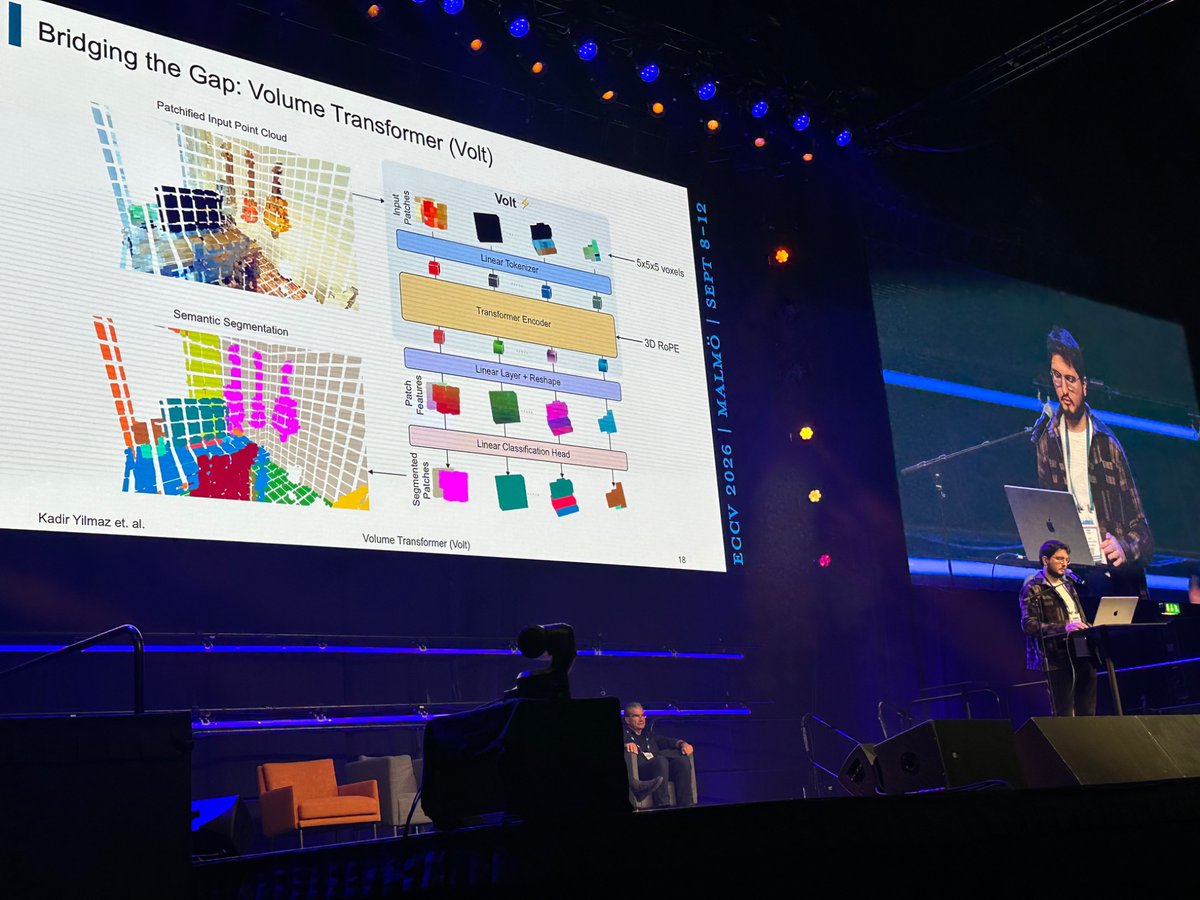
We are honored that Volt has been selected as one of the 28 Long Orals at ECCV 2026! 🎉
Looking forward to presenting our work and discussing it with others next week in Malmö. Hope to see you there!
*** Deadline extended! ***
New submission deadline: 28 July 2026
If you want to spread the word on your latest research on video understanding, submit a non-archival paper to ECCV's Video4Real workshop!
Are you working on video understanding and you want to share your findings with the community?
Looking for feedback on your ongoing project?
Looking to further advertise your published paper?
Submit a non-archival paper to ECCV's Video4Real workshop! [1/2]
📹 Working on video understanding?
Consider submitting your work to Video4Real 🫎, our #ECCV2026 workshop on Real-World Video Representation Learning!
📆 Important dates:
- Submission deadline: 18 July 2026
- Acceptance notification: 30 July 2026
📄 Submission is now open for non-archival papers. We welcome extended abstracts on:
- Ongoing work
- Recently published papers
- Datasets, benchmarks, and resources
- Emerging ideas
The Video4Real workshop is happening at ECCV 2026!
Submission is now open for non-archival papers on video understanding, and we welcome:
- Recently published papers
- Work-in-progress research
- Extended abstracts
- Datasets, benchmarks, and resources
- Emerging ideas
1/