@g__j@garethterrace As a Tesla battery owner we need better software that responds better to your firms initiatives we still think it is best that every house has a battery but we really need better software on the batteries to allow our energy firms to control some of our spare power
Read this brilliant piece on 23 June and Britain's near-miss grid crisis 🧵 https://t.co/rx5jWAwVWK
Summary:
→ Gas & nuclear outages (partly because of hot weather)
→ Solar great, then gone
→ Wind forecasts way off
→ Demand forecasts too national
→ Interconnectors saved us — barely
Gas and nuclear had huge outages that day — some sudden. Solar was brilliant, then died with the sun, exactly as it always will. We need way more batteries, especially in homes, to fill that gap.
Wind forecasts were miles out — not because wind is unpredictable, but because the central models used to plan the system are. Demand forecasts were even worse: a single national number can't capture where power is actually needed. London fell 472MW that evening while the model expected it to rise 1,138MW. That's not a rounding error, that's a system flying blind on geography.
Interconnectors saved us that night — but only after frantic phone calls, not because the market was built to use them well. With zonal pricing they'd work with the grid instead of against it every single evening.
The real lesson of 23 June: a grid built on one national price for everywhere is guessing at a national scale about problems that are actually local.
The crisis wasn't "not enough power" — it was too little power in exactly the wrong place, behind wires that were already full, while other regions had headroom to spare. A single price can't tell a battery in Kent to discharge and a battery in Scotland to wait — it just tells everyone the same story at the same time.
Zonal pricing fixes that: it makes location visible in the price itself, so flexibility shows up where the grid actually needs it. Pair that with batteries everywhere — homes, street corners, substations — and a genuinely digital grid that dispatches by the second rather than buying its safety margin in one panicked burst at 2pm, and near-misses like this stop being near misses at all. We have the technology. We just need the market design to use it.
Tongwei claims record-breaking 93.07% bifaciality factor for 770 W solar module: The result, which represents a world record for the bifacial technology, was verified by German certification body TÜV… https://t.co/bzIjH6SzAt #Photovoltaics#EnergyStorage#RenewableEnergy
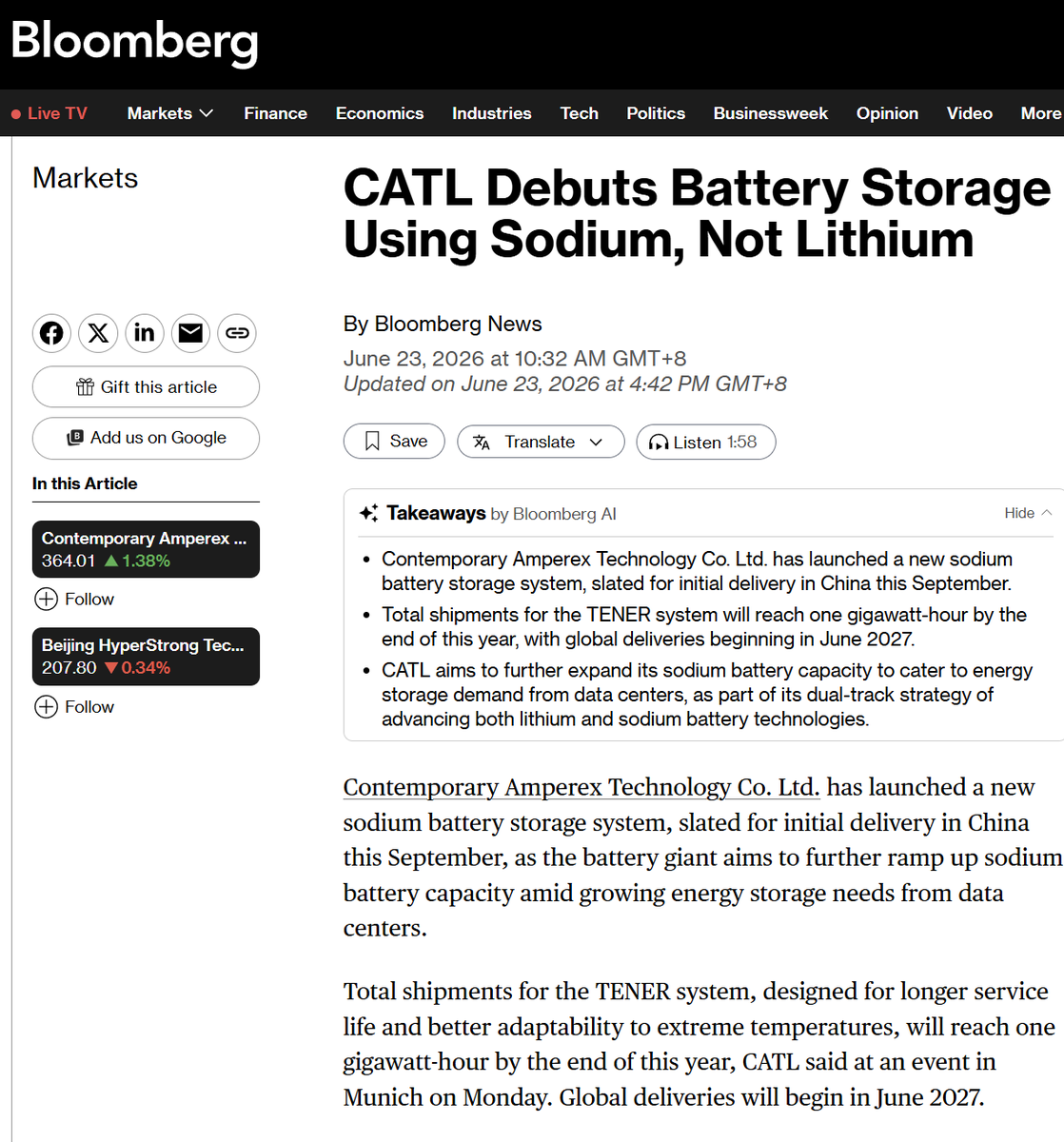
CATL just accelerated electrification everywhere with its breakthrough Tener Sodium battery
>Unprecedented 15,000 cycles for a 30-year lifespan, fireproof safety, and 92% capacity at -20°C Storage out of salt eliminates supply problems
>Fireproof technology outlasts gas turbines and runs in freezing fields: Burning fossil fuels for power is officially even more of a financial suicide
Wires are chewing pipelines everywhere
https://t.co/xLWkZ0JAWh
@g__j Great solution using the radiator as a heat exchanger. But can we sign up to a user focus group? I think it would be great to try this out in a real home(s) with different house types and different locations to get the right testing environments? Please DM?
Sneak peak...
So our incredible R&D team in Portadown have been beavering away and we'd love around 10 guinea pig customers to trial Cosy Cooler (slightly paradoxical code name but it alliterates nicely!)
Essentially, a cooling add on for the Cosy Heat Pump. Probably the most requested feature we've had, for obvious reasons...
We'll miss this Summer but hope to be properly available next Summer.
Scotland just delivered one of the most powerful clean-energy statements in modern history. On multiple occasions, the country’s wind turbines generated around 200% of national electricity demand, producing far more power than Scotland itself needed.
It can be done!!!
No time to wait. #ActOnClimate #renewables
@pvmagazine Great initiative and we still need to lower consumption of power as well. We can innovate much further to help homes run on alot less power.
One technology that remains hugely underestimated in the UK energy debate is Vehicle-to-Grid (V2G).
Great Britain uses around 750 GWh of electricity per day. A future EV fleet of around 34 million vehicles with average 60 kWh batteries would contain over 2,000 GWh of storage capacity.
The beauty of V2G is that the batteries are not being purchased primarily for grid storage. They are being bought for transport, making them a dual-use asset. Grid flexibility comes largely as a by-product of electrifying road transport.
This isn’t theoretical. My parents have been using bidirectional charging since 2019, first through Vehicle-to-Grid and now predominantly through Vehicle-to-Home, using the EV battery to help power the house and shift electricity from cheap periods to expensive periods.
The technology works.
Vehicle-to-Grid was already commercially available years ago using the CHAdeMO charging standard fitted to vehicles such as the Nissan Leaf. Unfortunately, the industry’s transition to the newer CCS charging standard was, from a V2G perspective, a retrograde step because equivalent bidirectional charging functionality took much longer to standardise and implement across manufacturers and charging equipment.
The result is that many people now assume V2G is a future technology, despite households having successfully used it in the UK for years.
Vehicle-to-Grid won’t replace grid batteries, pumped hydro or interconnectors, but it could become an important part of the flexibility mix.
So the question is: what are we waiting for?
Even a relatively small proportion of the UK car fleet participating in V2G could provide enormous daily balancing capability, helping absorb surplus wind and solar generation, reducing curtailment payments and cutting reliance on gas during peak demand periods.
The batteries are already being bought. Why not let them help support the grid while they’re parked?
#V2G #VehicleToGrid #EVs #ElectricVehicles #BatteryStorage #Renewables #NetZero #EnergyTransition #SmartGrid
My first onshore sites designed for 20 years are still running at 30+ years. My first Offshore site Scroby Sands running quite happily at 22 years will no decommissioning plans. Every decommissioned site I worked on was re-powered with significantly larger capacities.
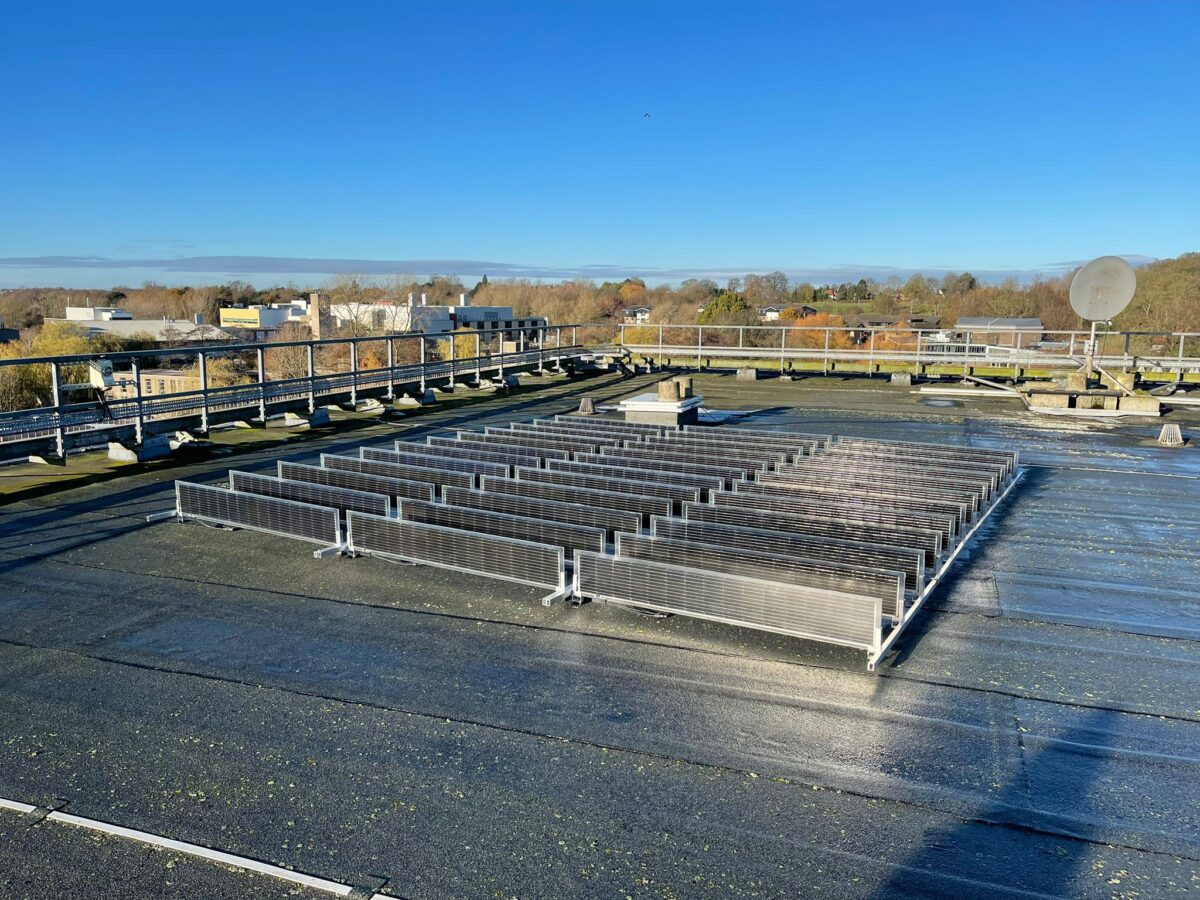
Vertical bifacial PV outperforms tilted PV systems in the UK: A year-long study in the UK finds vertical bifacial PV systems achieve an up to 26.91% higher output during morning hours compared to traditional… https://t.co/7D6si5wiKn #Photovoltaics#EnergyStorage#RenewableEnergy
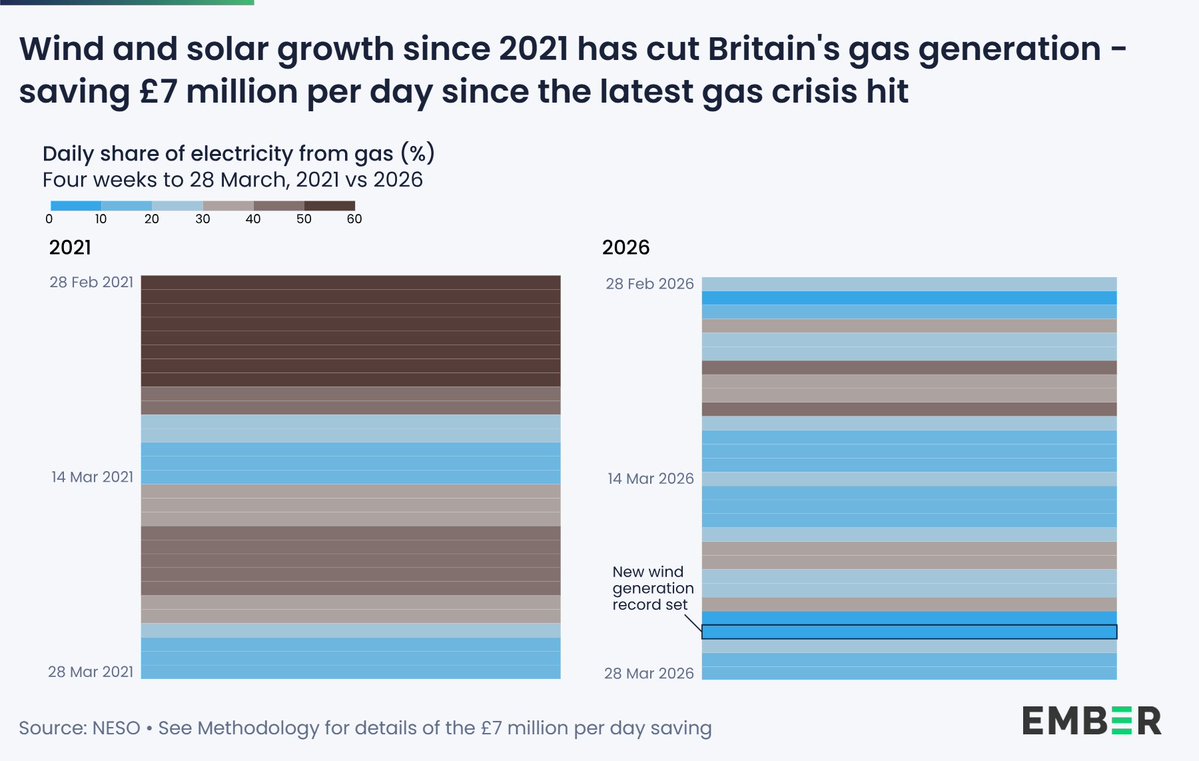
For the second time in four years, the UK is facing high gas-fired electricity costs due to a global fossil crisis.
The difference between four years ago and now?
Wind and solar capacity deployed since 2021 is reducing gas reliance and saving an estimated £7 million per day!
@pvmagazine Whilst this is a good idea, we need guidance from the government now: your photo: 3x solar panels fixed with wire ties to a balcony plugged into a powerstrip lead into an interior wall socket: it's not safe. Get safety messages out now #solar#plugin#powergeneration
@pvmagazine Green agricultural land needs to be preserved, but solar farms can accommodate live stock if planned correctly. We require urgent solar+battery generation of energy quickly. Solar farms solve these requirements faster than other methods.
@obamasucks1776@CFSMotorRacing Very true. In an EV car industry, there will only be warranty repairs and dealers can't make enough money to support their garage staff with just warranty repairs.
🔌 @ubitricity has acquired FM Conway’s SureCharge public EV charging network, adding over 2,400 EV charge points to the Shell Recharge network.
Read more here ⤵️
https://t.co/osf0mJhMX6