📣 we’re hiring
dcny is growing fast and need growth/marketing lead
fully remote and flexible
work directly with the founding team across @dcnydotco and other media/product brands we’re building
⭐️ you
· live and breathe marketing, tech, and startups
· love experimenting with new growth tactics and acquisition channels
· move fast and get things done without hand-holding
· use ai tools as part of your daily workflow
✨ what you’ll do
· run growth and marketing for dcny
· test new tools, workflows, and tactics
· experiment with acquisition, partnerships, and distribution
· support marketing across other brands we’re building
· work directly with the founding team on strategy and execution
👇
🌎 fully remote
🏃🏽♀️ tons of autonomy
✨ unlimited budget for testing new tools and tactics
💰 competitive salary + performance-based upside
💵 bonus structure includes lifetime commission on customers you help acquire
for context: current average customer lifetime value at dcny is ~$150,000
if this sounds like you, apply here, takes less than 5 minutes:
https://t.co/qSTMhwkMmg
follow me to stay up to date on our latest roles (more coming soon)
50+ clients pay us to build with AI agents.
It's the best product research you can do.
Now we're building a product for agentic engineering teams out of our own frustration.
Get paid to find the problem 🤙
When we launched @shortcutdotnews, getting recommended by just a handful of newsletters felt like a big deal.
Today, we crossed 100.
0 to 5: 5 months
5 to 25: 3 months
25 to 100: 2 months
And 450+ new readers joined just over the weekend.
While these numbers still feel small relative to where we want to be, the momentum is starting to feel real.
Huge thanks to everyone who recommends us and everyone who reads along.
We're just getting started 🤘
We're hiring one sales rep for https://t.co/z6ErVS04YJ
$3,500 for every customer you close, plus 10% of everything they pay for as long as they stay. Close one a week and that's $200k+ in year one.
No cap.
We do agentic engineering services for startups, agencies and enterprises. Clients pay $7,000/mo and stay 18 months on average.
The first 90 days are a trial. If it works, it becomes a real role.
We want someone who's deep into AI and building their own systems. Agents that find the right companies, research them, draft something specific. Automate as much as you want.
You need at least a couple of years closing B2B deals yourself, ideally services or SaaS.
Fully remote and flexible.
If this sounds like you, apply here:
https://t.co/jDnVtC1Tcc
Follow me to stay up to date on our latest roles (more coming soon).
Startup success largely comes down to this one thing:
Building a product so good that people spontaneously tell their friends about it.
Founders always want to believe it's something else, mostly because this is really hard to do.
But this is it.
Think about the most successful companies. Chances are, you found out about them because someone told you, "It's great. You've got to try this."
Build a product so good that people spontaneously tell others about it.
💬 @dhh: "the programming language of the future is English"
Even bigger shift is that ambiguity becomes a feature I think.
You describe intent, direction, and guide taste. Agents figure out the rest.
The scarce skill moves from writing precise instructions to knowing what good looks like.
Code → intent
At what point do we stop calling this programming?
💬 Paul Graham on the benefits of joining an accelerator like YC:
🤝 You get colleagues
Starting a startup is usually lonely. In an accelerator you’re surrounded by other founders building alongside you, even if everyone is working on their own startup.
🧠 You learn from other startups
If you hit a technical or operational issue, there’s a good chance another startup in the batch has dealt with it already, so you can ask how they solved it.
💸 You get a built-in early customer base
You can often sell your product to other startups in the batch, who are exactly the kind of users you want - early adopters who decide quickly.
💬 @dhh: the programming language of the future is English.
Instead of writing every instruction deterministically, describe intent, direction, and taste - then let agents interpret, build, and iterate.
Ambiguity isn’t necessarily a bug. It can be a feature.
The better AI gets, the less programming looks like writing code and the more it looks like communicating what you want.
Eventually, agents won’t just write software. They’ll operate computers, navigate the web, read specs, and implement entire systems.
Programming is moving up another layer of abstraction:
Code → intent
All true.
Also underrated: Poland has one of the best tech scenes and engineering talent pools on the globe.
Amazing technical talent + great western cultural fit.
🤘
Let me help with your AI FOMO.
We test multiple new AI tools and platforms across our businesses every week.
95% of these are just noise.
Ship.
Talk to users.
Repeat.
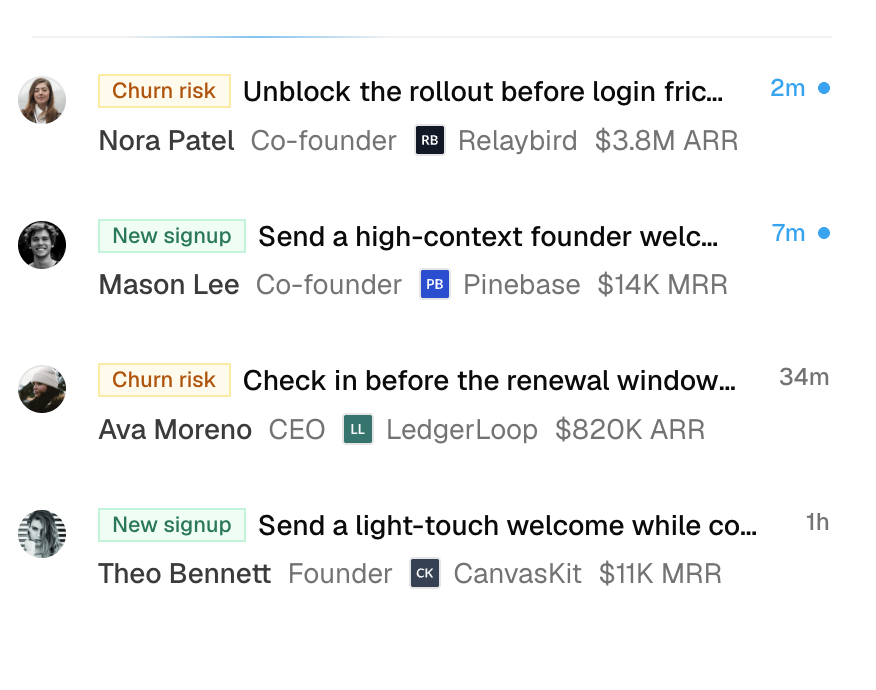
Churn doesn’t happen when a customer cancels.
That’s just when you notice it.
Your goal should be to act on signals that the customer is at risk and engage before the cancellation happens.
Opening an affiliate program for a client: a B2B engineering services company.
Their average client lifetime value is $150K. Partners earn 5% of lifetime revenue on every client they refer, so a single referral works out to roughly $7,500 over the life of the account.
Good fit: anyone with an audience or network of founders, CTOs, or product leaders at US companies up to 50 people, including funded startups, agencies, and scale-ups.
Full program terms and the client's identity are at the application link: https://t.co/HgMEaFyZy8
Anyone doing engineering or product management needs to watch this.
DHH on why the agentic age is a revelation:
@lexfridman
I think what programmers do well, good programmers do well, is systematic design, like think in terms of systems and rigor.
And I think still, and probably for a long time to come, even natural language-based control of agentic systems will require a certain kind of rigor. Not overly structured rigor, but really explain very specifically the goals of the system, how to do the verification, what kind of security testing. You wanna do all those kinds of things.
Although then to push back on that, the system will… should be smart longer term.
@dhh
I would’ve said the same thing six months ago.
Lex Fridman
Yeah, so this has changed.
DHH
And I think the same thing would’ve been true six months ago. What I have found since, especially even just the last few weeks of the agentically accelerated development of Omarchy, is that more often than not, I have the humility to recognize that the agent knows best.
Lex Fridman
You can legitimately say, “Make sure it’s secure.”
DHH
Correct. And it would know more about what that entails.
Lex Fridman
What a crazy world.
...
Lex Fridman
The interaction with the agentic system, if you create a nice interface for yourself, it can be super fun, and you’re focusing on the design part and the most fun parts of the design part.
DHH
Correct. And this is what humans are really good at.
Lex Fridman
Yeah, taste.
DHH
Differential evaluation. You give me three options, I pick one of them. Now, humans actually fall off a cliff if you give them 22 options. That’s the paradox of choice. But you give them three options, they very quickly within a split second will tell you what they like.
There are all these ways that exploit the fact that humans will make these snap judgments that are actually pre-intellectual, right? Like, they’re coming from the gut, and then they arrive up in the brain, and the brain tries to rationalize why the gut said what it said.
And if you’re willing to let go of some of that intellectual pre-processing rationalization and simply let your gut drive, the agentic age is a revelation.