New connection between Anthropic lobby and US intelligence agencies.
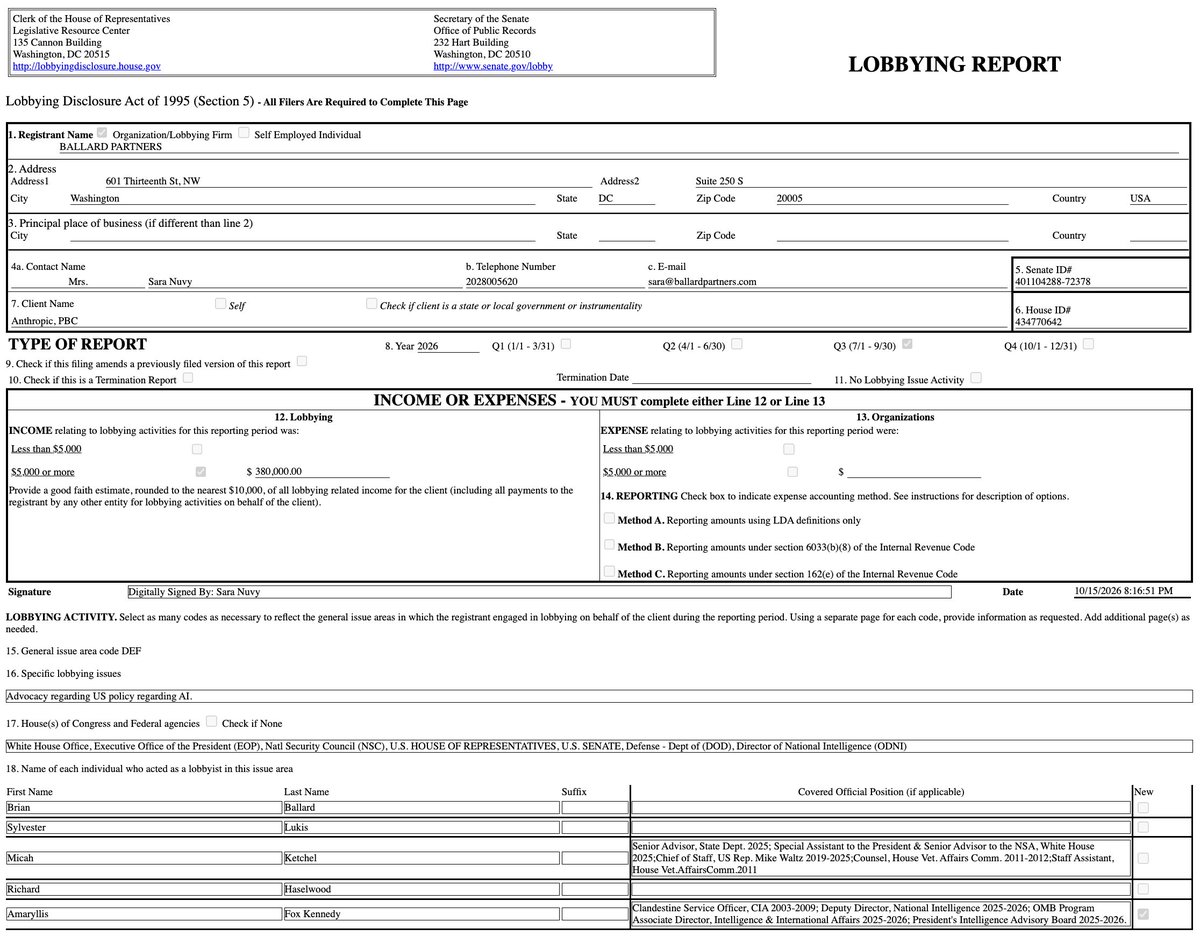
Amaryllis Fox Kennedy was Trump's Deputy DNI for Policy and Capabilities until May 2026. That's the same window U.S. intel was intercepting communications about Jensen Huang's affair with Alice Huang, and the same month Rubio briefed Trump on it.
She currently sits on the President's Intelligence Advisory Board, while she also lobbies for Anthropic. Members of that advisory board hold top secret clearances and can see classified intel across every U.S. spy agency.
https://t.co/QOLuNvjWyc
In July, Fox Kennedy joined the lobbying firm Ballard Partners. Its Q3 filing lists her lobbying the DNI's office, the NSC, the Pentagon and the White House for Anthropic, which has paid Ballard $890K this year.
https://t.co/DalXCZKuBa
Now Politico reports that Fox Kennedy joined Anthropic's own national security advisory council, a hire announced by Anthropic's Chief Global Affairs Officer, Tino Cuéllar (remember Cuéllar; he'll come back)
https://t.co/bbkc8mbtUn
AI company Anthropic has paid $1.63 million to two lobbying firms tied to Secretary of State Marco Rubio and former White House chief of staff Susie Wiles.
Since April 2025, Anthropic has paid $740,000 to Continental Strategy, whose DC office is run by Rubio's former Senate chief of staff, Alberto Martinez, and where Wiles' daughter Katie works. On March 9, 2026, it hired Wiles' former firm, Ballard Partners, for $890,000.
Ballard's team on the account includes former Rubio State Department adviser Micah Ketchel and former deputy DNI Amaryllis Fox Kennedy, RFK Jr.'s daughter-in-law.
Weeks later, Rubio's March 30 memo set off the fall of Nvidia CEO Jensen Huang, a longtime opponent of Anthropic's push to restrict chip sales to China. Huang was then turned away from meetings with Rubio three times.
Continental went on to lobby Rubio's National Security Council and State Department for Anthropic.
Follow: @AFpost
Over the past week, I’ve been overwhelmed by the love and support of friends, industry colleagues, and people I've never met. Thank you to everyone who has shown kindness to my family and me. It means the world to me.
I came to the United States 53 years ago, and becoming an American citizen is one of the greatest gifts and proudest moments of my life. NVIDIA has been my life’s work. Building it into the company it is today alongside my colleagues has been a privilege and an honor. Nowhere but in America could a company like NVIDIA be possible. I love our country, and I love NVIDIA.
I did not live up to the standards expected of everyone at NVIDIA, and I have made serious mistakes in my personal life. I created problems for the Board that I deeply regret. I own my mistakes completely, and I am committed to cooperating with the Board’s independent investigation.
Since my departure, I’ve seen an outpouring of calls from NVIDIA’s employees, investors, business partners, and customers for me to return as CEO. Many continue to reach out to me directly as the company navigates complex technology, market, competitive, and geopolitical dynamics. NVIDIA is a once-in-a-generation company. If the Board of Directors decides that my return is in the best interest of our shareholders, our employees, the company, and America, I would be honored to answer these calls and return as CEO.
Thank you again to everyone who has shared their good wishes. I am profoundly humbled by your support. To my family: I love you, and I will spend the rest of my life being worthy of yours.
Jensen
today's reporting be like "according to people familiar with the thinking of the guy who walks the dog of a roommate of a dude who's super duper in-the-know"
Nvidia doesn't have/never had a silicon design lead over Huawei
Huawei can't use TSMC
SMIC doesn't have access to EUV, so it can't produce sub 5nm chips
China's bottleneck is access to WFE tools, not design
I ran a PageRank-driven analysis on all recent news coverage related to Jensen, and traced how the New York Times shaped the entirety of this narrative: https://t.co/qKGMJ2LBV8
--
NVIDIA has lost over $1 trillion in market value since the first New York Times story broke about Jensen. I dug deeper to analyze how the news originated and spread, running a swarm of agents which analyzed almost 2000 stories, across 40 US and European news outlets, and applying PageRank to understand how they cited each other.
Core findings:
- Primary news driver: NYT, with 88 stories, most-cited
- Volume drivers: WSJ - 99 stories; Bloomberg - 140 stories; NY Post - 68 stories
All of this started from unknown sources who gave information to the NYT, which then ran the spy story (still unproven), and it was then picked up in other news publications. Curiously, even after that story, there was a 9 day period of extremely low volume reporting (28 stories only), after which there was a sudden spike after Jensen's own letter to NVIDIA staff. NYT then had multiple sequential spy and affair stories, which fed a wave of further news coverage. It was the originating hub of negative Jensen coverage. Multiple outlets since then had an explosion in stories about him starting earlier this week as well.
Overall, as you see this data, you will observe this was an exceptional media onslaught against Jensen with sharply negative coverage about him, his work, style, and family. Infact, it was brutal, and unlike coverage in the past of CEOs who have had affairs (such as Intel CEO in 2018). For eg, NYT ran just 2 stories about Intel's CEO who had an affair with his employee, compared to 88 on Jensen! Why ?
This analysis used a technique of how Google originally ranked webpages, using PageRank, and does deep dive link analysis so you can view how the news spread. What struck here was that it did not matter if there were proven facts or credible sources: the outcome here was pre-decided. The news was making the reality which it wanted.
During this period, NVIDIA has lost $1.27 trillion in market value since the first story broke. On Nov 12th-13th, further news broke that both the US Justice Department, and Singapore - are unable to even conclude the spy allegation.
This has been a catastrophic attack on one of the hardest working founders in modern times, who took an idea from a Denny's booth, through multiple instances of almost going out of business, to building the foundation of the entire modern world with how the NVIDIA story played out. Thanks to Jensen, we have hope that many formerly incurable diseases will get solved by AI, that quality of life will and have improved for billions around the world.
Now I do not know if he will come back as CEO or not, but I hope he does. What happened to him here, and to the wider industry, was not fair.
Under the @nvidia bylaws, shareholders who hold at least 15% of the voting power can call a special meeting, and they can vote to replace the board at that meeting. If the meeting is called, @JensenHuang will win the vote in a landslide.
Several people encouraged me to share a post I made on LinkedIn, here on X
I wrote this from the heart, about someone I had the privilege of working closely with for years.
No agenda. Just a side of Jensen I hope doesn’t get lost in the noise.
As the days pass, my heart grows heavier.
I have worked at NVIDIA for nearly eight years. I have never worked for anyone quite like @JensenHuang , and I doubt I ever will.
Much has been written about his extraordinary vision and the company he built. But there is another side to Jensen that I have had the privilege of witnessing. And I am only speaking to what I have personally witnessed.
I have watched him stand behind researchers, founders, and startups when few others would. Companies struggling to survive, ideas that seemed too early, people whose ambitions exceeded their resources. He saw possibilities most of us could not yet comprehend. And he committed his time, attention, and NVIDIA’s resources to helping them succeed. Some of these companies might not exist today without him.
His capacity for long-term thinking is extraordinary. Sometimes it took me years to appreciate the implications of something he had recognized almost immediately. Few could match his ability to connect technology, markets, and people.
My own journey at NVIDIA has not always been easy. Through difficult organizational transitions and moments of uncertainty, Jensen’s guidance and willingness to stand behind my work helped me persevere.
But what I will remember most is his humanity.
My sister, has been fighting an unforgiving battle with brain cancer. When her condition deteriorated during her visit to California, our family faced unimaginable circumstances: devastating medical decisions, overwhelming hospital expenses, and the possibility of losing her far from home.
Despite everything on his shoulders, Jensen found the time to care. He helped my family through circumstances that seemed impossible. And he took the time to meet my sister.
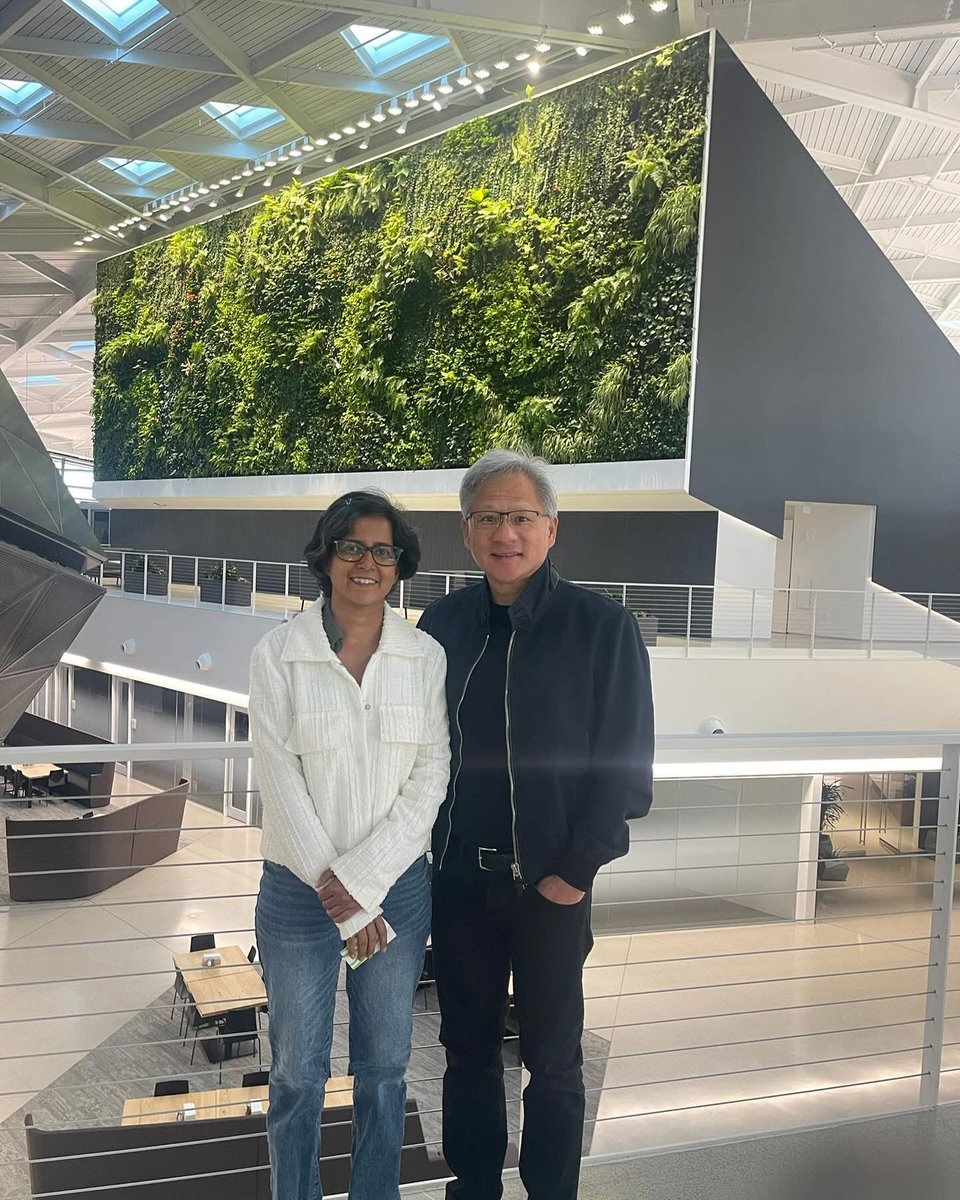
The photograph here is one I will treasure for the rest of my life.
When he told me, “I am proud of you. Treasure this time together,” I understood something about leadership that no professional experience could have taught me.
What I will miss most professionally is the extraordinary combination of vision, conviction, curiosity, and personal commitment he brought to everything. His ability to see around corners, to challenge conventional thinking, and to bring an entire ecosystem along with him.
Organizations evolve, leadership changes, and new chapters begin. But the influence of someone who has shaped so many people, ideas, and possibilities endures far beyond any role or title.
Jensen built far more than NVIDIA. He helped build an ecosystem of researchers, entrepreneurs, engineers, and companies whose futures became intertwined with his vision.
I do not know what comes next. I only know how grateful I am to have worked with him, learned from him, and experienced his kindness when my family needed it most.
Thank you, Jensen. For your guidance, for believing in people and ideas long before the rest of us understood them, and above all, for your extraordinary humanity.
@WSJ@WSJopinion You sort of set him up, didn’t you, by creating the impression that senior government officials anonymously provided information about spying, when in fact the info came from a lobbyist at a competing AI company?