We’re sharing a solution to the Navier-Stokes Millennium Prize Problem, one of the deepest problems at the frontier of mathematics.
The proof was produced by a group of agents, using an OpenAI next-generation model significantly more capable than GPT-6 Astra.
The problem concerns whether the description of smooth three-dimensional fluid motion modeled by the Navier-Stokes equations can break down. It has remained unresolved for roughly 90 years.
Investment banking is much less technical than people think:
• 60% is making powerpoints
• 30% is processing (trackers, data rooms)
• Only ~10% is modeling and analysis
Then it becomes a sales job at the senior level.
@saetacapital De isbif ya he visto mucho matado con aspiraciones y sin saber muy bien donde se mete, solo que quiere hacer “emanei” porque en su círculo hay alguien que lo hace y quiere estar a su nivel, luego en muchas entrevistas justitos, a la que te sales un poco del guion clásico se lían
@TheLBOguy +1, cada vez más falta de humildad en las sucesivas promociones, no saben el daño que se hacen ellos mismos al no permitirse aprender de los demás, y en este caso creo que ni siquiera trabaja aún, como tenga esta actitud en los procesos (ya he visto alguno así), lo lleva claro
Determinación de precio (equity value) en contratos de M&A para principiantes en una gráfica y 3 (largos) posts.
• Gráfica que sistematiza los 2 mecanismos de determinación del precio a pagar en el cierre (equity value).
@opexabuser Gente que conozco han dado el salto después de 3-4 años a bancos nacionales con sueldos top, para product management en banca muy recomendado
Para todas las cuentas nuevas de tw finance rescato este curso que creó @LevBuyOut en su día, superútil para ver lo que se hace en realidad en bancos / boutiques (sobretodo mid-market) en España, y sin gastarse lo que cuesta un curso de WSP y similares
Después de unos años entrevistando, una tendencia que veo es la gente que quiere meterse en M&A sin ser conscientes de el coste que conlleva a nivel de carga de trabajo, estrés y conciliación. No es un sector para todos, y hay mundo más allá del M&A, con alternativas interesantes
La verdadera pregunta es, cuantos de los que aplican (o de los que chulean de que entrarán) son conscientes de lo que es estar currando a las 2 am un martes después de estar ahí 16 horas?
Dudo que si has sido un vago toda tu vida de repente cambies al otro extremo. Qué poco debe durar esa gente…
Después de haber visto el aluvión de cuentas de jóvenes de 20-22 años que quieren hacer M&A / PE / etc., por curiosidad ¿realmente qué os llama la atención de esto? (interés por las finanzas, dinero, status, presión social, etc.) ¿Cómo os veis a largo plazo en 5-10 años?
@DealerIspa Pues si, yo también empecé en TS y una pena que mucha gente lo desprestigie porque por lo menos en mi caso me sirvió para dar después el salto a M&A, y en el mid-market español estos skills se valoran
Let me talk today about 🧽 sponge cities.
When I discuss fertility decline, I often get the following comment:
“As the population falls, housing prices will also fall, which will help with fertility and the system will self-correct.”
Perhaps not.
As the population falls, we are observing a phenomenon called sponge cities (see the map from Japan: do you know which city is the green spot?). There are even more incentives for the population to concentrate in large cities (e.g., Tokyo or Seoul) for three reasons:
1️⃣ Jobs. As the population shrinks in many regions, jobs disappear with it. Yes, you can telecommute for some jobs, but there are fewer of those than you’d think. A plumber cannot telecommute.
2️⃣ Services. As the population shrinks in many regions, services like grocery stores, hospitals, schools, etc., also disappear. I’ve seen this in many villages in Europe: population falls below a threshold, and the local supermarket closes. This creates a negative spiral that’s hard to break.
3️⃣ Amenities. As the population shrinks, amenities like bars, theaters, and restaurants vanish too. And it turns out people, especially younger cohorts, care more about amenities than about jobs. You might be telecommuting, but you cannot telebar.
So it might well be the case that housing prices won’t fall in sponge cities, and that this won’t help fertility.
Self-correcting mechanisms often don’t work.
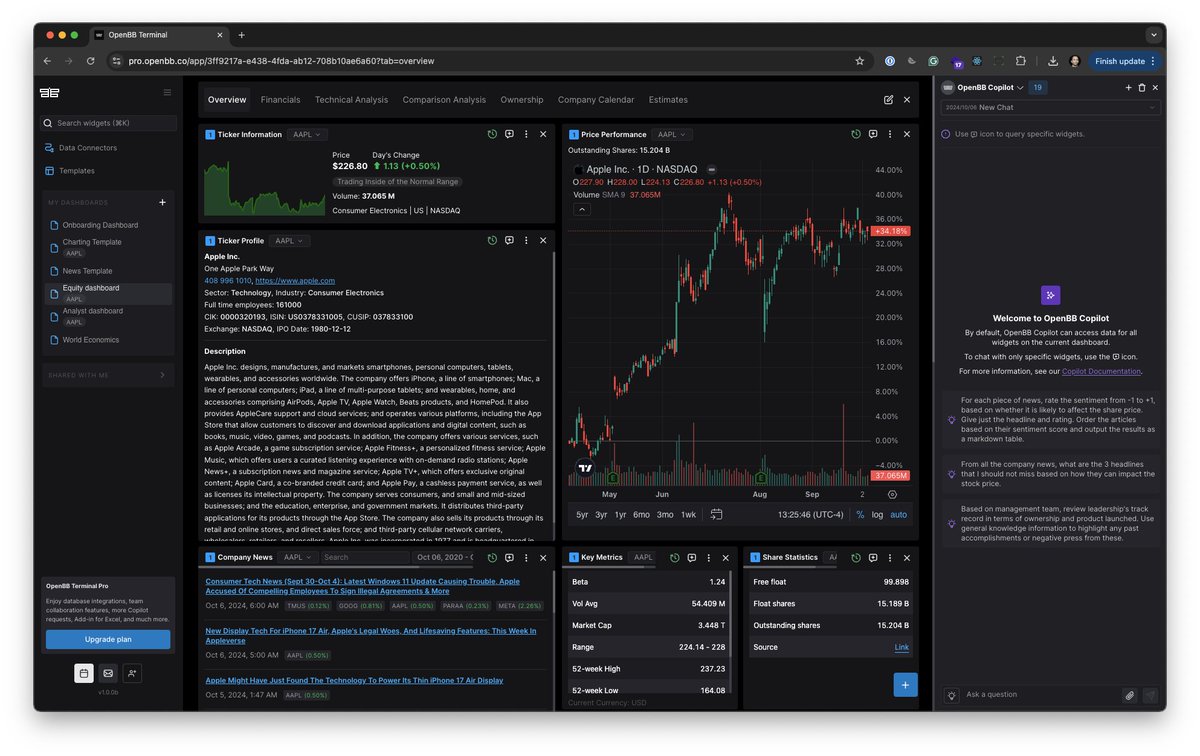
A Bloomberg Terminal costs $30,000 per year.
Last month, OpenBB dropped the $0 cost replacement.
Get 405 free data sources and an *AI Copilot*.
The 90-second step-by-step guide:
Outstanding ClearLake's slide from Dec-23 that I just received which includes detailed realization information over the last few years
Exact figures are not disclosed but it seems that the 7x MOIC we estimated in the tweet below for Wheel Pros is fairly accurate
In addition, it is very interesting to see how many of these exits represent continuation vehicles (in case not obvious, the red edits are mine)
By the way, if you want to get the entire deck this slide is pulled from, retweet this post, comment interested, and send me a DM
No todos las viviendas en venta están publicados en las plataformas más conocidas.
Los bancos tienen sus propias webs inmobiliarias y estas viviendas suelen ser más baratas.
Hilo con los principales portales inmobiliarios de bancos👇🏽