@ChazzonKe@majorart_eth@IonicDigital We may be looking at this the wrong way. I don’t think they made these decisions because they didn’t understand mining. I think their intent from day 1 was to strip the Co. Standard VC move with a distressed asset, especially when shareholders can’t fight back.
Tom Lee: "If you exclude the 10 best days for each year in Bitcoin, you'd actually be down 27% per year."
All the gains basically come down to 10 days. Miss them and you're wrecked.
The same window exists in the S&P too - miss 10 days and your 9% annual return flips to -10%.
FT @Scaramucci@FundStrat@AllThingsMkts@SkyBridge.
@elveton101@IonicDigital@owiener Is there any legit chance that with this vote we can continue to take power back with this company? Or is this still effectively a VC resource grab for leadership and a tax-loss harvest for us? Has Ionic shown any progress to profitability? They don’t communicate.
@Aaronbennett@gurgavin@grok@IonicDigital But is there any desire to actually let shareholders enjoy the benefits of these deals? The VC team that took over has shown no interest in doing anything other than syphoning value. Why should insiders make the shares public when they control the cash cow from within? Ugh…
Corporation: "We made $4B but spent $3.9B so we only owe taxes on $100M."
Government: "Totally reasonable."
You: "I made $60K but spent $58K on survival."
Government: "You owe taxes on $60K."
You: "That's not—"
Government: "File by May 15."
@carlodangelo I was there this year and last. I can believe they had 30k last year. But I’d be impressed if they got anywhere near 20k this year. ~2/3 the vendors. Lot of very empty audiences, possibly because they put the heavy hitters on day 1 behind the Pro pass which sucks for retail.
@coinbureau But what about his lieutenants who ran off to non-extradition countries? Shlomi Daniel Leon & Hanoch ‘Nuke’ Goldstein. Let’s not forget about them.
Robert Sapolsky es un neurocientífico de Stanford que demostró que el estrés crónico es el asesino silencioso que los médicos ignoran.
Reveló 10 hábitos que haces todos los días y que te quitan años de vida.
1) Repasar conversaciones en tu cabeza
Eric Weinstein just described the end of the mapped life.
For ten thousand years, humans had to earn the right to exist.
Pick a noun. Become the noun. Die as the noun.
Accountant. Teacher. Radiologist.
The box had a name. You climbed inside and stayed until retirement or death.
Weinstein: “Every occupation that is named is over.”
Not automated. Not replaced.
Named.
You picked a noun. It told the world who you were. Then it told you who you were.
If your future has a title your parents recognize, that future is already dissolving beneath you.
Weinstein: “A tsunami of a lifetime is coming and nothing your elders have seen is gonna prepare you.”
People hear this and assume it’s about unemployment.
It’s not. It’s about identity.
The machines aren’t absorbing tasks. They’re dissolving the categories we built ourselves around.
You spent your whole life becoming a noun. The noun is about to stop existing.
When the label disappears, what’s left of you?
Weinstein: “Get flexible. Get good on a bunch of different stuff. Learn how to think across disciplines.”
Stop being a noun. Start being a verb.
But the most important thing Weinstein said has nothing to do with strategy.
It touches something much older. Something closer to the bone.
In a world where AI is world-class at everything, what is the point of a human being?
Weinstein: “I think you should be able to just have a life. I have a golden retriever. I don’t know that it’s the greatest golden retriever in the world.”
For ten thousand years, human worth was measured by output.
How much you could lift. How fast you could think. How much value you could squeeze from a single day.
We trained ourselves to think like machines because machines didn’t exist yet.
Now they do.
And they will be better than us at every measurable thing.
Most people hear that and feel terror. They should feel something closer to relief.
When a machine can do it better, the metric dies. When the metric dies, the cage opens.
You were never supposed to be a spreadsheet. You were never supposed to justify your breath with a job title.
Your golden retriever doesn’t optimize. It doesn’t produce quarterly earnings. It doesn’t prove it’s worth to anyone.
It just lives. And you love it anyway.
That was always the offer. We just couldn’t afford it.
Now we can.
We spent ten thousand years trying to prove we were machines.
The machines just arrived to tell us we never had to be.
@puckrin Does this negativity need 2 punches in the face to reach rock bottom like 2022?
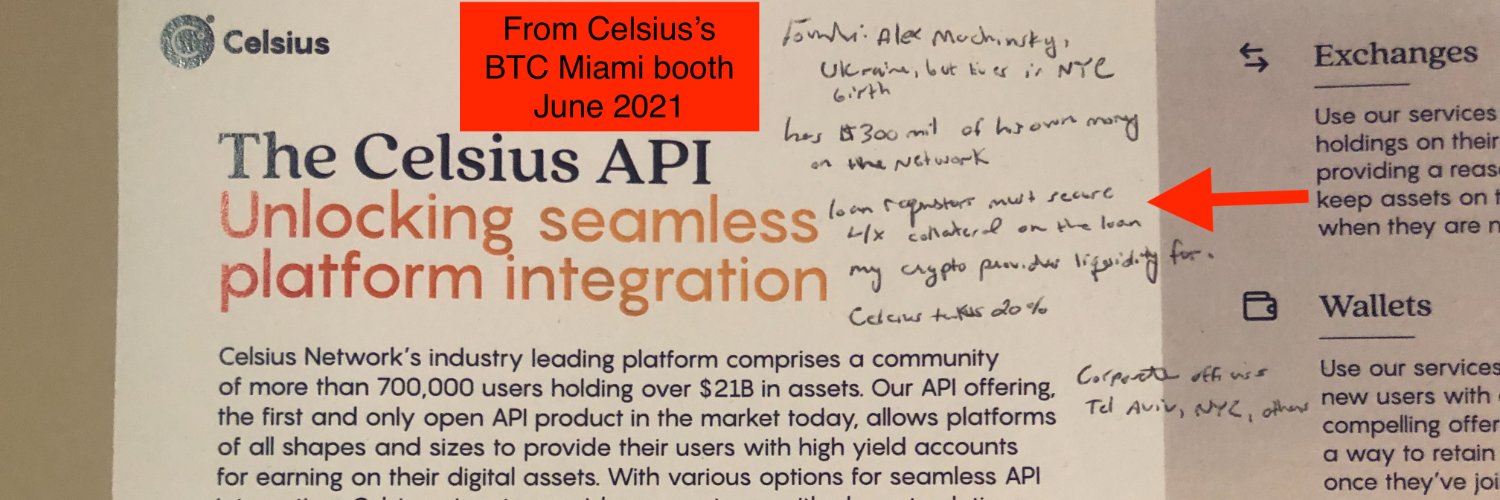
May '22: Terra Luna collapse. June: Celsius. November: BlockFi/FTX. It took 6 months from 1st punch (Terra Luna) to the 2nd punch (FTX).
10/10 was punch #1. Put your seatbelt on for #2.
1964, the last year silver was in our coins. Quarters and dimes pre-1965 were 90% silver, 10% copper.
1964 Median Family Income: $6,600.
Price of silver was $1.29 per oz. So the median family income was 5,116 oz of silver per year.
At $100 per oz, that is $511,600 per year.
Even if you go back to 2024 silver prices, the average was $25 per oz, which would have been $127,900 for 5,116 oz of silver. Actual median family income for 2024 was $83,000.
If you wonder why a family needs two incomes to survive now, it is because the govt removed silver from the coins and removed the US dollar from the gold standard (1971).
Those decisions enabled Congress to start running up massive debts and enabled the Fed to start manipulating interest rates and the currency to finance it all.
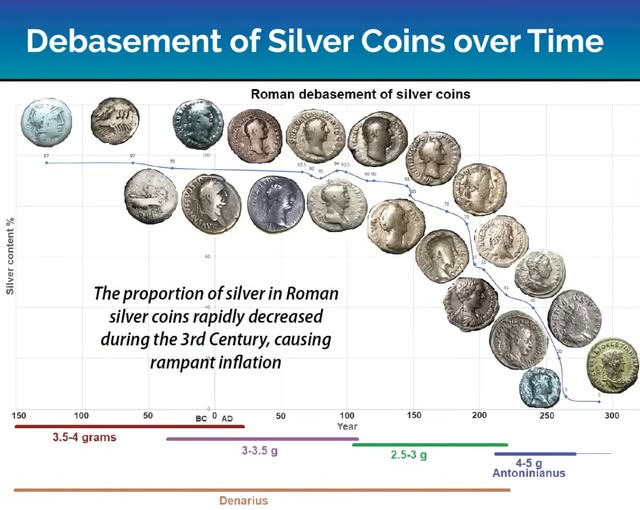
This is history repeating itself. As the Romans reduced the silver content of their money supply, their empire declined.
1971 minimum wage was $1.60 per hour, $64 per week or 1.82 oz of gold
In order to have the same spending power in 2026 the minimum wage would have to be $225 per hour
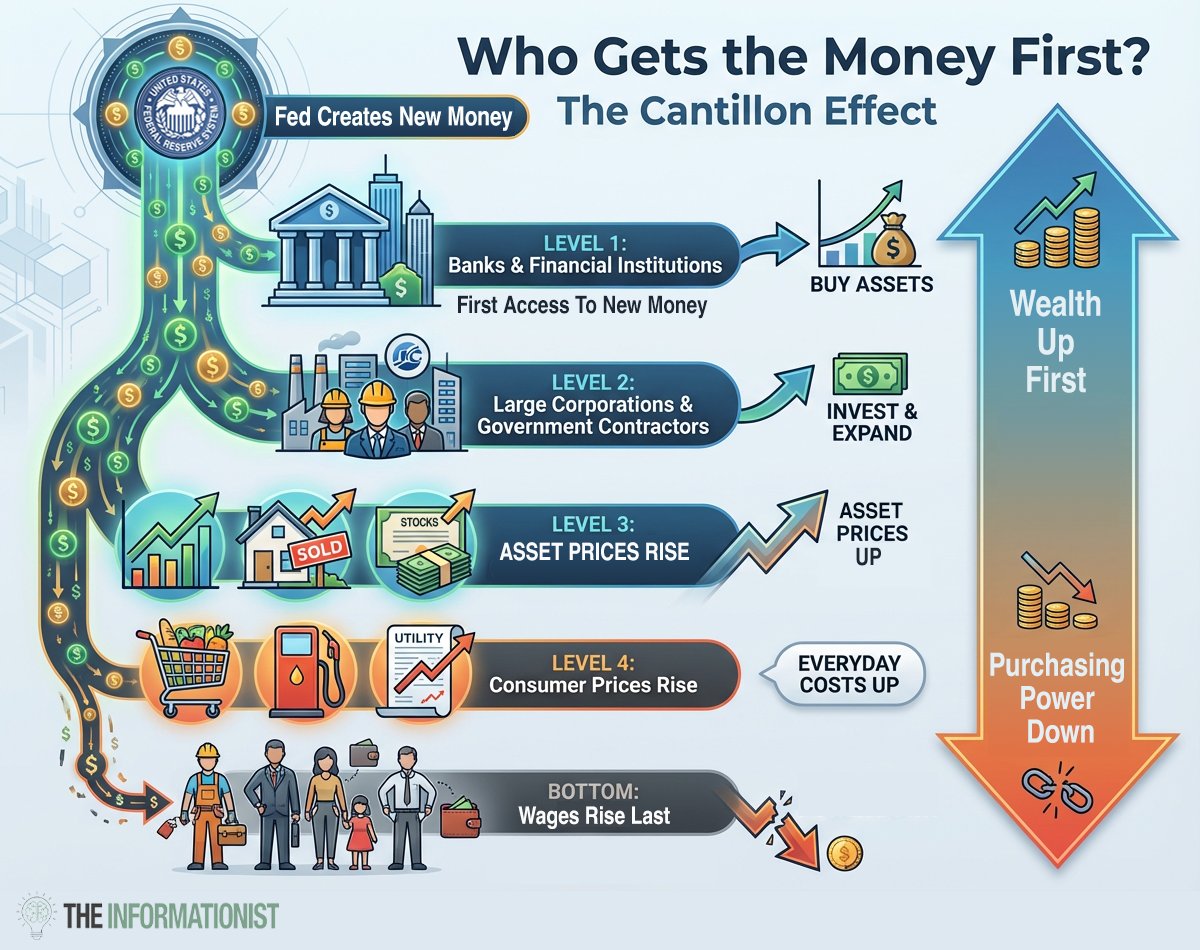
Most people have never heard of the Cantillon Effect.
But once you understand it, you’ll see the world of investing differently.
What is it?
In the early 1700s, Richard Cantillon noticed a simple pattern:
When new money enters an economy, it doesn’t reach everyone at once.
And whoever gets it first benefits the most.
Here’s how it works today:
New liquidity enters through the Fed and through bank lending.
Both follow a similar pattern:
→ Markets and large balance sheets get first access
→ Large corporations and well-connected borrowers tap cheap credit next, they invest and expand at today’s prices
→ Asset prices tend to rise as new liquidity chases finite assets
→ Consumer prices often follow
→ Wages rise last, usually after purchasing power has already declined
Fed data shows how lopsided the playing field is:
- The top 10% hold nearly 90% of equities.
- The bottom 50% holds about 1%.
It’s a simple but powerful monetary transmission.
Understanding this won’t change the system.
But it might change how you think about where to store your savings.
For those of you who don't know, I write all about topics like this every week in The Informationist. Last week, we dove deep on this one.
Link in bio if you want to read the full explanation.
@dangambardello What if we get liquidity and metals/the stock market keep going up - but crypto doesn't? Increased liquidity means "something" will pump, but it doesn't have to be crypto. If institutions now drive crypto, who says they'll leave stocks/metals for crypto? That's what worries me.