Hmm... 'Outsourcing plus LocalAI will soon become more economical vs Frontier labs'
https://t.co/pwL20Gnho9
"Tl:Dr: This essay is an attempt to answer at which point it becomes more economical to hire an engineer in a cheaper country and give them DeepSeek/local-AI API key vs using Frontier closed-source LLMs and concludes that at the very least, this dynamic puts a price ceiling on the frontier lab offerings. We use DeekSeek as a proxy for localAI costs."
cc @NGKabra@anandesh
Mammograms miss cancer in 50% of Indian women.
Not because of a bad machine.
Because of biology.
90% of Indian women under 45 have dense breast tissue.
On an X-ray? Cancer appears white. Dense tissue also appears white.
White on white. The cancer is invisible.
And in India, 45–50% of breast cancers occur in women under 45.
She has personally seen cancer lumps in a 17-year-old girl.
The West designed its screening technology for its own bodies.
@geethamhp designed hers for ours.
No radiation. No compression. No touching.
Just a thermal camera, AI, and 400,000 temperature readings per scan.
A fantastic story of ground up innovation on @mundhebanni.
Link in first reply. Share this with every woman you know.
Today, we’re taking a step toward truly galactic-scale capabilities. 🚀
We’re partnering with @SarvamAI to bring sovereign AI into orbit aboard India’s first orbital data centre satellite, a pathfinder mission bringing datacenter-class GPUs and high-performance remote sensing together in space.
Built and operated by Pixxel, with Sarvam providing the AI backbone, the demonstrator marks a step toward making orbital data centres real, operational, and scalable from India.
May the 4th be with us all! ✨
We started something we call Build Club. Every week, @DataRobot employees show up, open the platform, and build something live.
No slides. No demos. Just hands on keyboard.
Here's why it's working...and how you can run one too. 🧵
There r random behavioral science terms thrown around here, but clearly no user empathy involved in the analysis.
Wheelchair ‘abuse’ does not emerge from a point of confidence or entitlement but from a place of fear and anxiety. Of an environment not tailored to user emotions
Milton Friedman on 4 ways to spend money:
1) Your money on yourself (you’re careful about both cost and quality)
2) Your money on others (you care about cost, less about quality)
3) Someone else’s money on yourself (you care about quality, not cost)
4) Someone else’s money on others (you care about neither)
The last one is how government spending works
Recently, there was a clash between the popular @FFmpeg project, a low-level multimedia library found everywhere… and Google. A Google AI agent found a bug in FFmpeg.
FFmpeg is a far-ranging library, supporting niche multimedia files, often through reverse-engineering. It is entirely the result of volunteers and a marvellous piece of technology.
For people who have never been on the receiving end of ‘security researchers’, it is difficult to understand why there is a pushback against them.
Think about the commons. In Quebec, these are pieces of land where farmers send their cows during the summer. It is collectively owned, like FFmpeg.
Everyone is responsible to care for the commons if they are using it. If you are not using it, you are supposed to stay away.
Now, imagine a rich corporation comes in and sends its well-paid agents into the commons to find issues with it. Maybe a broken barrier or a dangerous hole. So far so good… But instead of fixing the issues, the corporation says “you have a month to fix the issue or else I will report you to the government”.
How much love would the big corporation get in this context?
Why do the security researchers insist on disclosing the issue without having contributed to fixing it? So that they can get credit for it. That's their entire scheme: find issues, irrespective of whether they affect the use case of their employer... after all, all issues no matter how small can be potentially significant at some point... and then brag about it without doing the hard work of trying to fix it.
Let me be clear that no everyone working in security behaves this way. Many are good actors. But there are enough 'security researchers' behaving as parasites that it has become a recognizable pattern.
« But Daniel, who should be fixing the bugs then? »
If you are paying for commercial support, then get in touch with the folks you are paying. If you are not paying, then it is on you.
It says so in the licenses. It is part of the moral code open source. It is part of the legal framework.
Let me be clear. You do not get to bite back at Linus Torvalds if a bug in the linux kernel crashes your server. What you do is that you identify the issue, narrow it down and propose a fix. If you cannot do it, then you pay someone to do it. Or you just do not use Linux.
@ProbFact Complete misconception. It's so easy to understand 5+/-2 . Because continuous probability has a geometry to it . It would have so easy to teach and understand continuous probability atleast for uncertainty because it's so visual . Bayes theorem also so easy to visualize.
The Kalpavriksha or the wish-granting tree that emerged during Samudra Manthan or the Churning of the cosmic ocean - is the Parijata/ Pavazhamalli - this tree came out along with Kamadhenu and both descended to Bhu loka or earth on this Govatsa Dwadashi day (the Dwadashi that comes before Deepavali)
Shastra says that this is the only tree where the flowers can be picked from the ground after the flowers drop and then used directly for pooja. All other flowers ideally must be plucked directly from the plant and picking from the ground for pooja ain't ideal (while not always practical) - but this rule is relaxed for the Parijata as it is very auspicious for Devatas
This tree holds a special place for the both of us - immediately after our wedding when we lived at Bengaluru for a short while, we resided at an apartment near 100 ft road, Indira nagar, that had a huge Parijata tree - that the owner/builder of the place had named the apartment Parijata Nilaya ...
I bought a few Parijata saplings and planted them in our mini garden at home on this auspicious Govatsa Dwadashi day today
My brain broke when I read this paper.
A tiny 7 Million parameter model just beat DeepSeek-R1, Gemini 2.5 pro, and o3-mini at reasoning on both ARG-AGI 1 and ARC-AGI 2.
It's called Tiny Recursive Model (TRM) from Samsung.
How can a model 10,000x smaller be smarter?
Here's how it works:
1. Draft an Initial Answer: Unlike an LLM that writes word-by-word, TRM first generates a quick, complete "draft" of the solution. Think of this as its first rough guess.
2. Create a "Scratchpad": It then creates a separate space for its internal thoughts, a latent reasoning "scratchpad." This is where the real magic happens.
3. Intensely Self-Critique: The model enters an intense inner loop. It compares its draft answer to the original problem and refines its reasoning on the scratchpad over and over (6 times in a row), asking itself, "Does my logic hold up? Where are the errors?"
4. Revise the Answer: After this focused "thinking," it uses the improved logic from its scratchpad to create a brand new, much better draft of the final answer.
5. Repeat until Confident: The entire process, draft, think, revise, is repeated up to 16 times. Each cycle pushes the model closer to a correct, logically sound solution.
Why this matters:
Business Leaders: This is what algorithmic advantage looks like. While competitors are paying massive inference costs for brute-force scale, a smarter, more efficient model can deliver superior performance for a tiny fraction of the cost.
Researchers: This is a major validation for neuro-symbolic ideas. The model's ability to recursively "think" before "acting" demonstrates that architecture, not just scale, can be a primary driver of reasoning ability.
Practitioners: SOTA reasoning is no longer gated behind billion-dollar GPU clusters. This paper provides a highly efficient, parameter-light blueprint for building specialized reasoners that can run anywhere.
This isn't just scaling down; it's a completely different, more deliberate way of solving problems.
5. Configure, Don't Code - How declarative data stacks enable enterprise scale by separating what you want from how it's implemented. https://t.co/BYFlCB0eYb
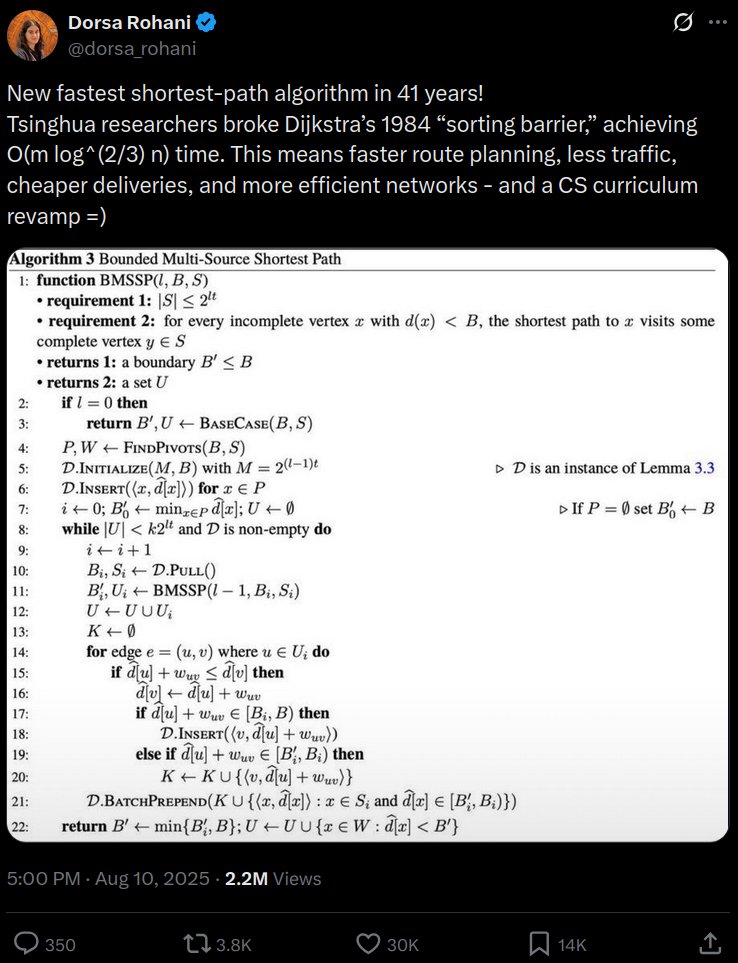
I take a break from twitter for a few days and come back to an AI grifter with IQ in the single digits deceiving the entirety of tpot.
No, this paper will not have any influence on large-scale road routing, because
1. plain Dijkstra is virtually never used for large-scale road routing lol
2. this is a theoretical result valid in the comparison-addition model, not for a physical machine (with actual bits, cache etc) where existing algorithms are already faster in the real world than the new one in that model
3. the new algorithm only beats Dijkstra's for sparse graphs
4. an asymptotically faster algorithm isn't necessarily better in practice -- it's often the opposite
5. route planning isn't a bottleneck that determines the severity of traffic lol
2.2M views, 30K likes. You people should be ashamed of yourself for falling for this clown's bullshit.
#Didyouknow
https://t.co/B3tHkamNOK has 20 online courses that amount to more than 300 hours of curated content on Indian history. Making it one of the largest repositories of Indological content on the web.
We want people to know about it.
So do help us spread the word.
I head a department in the US, am triple board-certified, with numerous publications, citations and invited lectures to my name. And yet, I won’t dismiss alternate systems of medicine as quackery just because they don’t fit a Western clinical trial model. Many chronic conditions defy modern medicine’s toolbox but respond to holistic approaches. That’s precisely why integrative care is gaining ground even in med school curricula.
As for allied health professionals such as optometrists, physical therapists, psychologists, pharmacists, they are not secondary. They are vital. They undergo rigorous training and licensure and are the backbone of modern healthcare delivery.
So please get off your ivory tower, quit the condescension, and embrace a more respectful, inclusive view of healthcare.
A note to NRIs, esp Tambrahms.
Stop at some logical point and get back here to India.
If not, arrange a caretaker for your parents who live alone in India. In case they don't agree, accommodate them in an elder care facility. Visit them atleast once in two years. When your parents turn 75 they begin to deteriorate. 80+ aged parents are so frail that they can't do anything on their own. I interact with many such NRI parents on a daily basis and am writing from what I see. There is enough material for three full fledged novels. You may be arranging Periyava Mandalis or Brahmotsavams in the USA, but the real gods that brought you to this world are languishing.
Your $s are less worthy than the adult diapers that your parents struggle to wear by themselves.
Amaruvi
08-06-2025
Difficult to overstate what an amazing picture this is—an officially released photo of the Integrated Air Command & Control System (IACCS) that executed the insane symphony of India’s air defence during Op Sindoor. Heroes all.
Happy hunting, India salutes you! 🇮🇳
judging an engineer by age is BS
- Linus Torvalds wrote Linux at 21
- Steve Wozniak built Apple I at 25
- Palmer Luckey created Oculus VR at 20
- Vitalik Buterin designed Ethereum at 19
- Mark Zuckerberg coded Facebook at 19
Looking back, I realize that 18-25 is the peak time.
"The young do not know enough to be prudent, and therefore they attempt the impossible – and achieve it, generation after generation."
I spent a few months in the US about ten years ago. I used to wonder so many people were obsessed about peanut allergies. I realised they were obsessed about it because many actually had peanut allergies. And many developed peanut allergies because they were not exposed to peanuts till they were three years old. And they were not exposed to it because their parents avoided giving them peanuts till they were three. And the parents did that because pediatricians told them not to give them peanuts. And pediatricians told them so, because the American Academy of Pediatrics recommended against it. And the American Academy of Pediatrics recommended against it because some study said so. And the study, it turned out, was flawed.
It's a useful story to remember.