Safaricom now plans to go beyond mobile money into savings, investments, insurance and AI, according to CEO Peter Ndegwa during a CNN interview.
Here are more details on what he said.
Thread below
Finally, let’s look at Safaricom’s ambition.
Ndegwa says Safaricom wants to become “Africa’s leading purpose-led technology company”, moving beyond traditional telecommunications to focus on technology, financial services and customer needs.
Court Annexed Mediation: 40 hours, KSh 22,000 online (KSh 35,000 physical in Thika). Open to professionals without a law degree.
Want admission details today? Tap to WhatsApp us on 0701 893 388. Your message is pre-written, just hit send.
An uncompleted land sale agreement can give rise to adverse possession where the purchaser remains in possession for the requisite statutory period of 12 years after possession becomes adverse to the vendor. Rights acquired through adverse possession survive the purchaser's death, form part of the deceased's estate and may be enforced by the legal representatives.
In Kanziwa Limited v Kandie & Another (Civil Appeal E111 of 2022) [2026] KECA 2080 (KLR), decided on 2 October 2026, Mativo, Kairaria and Hassan, JJA, of the Court of Appeal of Kenya at Nakuru dismissed an appeal concerning approximately 124 acres of land which the Court found had been purchased by the respondents' deceased father, Aaron Kimosop Kandie, in 1982.
The appellant denied the sale and disputed the family's possession of the land. However, the Court found that the documentary evidence, including Land Control Board consents, a signed application for consent and correspondence concerning the proposed sale, supported the trial court's finding that the deceased had purchased the land.
The Court reaffirmed that an uncompleted sale agreement can ripen into adverse possession where the purchaser remains in possession for the requisite statutory period after possession becomes adverse. It further held that rights acquired through such possession survive the purchaser's death and may be enforced by the administrators of the deceased's estate. The appellant had not established an effective interruption of possession, and the deceased's family had continued occupying the land after his death in 2002.
Accordingly, the Court dismissed the appeal with costs and upheld the High Court's decision entitling the respondents to registration as proprietors of the disputed land through adverse possession.
Read full judgment: https://t.co/ZJmED3aTD0
The Independent Policing Oversight Authority (@IPOA_KE) is recruiting results-oriented Kenyan citizens to fill 41 vacant positions.
Detailed job descriptions, specifications and the online application portal can be accessed at https://t.co/zyfmehcn1q
Deadline: November 10, 2026
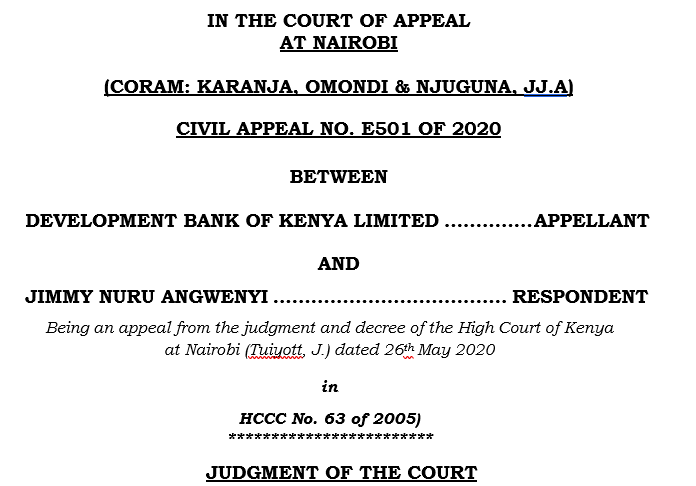
🚨🚨 YOU DEFAULTED ON A BANK LOAN, THEN THE BANK SOLD YOUR LAND WITHOUT PROPER NOTICE - WHO OWES WHOM NOW? THIS COURT OF APPEAL RULING IS A BOMBSHELL! 🔥
Imagine borrowing money from a bank, falling into arrears, then discovering that your land has already been auctioned without the legally required notice. That is what confronted Jimmy Nuru Angwenyi in Development Bank of Kenya Limited v Jimmy Nuru Angwenyi, Civil Appeal No. E501 of 2020, decided on 16 October 2026. The bank sold his Thika property for KShs 650,000, despite its own valuer placing the forced-sale value at KShs 1.2 million and the open-market value at KShs 2 million. The critical problem? Evidence before the Court showed that the bank had not served the required statutory notice under section 69A of the then-applicable Indian Transfer of Property Act. The Court reaffirmed that a borrower’s default does not give a bank permission to ignore the law. A lender exercising its statutory power of sale must comply with the required notice procedure and take reasonable steps to obtain the best price reasonably obtainable.
Now here is where it gets interesting. The High Court had awarded Angwenyi KShs 2 million in damages, representing the property’s open-market value at the time of sale. The bank appealed, arguing that the damages should instead reduce the outstanding loan debt, while Angwenyi cross-appealed seeking KShs 20 million. The Court of Appeal dismissed both the appeal and the cross-appeal, leaving the KShs 2 million award undisturbed because the higher valuation relied on by Angwenyi was not supported by comparable evidence. The lesson? Owing a bank money does not strip you of your legal rights, and a bank’s power to auction your property is not a licence to disregard the law. Banks must follow the required procedures; borrowers must also prove their claims with credible evidence. So, if a bank sells your property unlawfully, should it still be allowed to pursue the outstanding loan without accounting for the damages it has been ordered to pay? 🔥
Kindly retweet🙏
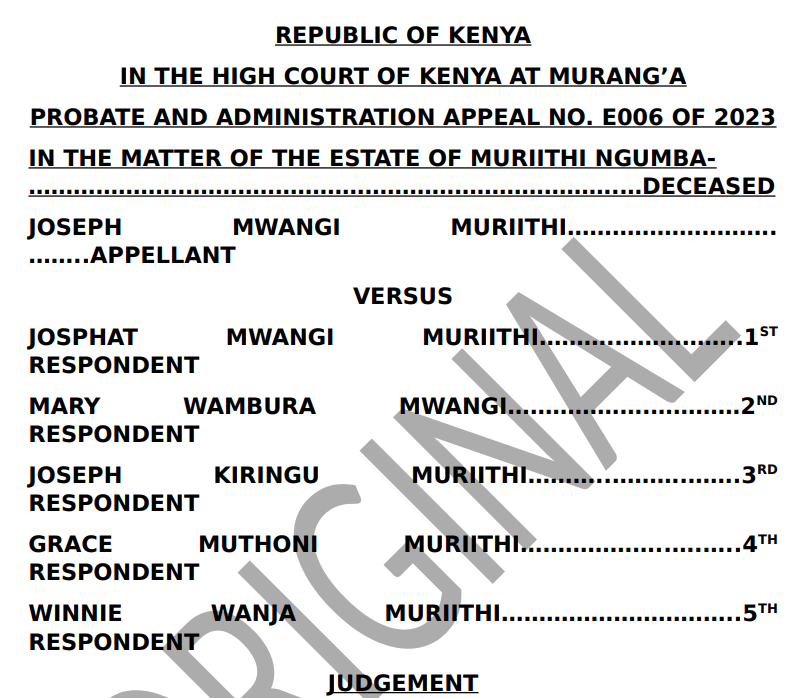
🔴 High Court Clarifies Two Powerful Rules in Succession: Customary Law Still Matters, and Courts Can Correct Their Own Slips.
In Joseph Mwangi Muriithi v Josphat Mwangi Muriithi & 4 Others, a family battle erupted over land belonging to a man who died in 1980, before the Law of Succession Act came into force. The deceased had two wives and two parcels of land. One parcel had already been given to the second household, registered in the name of a son to hold in trust. The other parcel remained in the deceased’s name and was used by the first household. Years later, the first son obtained a grant of administration and had that remaining parcel transferred to himself. Decades after that, the children of the second house rushed to court claiming they had been disinherited and asked the magistrate’s court to revoke the grant issued in 1984.
The High Court took a cold, methodical look at the facts and the law. First, it reminded everyone that when a person dies before 1 July 1981, distribution of the estate is governed not by the Succession Act but by customary law, thanks to Section 2(2). Under Kikuyu customary inheritance, a polygamous man’s property is divided between houses, not between individual children. Each wife represents a house, and each house gets an equal share regardless of how many children are in it. Since the deceased had already effectively distributed the two parcels to the two houses during his lifetime, the court found that no house had been disinherited at all. The attempt to reopen the distribution decades later collapsed.
The judgment also dealt with a procedural twist that lawyers love arguing about. The magistrate had initially delivered a ruling dismissing the revocation application, then two days later corrected the ruling saying it had accidentally failed to reflect the court’s real intention. The appellant claimed that the court had no power to revisit its decision. The High Court disagreed. Relying on Rule 73 of the Probate and Administration Rules and the long-standing “slip rule” principle, the court held that a judge may correct an accidental error or omission to give effect to the court’s true intention. Courts exist to do justice, not to be trapped by their own typographical mistakes.
The jurisprudential lesson is blunt. In Kenyan succession law, timing matters. If death occurred before the Succession Act, customary law still governs distribution. And on the procedural side, courts retain inherent power to fix accidental slips so that justice reflects intention rather than clerical error. Family land fights already stretch across generations. The law is not eager to reopen them unless there is real injustice.
@georgediano@NelsonHavi@MarthaKarua@Thuranira_1@joshuamalidzo #RevvvishaNaKCB2026 #FeelTheRoar Sleeping Warrior Blessed Sunday
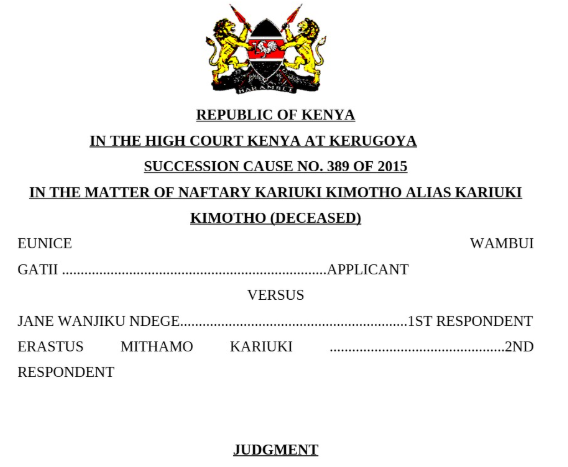
🚨 YOU BUY LAND, THE RECORDS ARE CHANGED, YOU GET THE LICENCE - THEN YEARS LATER THE FAMILY OF THE FORMER OWNER FILES SUCCESSION OVER IT. CAN THEY TAKE IT FROM YOU?
Imagine discovering that land you acquired and had officially recorded in your name has suddenly appeared in a succession case as property belonging to someone who died years earlier. That is exactly the dispute that reached the High Court at Kerugoya in Eunice Wambui Gatii v Jane Wanjiku Ndege & Another, Succession Cause No. 389 of 2015. A rice holding in the Mwea Irrigation Scheme had already been subdivided and the records changed before the succession proceedings were filed. The Applicant argued that her portion, 3740A, had already been transferred to her and that she had been issued with a tenant card and licence. Yet the succession court later confirmed a grant purporting to give the entire original holding to the deceased’s daughter. The Court asked the critical question: was this even property capable of being inherited?
The answer was no. The Court held that the rice holding was government property allocated under a licence and was therefore not the deceased’s “free property” under section 3 of the Law of Succession Act. It could not simply be placed in a succession cause and distributed as though it were privately owned land. Worse, the original holding 3740 no longer existed when the succession case was filed - it had already been subdivided into 3740A and 3740B. The Court therefore annulled the confirmed grant under section 76, holding that the succession proceedings had been marred by illegality and were calculated to defeat interests arising from the earlier transactions. The message is significant: you cannot use a succession court to create ownership where the deceased had no freely disposable property to begin with. Where another statute provides the procedure for dealing with that property, that procedure must be followed.
Kindly retweet widely🙏
These are called roadside declarations. I hope he knows what he is talking about because farmers are paid for paddy, not rice. (takes 1.6kg of paddy to get a kg of rice). 85/= that would translate to Sh136 per kg of rice.
DIVORCE DOES NOT MEAN DISAPPEAR WITH THE ASSETS
Mombasa. A woman walked out of a 33-year marriage to a Comoros national. Returned Sh50,000 dowry. Kadhis Court granted khul divorce. Co-parenting ordered for the 9-year-old daughter. She followed the law. She went to court.
The Court of Appeal in PRS v MWR [2026] KECA 2012 dismissed a husband's stay of execution application after the High Court ordered equal sharing under S.6 of the Matrimonial Property Act, 2013. He failed the twin principles test under Rule 5(2)(b) of the Court of Appeal Rules, 2022. He could not demonstrate nugatory. As Elior v Njoroge [2026] KECA 1209 held, arguability is only step one.
Both counsel cited the Civil Procedure Rules, 2010 instead of the Court of Appeal Rules, 2022. The bench called it a procedural misstep. The Civil Procedure Rules do not apply in the Court of Appeal. As Owino & Onyango [2026] KECA 863 confirmed, mastery of appellate procedure is the boundary line. Get the rules wrong, your client loses the property. That is not vibes. That is negligence. And the law as we always say is not vibes, and it is not inshallah.
S.7 Matrimonial Property Act: property vests according to contribution. Monetary or non-monetary. Housework. Childcare. Farm management. The title deed is not the final word.
In Reliance Bank Ltd v Norlake Investments Ltd [2002] 1 EA 227, nugatory means worthless, futile, trifling. The husband could not prove that. Monetary compensation could remedy any error on appeal.
Execute true judgment, and shew mercy and compassions every man to his brother. Zechariah 7:9.
Matrimonial property. Divorce. Custody. Access. Maintainance. Allan Mulama Advocates. 0725 823 695 / 0707 819 519. The vibes can wait. The law cannot.
What it takes to help small businesses access finance, grow, and create jobs? From better data to stronger partnerships, here’s what attendees had to say about unlocking the potential of small businesses.
Watch the replay of this #WBGMeetings event: https://t.co/xTjNt5B3Qw
If you think SHA is communism, hujaona income tax. A grade 1 teacher earning 30k pays PAYE every month, but an "unemployed" boda guy earning 2k daily (60k monthly) in Nairobi and an informal business man earning 300k daily selling spare parts pays zero PAYE.
On Sept. 2, Uber exited Nigeria and Uganda, adding to earlier departures from Tanzania and Ivory Coast as the ride-hailing giant finds that Africans are prioritizing cost over comfort and safety https://t.co/DcT9hZjF6s
Never in my life, have I ever had Baba Raila Odinga opposing development projects no matter how crooked a regime was.
There comes a time when we have to differentiate activism and Patriotic acts.
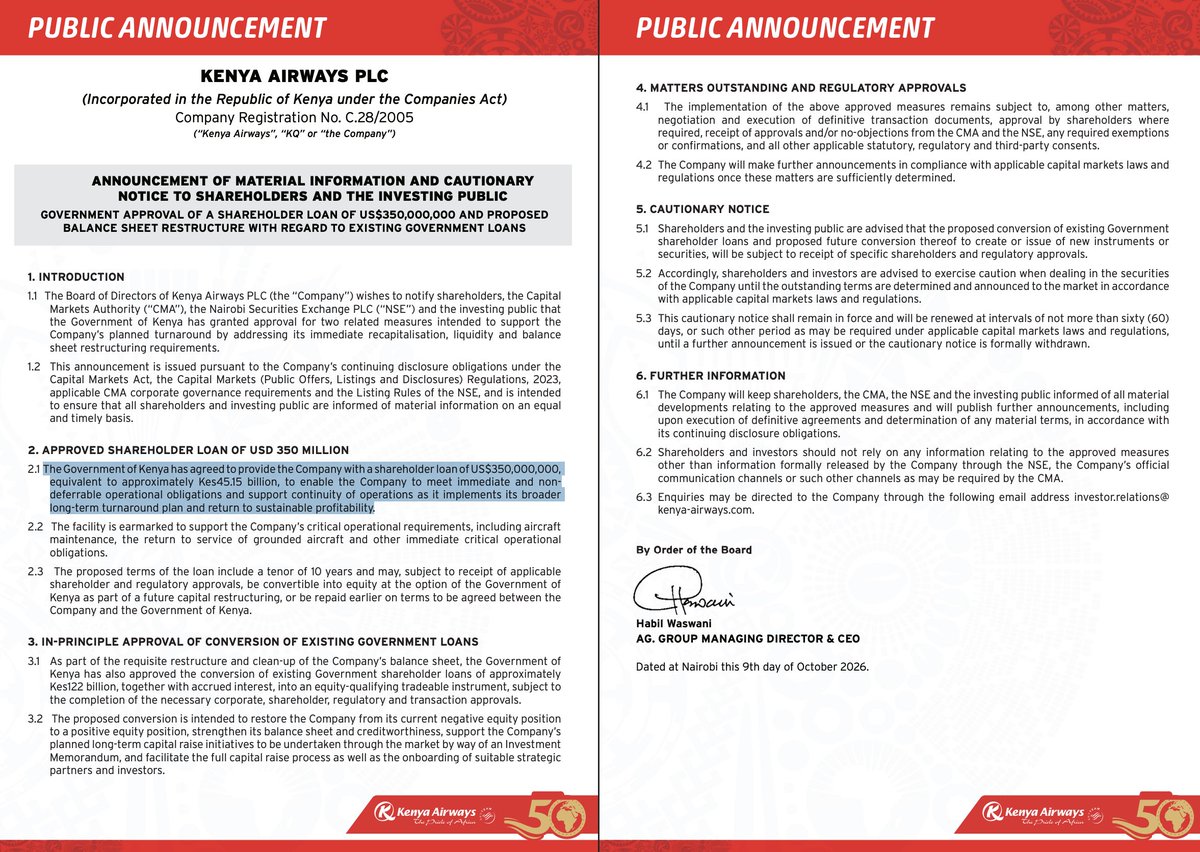
Following today's Cabinet approval, Kenya Airways has formally notified shareholders of the Government's approval of a $350M (~KES 45.15B) shareholder loan and proposed conversion of ~KES 122B in existing Government loans, plus accrued interest, into an equity-qualifying tradable instrument:
— The $350M facility has a proposed 10-year tenor, with an option for conversion into equity or earlier repayment.
— The KES 122B restructuring aims to reverse the airline's negative equity position, strengthen creditworthiness, and facilitate future capital raising.
— Kenya Airways intends to pursue additional market financing and attract strategic investors following the restructuring.
— The measures could materially improve solvency and liquidity, but potential equity conversion raises dilution risks for existing shareholders and increases the Government's exposure to the airline.
—Implementation remains subject to shareholder and regulatory approvals, with final transaction terms yet to be determined.
The IMF now says Kenya could raise more tax revenue without new taxes by improving KRA’s tax administration.
This includes registration, filing, payment and refunds, with stronger tax administration linked to 1.7% of GDP more in revenue.
Suspected criminals explain how they allegedly use scopolamine, commonly known as “Devil’s Breath,” a drug that can cause confusion and memory impairment.
They claim they conceal the substance under their fingernails and use physical contact, such as a handshake, to expose their targets. They allege that victims may then become confused and hand over valuables.
According to their claims, they mainly target electronics and M-Pesa shops. Several similar incidents have reportedly been raised as concerns.