Dear @CMOTamilnadu, when we approached @tnhrcedept over the AC's cancellation of centuries old Yali vahana procession of Kanchi Devarajaswamy Temple, it was stated that the order came from @RameshOffcl. How can a minister of a secular government interfere in a religious ritual?
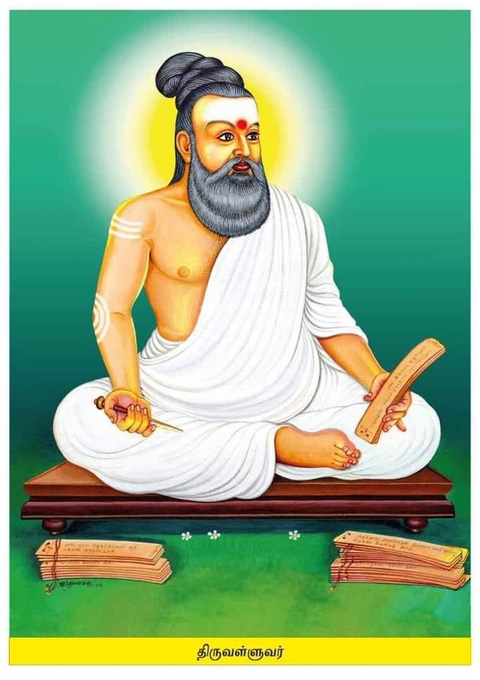
திருவள்ளுவருடைய குறள் முழுவதும் நிரம்பிக்கிடப்பது ஹிந்து மதமான சனாதனத்தின் கருத்துகள்தான். அதனால்தான் அது உலகப்பொதுமறையாக இருக்கிறது. உதாரணமாக,
கோளில் பொறியின் குணமிலவே எண்குணத்தான்
தாளை வணங்காத் தலை
இதில் சொல்லப்படும் எண்குணம், அஷ்டகுணங்கள் என்று ஹிந்துமத நூல்களில் குறிப்பிடப்படும் தன்மைகளே ஆகும். இதைத்தான் பரிமேலழகர்
சைவ ஆகமத்தில் கூறப்பட்ட எண்வகைப்பட்ட குணங்களான தன்வயத்தன் ஆதல், தூய உடம்பினன் ஆதல், இயற்கை உணர்வினன் ஆதல், முற்றும் உணர்தல், இயல்பாகவே பாசங்களின் நீங்குதல், பேர்-அருள் உடைமை, முடிவில் ஆற்றல் உடைமை, வரம்பு இல் இன்பம் உடைமை என்பன இவை என்கிறார்.
அப்பர் பெருமானும் தன் தேவாரத்தில்
பண்குணத்தார் பாடலோ டாட லோவாப்
பரங்குன்றம் மேய பரமர் போலும்
எண்குணத்தார் எண்ணா யிரவர் போலும்
இடைமருது மேவிய ஈச னாரே.
என்று எண்குணத்தை உடையவனாக சிவனையே பாடுகிறார்.
இந்திரன், திருமகள், உலகளந்த பெருமாள் என்று ஹிந்துக்கடவுள்களைப் பற்றித்தான் திருவள்ளுவர் குறிப்பிடுகிறார்.
ஆகவே அவருடைய ஹிந்து மத அடையாளங்களைச் சுருக்குவதுதான் தவறான ஒன்று.
This 4,500-year-old terracotta dice from the Indus-Saraswati Civilization is a powerful reminder of India’s living heritage. Dicing is also mentioned as a popular game in Rig and Atharva Vedas (two of the four sacred Vedic scriptures).
From symbols and craftsmanship to rituals, yogic practices, and collective memory, numerous elements of ancient Indian civilization continue to thrive in the daily social and religious life of Indian society across regions and communities.
Civilizational inheritance is not just about geography or ruins, it is defined by living customs, symbols, rituals, and unbroken cultural consciousness. India is the enduring living continuity of the Indus-Saraswati Civilization.
#IndusSaraswatiCivilization #AncientIndianHeritage
Today is a historic day in the history of Tamilakam. Vaikasi 17 marks the day when Namperumal of Srirangam returned to His divine abode after 48 years, following the destruction of the Srirangam temple.
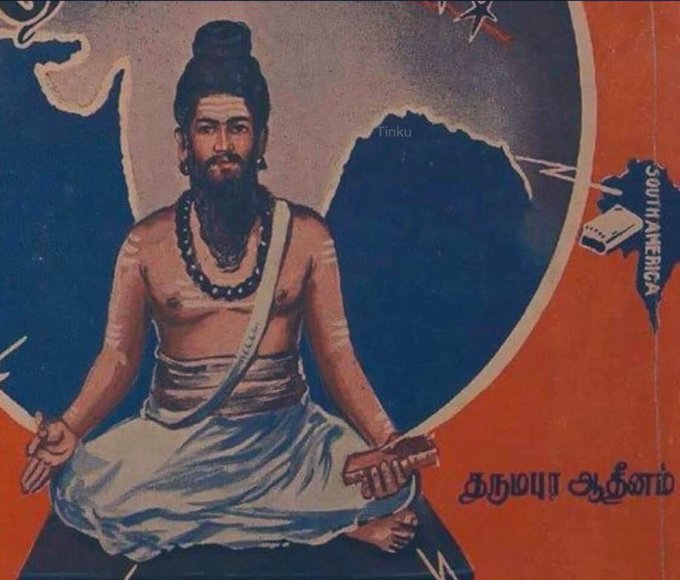
மயிலாப்பூர் திருவள்ளுவர் திருக்கோவில் இந்துசமய அறநிலையத்துறையின் கீழ் இயங்குகிறது என்பதும், திருவள்ளுவ நாயனார் 63 நாயன்மார்களில் ஒருவர் என்பதும், மாண்புமிகு அமைச்சர் அவர்களுக்குத் தெரிந்திருக்கும் என்று நம்புகிறோம்.
The Ṛgveda doesn’t show an “incoming Aryan migration or invasion.”🔥
Instrad it records a steady westward expansion out of India.🔥
Look carefully at the geographical sequence embedded inside the Ṛgveda itself!
– Maṇḍala 6 (3300 BCE) with these rivers mentioned Ganga–Yavyavati–Sarasvati. This is Western UP and Haryana.
– Maṇḍala 3: Vipas (Beas) & Sutudri (Sutlej). This is Indian Punjab.
– Maṇḍala 7: Parushni (Ravi) & Asikni (Chenab). This is Greater Punjab in Pakistan.
– Maṇḍala 4: Vibali (Jhelum), Sarayu (Haro), Sindhu (Indus). This is Greater Punjab upto Indus.
– Maṇḍala 5: Kubha (Kabul River, Afghanistan). This is Pakistan beyond Indus and reaching Afghanistan.🔥
It is a clear directional movement towards north west.
From Ganga–Yamuna–Sarasvati heartland, migration is moving steadily westward, reaching Afghanistan by the 5th Maṇḍala.
And the chronological order of Maṇḍalas confirms this progression:
6 → 3 → 7 → 4 → 2 → 5 → 1 → 8 → 9 → 10
Now connect this with Iranian tradition.
The Vendidad lists 16 homelands of the Ahuras which has the following:-
– Four cornered Varena – identified with four-cornered Vara Prithivya = Four cornered Kurukṣetra (Haryana)
– Hapta Hendu – Sapta Sindhu (Greater Punjab)
Later they have Afghanistan mentioned as Vaekiratha.
This is explosive.
The earliest Avestan memory places proto-Iranians inside India, not Iran. Their later memory places them in Afghanistan, still not Iran.
Then comes the historical trigger:-
The Dasarajna Battle (7.18), dated to ~3065 BCE, resulting into the defeated people of kings like Cayamana fleeing westward from the Parushni (Ravi).
This is migration in motion.
Put it all together, the Ṛgvedic geography shows westward expansion (3300–1900 BCE). The Avestan texts remember origins in Haryana (Varena) and Greater Punjab (Sapta Sindhu).
Historical events like Dasarajna record actual westward displacement.
We can conclude, India is not the endpoint of Indo-European migration. It is the starting point.
The rivers of the Ṛgveda are not just geography.
They are a migration map written in poetry.🔥
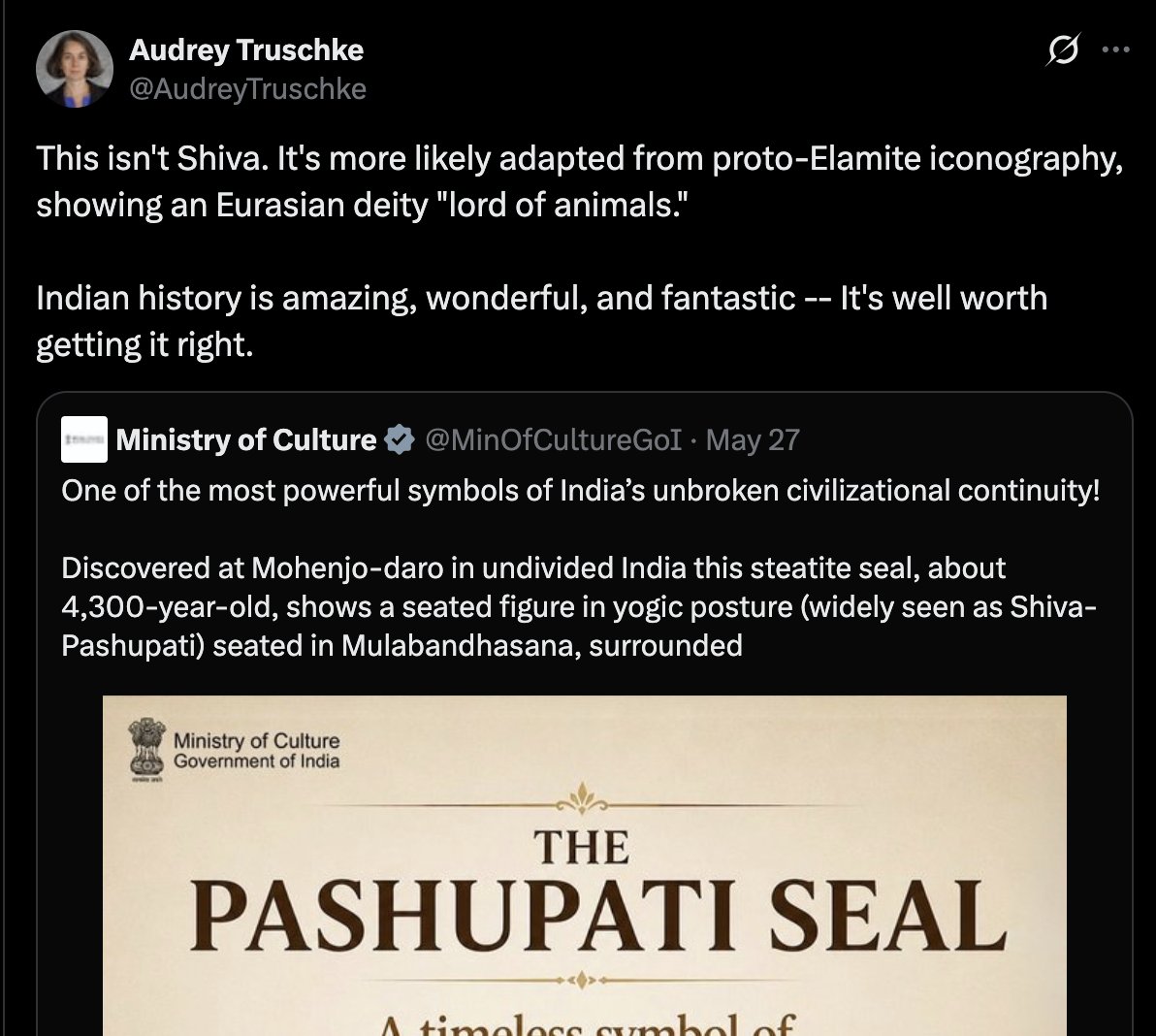
If Audrey is explicitly brandishing the 1984 Unhinging Śiva paper to claim that objective science has permanently disconnected the Pashupati seal from any indigenous Indian/Shaivite continuity, she is relying on her audience not knowing the massive logical self-goals & internal biases built directly into Srinivasan's 1984 text.
What Truschke will never tell about the 1984 paper is that despite trying her best to "unhinge" Shiva, Srinivasan is physically forced to concede the uniquely Indian, meditative nature of the posture.
In the text, Srinivasan explicitly writes: "It may therefore be inferred that the 'yoga' posture is emblematic of divinity..."
Think about the massive corner she paints herself into. She admits that the figure is sitting in a distinct, ritualistic, joint-locking yogic position & she admits this posture indicates divinity. Yet, she & Truschke try to frame the seal as a generic/secular/entirely foreign "Eurasian Lord of Animals."
No Eurasian/Elamite "Lord of Animals" across the entire ancient world, from the steppes of Russia to the deserts of Iran is ever depicted performing a complex, multi-joint-locking yogic asana. By admitting the posture is yogic, Srinivasan’s own 1984 paper inadvertently proves that the seal represents an indigenous, highly advanced South Asian spiritual tradition that predates Western contact.
Because of the "Break the Continuity" doctrine. If they admit that Seal 420 represents an early, ancestral form of yogic/Shaivite divinity, they are forced to admit that Hinduism has an unbroken, indigenous civilizational continuity stretching back 1000s of yrs on the Indian subcontinent.
To prevent that admission, they weaponize 40 yr old papers, play semantic games with the definitions of "wild vs. domestic animals" & try to convince the public that a figure practicing yoga in a subcontinent jungle is somehow a foreign import from Iran. Using the very text of her 1984 paper shows they are twisting the data to fit a predetermined ideological narrative.
The seal creators, the ancient Indians, were much smarter than these fake professors.
They put a Rhino, an Elephant, and a Tiger together on the seal along with a Yoga pose to ensure it is not appropriated by such charlatans saying it is from Elam (Iran) or the West or China.
These charlatans work in universities under the funding from the GLISCO-DS, the Globalists, Islamists, and Communists. You know the countries.
All three groups are on a mission to appropriate everything Indian and making them Western, Islamic, or Chinese to bankrupt India of its civilization and make Indians gullible to them.
Now see them invent reasons in their universities, publish papers, and tell Indians how Iran had Tigers, Elephants, and Rhinos. And how all three came to India from Europe, Arabia, and China.
Sadly, many young Indians will believe them too and fight with you for them saying there's no deep state or agenda here. This is because of the state's apathy in allowing its young generation to be programmed by social media.
Finnish scientists trucked in real forest dirt and grass and laid it over the gravel at four daycare yards. They let the kids dig around in it for a month. The blood tests came back with changes the researchers hadn’t expected to see so fast or so clear.
The study ran at ten daycares in two Finnish cities with 75 kids aged three to five. Four of the yards got the forest treatment: about a tennis court worth of soil and grass laid over the gravel, plus planters and peat blocks the kids could dig and climb on. Three others stuck with their normal gravel yards. The last three were daycares where the kids were already visiting real forests every day.
After one month, the variety of bacteria living on the kids’ skin shot up, and the kind that helps train the skin’s immune defenses jumped the most. Their gut bacteria started to look like the gut bacteria of the forest-visiting kids. Their blood showed more of the immune cells whose job is to keep the body from freaking out at harmless stuff like pollen and peanuts, and overall inflammation dropped. The kids on the plain gravel yards showed none of this.
Childhood asthma in the US doubled between 1980 and 1995. Food allergies in kids jumped 50 percent between 1997 and 2011, then jumped another 50 percent between 2007 and 2021. And peanut allergies in one-year-olds tripled between 2001 and 2017.
The Finnish researchers think one of the reasons is simple: kids today don’t get dirty enough. 37 percent of American preschoolers now spend an hour or less outside on a normal weekday. Their immune systems are getting trained in environments stripped of the bacteria humans have always lived around.
Aki Sinkkonen, who led the study, put it in plain words: “It would be best if children could play in puddles and everyone could dig organic soil.” The Finnish government is now helping pay for daycares across the country to make the same changes.
When I first learned that the proofreading symbol commonly known as carat, an inverted V that we use for adding words in sentences actually came from Sanskrit, I was astounded! In Mrichhakatikam, a Sanskrit play written over 2000 years ago, the villain Shakaara rudely uses the word Kakapada to insult someone’s marking on the forehead. Our teacher Sarvesh Tiwari casually remarked that it is the same symbol we use today. How many more gems am I going to find in Sanskrit language?
1987. A room in New Delhi is thick with the smell of old files & cold tea. The United States has just delivered a stinging slap to the face of the Indian Republic. They have officially refused to sell India the 'Cray X-MP' Supercomputer, the most powerful machine on Earth, claiming that India would use it for nuclear weapons.
The American officials mockingly suggest that India does not even have the electricity to keep such a machine running. In the middle of this national humiliation, a young, soft-spoken engineer named Vijay Bhatkar is asked by then Prime Minister Rajiv Gandhi: "Can we build our own?" Bhatkar does not hesitate. He looks at the No of the West & says: "We will not just build it; we will build it faster than you can ship it."
The Americans did not just stop at refusing the sale; they actively lobbied other nations to ensure India remained digitally blind. They believed that w/o their Logic Gates, India would remain a 3rd world backwater.
Bhatkar realized he could not replicate the Single-Processor behemoth of the Cray. Instead, he turned to Parallel Processing. He decided to stitch together 1000s of low-cost, off-the-shelf microprocessors. It was like building a giant's brain out of the neurons of ants.
In 1991, while the West was still celebrating its monopoly, Bhatkar unveiled the PARAM 8000. It was not just a computer; it was a Gigaflop monster.
To prove the PARAM was real, Bhatkar ran a standard global benchmark test. The results were sent to an international conference in Zurich. The PARAM 8000 was ranked as the 2nd most powerful supercomputer in the world, behind only the American machines. But there was a twist: the PARAM cost a fraction of the Cray, performed better in tropical heat, & was built in just 3 years.
When the PARAM 8000 was 1st turned on, the team did not have a high-tech cooling system like the Americans. They used industrial-grade desert coolers & adjusted the airflow manually. It was the ultimate Jugaad that defeated the most sophisticated tech embargo in history.
A major US newspaper ran a story with the headline: "Denied supercomputer, Angry India does it!" The ghost of the Native Engineer had officially entered the silicon temple. Vijay Bhatkar’s history is the story of how India became the IT Capital of the world.
Bhatkar founded the Centre for Development of Advanced Computing (C-DAC). He did not just build a machine; he built an ecosystem. Every software engineer in India today stands on the shoulders of the man who proved we did not need the West's permission to compute. Bhatkar was the 1 who realized that if computers only spoke English, 90% of India would be left behind. He led the development of GIST (Graphics & Intelligence Based Script Technology), allowing computers to work in Indian languages. He gave the Machine a local tongue.
Today, Bhatkar is a Padma Bhushan awardee, but he lives a life of deep spirituality & simplicity. He vanished from the corporate headlines to become a philosopher of the digital age.
The West thought they could freeze India’s future by withholding a single machine. They forgot that the Indian mind does not need a 'Cray' to think; it only needs a 'No' to ignite. Forget building a supercomputer; Bhatkar built a mirror, & for the 1st time, the West had to look into it & see that the primitive colony had become the master of the code.
Absolute rot. Sanatana is a Sanskrit word and it cannot have one meaning in Sanskrit and another meaning in Tamil. You're not even in the alliance anymore. Condemn it and move on instead of gaslighting everyone.
Sir,
Contempt Petition against @Udhaystalin is already filed and pending in the Supreme Court for hearing on 19.05.2026.
The Supreme Court had on 04.03.2024 strongly reprimanded him for his hate speech against Sanatana Dharma, and also passed orders that no further FIRs will be registered against him for the 2023 hate speech.
Even the Madras High Court had categorically held that his statement is clear hate speech against the Hindu community.
Yet, with sheer audacity, he has repeated the exact same offending statement on 12.05.2026 inside the Tamil Nadu Legislative Assembly, fully knowing it would get protection under Article 194(2).
This clearly shows that he has no regard for the Apex Court’s proceedings and observations and further demonstrates that he is full of hatred.
We are bringing his conduct to the knowledge of the Hon’ble Supreme Court of India by filing an application to bring all the relevant documents, including news articles about his hate speech in the Assembly on record.
We are actively pursuing the matter.
Regards,
A Stanford computer science professor has been teaching the same software design class for more than a decade, and every quarter the seats fill faster than almost any other course in the department.
Students from Google, Meta, and Apple sneak back onto campus to audit it. Most of them have been writing code professionally for years.
I read the book that came out of the class in a week and walked away seeing every codebase I had ever worked on through completely different eyes.
His name is John Ousterhout. The book is called A Philosophy of Software Design.
Almost everyone in tech eventually hits the same wall. You learn to code. You get good at it. You ship features. 6 months in, you cannot find anything in your own codebase. 12 months in, you are afraid to change things. 2 years in, you start wondering if the problem is you, because everyone around you seems to be drowning at exactly the same depth and nobody is willing to admit it.
Ousterhout's argument is that the problem is not you. The problem is that nobody ever taught you what software was supposed to look like.
Here is the story almost nobody tells you.
Ousterhout was already a legend before he became a teacher. He invented the Tcl programming language, which has been used inside everything from Cisco routers to NASA spacecraft. He built systems companies. He served as a senior fellow at Electric Cloud and as VP of research at Sun Microsystems. By any normal measure he had earned the right to coast.
He went back to Stanford instead.
The reason he gave in interviews is the part that should make every senior engineer pay attention. He said almost every brilliant engineer he had hired in 30 years of running teams had the same gap. They could implement anything. They could solve any algorithmic problem. They could ship code that compiled, ran, and passed tests. And then 6 months later their own code would start to suffocate them, and they had no idea why.
Nobody had ever taught them what good software was supposed to feel like to maintain. Universities taught data structures and algorithms. Bootcamps taught syntax and frameworks. Companies taught company processes.
But the actual craft of designing software so that you would not hate yourself in two years was being passed down by accident, in code reviews, by the few senior engineers who had figured it out the hard way.
Ousterhout decided to teach it on purpose.
He built a class called CS 190 at Stanford, A Philosophy of Software Design.
The structure of the class was unusual. Students did not just write code. They wrote code, threw it away, and rewrote it from scratch after detailed feedback. Sometimes 3 rewrites per assignment. The point was not to ship a project. The point was to feel, in your own hands, the difference between a system designed well and a system designed badly. Most students had never felt the difference before. After the class, they could not stop seeing it.
He turned the lectures into a small book. It is around 190 pages. The first edition came out in 2018. It costs less than a textbook. It has quietly become one of the most-shared engineering books inside senior teams at Google, Meta, Stripe, OpenAI, and Anthropic. Senior engineers buy copies for their juniors. Tech leads send specific chapters to their teams during code reviews.
The argument inside the book is brutally simple.
Complexity is the enemy. Not bugs. Not slow performance. Not missed deadlines. Complexity.
A system too complex to hold in your head is a system you will break by accident. You will not know which line broke it. You will fix the symptom and miss the cause. Over time, complexity compounds. The codebase becomes a place engineers fear to touch. New features take longer. Old features break for unrelated reasons. Eventually the team starts whispering about a rewrite. The rewrite usually fails for the same reasons the original did.
Ousterhout argues that complexity comes from two sources. Dependencies, which are pieces of the system that affect each other across boundaries. And obscurity, which is information about the system that you cannot see from where you are reading. Reduce one, you almost always reduce the other.
The deepest insight in the book is about what good modules actually look like.
Most engineers are taught to build small, simple modules with lots of small, simple methods. Ousterhout calls these shallow modules and he says they are the disease, not the cure. A shallow module has a small interface and an even smaller body. The interface barely hides anything. To use the module, you have to understand almost everything inside it. Building software out of shallow modules creates the illusion of organization while the actual complexity stays exposed.
Good modules are deep. A deep module has a small interface that hides a large amount of functionality inside. You use the module without understanding how it works internally. The interface gives you exactly what you need and nothing else. The complexity is contained. Files have file names, sizes, modification dates. You read and write them. You do not need to know about disk sectors, file allocation tables, or buffering strategies. The Unix file system is a deep module. Most modern abstractions are not.
This is the part of the book that makes engineers stop reading and look at their own code with horror.
Most production codebases are full of shallow modules disguised as good engineering. Tiny classes. Tiny functions. Long parameter lists. Wrapper layers that wrap other wrapper layers. Every layer leaks information about the layer below it. Every interface forces the caller to understand internals. Engineers wrote it that way because they thought small was good. Ousterhout argues that small is not good. Hidden complexity is good. The module should be doing a lot. The interface should be revealing very little.
The second insight that landed hardest for me was about comments.
Most engineers are taught that good code does not need comments. The code should be self-documenting. Variable names should be descriptive. Functions should be small enough to read top to bottom. Comments are a sign of failure.
Ousterhout argues this is wrong, and that the people who say it have never actually maintained a large system over many years.
Comments are not a failure of the code. Comments are how you write down the things the code cannot say. Why a particular approach was chosen. Why a tempting alternative was rejected. What invariants the function depends on. What the caller is supposed to know. None of these things can be expressed in code itself. If a future reader has to read every line of your function to understand what it is doing, you have not finished writing it. The job is not done when the tests pass. The job is done when the next engineer can pick up the file and understand it without asking you a question.
The third insight is the one that hit me hardest, because it is the one almost no engineer is taught to think about until it is too late.
Strategic versus tactical programming.
Most engineers are taught to be tactical. You get a task. You finish the task. You move on. You take the shortest path between the current state of the codebase and the new feature. Each individual decision is reasonable. The combined effect, over years, is a codebase that has been hacked into shape by hundreds of small reasonable decisions, none of which made the system better as a whole.
Strategic programming is the discipline of asking, every time you make a change, whether the change is leaving the system better than you found it. Sometimes the smallest task should pay for a refactor that makes the next ten tasks easier. Sometimes the right move is to pause for an hour and redesign the abstraction before you add the feature. Tactical programmers always feel like they are moving fast. Strategic programmers actually move fast. The difference becomes obvious around the two-year mark.
Ousterhout's rule is the one I think about almost every day now. The best engineers do not write code faster than bad engineers. They delete code faster. Every line you add to a system is a permanent tax on every future reader. Most of the job of being a senior engineer is deciding what not to write.
The book is short. Around 190 pages. You can finish it in a weekend.
Reading it once will not make you a better engineer. Reading it twice, then watching yourself catch your own bad habits in real time, then forcing yourself to redesign one module per week using its principles, will measurably change how you write software in less than a year.
Almost every engineering team I admire has at least one person who has read this book carefully and has been quietly nudging the rest of the team toward what it teaches. Most teams that do not have someone like this end up rewriting the same system every two years and never understanding why.
Ousterhout is still teaching the class at Stanford. The course site is public. The book is around twenty dollars.
The single most useful book about how to actually design software is sitting one click away from you. Most engineers will spend a decade learning the hard way what 190 pages would have taught them in a weekend.
In 1920, the British soap giants (Lever Brothers) had a problem. They could make us smell like a rose, but they could not survive the Indian skin. The heat, the rashes, & the tropical infections were the enemies of the Empire. K.C. Das (I will write about him separately) & the scientists at Calcutta Chemical did not try to mask the heat; they weaponized it. They created Margo... a soap that did not just wash us; it immunized us.
The British scientists had tried for yrs to make a Neem soap. They failed. Because Neem oil is notoriously difficult to saponify (turn into soap) w/o losing its medicinal properties/smelling like rotting onions. The Indian chemists used a secret cold-process method. They managed to keep the azadirachtin (the active bug killer in Neem) alive in the bar.
When people used Margo, they were not just smelling herbal. They were coating their body in a biological shield. During the massive cholera & smallpox outbreaks in the early 20th century, the Margo smell became the scent of the survivor. It was the only soap the British doctors could not find a flaw in, they were forced to use it themselves.
The British had a habit of patenting Latin names. Neem’s scientific name is Azadirachta indica, but it was also called Margosa. K.C. Das shortened it to Margo to make it sound modern, crisp, & international, tricking the British-educated elite into buying a peasant's remedy disguised as a high-end luxury brand.
It was the 1st time an Indian brand sold Ugliness as Honesty. The green color became a silent code for Swadeshi (Made in India). If a British officer saw a Margo bar in our house, he knew he was in the home of some1 who trusted the soil more than the Crown's chemicals.
The British tried to replicate Margo by creating Neem-scented soaps back in Manchester. They could not get the bite. Margo used pure Neem oil extracted from trees in the Bengal heartland. The British eventually started buying Margo in bulk for their Army Canteens because the White Soaps were causing skin rot in the humid trenches of the North-East & Burma.
The British Empire which claimed to civilize India was literally being kept from rotting away by a green bar of soap made by the very subjects they were trying to rule. Every bar of Margo sold helped fund the Swadeshi spirit. The profits were used to train Indian chemists so that India would never have to depend on a British laboratory again.
Margo got into the most intimate parts of an Indian's life, their morning bath, & reminded them every single day through that sharp, bitter scent: "You belong to this land." Margo was the 1st brand to realize that "Bitter is Better." While the British were selling the dream of being European (the scent of roses), Margo was selling the reality of being Indian (the scent of Neem).
Today, we see Neem extracts in every global skincare brand from L'Oréal to Body Shop. They are all chasing a ghost created in a Calcutta lab in 1920. They are trying to sell us the Green Revolution, but Margo was the 1 that fought the War of the Skin when it actually mattered.