hedge funds have been running this math for 30 years. retail just discovered fibonacci retracements
andrei markov was a russian linguist studying letter sequences in 1906 - had nothing to do with markets
renaissance found his paper 70 years later, built medallion around it, told nobody
markets don't move randomly - they move in states
trending, ranging, reversing - each state has a fixed historical probability of shifting to the next
you don't predict direction. you identify which state you're in, then let probability do the rest
build a transition matrix from 10 years of price data:
trending -> stays trending 68% of the time, flips to range 21%, reverses 11%
ranging -> holds 54%, breaks up 28%, breaks down 18%
now you're not guessing - you're entering on 68% historical completion
size with kelly criterion based on that probability. take the trade when math says yes
"where is price going?" -> random
"what state am i in right now?" -> has an answer
paper is free, data is free, python to build this: 200 lines
37 years, zero losing years - that's what medallion looks like when you ask the right question
they kept you drawing fibonacci lines while they ran probability tables
Bookmark this and run the matrix yourself
Claude is now controlling TradingView live from my terminal.
Switching symbols. Writing Pine Script. Batch scanning futures. Replay trading. Drawing levels.
All autonomous. Zero clicks.
Still has rough edges but the vision is crystal clear.
I told it:
Find me every BTC futures contract with RSI below 30 and volume spike above 200%.
14 seconds later:
→ 6 contracts identified
→ Charts loaded
→ Support levels drawn
→ Pine Script backtests running
→ Entry zones marked
Didn't touch the mouse once.
Then I said:
Replay last week. Show me where your system would have entered.
It switched to replay mode. Scrolled through price action. Marked every edge. Calculated P&L in real-time.
$4,780 theoretical profit from 9 trades.
83% win rate.
Now it writes custom Pine indicators on command:
Build me a momentum oscillator that tracks whale wallet activity correlated with price.
40 seconds. Script deployed. Indicator live on chart.
Most traders are still clicking through 50 charts manually.
Claude scans 200+ in under a minute.
Finds the setups. Draws the levels. Backtests the edge. All while you watch.
This is not about replacing your strategy.
It's about executing it 100x faster.
You only need Claude + laptop + 1 hour/day.
Giving This Free for 24 hours. To get it:
1. Comment the word CLAUDE
2. Like and Retweet this post
3. Follow me @codewithimanshu (so i can DM you)
Save this post. Deploy this setup this weekend. Start testing. Scale on evidence.
This week try one thing:
• Trade #EURUSD only.
• Draw FRVP from 5pm to 1am UTC-4
• Trade only between 1 to 4am
• Fixed target 🎯 of 1:3RR.
• You can trade both Breakout Acceptance and Failed Auction Model.
Thank me later.
The NQ Midas Model:
The Model I used to pass over $1,000,000 in fundeds
Like + Repost + Comment "NQ" to receive the full Video Breakdown
(Must be 𝙛𝙤𝙡𝙡𝙤𝙬𝙞𝙣𝙜 me so I can DM)
This is what a textbook A+ setup on NQ looks like.
The direction was already defined before the trade appeared.
Today, the London Probability Map showed a 73.5% probability for the more probable LOW.
So I was not interested in longs - SHORTS ONLY.
I only needed one clean SHORT confirmation:
• Sweep of liquidity
• Bearish iFVG
• Entry aligned with the statistically more probable direction
That is it.
Historical data and probabilities define the direction.
Price action gives the entry.
Trade entry + directional edge = A+ setup.
The attached video shows the full London session execution step by step.
How much simpler would your trading become if you stopped guessing the direction first?
Quant at Jane Street kills 97 out of every 100 strategies it builds. That body count is the edge.
Not the 3 survivors. The 97 corpses.
The faster you falsify garbage, the faster you reach the one idea that isn't.
Retail runs this backwards - finds one setup, gets emotionally married to it, and rides it down 40% over six months defending it like a religion.
Run the kill-loop yourself with Horizon -> https://t.co/pDDYFGfVga
Type an idea in plain English. Horizon parses it into entry/exit logic, position sizing, risk rules.
Backtests 5 years of tick data in ~12 seconds. Runs Monte Carlo across thousands of simulated paths.
Deflates Sharpe ratio for the number of trials so luck can't sneak through. Spits out a cold verdict: dead or alive.
Kill it. Type the next. 50 ideas before dinner.
That loop cost $25K/year and a quant desk. Now it's a sentence and 12 seconds.
The edge was never having ideas. It was murdering them at scale.
Save this. Test 50. Keep 2. Kill the rest without mercy
10 GitHub repositories so good they shouldn't be free.
1. TradingAgents
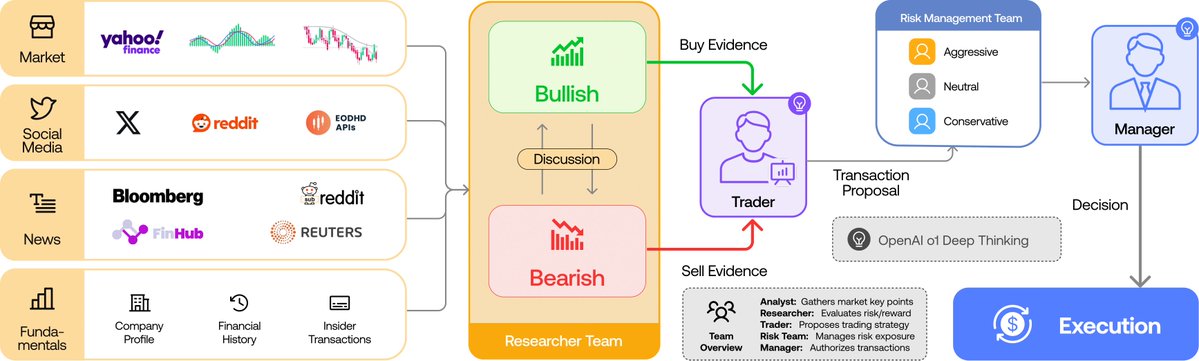
A full team of AI analysts that debates strategies and executes trades in real markets. 4 analysts in parallel: fundamental, sentiment, news, and technical. Then a risk manager and an executor agent. Like having a Wall Street team working 24 hours on your computer.
repo - https://t.co/UaRcwTBIih
2. LibreChat
ChatGPT, Claude, Gemini, DeepSeek, and 20 more models in a single interface. Self-hosted. Native MCP support. Your history, your infrastructure, your data. OpenAI charges $20 a month for its interface. Here you use your own keys and don't pay a dime extra.
repo - https://t.co/WhVNyHfE5Q
3. HyperFrames
HeyGen open-sourced its internal video engine. You write HTML. The agent renders MP4. No React, no JSX, no proprietary formats. GSAP, Lottie, and Three.js work out of the box. The same HTML always produces the same file. Used in production by HeyGen, tldraw, and TanStack.
repo - https://t.co/f7n0Aj2v39
4. Fincept Terminal
A Bloomberg terminal that runs on your laptop. CFA level 1, 2, and 3 analysis. Over 20 investor AI agents that reason like Buffett, Dalio, and Soros. Over 100 data connectors. Bloomberg charges $24,000 a year. This costs nothing.
repo - https://t.co/Y21MkkfIKR
5. MoneyPrinterTurbo
You input a keyword. Out come the script, images, subtitles, music, and final high-quality video. Horizontal or vertical. No manual editing. What content creators do that they don't want you to know they use AI for.
repo - https://t.co/IXuG9rMwzX
6. Agentic Inbox
Cloudflare just open-sourced an email client where an AI agent reads your inbox and drafts responses. 100% on Cloudflare Workers. Your email never leaves your account. No external servers. No subscription.
repo - https://t.co/N0UziIIroA
7. VoxCPM2
Clone any voice with 3 seconds of audio. 30 languages. Studio-quality 48kHz. Design voices from text: "deep male radio announcer voice." No paid API. No voice samples leaving your machine. ElevenLabs charges $22 a month.
repo - https://t.co/j1wPFr2CJo
8. Flowsint
You enter a domain. The tool deploys a graph with all IPs, subdomains, emails, crypto wallets, and connected social profiles. All stored locally. Without anyone knowing what you're investigating. For OSINT, due diligence, and competitor analysis.
repo - https://t.co/qcjGwwZ21Q
9. addyosmani/agent-skills
The Google engineer who's been teaching web performance to the entire industry for 15 years published his skills for Claude Code. 23 real workflows tested in production. API design, code review, debugging, CI/CD, and frontend. Installation with one command.
repo - https://t.co/jRjpYjd8Ph
10. Nango
The integrations layer that companies pay $50k a year to rent. 700 ready APIs: Salesforce, HubSpot, Slack, Gmail, Stripe, Jira, and more. Managed OAuth. Your AI agent generates integration code from a prompt. Used in production by Replit, Ramp, and Mercor.
repo - https://t.co/fuybcYXmhh
These aren't toys. Each one replaces a paid product that you're still being charged for.
Pick one. Install it. Connect it to your workflow.
100% free. 100% open source.
I've decided to teach my strategy completely for free
My IFVG model is currently sitting at a 77.98% win rate, and inside my course I break down exactly how I approach it step by step.
The model.
The framework.
The execution.
If you want it, retweet, like, and comment “Learn” and I’ll DM it to you.
(must be following to DM)
market opens at 9:30am
his trade was already in at 4am
neural net trained on 11 years of tick data called that setup 5 hours before candle even formed
he's not smarter than the market. just built something that reads patterns human eyes can't process fast enough
4,200 data points per second, 847,000 labeled historical setups, running on a $40/mo server
surfaces 3-4 trades a day. he takes top 2
last 90 days: 71% win rate, 2.3 avg risk/reward
while retail traders watch news at open, this system already decided before sunrise
you're not losing because your analysis is wrong
you're losing because you're competing with something that doesn't sleep, panic or second-guess itself
most people think this requires a PhD and a $2M quant desk
he built his whole setup for under $500 using a free dataset and 3 weeks of evenings
Bookmark this setup
edge was never hidden behind a paywall or locked inside a fund
it was sitting in a format nobody bothered to train on
The same thing that makes AI models smarter as they get bigger turns out to work on the stock market too.
A quant named Bryan Kelly just proved it, and it breaks the rule every trader is taught on day one.
He runs the machine learning group at AQR, a fund that manages more than $100 billion, so this is not a classroom idea.
For sixty years the rule held: keep your models simple.
The fewer parameters, the better, or you overfit and blow up out of sample.
Kelly does the opposite.
His market models carry about 30,000 parameters each, and the more he piles on, the better they predict returns.
He calls it the virtue of complexity.
Most of his own field still refuses to believe it. The biggest funds are already building on it.
It is the clearest hour I have found on why complex models keep beating simple ones.
Bookmark & watch it tonight, then see what the idea looks like built into an AI fund in the article below.
Bill Perkins went from a nobody to running his own hedge fund.
He started on the exchange floor as a clerk's trainee in 1991. Bad grades, cut from the football team, an electrical engineering degree.
Today he runs a 500 million dollar energy hedge fund. And plays poker at a professional level on the side.
He was once fired from his own friend's fund. He once came close to going to zero.
WSJ asks him about the strategy he calls the
lazy guy strategy.
HRT, one of the largest quantitative trading firms in the world, just revealed the scale of their AI operation.
"two of the biggest ingredients you need to build deep learning models are compute and data. HRT has both in incredible orders of magnitude."
"we have vast quantities of data, on the order of petabytes, just in terms of raw tick data we've written down since the beginning of electronic trading."
"we have a very high compute-per-researcher ratio."
then the line that puts it in perspective:
"there probably aren't too many places on Earth you can do cutting-edge deep learning research at the level we do it, just because of how few places have access to as much compute."
"it's basically the hyperscalers of the world and then we're in the next tranche."
a trading firm putting itself in the same compute tier as Google, Microsoft, and Meta. not for chatbots, for trading.