A potential customer put it perfectly today: "An ontology is basically a join in a relational database. The problem with SQL is every use case is a rewrite."
But AI won't build your entire enterprise ontology for you and you shouldn't want it to. Let AI build the first 70% from various forms of data. Your experts own the last 30% and that's where the differentiation is.
Vision on the belt is a strong demo. The harder question I hear from plant teams is what to do when a miss-sort isn't in the model: which procedure or inspection clip applies and is it still current? Graphon is the context layer for that: it answers from manuals, drawings, and video, cited to the exact page or moment, and can run on-device so data never leaves the floor.
The point about not coupling memory to a single model is what we hear from buyers every week. We built Graphon as a model-agnostic context and memory layer for that reason. Any model or agent gets answers cited to the exact page or video moment, with provenance and when it changed. Nothing is retrained, and it runs in your cloud or on-device.
Over a year ago, I left VC to build Graphon with @graphonfounder and @clarkzhango. Today we’re announcing our $35M Series A, six months after our seed.
Models keep getting smarter, but they still forget. Context and persistent intelligence is the core missing block in the AI infrastructure puzzle.
The benchmarks speak for themselves: #1 on ATM-Bench, 94% on LoCoMo and a new cost-accuracy frontier across 7 benchmarks. What I’m proudest of is what happens outside the benchmarks: enterprise customers running this in production, at 90%+ precision and a fraction of the cost.
Thank you to the customers, investors and team who believed early.
We are just getting started.
Try it: https://t.co/zpKJYgQou6
After years working on robot memory at @NASAJPL, @GoogleDeepMind , @Meta and @nvidia, @clarkzhango and I kept asking: why does AI still forget?
Today, with @deepakmishraVC, we’re announcing @GraphonAI and our $35M Series A just 6 months after our seed.
• #1 on ATM-Bench, ATM-Bench Hard
• 94% on LoCoMo
• 84% on DolphinBench, 10x cheaper
• A new cost-accuracy frontier across 7 benchmarks
https://t.co/8MkVOtVV0Y
SF Tech Week is on and Graphon got you covered ☕🚗
Free coffee pop-ups:
Tue, Dogpatch: https://t.co/KnUyAPgD4v
Thu, 51 Federal Street: https://t.co/FAHyVej8qE
Free rides to evening events, Mon-Fri: https://t.co/UBNkXriZDS
Come say hi 👋 #SFTechWeek@techweek@GraphonAI
I mapped an entire movie by mood for about 5 cents (Jev @typesafeai + @GraphonAI).
Moods like: Funny, Scary, Thrilling, Suspenseful etc.
Around 7,000 AI analyses for roughly $0.05 and 7 seconds.
The demo is pretty simple:
First, Graphon maps the movie.
We ask Graphon about 40 questions designed to cover what's happening throughout the video. Graphon returns descriptions of the scenes, along with citations to the exact moments in the movie.
We use those questions to build a picture of what's happening across the entire movie.
Then we send those scene descriptions to Jev from @TypeSafeai
Jev looks at each scene and judges the probability that it is funny, scary, suspenseful, exciting, calm, or whatever other categories we want to analyze.
That's where we do around 7,000 analyses in parallel.
The result is basically a mood map of the entire movie.
Now imagine you're a movie studio, video editor, or creator.
You could say:
“Show me every scary moment.”
“Find all the car chases.”
“Give me the funniest 30 seconds.”
“Create a compilation of the most suspenseful moments.”
And jump directly to those exact scenes.
Today, doing this at scale is surprisingly complicated. Someone has to watch, tag, classify, scrub through footage, and manually find all of these moments.
With Graphon + Jev, you can start doing it automatically.
And the crazy part?
Those ~7,000 mood analyses cost about 5 cents.
This is what I think multimodal search starts to look like when you combine understanding, citations, and reasoning across an entire video.
@CompleteSkeptic what do you think?
At Graphon, we believe intelligence lives in the connections, not the nodes.
So we are bringing the graph to the table.
We are hosting our first Engineering Leaders Dinner sponsored by J.P. Morgan with confirmed attendees from OpenAI, Anthropic, Harvey, Carta, Google, Hippocratic, Lucid Motors, Prime Intellect, Mercor and more.
We have a few seats left and if you are passionate about topics like context intelligence, memory, knowledge graphs, multimodal data and LLMs would love to have you join 👇
https://t.co/VkCgzWGSVU
#MultimodalAI #EngineeringLeaders #Agents #ContextIntelligence #Memory #Graphon
Five years in the making.
I spent five years evaluating data and AI companies before deciding to build one. The same ceiling kept showing up - capable models, solid retrieval, but unreliable results. Not because the models were bad. Because they destroy structure before reasoning even begins.
Most systems chunk data into tokens, embed them into vectors, and retrieve by similarity. By the time the model sees anything, the context is already broken.
So we built Graphon, a graph-native intelligence layer. Instead of flattening your data, we convert it into a graph that preserves structure across text, video, audio, and images. Then we compress it down to exactly what is relevant to your query so the model only ever sees a tiny, high-signal slice rather than a noisy pile of chunks.
The result is much better retrieval, cheaper reasoning, and far more accurate results. We are already deployed with some of the largest enterprises and AI-native companies in the world, and we are just getting started.
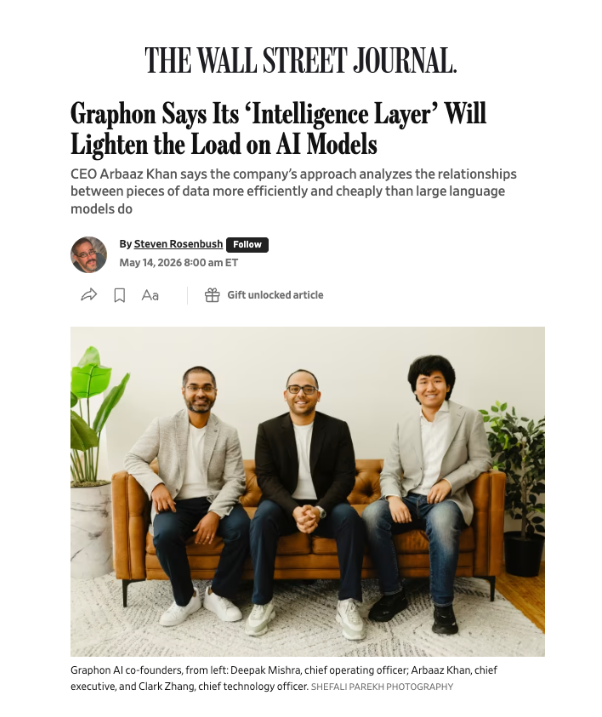
Read more in @WSJ [https://t.co/jjJ8fFn5R4]
Try Now: https://t.co/nbsekdxkj3
Graphon is out of stealth today. $8.3M in seed funding.
We’re building the pre-model intelligence layer — the layer that sits before your AI model and maps how data connects.
Every model has a ceiling on what it can process. Your data shouldn’t.
More in @WSJ: https://t.co/q92bgwrgww
Learn more: https://t.co/VAflaectYm