Building solidarity with the women-led revolution in Rojava / NE Syria. We demand political recognition for AANES and an end to Turkey's occupation. Join us!
Dear friends, please follow and stand with our friends at
@ScholarsRojava
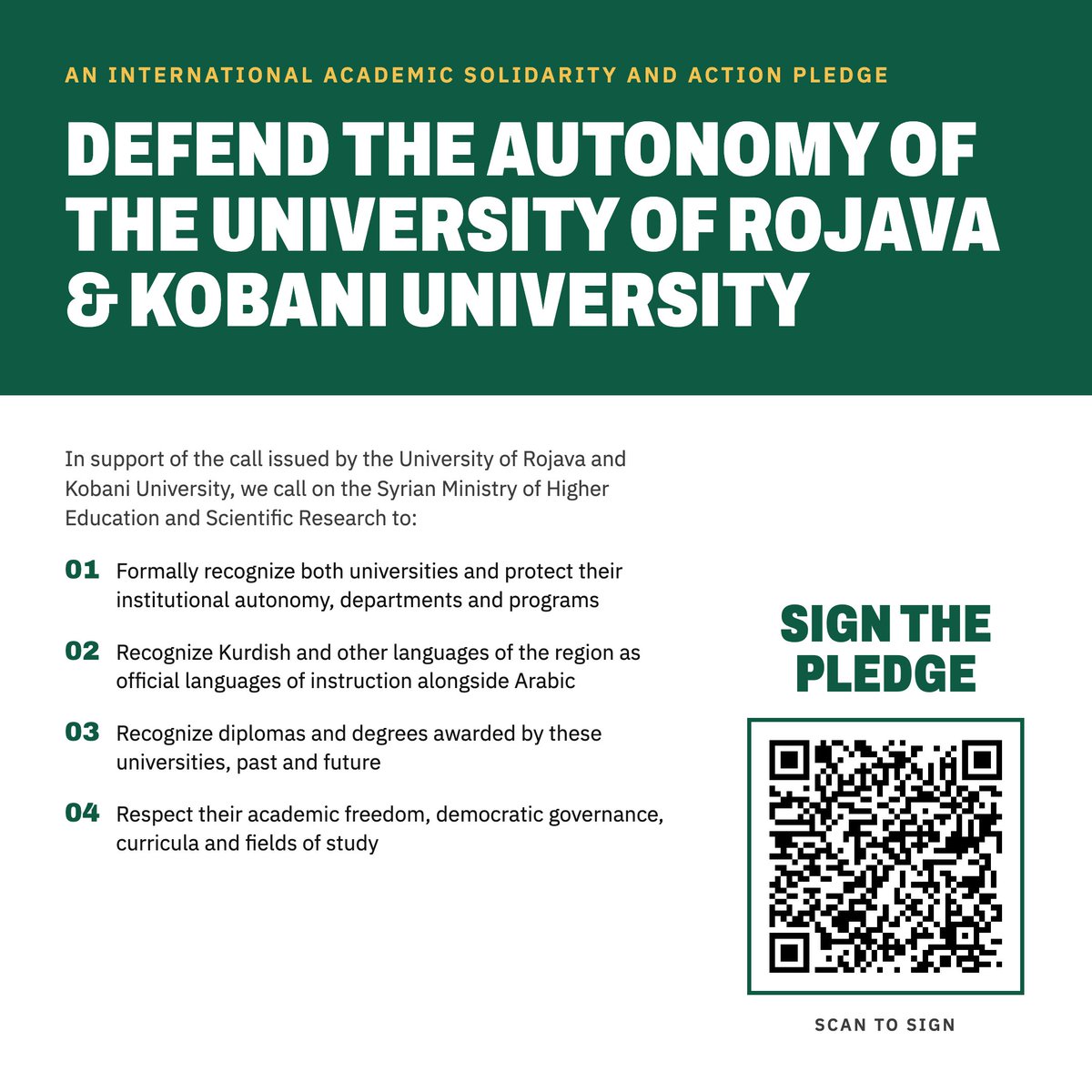
who are supporting Rojava and Kobani Universities as they seek institutional recognition during Syria's integration process.
Syria’s interim Ministry of Higher Education still does not recognize Rojava and Kobani Universities as institutions. Some programs received temporary recognition, but serious concerns remain about what “integration” will mean for their autonomy, and instruction in mother-tongue.
The Global Scholars’ Network for Rojava Universities has launched an International Academic Solidarity and Action Pledge to endorse University of Rojava and Kobanî University's demands and encourage concrete forms of academic support. Here is the link:
https://t.co/zR6GgzZWNL
It is URGENT!!! Universities in Rojava are under immense pressure from the Syrian state, which is seeking to take over the universities, change the language of instruction from Kurdish to Arabic, and much more. Please read their call for solidarity:
https://t.co/jcidkwhSD2
The Global Scholars’ Network for Rojava Universities has launched an International Academic Solidarity and Action Pledge to endorse University of Rojava and Kobanî University's demands and encourage concrete forms of academic support. Here is the link:
https://t.co/zR6GgzZWNL
🆕⁉️JUST IN🇸🇾 My latest dispatch from Syria explores how language barriers are shifting attitudes among Kurds and Arabs who face discrimination, creating empathy and opening minds in unexpected ways.
https://t.co/Fp3f4t205i
https://t.co/PPMCeaq7C9
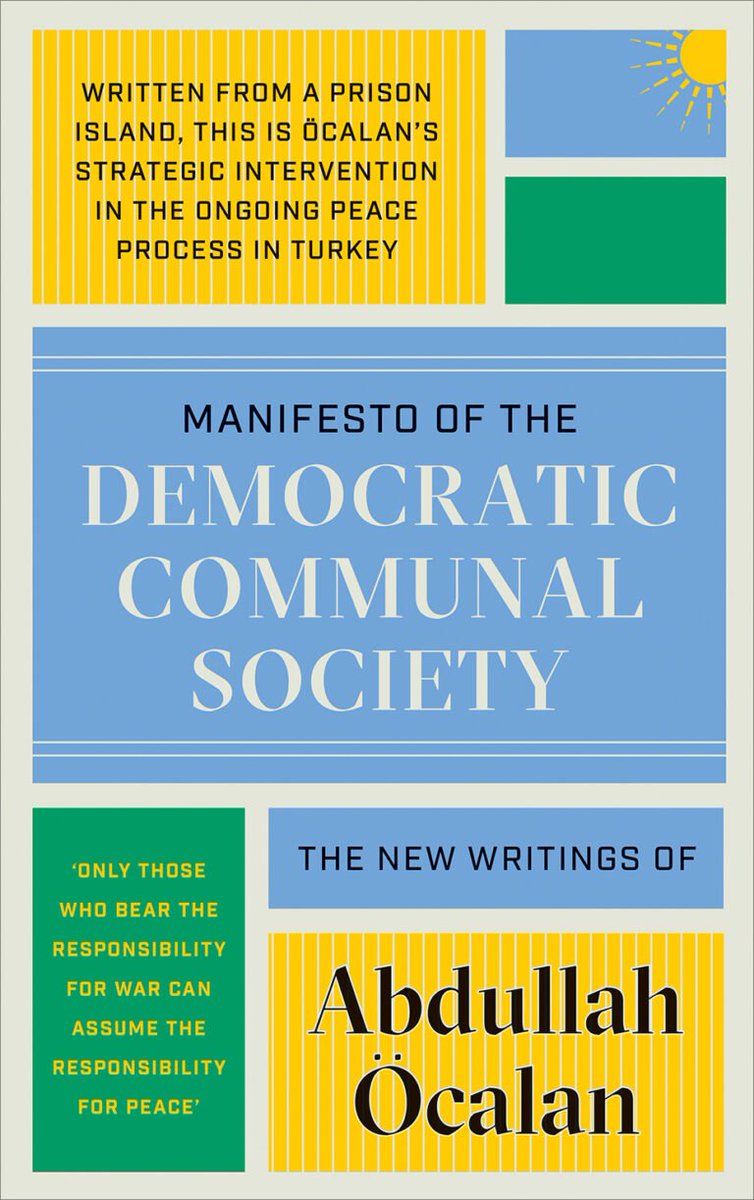
Manifesto of the Democratic Communal Society
The New Writings of Abdullah Öcalan
The book is now live on the Pluto website and ready for pre-order!
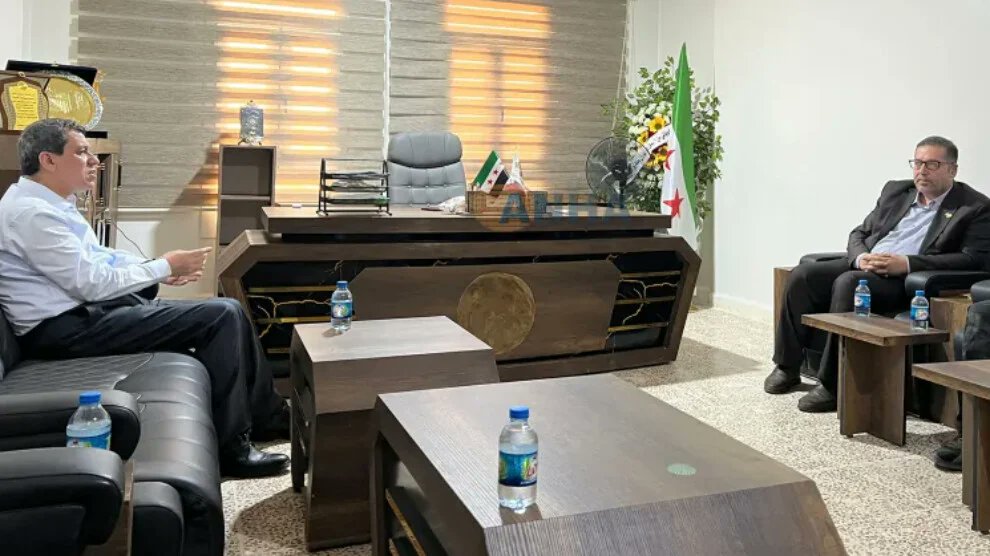
Syrian presidential adviser @MazloumAbdi met with Kobani Regional Director Îbrahîm Muslim at the directorate’s building to discuss the Kobani prison fire in which 9 died, 17 others were injured.
@MazloumAbdi said that an independent and transparent investigation should be launched and that those responsible should be held accountable - ANF
These developments show that many people feel:
- poorer,
- less secure, AND
- less politically and socially equal
than they were before the integration of the northeast into the central state.
That doesn't portend a stable future.
Iranian Kurdistan's political parties coalition reportedly calls for general strike Wednesday, September 16, marking fourth anniversary of Jina Mahsa Amini's death. Coalition urges citizens to close shops, stay home in protest of government policies.
Update from Kobani: I am told HTS-affiliated Syrian security forces from outside the region remain with at least 12 vehicles and are harassing residents and making arrests.
The U.S. and intl community must press them to leave to protect residents and allow funeral processions.
In this exclusive interview with The Amargi, journalist Irfan Aktan speaks with Ilham Ahmed about the future of Rojava, the integration process with Damascus, Kurdish rights, and the risks that Syria’s Kurds still face.
Read the full transcript here: ⬇️
https://t.co/OLv2rLD1mC
PKK wants the YBŞ to integrate into the Iraqi army and a Yezidi self-administration in Sinjar, but keep some form of command and control as a local defense force.
"Their self-defense forces want to integrate with the Iraqi army but also want to be a local defense force affiliated with the Iraqi army."
The new academic year began across Syria on Sunday, but many Kurdish students in the country’s northeast (Rojava) boycotted classes in protest against a recent government decision limiting Kurdish-language education to three hours a week.
READ MORE: https://t.co/EULIbulEwu
The Women's Protection Units (YPJ) has reached an initial understanding with the Syrian government to integrate the all-female force into the interior ministry as a special mission unit, a YPJ spokesperson said on Monday.
https://t.co/OdEBeaUxQx
Looking forward to this! Highly recommend watching Mazlum, a new Syrian presidential adviser, and former PKK militant/leader of the Kurd alliance with U.S. and the Rojava Revolution. It’s quite a transformation.
New on the SDF-Damascus integration agreement:
• Yesterday and today, a sizable number of Damascus-linked Syrian Interior and Defence Ministry personnel entered Hasakah city in preparation for taking over the city's security affairs. We reported five days ago, citing reliable sources, that additional Damascus-appointed security personnel were set to enter Hasakah in the coming days.
• Based on this change on the ground, we are recolouring two areas within Hasakah and the Qamishli countryside to green, denoting Syrian government forces. The entire SDF pocket is now nominally under Damascus control, but outside these areas that control remains nominal, which is why we are keeping the rest yellow, where the SDF holds real power on the ground.
• Two indicators that security control of the city is being taken over: yesterday, a convoy of around 100 military police, a Defence Ministry force, was stationed in the northwest of the city, and today, some 300 to 350 personnel from the Special Tasks Forces were stationed on the eastern and east-northeastern edge of the city.
• Today's deployment is especially large because the role of the Special Tasks Forces is rapid intervention and dealing with exceptional security incidents, including serious disturbances, hostage situations and other sudden security threats. It is a strong sign that they are there in preparation for a further deployment of Syrian government forces into the city. According to a reliable source embedded with the deployed security force, the task forces are one of the first operational components of a phased takeover, providing an early high-readiness security capability while the rest of the state security institutions are deployed sequentially.
• In the coming days, civil police, road security, further military police and other security agencies are set to enter the city to take over their respective functions across it. These forces also include the integrated SDF-linked Asayish personnel, who will form part of the broader security structure under Damascus command. This is important because it shows that while the personnel are being absorbed, as Damascus has previously stated, the command sits with Damascus.
• Two other points are worth noting. The three key security appointments in Hasakah province have now been made, and all three are Damascus-appointed, with none coming from the SDF. This matters because the key goal is command.
• Marwan al-Ali was already appointed head of Internal Security in the province, which oversees and coordinates the Interior Ministry's security presence, including civilian policing, public security, criminal security operations and civilian checkpoints. Imad Fawaz al-Ayash has been appointed head of military police, which enforces military law and discipline, deals with violations by military personnel, carries out military arrests and maintains military order.
• This is significant because while three brigades in Hasakah province are populated by former SDF personnel, the discipline side is handled directly by Damascus, which means they will not function autonomously, and in cases of violation the Damascus-controlled military police structure may intervene.
• The third post went to Thaer Obeid al-Bilal, appointed head of military security, which broadly concerns the security of the military establishment itself: force protection, security oversight, vetting, counter-intelligence functions and the security of installations, although the precise formal remit of the reorganised Military Security structure has not been publicly detailed. Both his appointment and that of al-Ayash were publicly confirmed during the latest integration meetings.
• Today, importantly, the executive office of Hasakah province held its first meeting. We have reported on the appointments to the executive office, which is numerically dominated by SDF-linked figures. As we argued at the time, this executive office is more civilian-facing, and Damascus appears to have compromised by allowing the SDF a stronger civilian-facing role in the province while retaining tighter control over the coercive institutions. That is what is now happening on the ground.
• Aside from that, in the coming weeks more Interior Ministry personnel are expected to enter Qamishli as part of the deployment of Internal Security from Qamishli towards Derik/al-Malkiyah. Damascus-linked Internal Security forces are also expected to be deployed to the Semalka border crossing.
• This is significant because Semalka has already been administratively integrated under the Syrian central government, while the security side has been integrated only on paper, with almost all personnel on the ground being former SDF or Autonomous Administration-linked figures.
• It is now likely that Damascus will deploy its own forces and absorb some of the remaining SDF and Asayish personnel as part of this broader mixed force. The distinction matters, because absorption into a mixed force leaves these personnel without exclusive control of these areas.
• How extensive the deployment will be is unclear. In Qamishli, for instance, no final arrangement appears to have been reached, but the outcome is likely to be a mixed force of integrated SDF Asayish and Damascus-linked security.
• For now, we have changed the colour only of the Hasakah pocket and the triangle towards Qamishli, because the security environment there has already changed to a degree that warrants it. The rest are expected to follow.
More details and a more detailed interactive map: https://t.co/wZri1fGRgC
Ilham Ahmad, co-chair of the #AANES Foreign Relations Department, says #Syria has entered a new political phase focused on justice, peace and democracy, warning that its challenges could be harder than war. #Kurds#SDF
https://t.co/6Lnjkya66d
This is much less than anyone had imagined. Without sustained effort on the part of families, communities, and non-governmental institutions, mass ability to read and write in Kurdish will be lost in a generation under such a restrictive policy.