My own theory about RosaicLabs
Lip-Bu said on several podcasts that he was going to bring in top CPU talent by June (Rosaic was founded in May)
However to get the best talent he and Amarjit Gill are using RosaicLabs as an equity vehicle
Intel shares the E core RTL which is set to be Unified Architecture in a few years
RosaicLabs is either improving performance on blocks or pursuing an interesting 'leapfrog' that Lip-Bu has talked about
Ultimately if they meet performance targets Intel pays RosaicLabs with equity/buyout. Engineers get startup like pay that would be hard to offer at Intel and Intel gets a superior CPU arch
$INTC
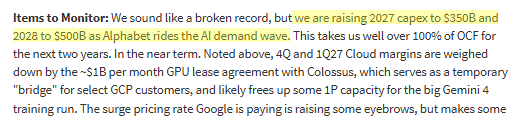
If this is accurate and I’m guessing it is because it’s inline with what the MS analyst is saying about $SPCX plans to increase GW capacity over the next few years… then it raises the high end of the 2027 capex whisper numbers above $1.4 trillion which would be up approx 75% YoY from the ~$800B that is likely going to happen in 2026.
$650-700B between $GOOG and $AMZN
$475-550B between $META and $MSFT
$125-175B between $ORCL and $SPCX
My condolences to anyone that is bearish on ai infrastructure and compute demand.
Don't ignore these negative catalysts:
The USD-JPY Carry Trade now that US is involved in STRENGTHENING the yen its negative for the market specially higher beta stocks.
Iran War going to a deeper phase where US will strike energy targets and have longer bombing campaigns, more countries are joining the war against Iran
Russia mobilizing about 500k soldiers preparing to arrive by Autumn (11 divisions about 10-20k each)
This isn't a clean setup. No Fed guidance through the turmoil, and Warsh wants fewer meetings meaning less information, more reaction. Expect violent moves in either direction.
KIOXIA UNLEASHES ¥800 BILLION: THE GREAT MEMORY BUYBACK BEGINS
TLDR: Kioxia announced up to ¥800 billion ($5.1 billion) in share repurchases and a total shareholder-return target of about 50%. Nomura separately expects Korean corporate buybacks to rise sharply, led by Samsung Electronics and SK Hynix.
Kioxia reported FY2027 Q1 sales of ¥1.767 trillion ($11.2 billion) and non-GAAP operating profit of ¥1.326 trillion ($8.4 billion), with an operating margin of 75%. ASP rose about 70% QoQ, while bit shipments increased by a low-single-digit percentage.
UBS estimates that if half of its FY2028 net-income forecast of ¥9.42 trillion ($59.8 billion) went toward buybacks, Kioxia could retire about 19% of its outstanding shares. Kioxia also plans to begin paying dividends from FY2028.
Nomura forecasts Korean listed-company buybacks of ₩116 trillion ($80.4 billion) in 2026, ₩274 trillion ($189.9 billion) in 2027 and ₩328 trillion ($227.3 billion) in 2028. It expects roughly 90% to come from Samsung Electronics and SK Hynix.
#키옥시아 #자사주매입 #메모리반도체 #주주환원 #Kioxia #ShareBuybacks #MemoryChips #ShareholderReturns $285A $005930 $000660 $SOX $SOXX $SKHY $DRAM $RAM $EWY $KORU
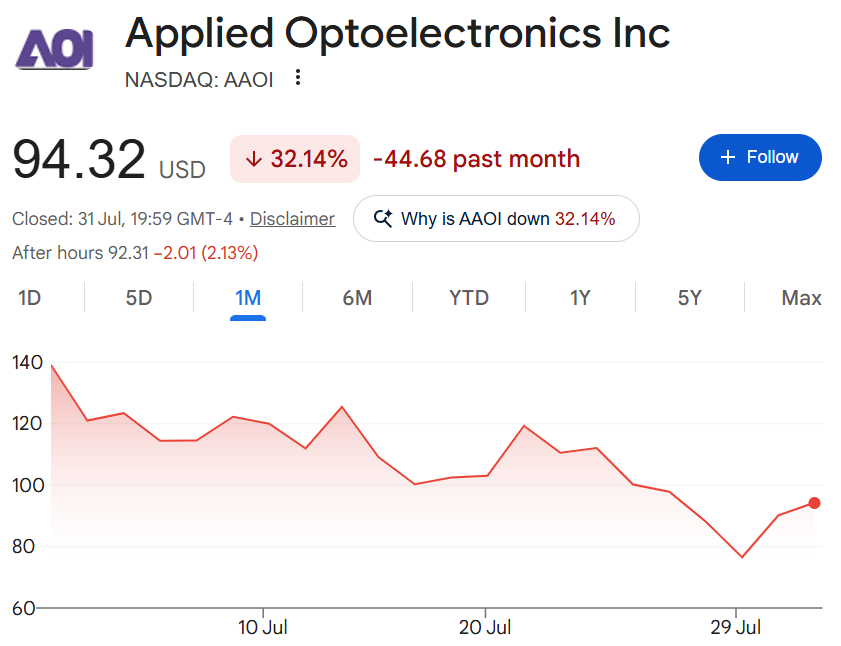
Probably nothing for $IREN $NBIS $CIFR $MU $SNDK $AAOI…. Move on.
Today: about 20 million AI chips (measured as $NVDA H100-equivalents) in data centers worldwide.
> Growth rate: expected to CONTINUE to double roughly every 7 months.
> Projection: about 200 million by the end of 2028 (roughly 10× current levels).
-BP
Not financial advice.
Notes on $AAOI ahead of Q2 earnings next week:
For the TLDR thesis: $AAOI is the only Western vertically integrated transceiver maker with its own InP laser fab pointed directly at the 800G/1.6T ramp. Currently undergoing capacity expansions in Texas, so if the capacity lands, the revenue is essentially pre-sold due to the demand/supply gap. Everything else, like a high multiple / dilution risk / CPO timelines is secondary noise to whether $AAOI can actually build modules fast enough.
On the Q1 call, CEO said: “the actual demand is not $1.1B, it is $1.4-1.5B” with the FY guide raised only to “exceed $1.1B” revenue because production and supply chains are their cap right now.
Therefore, given that demand > supply, $AAOI then becomes a bet on manufacturing execution.
I.e. can $AAOI take 800G/1.6T capacity from ~100,000 modules/month (in Q1) to >650,000/month by Y/E and ~930,000/month by the end of 2027? Since I’m not an insider, I have no idea. But if they ramp up, both revenue and margins inflect.
Also, I personally feel like most $AAOI bear posts I read are over-indexing on customer concentration and dilution, while under pricing their one properly differentiated asset: the laser fab.
Everyone is short InP.
InnoLight, Eoptolink, and the entire merchant module base buy their EMLs from a handful of suppliers. Mainly $LITE and $COHR. Who themselves are capacity constrained and locked in their supply via the $NVDA investment back in March. Even $FN mentioned that their datacom line is capped by component and material supply e.g. lasers, DSPs, ASICs, and not demand.
Whereas $AAOI is the one player in Western supply chains that makes its own EMLs on its own tools and is expanding that laser fab by ~4x heading into 2027.
In Q1, the CFO said: “equipment availability has not been a problem to date because most of this equipment is developed in-house… which means that we are not generally in direct competition with other similar companies for supply.”
So in a world short of lasers, vertical integration essentially means that $AAOI can actually ship while merchants can’t.
That’s also why the tariff overlay matters more than you think because the bulk of global transceiver assembly sits in China. For U.S. hyperscalers, a U.S. laser fab supplier is an effective procurement hedge with no Chinese peers. Chinese modules still undercut on price by ~20-25%, so this is a security/supply argument rather than a cost saving one. Which is the structural reason why $AMZN and $MSFT engaged in the first place, and is why $AAOI’s Texas expansion is genuinely strategic rather than vanity capex like many people have feared with the AI infra buildout.
That said, 800G is still tiny: in Q1, it was just 5.6% of DC revenue, with the quarter carried by 100G (41% of DC) and 200G/400G (46.7%). The “800G ramp” is a forward event that should begin showing up slightly in Q2, but a lot more materially in Q3.
For this reason, I believe that the Q2 numbers will be “disappointing” to a bunch of people who are bullish. For context, management explicitly told everyone H1 is only about 1/3 of the FY, and that the “significantly larger ramp” starts in “Q3 as additional capacity comes online.”
So, a “weak” Q2 wouldn’t be a warning signal if optical margins are soft. Really, the only number that matters is Q3 guidance and the 800G unit trajectory.
If $AAOI guides Q3 to the 60-80% sequential growth, that just confirms 800G becoming their largest DC rev line, with 1.6T beginning to contribute. Obviously, if the Q3 guide is soft, the capacity conversion story I talked about slips, and then we rightly have to look back at management and their prior track record of overpromising / disappointing shareholders.
Imo, these are the things to watch in order:
1. Q3 revenue guide
2. 800G revenue and unit shipments
3. Gross margin vs. the 29-30% guide + any reiteration of the Y/E ~35% target
Disclosure — I have a position in $AAOI.
3 biggest takeaways from $AXTI earnings
1) Indium phosphide capacity 2x'es, then 2x'es again in under 2 years.
2) Lumentum VOLUNTARILY prepaid to have capacity through 5 years, this is the opposite of memory LTA. The laser shortage may be more severe than the memory shortage.
3) Gross margin is going to start with a five. Could potentially hit 6 if the above is correct, making the upside significantly higher than I modelled as revenue + margin increase simultaneously
The InP laser shortage is hitting AI data centers harder than the memory crunch.
Lumentum CEO Michael Hurlston warned at the RAISE Summit that the supply gap for indium phosphide lasers powering AI data centers is more severe than the ongoing memory shortage.
Even with Lumentum running five InP fabs at full capacity, shipments are still projected more than 30% below customer demand.
The bottleneck is already acute for electro-absorption modulated lasers and is rapidly spreading to continuous-wave lasers as co-packaged optics technology ramps up.
What used to be a telecom-scale need of around 100 lasers per system has exploded into hundreds of millions required by Nvidia and the hyperscalers. This is the classic chokepoint thesis playing out in real time.
The companies at the center of this optical supply chain, Lumentum, AAOI, SIVE , and Coherent, look increasingly well-positioned as demand continues to outstrip available capacity.
Laser supply constraints are no longer a niche concern. They are becoming one of the most critical limiting factors for AI infrastructure buildout.
How do you see the InP laser shortage affecting the timeline for co-packaged optics adoption in AI data centers?
They say that TSMC secretly wants to become Intel, creating "EMIB-like" bridging tech with Kinsus, but you didn't hear it from me. Nice nickname, "EMIB-like." It's quite funny how everyone came to the conclusion that this news is actually positive for TSMC, which is utterly wrong in my opinion. The wannabe🎩Mr. Monopoly Man looking to copy a competitor's tech is soooooo bullish for that company. Not the one doing the copying, but the one copied.
So why would they?
Think about what CoWoS-L does on a mechanical level. You place your chiplets on an RDL interposer which has silicon bridges inside it, and then place the entire carrier on an organic substrate. Two assembly steps, and more importantly two mechanical systems stacked on top of each other, each of which wants to expand by itself when it gets hot. EMIB does away with the entire carrier and hides the bridge in the substrate, hence the chiplets land only once.
This seems like a matter of preference until you do the math. The coefficient of thermal expansion of silicon is about 2.6 ppm/K. That of organic substrate ranges from 15-17 ppm/K. Over the temp range of 100 K within a package with a 100 mm dimension, the difference in thermal expansion is of the order of 100 µm. Your bump pitch is 36 µm and the standoff is in the order of tens of microns. This is the same reason why a cheap frying pan will not sit flat on the burner when heated. The package does not have to bow much before dies stop making electrical contact.
NVDA has now eaten this twice 😋😋. Blackwell required a mask and top metal respin due to thermal expansion (CTE mismatch) between chiplets, LSI bridges, redistribution layer, and substrate resulting in warpage under thermal cycle at 1000W back in 2024. Then Rubin Ultra, quad-die, 3,400 mm² active silicon area and 16 HBM4E stacks, cancelled outright because of the same problem.
The replacement ships two dies at roughly half of the package-level compute. Just look at how the problem was addressed. It did not happen in TSMC's process but rather in NVDA's roadmap. When your packaging vendor cannot move forward, the logical idea would be to move, right?
Defect-limited yield goes as e^(-A*D). Area is in the exponent. That's the entire thing. Take just the compute silicon of the quad-die complex, 3,400 mm², and ignore the 16 HBM stacks and the keep-out that the carrier also has to span. EMIB-T bridge is 3x18 mm = 54 mm². So 63x, MINIMUM. And because area sits in the exponent, you do not have to agree with me on defect density. The bridge wins at every D, and the worse D gets, the wider the gap. Delete the interposer.
This is reinforced by ECTC 2026. Intel is scaling the FLI pitch to 25 µm, over 9x reticles of silicon on a 120x120 mm package, ~0.25 pJ/bit, 64 Gb/s UCIe, over 12 Gb/s HBM4E. Granite Rapids shipped at 45 µm, they've validated 36/35 µm on 2x reticle for 65% density gain, and since bump density scales as 1/p², 45 to 25 µm gets you 3.2x the I/O per unit area. The 2028 roadmap is over 12x reticle in 120x180 mm with more than 24 HBM dies and more than 38 bridges. One reticle as we know is 858 mm², so 12x is roughly 10,000 mm² of silicon in a single package. CoWoS-L is 3.5x in production, 5.5x qualifying now, and 9.5x still in development.
Another thing we have to think about here is WHERE the wafer goes. Everyone agrees that Taiwan concentration is a risk, yet the same people like to think of Arizona as some savior. But where does a wafer from Arizona go to get packaged? Taiwan. You can fab a die in Phoenix and it still has to fly all the way over the beautiful Pacific Ocean twice before it's a functional accelerator. Like yes, fab in AZ, cool, but you have to send it alllllll the way back and forth to actually have it function. Literally did nothing but add shipping. That does not remove a single point of failure. And before someone wants to tag me and point out Amkor, yes, Peoria is coming with CoWoS and InFO, and TSMC's own AZ packaging site targets 2029. But Peoria production starts in 2028 and qualification runs well behind construction. So if you need qualified domestic packaging for 2028 delivery, you are picking right now. Intel's Fab 9 in Rio Rancho will be the largest advanced packaging facility in the US at full production and a couple of days ago they completed RAMP-C which gives the Dept. of War domestic 18A and advanced packaging as the only US leading-edge source. Meanwhile you go over to Mr. Monopoly Man 🏘️🎩💰 and CoWoS lead times are 52-78 weeks and qualification adds more on top. "But so does EMIB." Sure, but a 78 week queue is not about how fast the process runs but rather how OVERSUBSCRIBED it is. 55% of that oversubscribed line belongs to Mr. Leather Jacket, so you are bidding against the biggest buyer in the industry for slots, and what will TSMC do? Allocate to the largest. Contracts being signed right now and later in the year are what govern 2028 availability, so to those of you pricing Taiwan risk on a 2027 horizon, you're already late⌛️.
Third thing here Padawan, listen closely. Intel is shipping Atom RTL to RosaicLabs. Two days before that came out, Christian Ludloff posted to LKML documenting a working x86 implementation with 16 and 32 AMX tile registers. Intel ships 8. Same guy relayed opcode allocations and an E000_xxxx CPUID and MSR range back in October 2025 that he said were already in active use by an entity that is neither AMD nor Intel. "So why is it interesting group leader?" I am glad you asked. This is interesting to me because AMX gives you 8 tiles, 16 rows of 64 bytes each. So 1 KB per tile and 8 KB of architectural state. But TILECFG is 64 bytes and already carries fields for 16 tiles, shipping silicon just uses the first 8. The architecture was ALWAYS wider than the hardware. Getting to 16 needs no new encoding at all since VEX already reaches TMM15. Getting to 32 needs EVEX out to TMM31 and doubles TILECFG to 128 bytes. Putting tile state at 32 KB per hardware thread. Nobody puts that much save-restore state per thread in a general purpose server CPU because the context-switch cost across 128 cores eats you alive. You do that on a machine that does one thing. 🥇
And it makes sense to me why you'd want that. I mean think with me here, please, activate that large brain. Tile registers are the innermost blocking level of a matmul, which is where operand reuse lives. 4x the tile file and you hold a bigger accumulator block resident, fetch fewer bytes per FLOP, all while pushing right along the beautiful roofline before the memory wall catches you. So, Atom is the host. To be fair, nothing public links Rosaic to those mailing list posts and the opcode notice predates the incorporation by 7 months so this is pure speculation.
But zoom out from your little scope before you start commenting something on this post about how I am wrong about something. Intel handed out 286 and 386 manufacturing licenses in the 80s and watched it create competitors. They proceeded to shut the door for 40 years. Now they're letting synthesizable core RTL out of the door. "But group leader, wouldn't Intel be competing with its own product line?" Only if it still held that socket. Guess what? It does not in accelerator-attached configs. As you probably already know, every Grace part shipping today is a seat Intel ALREADY lost, you can't lose the same seat twice. It's more recapture than erosion. Separately, Intel and AMD jointly defined ACE through the x86 EAG as a common matrix target. Now move your little scope to what every hyperscaler is doing right now: building custom ASICs. They pick either Arm or RISC-V for the host and then pay for a software port. If x86 cores are licensable you skip that entirely and run the existing enterprise estate natively. Jab jab uppercut. Now what? What is the finishing move? The opponent is on the floor. What will the finisher be? The fact that the tenant needs a fab and a package. And most of them need help designing the thing, ASIC design service, which is another line item. You know who can do all of it inside the borders of the United States of America??? INTEL. LBT is playing 4D chess and people are still focused on the Foundry turnaround saying that it won't happen. I'd check on all of those people. Because the IP, wafer, and package all being with one company leads to volume, which leads to money and then money leads to the Street being happy.
I know LBT would be proud of me. I am a chess grandmaster myself.
The US housing market is in for a wild ride.
As rates rise to new highs, the average interest rate on a 30Y Mortgage is nearing 7%.
In other words, if you bought a home in 2021 at 3% interest, moving to a new home today would increase your rate by ~400 basis points.
Assuming you buy a $500,000 home with 20% down:
1. Monthly Payment at 3% Interest: $1,686/mo
2. Monthly Payment at 7% Interest: $2,661/mo
That's an increase of almost $1,000/mo, or +58%.
The already stagnant housing market is set to freeze.
$AXTI is holding $134.7M of customer money for wafers it has not made yet. Lumentum, Coherent and Casela each prepaid to lock indium phosphide substrate, one of them through 2031!
Napkin math:
• Current revenue: ~$190M/yr (Q2 annualized)
• FY2028 revenue: $705M (3.7x)
• Market cap today: ~$4B
• FY2028 target: ~$6B
• Upside: 1.5x from here
1/ AXT grows indium phosphide substrates. Every EML and CW laser in an AI optical link is epitaxially grown on one. Silicon cannot emit light, so there is no substitute material.
2/ Q2 2026, reported July 30:• Revenue $47.6M, the highest quarter in company history!
• Up 77% sequential, 165% year over year
• InP revenue $30.7M, a record, driven by datacenter
• Gross margin 44.9%, up from 8.0% a year ago
The Casela, Coherent and Lumentum agreements did not materially contribute to that quarter. All three are incremental from here.
3/ Three companies hold over 90% of global InP substrate supply. Sumitomo at roughly 42% share and 800k wafers. AXT at 36% and 300k. JX at 13% and 200k.
-=-=-=-=-=-
Sumitomo is saturated and consuming more of its own output internally. JX has announced no expansion. AXT is the only one of the three adding capacity, and the only one whose capacity is for sale.
-=-=-=-=-=-
4/ Management's own targets for InP revenue capacity:• $60M per quarter exiting 2026
• $130M per quarter exiting 2027
From $30.7M in Q2, that is a double in two quarters and another double in four more. Their words: this would make AXT "by far the largest indium phosphide producer in the world."
5/ On the demand side, from the same call
"Customer demand continues to outpace supply, no matter how fast we add capacity". This is what we like to hear, keep talking dirty to us managment.
• Backlog above $100M, and management says that figure no longer reflects all available demand
• China demand more than doubled
• Materials now in "multiple US hyperscalers"
• Targeting gross margin "that begins with a five"
6/ The margin math is more interesting than the headline number suggests. AXT sells five things and they earn very differently.Q2 2026, derived from the reported split
• Core InP substrates: ~$28M at ~54% gross margin
• 6-inch InP for CPO: ~$2.7M at ~58%
• GaAs: ~$6.3M at ~30%
• Germanium: ~$0.3M at 25%
• Raw-material JVs: ~$10.3M at ~26%
-=-=-=-=-=-
The core product already earns in the mid-fifties. The reported 44.9% is legacy businesses diluting it. "A number that begins with a five" needs no pricing improvement at all, only for InP to keep growing as a share of the mix.
-=-=-=-=-=-
7/ As InP goes from 64% to 86% of revenue on the two capacity doublings, blended margin reaches 55% by late 2027 on arithmetic alone. Shortage pricing sits on top of that.Revenue up 3.7x and margins expanding at the same time.
8/ Where $AXTI sits:AI optical link
→ transceiver / optical engine
→ EML and CW lasers from $LITE $COHR $AAOI $SIVE
→ epitaxy on InP wafer
→ AXT (substrate)Lumentum runs five of its own fabs and is converting a Greensboro site to InP. It still put $87M down to reserve AXT capacity through 2031. That tells you what its internal position is worth.
9/ Risks
Export permits. Manufacturing is in Beijing, and management names China export licensing as its single biggest challenge
• Coherent is building its own 6-inch InP capacity and has a CHIPS LOI for Sherman, Texas. That competes with AXT's highest-margin line
• The prepayments cut both ways. Coherent can terminate on a six-month capacity miss
• VCSEL and microLED could take short-reach optical volume from InP. Partly hedged by AXT's GaAs lineCounter-evidence on the last one: NPO and CPO both need more InP, not less, and the industry is moving toward them.
(image courtesy of @aleabitoreddit)
Still gobsmacked at @ChrisCamillo today.
Ran up a $30K to ~$80M portfolio over many decades, now likely in his 50's.
Back against the wall getting margin called and basically goes all in on Amazon weeklies on a Thursday?
Biggest trading day of his career. Balls of steel.
The market digested Amazon's earnings, but most analysts skipped the real structural signal.
It wasn't the cloud growth numbers.
It was Andy Jassy quietly defining the next physical bottleneck in AI compute:
“The bottleneck in AI compute has evolved. It’s no longer just about chip availability - it’s about rack-level power delivery, thermal management, and custom silicon efficiency.”
AWS custom silicon run-rate hit $25B, driven by Trainium scaling.
Everyone is building in-house ASICs to drive down TCO.
But as the custom chip transition accelerates, the bottleneck doesn't disappear - it shifts straight into physics.
It doesn't matter whose custom silicon wins the race.
When you cram 100+ kW into a single rack and pull 1,000A+, chip performance becomes secondary to power delivery and thermal management.
The picks-and-shovels plays hold all the leverage:
> $VRT Vertiv – direct-to-chip liquid cooling (air cooling simply fails above 80–100 kW).
> $VICR Vicor – Vertical Power Delivery (routing current from directly beneath the die to eliminate board losses).
The custom silicon war isn't being won on the chip layout.
It's being won at the rack level.
Which infrastructure bottleneck is your top watch for this cycle?
Drop your takes below 👇
We are going to see a lot of vertically focused AI native companies accelerate.
Routers, open-source models and specialized post-training enabled by companies like @FireworksAI_HQ have all made dramatic advances and the combination of the three is driving accelerating growth.
Companies like @wearelegora can now use their data to post-train an open-source model and then combine it with frontier models behind a router to get the same or better outcomes at lower costs than the frontier alone.
This dramatically improves the business model for all these companies. @cognition seeing similar trends.
This is an absolutely crazy stat.
Someone asked about factoring in oil, bonds, and Japan into the current tech selloff.
So I pulled the data for every single time oil surged 10%+ in a month while bonds AND Japan were both negative. There's been 29 times this has happened since 2000.
Here's what $QQQ did next:
• 1 month: +0.9% median (61% win rate)
• 3 months: +4.5% median (75% win rate)
• 6 months: +9.8% median (78% win rate)
• 1 year: +9.7% median (67% win rate)
Also for $SPY:
• 1 month: +0.8% median (64% win rate)
• 3 months: +2.5% median (75% win rate)
• 6 months: +7.3% median (70% win rate)
• 1 year: +7.2% median (67% win rate)
The near term is choppy. 1 month is basically a coin flip. But 3 months out, 75% win rate for both QQQ and SPY. 6
months out, QQQ averages nearly 10%.
You have a 75% chance of being green in 3-months and a year's time.
I rotated some of Micron $MU into SK hynix $HY9H earlier this week, here is why:
Most people are bullish on memory because they believe memory is less cyclical from here on due to AI demand and LTAs. Rightly so, in my opinion.
But in my eyes, that is more apparent for HBM than for DRAM and NAND. DRAM and NAND still have considerable exposure to the cyclical consumer market. At this point, price increases lead to demand destruction in the consumer sector while AI demand remains robust, hyperscalers and large enterprises are much less sensitive to price increases. While AI demand keeps increasing, demand destruction in the consumer sector partly counters that.
In case of HBM, there is no exposure to the consumer market, only to hyperscalers and large enterprises who are not very sensitive to price increases. For less cyclicality, HBM revenue therefore is of higher quality in my eyes that deserves a lower discount rate, and therefore a higher valuation multiple.
SK hynix is the current leader in HBM and over half of $NVDA’s HBM4 needs for the coming year will be fulfilled by SK hynix. While Micron is seeking to expand its HBM market share, I expect SK hynix to remain the leader in the coming years.
Furthermore, SK hynix’s HBM revenue is expected to take up a larger share of their total revenue than in case of Micron. For SK hynix, it will be approximately ~35%, ~50% and more than 50% in 2026, 2027 and 2028. In case of Micron, it will be approximately ~20%, ~30% and ~35%. With SK hynix having a higher exposure to HBM revenue, I believe SK hynix’s revenue mix to be of higher quality in the coming years. This makes me a bit more bullish on SK hynix than on Micron.
Recently, the drawdown on SK hynix has been more severe than on $MU, presumably due to the South Korean market being more leveraged with more forced liquidations occuring. From here, I believe SK hynix has a bit more upside so this seemed like a decent moment to make the rotation. SK hynix is now my biggest position, but I remain bullish on $MU, which is now my second biggest position.
$SKHY $MU $DRAM $EWY
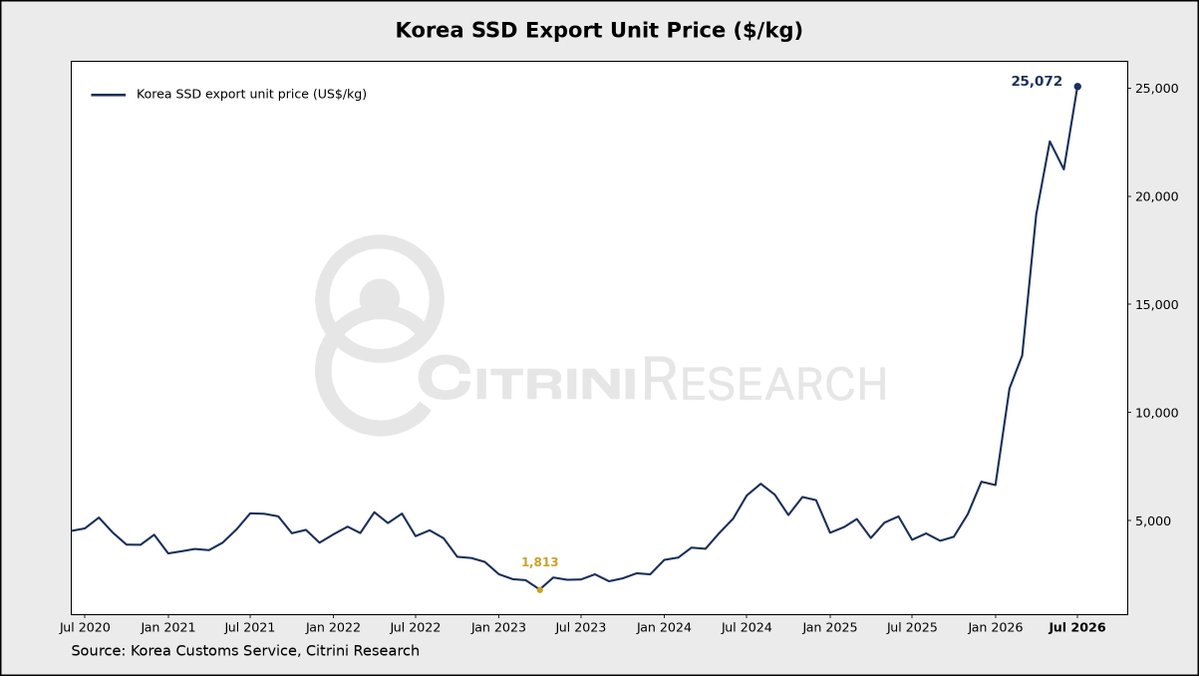
Interestingly, Korea’s NAND export unit prices declined in July, while SSD export unit prices rose.
This suggests that high-margin products continue to account for a growing share of the NAND flash revenue mix.