The Degree of Difficulty Myth: Too often, we fall into the trap of believing that exhausting, complex, or agonizing approaches are more valuable. Warren Buffett shattered this myth at the Berkshire Hathaway 1998 Annual Meeting,
"In Olympic diving, you know, they have a degree of difficulty factor. And if you can do some very difficult dive, the payoff is greater if you do it well than if you do some very simple dive.
That’s not true in investments. You get paid just as well for the most simple dive, as long as you execute it all right. And there’s no reason to try those three-and-a-halfs when you get paid just as well for just diving off the side of the pool and going in cleanly.
So we look for one-foot bars to step over rather than seven-foot or eight-foot bars to try and set some Olympic record by jumping over. And it’s very nice, because you get paid just as well for the one-foot bars."
This is the core philosophy behind Degree of Simplicity. Hunting for one-foot bars isn’t about being lazy; it’s about being effective. Wealth and success can be built on steady, sustainable gains. When you choose clear, repeatable wins, you compound gains while avoiding unnecessary complexity.
https://t.co/LKXZ2H3tr7
@realEstateTrent Different cultures take on kids in restaurants is one of the most fascinating societal values.
Italians: kids welcome everywhere, at 10pm, running around the servers, playing on the piano, no one cares.
Germans: feed the kids, put them to bed, then go out to eat.
@Jason@jasonfried@TimurNegru 100%! Even my small “estate” demands at lot of afternoon and weekend time. Owning a mansion used to be a dream. Now I’m thinking it could be more like a nightmare.
Great Salad Oil Scandal of 1963 is a crazy story. Oil tank inventory inspectors are fooled by dishonest soybean business man. His certified inventories are ceased but found to be missing. AMEX ends up on the hook and is over sold, 50%+ drop. Buffet sees a wonderful company with strong fundamentals, swoops in and grabs the cheap shares.
@money_cruncher Mortgage amortization is designed to front load interest. Banks know the data: The average American moves about 11.7 times in their lifetime. So they get their interest first before another buyer comes along with a new loan.
The joke is that Jeremy has predicted 27 of the last 3 crashes. Infamous bear who said S&P 500 was going to crash by 30% back in 2023.
Bottom line, no one can predict the market. The ones who get it right are merely a small group of survivors out of the masses that were wrong.
https://t.co/Yw6dhJFNXp
When should you stop rooting for a market crash?
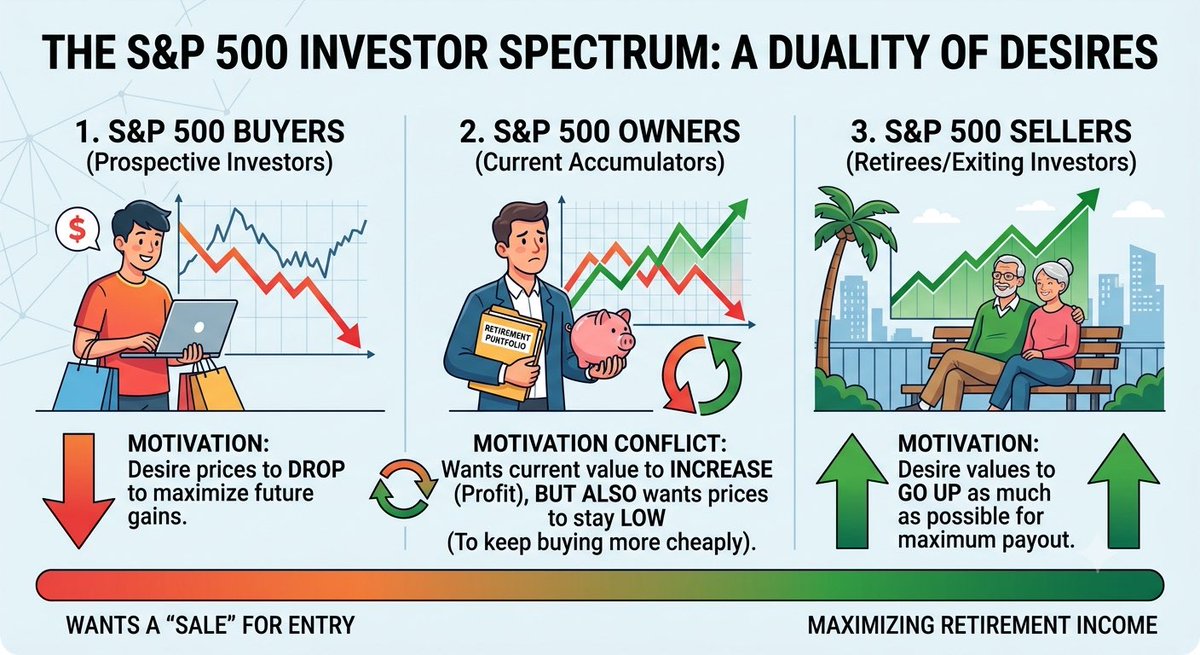
The great paradox of being a long term index investor is that you are often rooting against your own portfolio. As a buyer, you want shares to be as cheap as possible. Sell-offs, corrections, and crashes are essentially flash sales on your favorite assets. But eventually, the math shifts and those downturns start hurting your nest egg.
The investor journey generally breaks down into three phases:
The Buyer Phase: Just like shoppers hunting for a discount, new investors want to acquire assets at the lowest possible price. During this stage, a significant market downturn is highly welcomed. What newly hired 22 year old would not love to start contributing to their first 401k right after asset prices drop?
The Accumulator Phase: You are a little older and have been buying into your preferred ETF for a while, building a respectable net worth. This is where loss aversion creeps in. If the market tanks, your monthly statements look terrible, but you still get that discount on your regular contributions. You are caught in a tug of war between enjoying the discount but hating the paper losses.
The Seller Phase: You are retired or funding your lifestyle with your existing investments. A higher market means you sell fewer shares to generate the same amount of cash, preserving your wealth for longer. In this phase, any market retraction is an active threat.
Somewhere, you shift from hoping for cheaper equities to being harmed by every downturn. **But when exactly does that happen?**
Enter Critical Mass theory: Many financial planners point to a mathematical threshold called Critical Mass. This is the exact moment when the expected organic growth of your portfolio exceeds your annual out-of-pocket contributions.
Let's look at the math. In 2026, the maximum employee contribution limit for sponsored plans like 401(k) is $24,500. If you project a conservative 7% average annual return, you need a portfolio size where 7% yields more than that maximum contribution. Therefore, Critical Mass is achieved at $350,000.
Once your balance crosses that line, the compound growth does more heavy lifting than your contributions. Adherents to this theory believe that once you hit this milestone, your mindset must shift toward wealth preservation, asset diversification, and long-term tax mitigation strategies to protect what you have built.
The Counterargument: Not everyone agrees with the Critical Mass theory. Warren Buffett famously pushes back against the idea that a large portfolio should make you fear a crash. In his 1997 shareholder letter, he framed it like this: “you plan to eat hamburgers throughout your life and are not a cattle producer, should you wish for higher or lower prices for beef? The answer is obvious: You should wish for lower prices... But how do investors behave? Even though they are going to be net buyers of stocks for many years to come, they are elated when stock prices rise and depressed when they fall... This reaction makes no sense. Only those who will be sellers of equities in the near future should be happy at seeing equities rise.”
For Buffett, the size of your portfolio is irrelevant. You should only stop rooting for downturns when you officially enter the Seller Phase.
What do you think? At what point should you stop hoping for a market downturn and start cheering for the bull run?
Taleb has warned about this for years. Mean Absolute Deviation is calculated by squaring the deviations from the mean before taking the square root, creating a disproportionately massive weight to larger observations. Fat tail events aren’t accurately represented.
https://t.co/jZVb6NoMPB
@AffordAnything Jamie Dimon warned of the real possibility that interest rates could return to these levels if the economy experiences a 1973-1975 style recession
🚨NEW EPISODE🚨
60 minutes with JAMIE DIMON
- wouldn't buy long bonds or SP500 here
- "risks are bigger than people think"
- "I want @AndyBurnham to succeed", but Banks Levy is "wrong"
- Leadership masterclass - breaking bureaucracy; overcoming insecurity; loneliness at top
STOCK MARKET: "In general would I be a buyer at this price? No."
BUYER OF LONG DATED BONDS? “Personally, no. I would not be a buyer and part of it is interest rates. I mean even if inflation was 2%, the 10-year bond should probably be at 4-4.5%. And the short rate should be at 3.25-3.5%. And they're almost there today. So I don't understand what the upside is, even if you think inflation going to go to 2%. But being an economic historian, I can't take out of my mind what happened after the great recession of 74. Deficits were less…And it climbed from 3.5% to 5% to 7% to 9% to 11%.”
ECONOMY/MARKET RISKS: “Make a list of all those really complex long-term geopolitical tectonic plates things that affect the market or may not… I do think those risks are probably bigger than other people think.”
MARCH 2020 NEAR DEATH EXPERIENCE: “So I knew at that point in time that there might be goodbye. Yeah.” And what stood out for you in the life that you'd led in that moment? “I remember I spoke to my wife and I told her to call their company and tell them exactly what's happening so they can do what they got to do. But the good news is I didn't have any great regrets. I would be leaving behind great children, great wife, great company. I did the best I can. Of course I made mistakes. But fortunately I recovered from all that.”
ON ANDY BURNHAM: “I want him to succeed. I want to see the UK thrive. I want London to succeed. But the UK, like everybody else and like my own country…you need a strong economy to do that. So the new Chancellor going to need good policies that actually cause growth. So I'm praying that they get policy right and government after government get it wrong.”
ON BANKS LEVY: “I have always thought it was wrong. JP Morgan did not damage the UK and I called the Chancellor at the time. We're a great citizen there. We hire people there. We want to be bigger there. We train people there. We hire veterans there. All of our people get medical and all that stuff like that. And I just thought it was a lack of principle to punish a company that had nothing to do with the crisis. And it's still there seventeen years later. Is that fair to a shareholder? I mean, it may sound great, 'tax the banks', but it's $5 billion that my shareholder's paid on that extra tax. And I just think things like that have adverse consequences.”
Timestamps:
0:00 Intro
2:14 As good as it gets environment
3:08 Risks bigger than people expect
4:28 Resilience despite Iran
9:21 Would not buy bonds here
12:50 AI risk & opportunity
15:16 Not buyer of SP500 here
16:02 SpaceX valuation
17:45 Lessons from Financial Crisis
19:09 Don’t expect success
21:00 Loneliness of leadership
23:25 Commitment to NYC @NYCMayor
25:03 I want @AndyBurnham to succeed
26:40 UK Banks Levy is wrong
29:14 Fighting bureaucracy
33:20 Character most important trait
35:26 Insecurity ruins leaders
39:46 Success is not just your own
43:15 Politics is a very tough game
47:55 Dimon’s founder-like impact & succession
51:30 Near death experience
53:05 Family
56:34 Learn, learn, learn – from history & people
@jpmorgan@Chase@chase_uk@JPMorganAM
Some people just don’t care about money. We all know (or are married to) someone like this. At most, managing finances is like brushing teeth, they only do it because they’re told it’s important. Many, lile the young co-worker you described, don’t even care enough to do the basics.
What Buffet will leave for his wife
Buffett's instructions for his wife's inheritance after he's gone: 90% in a low-cost S&P 500 index fund, 10% in short-term government bonds.
Buffett says for most investors, a simple index fund will outperform the vast majority of actively managed alternatives over time, net of fees — including most of what Wall Street sells as sophisticated. Simplicity isn't a limitation here. It's the point.
— Warren Buffett, 2013 Letter
Yes, but I often wonder if we’re about to enter a similar period. In 1993, $SPY had a closing price of $46.59. At the start of the lost decade in 1999, it was up to $146.88. Then it bounced around from $140s to high $80s for the the ten years.
Are we at 1999 again? Super low unemployment rate, coming to the end of an amazing bull run. Will we see broad market ETFs stagnate for the next decade? If so, it means we should be buying the heck out of the index going forward…
@OilCoIntern But they are unlucky. It would be better if the prices stayed flat or contracted. Gen X enjoyed an amazing opportunity to buy cheap ETF shares between 1999-2009. The younger generations are having to pay higher and higher prices throughout this bull market.
When should you stop rooting for a market crash?
The great paradox of being a long term index investor is that you are often rooting against your own portfolio. As a buyer, you want shares to be as cheap as possible. Sell-offs, corrections, and crashes are essentially flash sales on your favorite assets. But eventually, the math shifts and those downturns start hurting your nest egg.
The investor journey generally breaks down into three phases:
The Buyer Phase: Just like shoppers hunting for a discount, new investors want to acquire assets at the lowest possible price. During this stage, a significant market downturn is highly welcomed. What newly hired 22 year old would not love to start contributing to their first 401k right after asset prices drop?
The Accumulator Phase: You are a little older and have been buying into your preferred ETF for a while, building a respectable net worth. This is where loss aversion creeps in. If the market tanks, your monthly statements look terrible, but you still get that discount on your regular contributions. You are caught in a tug of war between enjoying the discount but hating the paper losses.
The Seller Phase: You are retired or funding your lifestyle with your existing investments. A higher market means you sell fewer shares to generate the same amount of cash, preserving your wealth for longer. In this phase, any market retraction is an active threat.
Somewhere, you shift from hoping for cheaper equities to being harmed by every downturn. **But when exactly does that happen?**
Enter Critical Mass theory: Many financial planners point to a mathematical threshold called Critical Mass. This is the exact moment when the expected organic growth of your portfolio exceeds your annual out-of-pocket contributions.
Let's look at the math. In 2026, the maximum employee contribution limit for sponsored plans like 401(k) is $24,500. If you project a conservative 7% average annual return, you need a portfolio size where 7% yields more than that maximum contribution. Therefore, Critical Mass is achieved at $350,000.
Once your balance crosses that line, the compound growth does more heavy lifting than your contributions. Adherents to this theory believe that once you hit this milestone, your mindset must shift toward wealth preservation, asset diversification, and long-term tax mitigation strategies to protect what you have built.
The Counterargument: Not everyone agrees with the Critical Mass theory. Warren Buffett famously pushes back against the idea that a large portfolio should make you fear a crash. In his 1997 shareholder letter, he framed it like this: “you plan to eat hamburgers throughout your life and are not a cattle producer, should you wish for higher or lower prices for beef? The answer is obvious: You should wish for lower prices... But how do investors behave? Even though they are going to be net buyers of stocks for many years to come, they are elated when stock prices rise and depressed when they fall... This reaction makes no sense. Only those who will be sellers of equities in the near future should be happy at seeing equities rise.”
For Buffett, the size of your portfolio is irrelevant. You should only stop rooting for downturns when you officially enter the Seller Phase.
What do you think? At what point should you stop hoping for a market downturn and start cheering for the bull run?
@TimIsgro Buffet said it’s the moat. He pointed out that to the owner, the $1000 iPhone is more valuable than a $1 million jet. If you lose the jet, you can get by. If you lose the phone, everything stops.