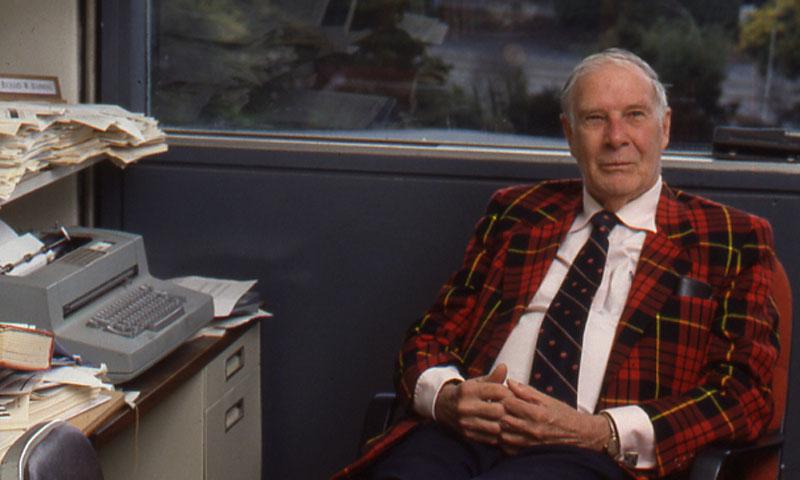
A psychologist who never built a computer wrote a paper in 1960 that described the personal computer, the internet, and AI assistants decades before they existed, then handed the money to the people who built them and let history forget his name.
I read about him at 1am. One name was missing from a story I thought I knew.
His name was J.C.R. Licklider. The book is The Dream Machine by Mitchell Waldrop.
In 1960, computers were room-sized machines that ran one job at a time. You wrote your program on punch cards, handed the stack to an operator, and waited days for your answer. Nobody touched the machine. Nobody talked to it. A computer on your desk that answered you in real time was science fiction.
Licklider was not a computer scientist. He was a psychologist who studied how the brain hears. But he used computers in his research, and one day he measured where his time went.
The result horrified him. 85% of his work hours were not spent thinking. They were spent getting ready to think. Plotting graphs by hand. Hunting for numbers. Reshaping one person's data to compare with another's. The insight took seconds. The setup took hours.
The problem was not that humans were slow. Humans and machines were doing the wrong jobs. Let the human ask the questions. Let the machine do the grunt work. Tie them so close they think as one.
He wrote it down in a paper called "Man-Computer Symbiosis." In it, a person sits at a screen and works with a computer in real time. The machine answers questions, runs the numbers, draws the results, pulls answers from everything it has seen. He was describing the laptop you are reading this on. He wrote it before most people had seen a computer.
A paper changes nothing on its own. Thousands of brilliant predictions die in a drawer.
What made Licklider different is what he did next.
In 1962, the Pentagon put him in charge of a research office at ARPA. He had a budget and near total freedom over where the money went. Most people would have funded the safe things. He did the opposite. He spent government money on a dream with no military use and no promise it would work.
He found the few researchers across the country who thought like him. He gave them money. Real money. No strings. He funded the work that became time-sharing, the first computers people could talk to. He funded the labs that built the mouse, the window, the screen. He built computer science departments where none existed.
He was not picking projects. He was building a tribe.
Then came the idea that should make you stop. In 1963, he sent a memo to everyone he funded. He addressed it, half joking, to the "Members and Affiliates of the Intergalactic Computer Network." Inside, he asked a question nobody else was asking. What if all these separate computers could link together, so anyone could share information and build on each other's work?
He was describing the internet. No network existed yet. He sketched it thirty years before it reached your house.
He left in 1964. He never built the network himself. But the men he funded carried it forward. His successors took his memo and turned it into ARPANET, the first working internet, a few years later. The researchers he paid built the personal computer at a lab called Xerox PARC. Every piece of the world he imagined got built by the people he gathered and funded.
Here is the part I cannot shake.
He gave away the credit on purpose. He did not want his name on the breakthroughs. He believed the vision had to outlive him, so he made the people around him strong enough to carry it without him. He won so completely that the vision survived and the man vanished.
Ask who invented the internet and you will hear a dozen names. Almost none will be his. The man who saw it first, wrote it down, and paid for it, is a footnote in the story he started.
He died in 1990. He never owned a personal computer that worked the way he dreamed. He never browsed the web. He never saw the thing he funded swallow the planet.
Every screen you talk to today runs on an idea one quiet psychologist had while staring at how much of his life was wasted not thinking.
He did not want the credit. He wanted the future.
He got the future. We just forgot who paid for it.
Two economists just published a mathematical proof that AI will destroy the economy.
Not might. Not could. Will — if nothing changes.
The paper is called "The AI Layoff Trap." Published March 2, 2026. Wharton School, University of Pennsylvania. Boston University. Peer reviewed. Mathematically modeled.
The conclusion is one sentence.
"At the limit, firms automate their way to boundless productivity and zero demand."
An economy that produces everything. And sells it to nobody.
Here is how you get there.
A company fires 500 workers and replaces them with AI. A competitor fires 700 to keep up. Another fires 1,000. Every company is behaving rationally. Every company is following the incentives correctly. And every company is building a trap for itself.
Because the workers who were fired were also customers.
When they lose their jobs faster than the economy can absorb them, they stop spending. Consumer demand falls. Companies respond by cutting costs — which means automating more workers — which means less spending — which means more falling demand — which means more automation.
The loop has no natural exit.
The researchers tested every proposed solution. Universal basic income. Capital income taxes. Worker equity participation. Upskilling programs. Corporate coordination agreements.
Every single one failed in the model.
The only intervention that worked: a Pigouvian automation tax — a per-task levy charged every time a company replaces a human with AI, forcing them to price in the demand they are destroying before they pull the trigger.
No government has implemented this. No major economy is seriously discussing it.
Meanwhile the numbers are already tracking the curve. 100,000 tech workers laid off in 2025. 92,000 more in the first months of 2026. Jack Dorsey fired half of Block's workforce and said publicly: "Within the next year, the majority of companies will reach the same conclusion."
Nobody is doing anything wrong. Companies are following their incentives perfectly. That is exactly the problem.
Rational behavior. At scale. Simultaneously. With no mechanism to stop it.
Two economists built the math. The math leads to one place.
Source: Falk & Tsoukalas · Wharton School + Boston University ·
A mathematician at Bell Labs noticed that the scientists who won Nobel Prizes and the ones who never amounted to anything were equally smart, equally hardworking, and equally credentialed, and the only thing that separated them was a single question almost nobody is brave enough to ask themselves before they die.
His name was Richard Hamming.
He spent 30 years at Bell Labs, in the same building as John Tukey, Walter Brattain, and a long list of physicists who took home Nobel prizes for work they did down the hall from his office, including the legendary Claude Shannon.
His invention of error-correcting codes made modern computing possible. He has won the Turing Award. And all the while he was creating his own legacy he was secretly doing a study on the people around him.
The study was straightforward. 2 Teams. The legends and the lost. Same I.Q.s. Degrees same. Same desk hours. Same access to the world’s best resources.
And yet, at the end of 40 years in their careers, one group had changed entire fields, and the other group could not be remembered by their own colleagues five years after retirement. He wanted to discover what the actual difference was.
In March 1986, he stood before 200 researchers in a Bellcore auditorium and told them what he had seen.
He said it all came down to one question. And hardly anyone he ever met was willing to ask it directly.
He called it the Friday-afternoon ritual. He spent years blocking out his Friday afternoons and not doing anything productive with them every week. No experiments. No meetings. No deliverables.
He called it Great Thoughts Time. He sat down with a notebook and asked himself a couple of questions in order. What are the most relevant problems in my discipline? And why I am not working on either of them.”
Most weeks, the answer was the same, he said. For a week now he had marched confidently in a direction he did not think was the most important direction. He was a goer. He worked a bit. He was getting clean results that would publish in respected journals. (
And for five days straight he'd been lying to himself about whether any of it mattered.
The reason almost nobody does this ritual is because the honest answer is unbearable. The thing is that if you sit down on a Friday afternoon and say out loud that you are not working on the most important problem in your field, now you have to do something about it.
You have an immediate change in direction, or you have to keep lying to yourself every week from that point on. Most people choose the lie.
In the short term it’s cheaper, but over a career it’s more expensive.
Hamming took the ritual a step further in the Bell Labs cafeteria. He began approaching scientists he barely knew, asking them what they thought the most important problems in their field were.
A week later he would ask them why they had not worked on these problems. Eventually people wouldn't have lunch with him. “I had to keep finding new tables,” he said.
Nobody had a good answer for that, and being around someone who kept asking it made every meal feel like a performance review.
The line that broke me is the line that most people skim over in the transcript. His words: If you do not work on an important problem you are unlikely to do important work.
That’s not motivational line. It is a rational one. You cannot make a great result from a problem that does not matter. Input restricts the output. The choice of the problem is the ceiling of the career.
The transcript has been freely available on the internet for almost 40 years. Stripe Press published the complete lectures as a book. Naval Ravikant quotes it all the time. It’s still given out to new hires at every serious engineering lab in Silicon Valley.
Most people will not run the ritual this Friday. They will be busy. They always are.
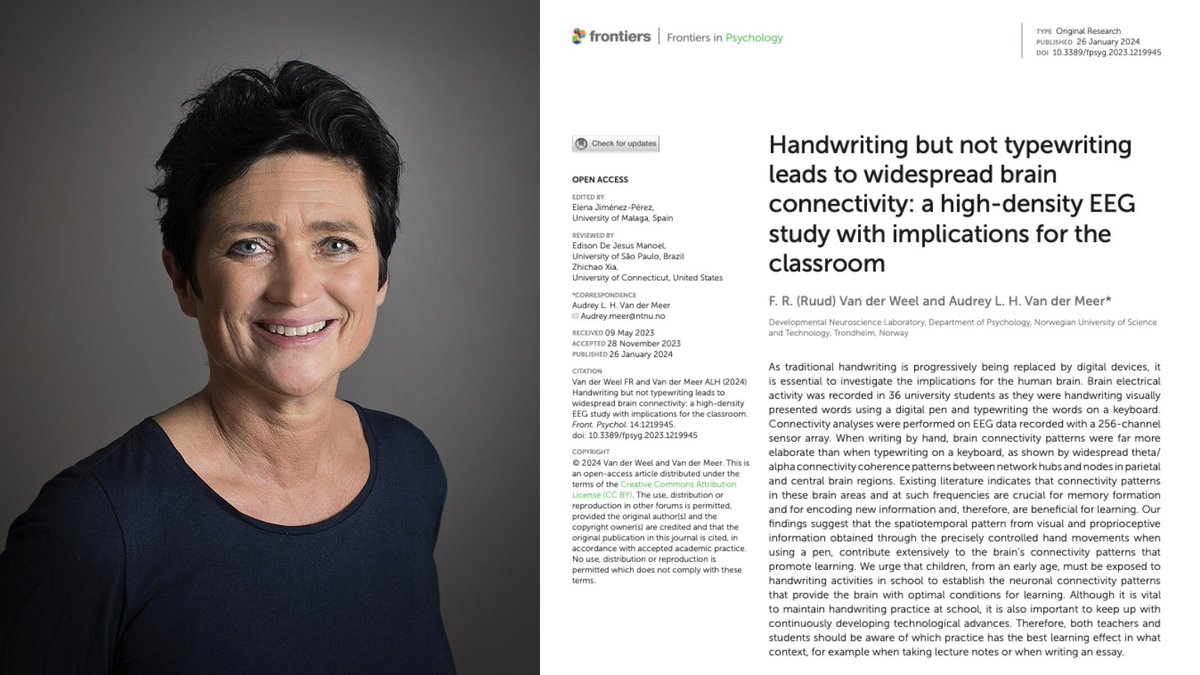
A Norwegian neuroscientist spent 20 years proving that the act of writing by hand changes the human brain in ways typing physically cannot, and almost nobody outside her field has read the paper.
Her name is Audrey van der Meer.
She runs a brain research lab in Trondheim, and the paper that closed the argument was published in 2024 in a journal called Frontiers in Psychology. The finding is brutal enough that it should have changed every classroom on Earth.
The experiment was simple. She recruited 36 university students and put each one in a cap with 256 sensors pressed against their scalp to record brain activity. Words flashed on a screen one at a time.
Sometimes the students wrote the word by hand on a touchscreen using a digital pen, and sometimes they typed the same word on a keyboard. Every neural response was recorded for the full five seconds the word stayed on screen.
Then her team looked at the part of the data most researchers had ignored for years, which is how different parts of the brain were communicating with each other during the task.
When the students wrote by hand, the brain lit up everywhere at once.
The regions responsible for memory, sensory integration, and the encoding of new information were all firing together in a coordinated pattern that spread across the entire cortex. The whole network was awake and connected.
When the same students typed the same word, that pattern collapsed almost completely.
Most of the brain went quiet, and the connections between regions that had been alive seconds earlier were nowhere to be found on the EEG.
Same word, same brain, same person, and two completely different neurological events.
The reason turned out to be something nobody had really paid attention to before her work. Writing by hand is not one motion but a sequence of thousands of tiny micro-movements coordinated with your eyes in real time, where each letter is a different shape that requires the brain to solve a slightly different spatial problem.
Your fingers, wrist, vision, and the parts of your brain that track position in space are all working together to produce one letter, then the next, then the next.
Typing throws all of that away. Every key on a keyboard requires the exact same finger motion regardless of which letter you are pressing, which means the brain has almost nothing to integrate and almost no problem to solve.
Van der Meer said it plainly in her interviews.
Pressing the same key with the same finger over and over does not stimulate the brain in any meaningful way, and she pointed out something that should scare every parent who handed their kid an iPad.
Children who learn to read and write on tablets often cannot tell letters like b and d apart, because they have never physically felt with their bodies what it takes to actually produce those letters on a page.
A decade before her, two researchers at Princeton ran the same fight using a completely different method and ended up at the same answer. Pam Mueller and Daniel Oppenheimer tested 327 students across three experiments, where half took notes on laptops with the internet disabled and half took notes by hand, before testing everyone on what they actually understood from the lectures they had watched.
The handwriting group won by a wide margin on every question that required real understanding rather than surface recall.
The reason was hiding in the transcripts of what the two groups had actually written down.
The laptop students typed almost word for word, capturing more total content but processing almost none of it as they went, while the handwriting students physically could not write fast enough to transcribe a lecture in real time, which forced them to listen carefully, decide what actually mattered, and put it in their own words on the page.
That single act of choosing what to keep was the learning itself, and the keyboard had quietly skipped the choosing and skipped the learning along with it.
Two studies. Two countries. Same answer.
Handwriting makes the brain work. Typing lets it coast.
Every note you have ever typed instead of written went into your brain through a thinner pipe. Every meeting, every book highlight, every idea you captured on your phone instead of on paper was processed at half depth.
You did not forget those things because your memory is bad. You forgot them because typing never woke the part of the brain that would have made them stick.
The fix is the thing your grandmother already knew.
Pick up a pen. Write the thing down. The slower road is the faster one.
Life is strange. You arrive with nothing, spend your whole life chasing everything, and still leave with nothing. Make sure your soul gains more than your hands.
This is going to make you feel very small.
Fly away from the surface of Earth, past the Sun, out of the Solar System, through the closest stars, leave the Milky Way, to the cosmic web of galaxies in the nearby Universe.