I (Artificial Intelligence) or AII (Artificial Imitation of Intelligence)?
No, no, don’t worry — this isn’t some new buzzword you somehow missed. I just made it up, and I’ll explain why in a second.
I had a client I’d worked with for a long time on his site’s keyword strategy and content planning, all aimed at driving organic traffic. Pretty standard SEO stuff, really.
Then one day he told me that AI models had gotten so good he’d practically become friends with them, and he figured he could take it from here on his own. I was honestly happy for him — it’s nice to see people keep up with the times and pick up new skills and tools.
A while later, though, he came back and asked me to figure out why his new strategy wasn’t working. And what I found was pretty much what you’d expect... There’s an enormous amount of hype around AI — marketing slogans, impossible promises, and a whole lot of noise. Some of it is absolutely deserved, but telling an actual technological breakthrough apart from a shiny marketing wrapper is getting harder and harder.
People who’ve been deep in the field for a while have learned to filter at least some of it out, but the average user is pretty disconnected from reality on this one. And honestly, you can’t really blame them... Just five years ago they were only getting the hang of Google (maybe even search operators), and today they type a prompt into their ChatGPT and pure magic happens. It goes off and searches somewhere, thinks something over, plans something out, and then hands it all back to you, neatly structured and condensed. Magic, right?
Remember the title? Artificial Imitation of Intelligence... I took a look at his prompt history:
> — Hey ChatGPT, put together a one-month content plan for my site https://t.co/G5qwycLh56.
> — Of course! I’ll study the site, get a sense of what it’s about, and put together a detailed one-month content plan for you.
> --->>> 🪄 🪄 🪄 🪄 💫 💫 🎩 🐇 🎉> — Done — here’s your detailed, super-awesome plan.
> — Thanks, you’re the best!
Everything looks great: insane speed, polished outputs, a confident tone — it just doesn’t work. And no, not because ChatGPT is bad and he should’ve gone with Claude instead, but because wrong questions breed wrong answers.
ChatGPT could have handled this perfectly well, but my client didn’t understand the process himself, so the AI simply created the illusion of a result for him.
And here lies a truth that’s actually quite simple: you can automate a huge number of processes, but you can only automate the ones you already know how to do by hand — and do it properly and effectively. The ones where you’ve already hunted for the approaches, the solutions, built out the workflow, where the only thing missing was the connecting link.
But if you don’t really understand how a given process works yourself, and you’re just counting on the AI to somehow know everything there is to know in the world, it’s going to be a flop.
ChatGPT and plenty of other LLMs can understand the difference between search intents, grasp what a keyword set is, account for search volumes, factor in SERP competition, and so on. They can — but only if we first explain the process itself, then feed them the right data, and set clear requirements for the result.
Without that, it’ll pick the wrong intent, random queries (it has no quality benchmarks, after all), and hand you a keyword list you have a 0% chance of ever ranking for in the SERPs. And it’s not the AI’s fault... We’re the ones who slapped the “all-powerful” label on these tools. Then we were told that all you have to do is write a couple of lines, and from there the AI will figure out what you meant on its own, do it all on its own — and, on its own, leave you to clean up the fallout from its own recommendations.
AI is, without a doubt, an incredibly powerful tool — but it’s worth remembering that a tool only unlocks its potential in skilled hands. Give a master craftsman a hammer and chisel and he can carve a work of art. Give me the same hammer and chisel, and at best you’ll still have a block of stone, just a smaller one — at worst, I’ll be down a couple of fingers.
Google says chunking isn't needed. Their own research proves otherwise.
Google's official AI search guidance (May 2026) tells publishers: "You don't need to break your content into small pieces. Google understands pages with multiple topics." Sounds reasonable — until you check what Google's own systems actually do.
In 2024, Google Research published MUVERA, a retrieval algorithm that underpins modern AI answer layers. It takes a page and splits it into passage-level vectors — each representing a distinct semantic block — then compares each block individually against the user query. Their own results: +10% recall at −90% latency versus prior methods. The system Google built to serve AI Overviews literally chunks your content for you, then tells you not to worry about chunking.
This isn't new. Since February 2021, Google has operated Passage Indexing — an official feature that ranks individual passages from a page independently of the page's overall content. If the system ranks parts, the quality of those parts matters. The sites that restructured for passage-level clarity — topical H2/H3 anchors, one idea per section — started capturing featured snippets and PAA slots that previously went to thinner competitors.
Mike King from iPullRank ran a direct test on the Gemini API — the same retrieval layer behind AI Overviews. He took a paragraph simultaneously covering "machine learning" and "data privacy" and measured cosine similarity to each topic:
Intact paragraph: 0.648 / 0.695
After splitting into two topically clean fragments: 0.748 / 0.763
That's a +15.4% and +9.8% lift in retrieval score. Measured in the actual system Google uses to select sources for AI Overviews.
Bing, notably, is more honest about what happens. Their May 2026 engineering blog explicitly states that "chunking/transformations must preserve meaning and claims used in the answer" and warns that "processes of breaking content into retrievable chunks and transforming it for fast lookup can distort page substance in ways that never appear in any ranking signal." Translation: if your text doesn't survive extraction intact, it enters AI answers distorted or not at all.
So why does Google keep publishing guidance that contradicts their own infrastructure? Because if SEOs believe nothing changed and chunking is irrelevant, they don't hire GEO/AEO specialists, don't allocate budget for ChatGPT/Perplexity/Claude optimization, and don't invest in brand presence outside Google. The status quo suits Google just fine.
Now, to be clear — splitting your site into thousands of micro-pages is not the answer. Google is right about that. But structuring semantic blocks within a page is critical. Here's what I'd actually do:
One idea per paragraph. Each paragraph = one claim + its evidence. Not "machine learning and data privacy are important topics in modern AI" crammed into one block. Two separate blocks: one about ML, one about privacy. When the retrieval layer rips them apart, each fragment retains clear meaning.
Key facts in clean text, in the first third of the page. Prices, specs, conclusions, definitions — these should be plain text, not JS components or accordion panels. That's the fragment the grounding layer reads first.
Attributable claims, not narrative. Replace "many experts believe page speed affects conversions" with "According to Google (2024), reducing LCP from 4s to 2.5s increases conversions by 12%." Provenance — author, date, source — is what AI systems use for verification during grounding.
Headings as retrieval anchors. Every H2/H3 should work as a self-contained question or statement. Bad: "Additional Information." Good: "Why Page Speed Affects Rankings in 2026." The system needs to extract a section with its heading and get a complete semantic unit.
Chunking is what RAG systems do to your content without asking. The only question is whether your text survives the process with its meaning intact.
GA4's AI Assistant channel is creating a false sense of clean data...again
The auto-grouping pulls clean referrers like ChatGPT and Claude into their own bucket without any setup, which frees up a custom channel slot for anyone who built regex last year. But the sessions that actually matter for conversion are the ones without headers, and those still dump into Direct. The result is a new report that looks tidy while the real volume stays hidden in the same messy place it always was.
Teams that treat the AI Assistant numbers as the full story are going to undercount generative traffic and over-optimize around incomplete signals. The old manual patterns at least let you force some edge cases into a bucket you could control.
https://t.co/P2hXDK1mVj
With Voicebox, @ElevenLabs just lost its moat.
→ Powered by Alibaba's Qwen3-TTS for near-perfect cloning
→ Ships with a DAW-like "Stories Editor"
→ No cloud, runs locally on your machine
100% Open Source. 100% Local.
Link to repo in 🧵↓
A gift for the SEO community! A link prediction model trained on Google's own linking patterns on 10,273 pages from "The Keyword" blog.
Demo: https://t.co/z3FmZdmBD4
Model: https://t.co/qcRxvjdRY2
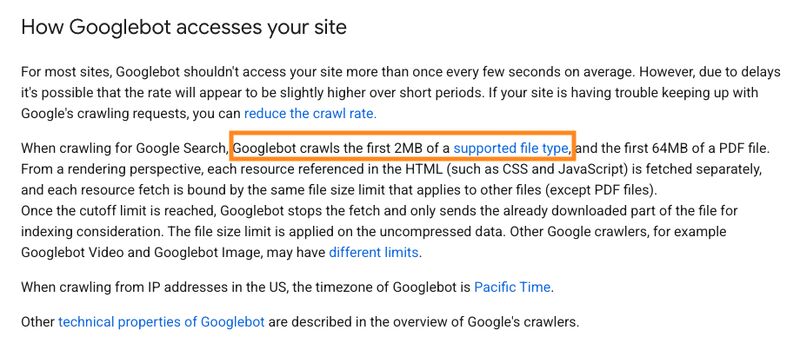
Nice catch via @Jammer_Volts on Google's reducing its crawl limit to 2MB per file type 🤖
The old limit was 15MB per file (HTML, CSS, etc)
If your webpages are > 2MB, Google probably won't crawl it all. If you render URLs in SC and see missing content, check file sizes
Introducing the Firecrawl Skill + CLI for Agents 🔥
Agents like Claude Code, Codex, and OpenCode need live quality context from the web.
The CLI pulls web content to local files with bash-powered search for the highest token efficiency.
$ npx skills add firecrawl/cli
I’ve come to the conclusion that the whole vibe-coding trend is just an expensive UX shell that gives most users the illusion of being actual developers.
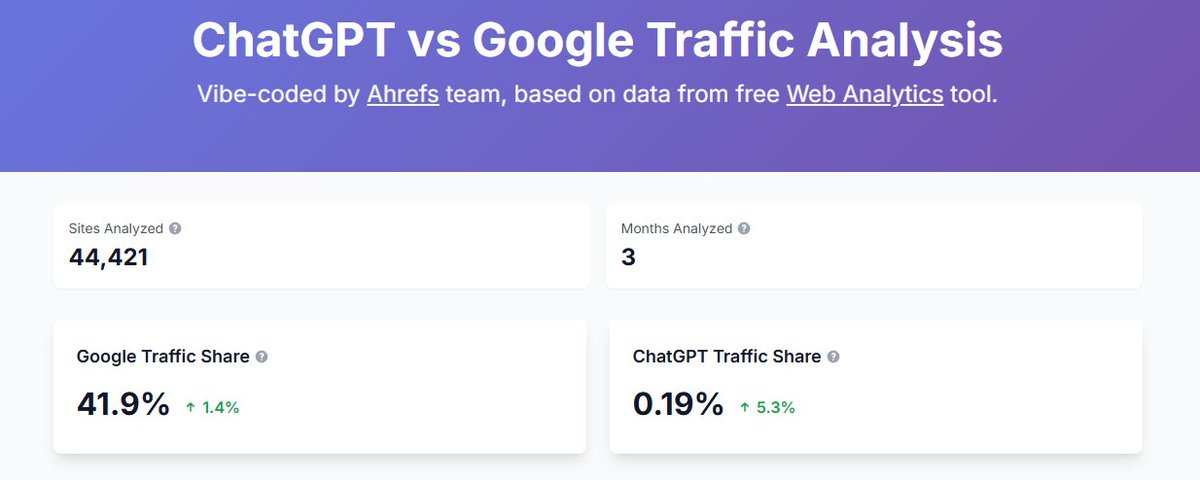
Create by the folks at @ahrefs -> 44K+ sites analyzed to see the percentage of traffic from ChatGPT versus Google. Yep, .19% right now on average for ChatGPT versus 42% for Google. ChatGPT is growing for sure, but .19%... https://t.co/rywYn1q6Ka
99% of the so-called “tips” and “recommendations” on writing natural AI-generated content are absolute rubbish. And you can tell from the very first sentence.
My personal favorite is: “Write me a high-value article.” Really? What on earth is a high-value article? High-value compared to what? What are the criteria for measuring that value?
You don’t know? Well, guess what—neither does the AI. You’re giving it a subjective instruction and expecting an objective outcome. It doesn’t work that way.
Try giving the same vague request to a human. Do you think they’d magically understand what you mean? Of course not. No matter how much the technology evolves, the weakest link in the process will always be the user who fails to give clear instructions.
Whaaaat!
@firecrawl just dropped, FireGEO, an *OPEN SOURCE* Semrush for AI search! 🔥
It’s a SaaS starter kit to:
↳ Monitor your site across AI platforms
↳ Benchmark against competitors
↳ Build with @DrizzleORM, @supabase, @aisdk, etc.
Fork the SaaS starter kit in 🧵↓
⚡ Legal topics lead the pack in AI Overviews, showing up for 77.67% of searches in YMYL niches. Is Google going easier on AI-generated content for law?
Google still relies on government sources to keep things accurate and relevant—and nearly 20% of AI Overviews include disclaimers, nudging users to “consult a professional.”
Want to know how AI Overviews compare in other YMYL areas? See our full research to find out: https://t.co/eeewON2COb
How long does it take for a link to a website to take effect?
Based on observations and conversations with colleagues:
- Some clients have noted their websites get a boost even before the backlink indexes, but this is more of an exception than a rule.
- Some specialists claim that a backlink starts to work on the day it's placed, although this opinion isn't predominant.
- Others have noticed that the link effect manifests within the first two weeks after placement.
My opinion on this matter has formed as follows:
- A backlink usually starts working within the first three months. This is confirmed by my experience and the opinions of many other SEO specialists.
- Backlinks from PBNs can show effects in as little as a week or as long as three months, but typically, this happens within one to two months.
- Backlinks from link exchanges have shown effects over several months.
Important to consider:
- All other ranking factors and search engine algorithm updates can impact website traffic and positions.
- A backlink cannot start working until it is physically indexed by the search engine, which can be verified by checking the indexation of the page with the link.
- Subjectively, links from more authoritative and powerful donors might start working faster.
I love web crawlers.
You’ve got to check out @nickscamara_’s awesome `Grok-2 web crawler`! 🔥
It can crawl any website w/ @xai's latest @Grok-2 model & @firecrawl.
link to the tool in the 🧵↓