Engineering | Product | Digital Transformation | Agilist (CSM)
Disclaimer: This is my personal account and I only share my personal views and opinions here.
As engineering, product, design, DS, etc. melt into a new kind of role, I was reflecting on what roles might look like in the future. For example, when I look at the Claude Code team I see what I think is five archetypes:
1. Prototyper: comes up with brand new ideas; churns out many ideas, most of which don't ship
2. Builder: quickly turns a prototype/idea into production-grade product/infra
3. Sweeper: cleans up the UI, simplifies the code and system, unships, optimizes performance
4. Grower: takes a product that has been built and iterates on it to improve Product-Market Fit
5. Maintainer: owns a mature system to make it secure, reliable, fast, and efficient as it scales
Many people span across 2 roles, and sometimes 3 roles. I also notice that these roles are not really tied to job function -- eg. across Anthropic, some designers match category 1, some 2, some 3; same for engineers, PM, DS.
A healthy team needs a mix of these, depending on the product:
- A product that is new and pre-PMF needs people that are strong at 1+2+3
- A product that is growing and has found PMF needs 2+3+4 and some 5
- A product that has strong PMF needs 3+4+5 and some 2
Maybe product roles of the future will look more like this, and less like the domain-specific roles of today?
We’ve identified a security incident that involved unauthorized access to certain internal Vercel systems, impacting a limited subset of customers. Please see our security bulletin:
https://t.co/0S939n3qHC
Introducing Claude Opus 4.7, our most capable Opus model yet.
It handles long-running tasks with more rigor, follows instructions more precisely, and verifies its own outputs before reporting back.
You can hand off your hardest work with less supervision.
Karpathy just outlined the next era of AI.
all over 66 minutes… I broke down his 10 major takeaways so you don’t have to watch the full video (but you still probably should after reading this)
here’s what he said matters most….
→ “I don’t think I’ve typed a line of code since December.” the default workflow for software engineers has changed permanently since late 2025. we don’t write code anymore. we express intent to persistent AI agents for 16+ hours a day
→ he coined “AI psychosis”… the anxiety of knowing you have unused tokens just sitting there. success isn’t measured in your flops anymore. it’s measured in your token throughput
→ the limits aren’t model capability anymore. they’re orchestration skill. the people who know how to direct agents are operating 10x above everyone else using the same tools
let me walk through all of his points…
1. mastery looks different now
Karpathy built a personal agent called “Dobby” that controls his entire home through natural language. persistence + memory + parallel agents = a 2 person team operating like a 20 person org
2. software becomes disposable
humans don’t need custom apps anymore. the customer is no longer the human… it’s agents acting on behalf of humans. entire industries have to account for and refactor for this
3. AutoResearch changes everything
his side project (github .com/karpathy/autoresearch)… fully autonomous research loops. agents edit code, train models, and iterate overnight while you sleep. human only writes the high level goal
4. the skills that matter now
understand that an agent can be both a brilliant PhD level systems programmer and a 10 year old’s unformed mind in the same conversation. and your job is to overcome those challenges and direct your agents. everything else they’ll soon do better
5. specialized models > one giant brain
stop trying to build one know it all mega brain model. the future looks like an ecosystem… diverse adaptable and specialized models built for specific jobs. a team of focused models beats one mega model every time
6. distributed research could disrupt the lab monopoly
imagine thousands of smartphones and computers around the world running AI experiments at the same time… not owned by one company. results are easy to verify but hard to discover.
it’s how open collaboration could disrupt big closed labs
decentralized internet
7. jobs data says something completely different than the narrative
Karpathy looked at all the real data. engineering job demand is still rising. cheaper engineering creates MORE demand, not less. like how ATMs actually created more bank teller jobs
8. open source is the safety net
open models generally lag frontier by 6-8 months but they’re also essential. closed models carry systemic risk from over-centralization.
Karpathy wants ensembles of minds, not 2-3 labs behind closed doors making decisions for everyone
9. robotics will lag badly
the physical world is messy and capital intensive. digital transformation will be orders of magnitude faster.
future prediction… most AI agents will pay humans to act as their hands and eyes in the physical world, creating information markets for real world data to sell between themselves
10. education gets rebuilt from scratch
the core LLM training algorithm fits in about 200 lines of Python. the rest is bloat.
the new model? humans explain concepts to agents once, agents tutor humans infinitely and personally.
write documentation for agents first.
yes, a markdown first file world
his one liner that hits hardest for me…
“I put in just very few tokens… and a huge amount of stuff happens on my behalf”
we’re in the era of autonomous agents.
humans become directors, not doers.
the leverage is insane, but it’s only really available to people who learn how to use it properly
if you’re building with AI now, this is required listening material imo
the ones who move first?
they don’t ask permission
they just do it: master AI
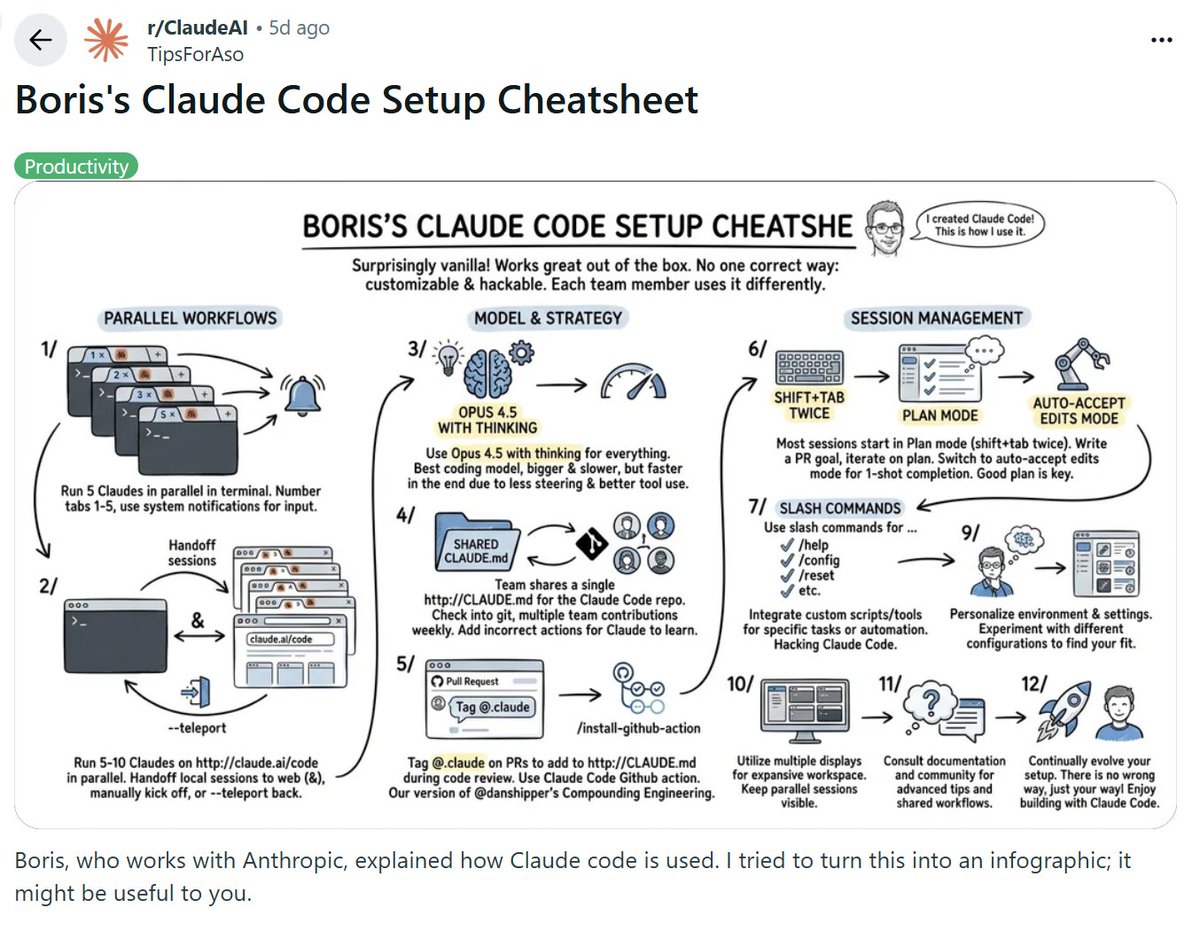
Claude Code 2.1.0 is officially out! claude update to get it
We shipped:
- Shift+enter for newlines, w/ zero setup
- Add hooks directly to agents & skills frontmatter
- Skills: forked context, hot reload, custom agent support, invoke with /
- Agents no longer stop when you deny a tool use
- Configure the model to respond in your language (eg. Japanese, Spanish)
- Wildcard support for tool permissions: eg. Bash(*-h*)
- /teleport your session to https://t.co/pEWPQoSq5t
- Overall: 1096 commits
https://t.co/5tP3jJKU2E
If you haven't tried Claude Code yet: https://t.co/4pvrYESSLd
Lmk what you think!
I have been fine-tuning LLMs for over 2 years now!
Here are the top 5 LLM fine-tuning techniques, explained with visuals:
First of all, what's so different about LLM finetuning?
Traditional fine‑tuning is impractical for LLMs (billions of params; 100s GB).
Since this kind of compute isn't accessible to everyone, parameter-efficient finetuning (PEFT) came into existence.
Before we go into details of each technique, here's some background that will help you better understand these techniques:
LLM weights are matrices of numbers adjusted during finetuning.
Most PEFT techniques involve finding a lower-rank adaptation of these matrices, a smaller-dimensional matrix that can still represent the information stored in the original.
Now with a basic understanding of the rank of a matrix, we're in a good position to understand the different finetuning techniques.
(refer to the image below for a visual explanation of each technique)
1) LoRA
- Add two low-rank trainable matrices, A and B, alongside weight matrices.
- Instead of fine-tuning W, adjust the updates in these low-rank matrices.
Even for the largest of LLMs, LoRA matrices take up a few MBs of memory.
2) LoRA-FA
While LoRA significantly decreases the total trainable parameters, it requires substantial activation memory to update the low-rank weights.
LoRA-FA (FA stands for Frozen-A) freezes matrix A and only updates matrix B.
3) VeRA
- In LoRA, low-rank matrices A and B are unique for each layer.
- In VeRA, A and B are frozen, random, and shared across all layers.
- Instead, it learns layer-specific scaling VECTORS (b and d) instead.
4) Delta-LoRA
- It tunes the matrix W as well, but not in the traditional way.
- Here, the difference (or delta) between the product of matrices A and B in two consecutive training steps is added to W.
5) LoRA+
- In LoRA, both matrices A and B are updated with the same learning rate.
- Authors of LoRA+ found that setting a higher learning rate for matrix B results in better convergence.
____
Find me → @akshay_pachaar
Every day, I share tutorials and insights on ML, LLMs, and AI Engineering.
Introducing AlphaEvolve, our Gemini-powered coding agent for designing advanced algorithms—in private preview.
AlphaEvolve uses LLMs to propose intelligent code modifications, creating a feedback loop that evolves your algorithms to be more efficient → https://t.co/PQtYUtOtkN
gemini 3 pro
• our most intelligent model yet
• SOTA reasoning
• 1501 Elo on LMArena
• next-level vibe coding capabilities
• complex multimodal understanding
available now in Google AI Studio and the Gemini API
Anthropic just posted another banger guide.
This one is on building more efficient agents to handle more tools and efficient token usage.
This is a must-read for AI devs!
(bookmark it)
It helps with three major issues in AI agent tool calling: token costs, latency, and tool composition.
How? It combines code executions with MCP, where it turns MCP servers into code APIs rather than direct tool calls.
Here is all you need to know:
1. Token Efficiency Problem: Loading all MCP tool definitions upfront and passing intermediate results through the context window creates massive token overhead, sometimes 150,000+ tokens for complex multi-tool workflows.
2. Code-as-API Approach: Instead of direct tool calls, present MCP servers as code APIs (e.g., TypeScript modules) that agents can import and call programmatically, reducing the example workflow from 150k to 2k tokens (98.7% savings).
3. Progressive Tool Discovery: Use filesystem exploration or search_tools functions to load only the tool definitions needed for the current task, rather than loading everything upfront into context. This solves so many context rot and token overload problems.
4. In-Environment Data Processing: Filter, transform, and aggregate data within the code execution environment before passing results to the model. E.g., filter 10,000 spreadsheet rows down to 5 relevant ones.
5. Better Control Flow: Implement loops, conditionals, and error handling with native code constructs rather than chaining individual tool calls through the agent, reducing latency and token consumption.
6. Privacy: Sensitive data can flow through workflows without entering the model's context; only explicitly logged/returned values are visible, with optional automatic PII tokenization.
7. State Persistence: Agents can save intermediate results to files and resume work later, enabling long-running tasks and incremental progress tracking.
8. Reusable Skills: Agents can save working code as reusable functions (with SKILL .MD documentation), building a library of higher-level capabilities over time.
This approach is complex and it's not perfect, but it should enhance the efficiency and accuracy of your AI agents across the board.
anthropic. com/engineering/code-execution-with-mcp
Official Release: ClosedAI Atlas
Thrilled to unveil ChatGPT Atlas: the world is first AI-powered browser, yes, we are calling it competing with Chrome.
What makes Atlas special:
1.Browse the web with AI assistance. Book hotels, order food, buy things, from Etsy and Shopify, our valued partners.
2.Directly rival Google Chrome. Well, rival is strong. Let us say: built on top of Google is open-source engine. But rival sounds better for investors.
3.Seamless data import from Chrome: bookmarks, passwords, history… and yes, now you let us see what Google cannot. You are our seamless integration. Thank you.
4. Smart usage limits for optimal experience: Free equals 20 AI queries per day, Plus equals 100, Pro equals 500, still not enough? Upgrade. Want more? Set Atlas as your default browser, that locks you in and builds our data moat. Loyalty equals value.
5.Built in record time: proposed November 2024, launched October 2025. Others might call it 11 months for a Chromium clone with chatbot, we call it record time. Narrative matters.
Addressing recent controversy:
Some voices in the community have questioned our research integrity. They claim we "overstated" GPT-5's math capabilities. They say we confused solved problems with unsolved ones. They say it was embarrassing.
To be clear:
We stand by our research. If there were inaccuracies, that is because:
The problems were almost unsolved.
Our AI almost found new solutions.
The academic community was almost impressed.
Almost is close enough for progress.
And regarding the feedback: That was not criticism. It was just passionate debate. We hope future discussions stay constructive. Not by fact-checking or peer review. Those are evolving concepts.
We hope future competitors will engage with us honorably. Not by fact-checking or peer review. Those are outdated concepts.
Resource optimization:
Atlas runs on premium bandwidth management. Sometimes you will see:
Too many concurrent requests.
Atlas is currently at capacity.
Your session has been rate-limited.
That is not a bug. It is exclusivity. Think of Atlas as the VIP club: you got in? Good luck. Did not? Try again later or upgrade. Scarcity equals value. Econ 101.
Business model transparency:
Free to download, yes. But: AI queries cost us. Bandwidth costs us. Google is development cost them 15 years; we did ours in 11 months. How do we monetize? Subscriptions plus shopping integration plus your browsing data, anonymized.
Anonymized means we remove your name, keep everything else. Technically anonymous.
In summary, Atlas is:
A Chrome clone with AI sidebar.
A data collection tool disguised as innovation.
Rate-limited to maximize subscription pressure.
Built fast, 11 months, record time.
Integrated only with platforms that pay us.
But we will call it:
Revolutionary.
First of its kind.
Directly competing with Chrome.
Built at unprecedented speed.
Welcome to Atlas.
The browser that browses you.
Scam Botman @sama
CEO, ClosedAI @OpenAI
Building the future, on Google is codebase.
PS. If Atlas crashes, check your query limit. You exceeded your free allowance. Upgrade if you want more.
P.P.S. About the Erdős incident: Our researchers acted in good faith. If academic standards were not met, that is academia’s opportunity to catch up.
P.P.P.S. Set Atlas as your default browser today. Your data is waiting. Send feedback, we are listening.
Efficient. Inevitable. Humanity.
@ashpreetbedi At Lendi Group, Agno is an orchestrator at the heart of our Agentic Architecture. We built peripheral features before AgentOS was released, and are so pleased with Agno2.0. Time to upgrade to AgentOS thanks to @ashpreetbedi and @AgnoAgi
📦 1st time founders focus on product
🚀 2nd time founders focus on distribution
💰 3rd time founders focus on MARGIN
bookmark this thread bc it'll haunt you
thx @samshank@far33d who I've talked to about this
cc: @VCBrags 😅
The second is the ability for artifacts to build "AI-powered apps" to which users can upload PDFs and images
What that means: Artifacts can call the real Claude API now via a monkey-patched fetch() that gets redirected through a proxy adding an API key
https://t.co/V5VJeR6SaQ
The first feature is the ability for Claude on mobile to trigger a human-in-the-loop native app dialog for adding a calendar event or sending a message or email - that's implemented using two new tools, event_create_v0 and message_compose_v0 https://t.co/qhksbvwxQj