CONDENSED VERSION (ecom):
Every time a competitor runs an ad, they're also creating buyers for you.
People see their Meta ads, get interested, don't buy, and search the product type on Google a few days later.
The brands at the top of that search get the sale.
So here's the setup:
1. Fix the foundation first
Set 1 primary purchase conversion, turn on enhanced conversions, and pass real order values from Shopify.
Then upload every customer you've ever had as a Customer Match list.
2. Cap brand at 20%
Run a brand campaign so competitors can't steal people searching your name.
BUT, never let it take more than 20% of spend, and exclude your brand from every other campaign.
3. Start Shopping with your best sellers
Begin with the products that already sell, then widen.
In this account, 2 collections out of 8 were carrying the results, so they got their own campaign and budget.
4. Add Search on high intent terms
Think "buy [product]", "[product] for sale", or the product type plus a feature.
Use tight ad groups, headlines that repeat the search, and landing pages that match.
5. Set prospecting targets near break even
A strict tROAS chases people who already know you.
Turn on the new customer goal and judge prospecting on new customer revenue.
6. Fix your feed
Shopping has no keywords, so your titles decide who sees you.
Write them as brand, product type, key attribute, then color or size.
7. Add Demand Gen and YouTube once capture maxes out
At $2K to $3K a day, we added static promo ads and moved their best Meta videos to YouTube.
Platform ROAS looked close to break even, but branded searches kept climbing.
8. Read impression share properly
Lost to rank means your ads or feed aren't strong enough.
Lost to budget means the demand is there and you're not paying for it.
9. Scale in steps
Raise budgets on campaigns above target, give each step a week, and judge it on MER and new customer revenue.
More in-depth breakdown in the article below:
Most ecom brands pay Meta twice.
Once to drive traffic. Again to retarget the 97% who didn't buy.
Here's the problem:
→ CPMs keep climbing ($10-15 avg)
→ Frequency kills your CTR
→ You're bidding against your own campaigns
The fix? Retarget that same traffic with Google Demand Gen.
YouTube, Shorts, Discover, Gmail — platforms where they've never seen your brand. Fresh touchpoint. Lower CPMs. Higher conversion rates.
I break down the exact setup in this video — audiences, creative, bidding, and how to use the new "Platform Comparable" column to compare Demand Gen vs Meta apples-to-apples.
Want to know how I can write like 100+ good ads in a single day using AI? For pretty much any format imaginable?
Well, here you go.
I did an epic live call today where I broke it down. Had like 400 people on at one point.
If you watch even the first 20 mins or so of this, I’m willing to bet you’ll get significantly better outputs with AI than you are right now. Vid is long-form, but it’s also saucy AF. Hope you enjoy :)
A new brand we started in June just crossed 100,000 orders today
Subscription based, no funding, no debt, profitable and hitting 7 figures per month
So how did we do it?
I hear all the time you need a lot of money to start a subscription based brand.
"prepare to be unprofitable for months until repeat revenue compounds"
At my core, I'm a retard and I like it when things are super simple
I haven't done any financial projections, borrowed money to fund growth or anything like that. I literally started this with a purchase order of 250pcs and a $100 per day ad budget
Here is the retard proof formula to starting a subscription focused brand if you don't want to float losses, borrow money, take on investment or spend hours in google sheets making projections and financial models etc
Pre-requisites:
- Fulfil form China in the beginning. Non negotiable IMO if you want to follow the same playbook. Will keep your costs minimal and with super fast lead times it lets you be very reactive to performance and scaling budgets etc without having to place large PO's or make projections with no data
- Do not enable subscriptions when starting. Adding subscriptions will always lower your conversion rate. In the beginning getting more conversions, more data, more traffic etc is far more valuable as you have limited budget. This will allow you to test offers, creatives etc faster as you'll be able to raise ad budgets faster
Ok lets go
At the start test offers to find something that lets you be first order profitable. For us this took around 1 week at a $100 a day budget
Then we started scaling making sure to maintain healthy margins
We scaled to around $1k per day and then introduced subscriptions. CVR rate lowered but take rate was high and we were still profitable first order
Once our first rebills started hitting we then raised budgets and scaled at break even on ads. Profits were driven by the repeat revenue
Those first re-bills won't be anything crazy which is why we didn't go below break even on front end as I didn't want to risk getting caught with my pants down.
Continue to scale at breakeven and let subs compound. This will add up quick and your margins should be very high going into second month of re-bills (we were averaging 45% net
Then once month 3 re-bills hit and we had some decent LTV data and cash in the bank we raised ad budgets and started scaling ads at a loss now knowing what CAC we could afford based on that data and the cash we had i
That's it. Nothing complicated, no fancy financial models needed
Just stay profitable first order in the beginning
When first re-bills start hitting, scale at breakeven. Collect profits from repeat rev
Once you have 3 month LTV data scale ads at a loss if your data allows it
This allowed us to never be in debt, always have money to fund inventory and scale
Worth mentioning we also were able to fund this growth while having 25% hold on PayPal
If you think you need to take on debt or raise money, sorry but it's a skill issue
I am terrible at maths and probably one of the most financially illiterate people you will ever meet in ecom, which is why I like to break things down to their most simple form
If I can do this, anyone can
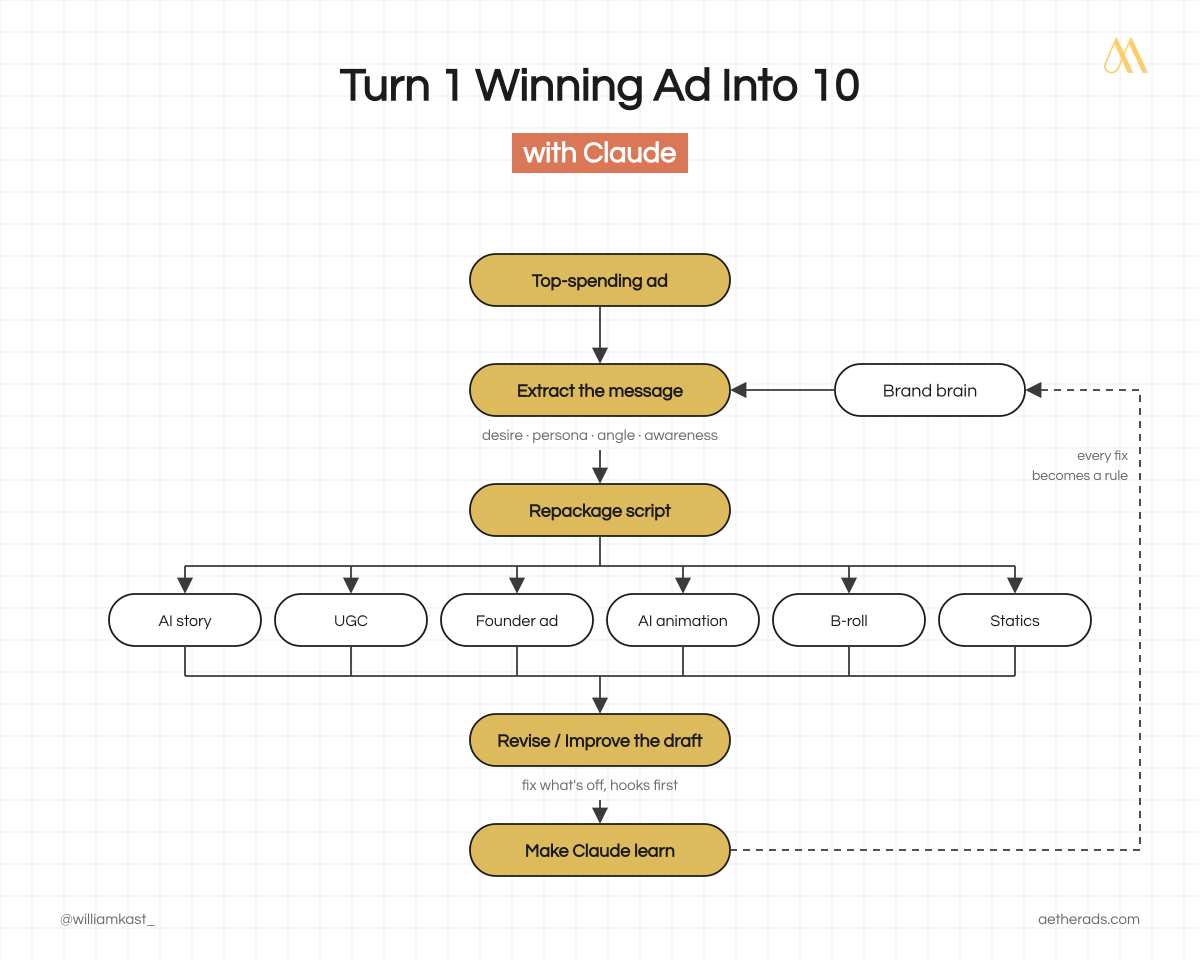
Our Ad Iteration Framework:
Step 1: Pick your winner
Take one of your top-spending ads of the last 7-30 days.
Transcribe the script, on-screen text, and scan the visuals with AI.
Step 2: Decode the message
Ask Claude to break down why it wins, not what it says:
- Desire: what does the buyer really want?
- Persona: who exactly is buying?
- Angle: how is the problem framed?
- Awareness level: how much do they know already?
Push it past demographics.
"Women 30-45 who want more energy" is useless.
"Someone who's exhausted by 2pm, tried 3 energy supplements that made her jittery, feels guilty she can't play with her kids" is a message you can repackage.
Feed all the learnings into your company brain first.
Otherwise it writes generic copy.
Don't let AI do all the thinking for you.
Use your own brain and common sense because AI will make mistakes.
Step 3: Repackage the script
Take the winning message that you decoded and keep those variables the same while changing the format.
- AI story: she nods off at school pickup, a friend tells her what fixed it
- UGC: a creator who lived the 2pm crash, talking to camera
- Founder ad: the founder answers "why did you build this?"
- AI animation: the crash explained visually in 60 seconds
- B-roll: visual organic storytelling + on-screen text, no voiceover
- Statics: "This weird energy hack keeps me going after 2pm"
Each format reaches a different pocket of your audience.
Step 4: Revise/ Improve the draft
Claude is great but not a world-class copywriter.
Read every script and check:
- Is the hook strong enough?
- No fluff?
- Does the hook fit the awareness level?
- Is it still the winning message, or did it drift?
- Does it sound human, or like AI?
Fix what's off.
Step 5: Make Claude learn
Every fix you make, tell Claude to save it as a rule for that brand.
Next batch, it gets it right without being told.
Your strategist stops fixing the same things twice.
That's it.
Don't let the winner die together with the format.
Most of the time, it's the format that's exhausted, not the winning message.
Native ads are one of the hardest ones to make actually work.
The image part is easy, just create a batch of 20 variants. Done. But the hard part is the storytelling and taking a reader from unaware to fully aware.
My ideal set up for the copy is:
1. Hook -> STOP the scroll + create curiosity
2. Problem -> Make them recognize themselves
3. Failed solutions -> WHY what they tried didn't work
4. Mechanism -> Explain what's ACTUALLY causing the problem
5. Solution -> Introduce your product naturally
6. Proof -> Reviews / authority / results
7. Offer -> Give them a reason to take action
The magic happens in the storytelling. Make it personal so someone from your ICP can literally think: “this is me.”
Talking in the same language as your ICP makes the storytelling actually stick (so research the keywords/language your audience uses in FB groups, Reddit etc).
We often see that a PDP works best in these cases when the copy is good. Bc the long-form primary text basically works as your prelander.
Some Native Tips:
-Always mention a family member in the story (husband, daughter, ex husband)
-Be creative - use something weird and wonderful in the image that doesn't feature the product but hooks people into the story
-Source native images via Google Images: "[thing] reddit" (e.g. "engagement ring reddit")
We’re printing $5M+ per month with native ads alone for our ecom clients.
Huge shoutout to @gethookdai and @FedotOff90 for building such a great tool.
We use Claude Opus 4.8 + Gethookd MCP to do the creative research and build out native ads for our 7-9 figure DTC clients.
Its Genuinely Over Ecom Lads.
New W update to the tool.
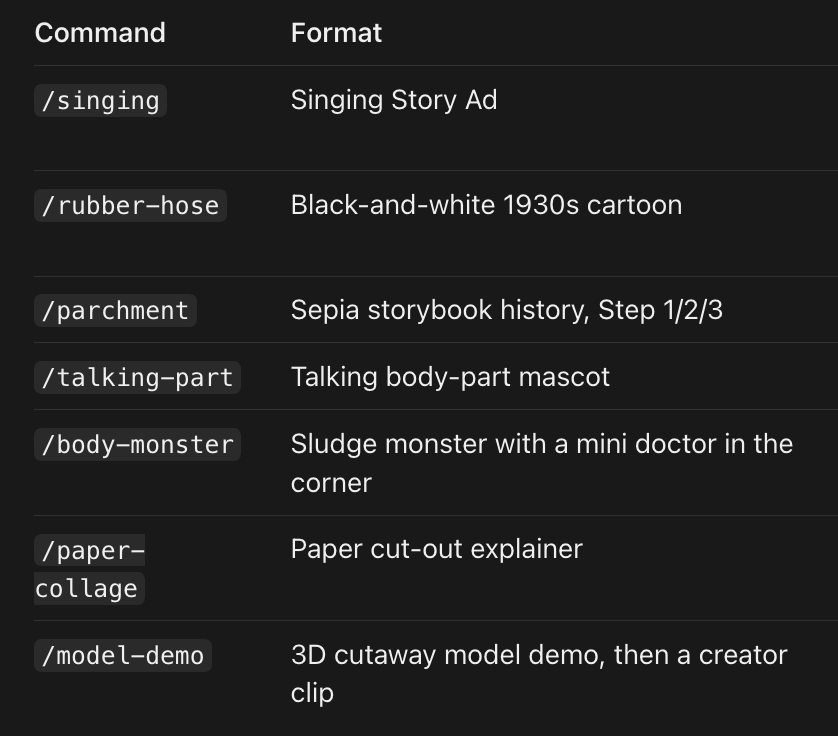
shit ton of new formats added.
Automated updates, The tool filters New trending ads and formats using spy tool connected to it
breaksdown the trending ads frame by frame, and stores in memory for new formats
this is the future, You're right here and missing out on it
quick observations from the claude fable and mythos 5.2 launch:
1/ it went from doing 21% of real freelance work to 41% in one release, so agencies are about to start charging per deliverable instead of per hour!
2/ it can work 10-12 hours on its own, which basically gives every small business a night shift (might as well use it if you know what you want to build)
3/ over 90% of anthropic's own code is now written by claude, and so i think the solo $1b founder is coming soon
4/ one engineer ran 1000+ subagents for 8 days and got an operating system that boots, so the ancient software running hospitals and airlines is finally rebuildable (lots of opportunity here on rebuilding)
5/ it designed 3 working electronic devices from a single prompt, which makes 1 person hardware companies a real thing
6/ it now says "i don't know" instead of guessing, and that's what law, medicine and finance have been waiting for (this has been the biggest thorn for these industries, hard to trust guessing)
7/ 1000 agents formalized fermat's last theorem in 30 hours, so software that's mathematically proven not to break is coming for payments and medical devices
8/ mythos is only for verified orgs, which means someone is going to build a business selling what only they have access to
9/ the models are getting better at noticing when they're being tested, so testing ai out in the real world is about to become its own industry
i love new model day
Check These 5 Critical Settings in Meta BEFORE Black Friday
Open Ads Manager and go to Advertising Settings.
Everything here applies to your whole account, so one bad default hits every campaign.
1. Placement controls
Pull your placement breakdown for the last 6 to 12 months.
Turn on "My business can only advertise on specific placements" and uncheck anything that lost money.
Audience Network should come off for almost every brand, and Marketplace too unless you sell a cheaper impulse product.
2. Existing customers
Stack an all time purchaser CSV, a Klaviyo purchase event, and the pixel purchase event on its longest window.
Any one source alone misses buyers, and Meta counts the buyers it misses as new customers.
Refresh the CSV every month.
3. Engaged audience
An Instagram like and a 2 minute product page visit carry VERY different value.
High AOV brands should require a view content or add to cart in the last 30 to 90 days.
Low AOV brands can use 14 to 30 days.
4. Test new creative features
Turn it off, then hit Edit test and uncheck everything except translate media, comment keywords and image touchups.
If you leave it on, Meta runs AI experiments on your ads with your budget.
5. Catalog ads
Product browsing is on for existing ads unless you opted out before October 28.
Warm buyers who tap your ad can end up in a catalog of carousels instead of your site.
Turn off "Add product browsing" under Advantage+ creative and in Destination on every ad, including duplicates.
Then turn off videos in your catalog ads (the "Dynamic media" toggle).
If you leave it on, Meta swaps your product images for catalog videos that rarely beat a clean product shot.
Plenty of 7 to 9 figure brands skip these basics.
Don't be one of them.