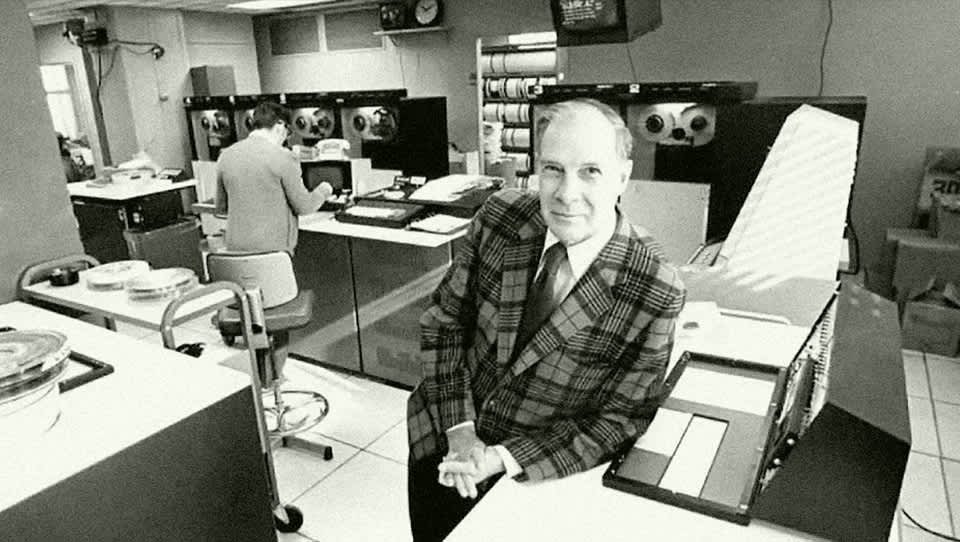
A mathematician who shared an office with Claude Shannon at Bell Labs gave one lecture in 1986 that explains why some people win Nobel Prizes and other equally smart people spend their whole lives doing forgettable work.
His name was Richard Hamming. He won the Turing Award. He invented error-correcting codes that made modern computing possible. And he spent 30 years at Bell Labs sitting in a cafeteria at lunch watching which scientists became legendary and which ones faded into nothing.
In March 1986, he walked into a Bellcore auditorium in front of 200 researchers and told them exactly what he had seen.
Here's the framework that has been quoted by every serious scientist for the last 40 years.
His opening line landed like a punch. He said most scientists he worked with at Bell Labs were just as smart as the Nobel Prize winners. Just as hardworking. Just as credentialed. And yet at the end of a 40-year career, one group had changed entire fields and the other group was forgotten by the time they retired.
He wanted to know what the difference actually was. And he said it wasn't luck. It wasn't IQ. It was a specific set of habits that almost nobody is willing to follow.
The first habit was the one that hurts the most to hear. He said most scientists deliberately avoid the most important problem in their field because the odds of failure are too high. They pick a safe adjacent problem, solve it cleanly, publish it, and move on. And because they never swing at the hard problem, they never hit it. He said if you do not work on an important problem, it is unlikely you will do important work. That is not a motivational line. That is a logical one.
The second habit was about doors. Literal doors. He noticed that the scientists at Bell Labs who kept their office doors closed got more done in the short term because they had no interruptions. But the scientists who kept their doors open got more done over a career. The open-door scientists were interrupted constantly. They also absorbed every new idea passing through the hallway. Ten years in, they were working on problems the closed-door scientists did not even know existed.
The third habit was inversion. When Bell Labs refused to give him the team of programmers he wanted, Hamming sat with the rejection for weeks. Then he flipped the question. Instead of asking for programmers to write the programs, he asked why machines could not write the programs themselves. That single inversion pushed him into the frontier of computer science. He said the pattern repeats everywhere. What looks like a defect, if you flip it correctly, becomes the exact thing that pushes you ahead of everyone else.
The fourth habit was the one that hit me the hardest. He said knowledge and productivity compound like interest. Someone who works 10 percent harder than you does not produce 10 percent more over a career. They produce twice as much. The gap doesn't add. It multiplies. And it compounds silently for years before anyone notices.
He finished the lecture with a line I have never been able to shake.
He said Pasteur's famous quote is right. Luck favors the prepared mind. But he meant it literally. You don't hope for luck. You engineer the conditions where luck can land on you. Open doors. Important problems. Inverted questions. Compounded hours. Those are not traits. Those are choices you make every single day.
The transcript has been sitting on the University of Virginia's computer science website for almost 30 years. The video is free on YouTube. Stripe Press reprinted the full lectures as a book in 2020 and Bret Victor wrote the foreword.
Hamming died in 1998. He gave his final lecture a few weeks before. He was 82.
The lecture that explains why some careers become legendary and others disappear is still free. Most people who could benefit from it will never open it.
The math on this project should mass-humble every AI lab on the planet.
1 cubic millimeter. One-millionth of a human brain. Harvard and Google spent 10 years mapping it. The imaging alone took 326 days. They sliced the tissue into 5,000 wafers each 30 nanometers thick, ran them through a $6 million electron microscope, then needed Google’s ML models to stitch the 3D reconstruction because no human team could process the output.
The result: 57,000 cells, 150 million synapses, 230 millimeters of blood vessels, compressed into 1.4 petabytes of raw data. For context, 1.4 petabytes is roughly 1.4 million gigabytes. From a speck smaller than a grain of rice.
Now scale that. The full human brain is one million times larger. Mapping the whole thing at this resolution would produce approximately 1.4 zettabytes of data. That’s roughly equal to all the data generated on Earth in a single year. The storage alone would cost an estimated $50 billion and require a 140-acre data center, which would make it the largest on the planet.
And they found things textbooks don’t contain. One neuron had over 5,000 connection points. Some axons had coiled themselves into tight whorls for completely unknown reasons. Pairs of cell clusters grew in mirror images of each other. Jeff Lichtman, the Harvard lead, said there’s “a chasm between what we already know and what we need to know.”
This is why the next step isn’t a human brain. It’s a mouse hippocampus, 10 cubic millimeters, over the next five years. Because even a mouse brain is 1,000x larger than what they just mapped, and the full mouse connectome is the proof of concept before anyone attempts the human one.
We’re building AI systems that loosely mimic neural networks while still unable to fully read the wiring diagram of a single cubic millimeter of the thing we’re trying to imitate. The original is 1.4 petabytes per millionth of its volume. Every AI model on Earth fits in a fraction of that.
The brain runs on 20 watts and fits in your skull. The data center required to merely describe one-millionth of it would span 140 acres.
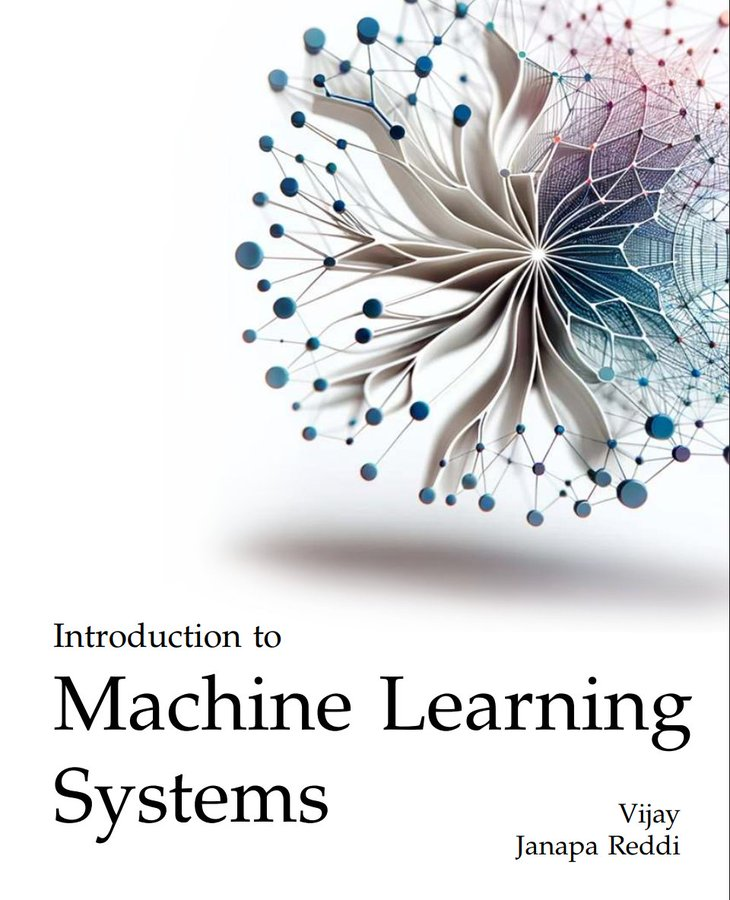
"Introduction to Machine Learning Systems"
- FREE from MIT Press
- Authored by Harvard Professor
- 2048 Pages
To Get It Simply:
1. Retweet & Reply "ML"
2. Follow so that I will DM you.
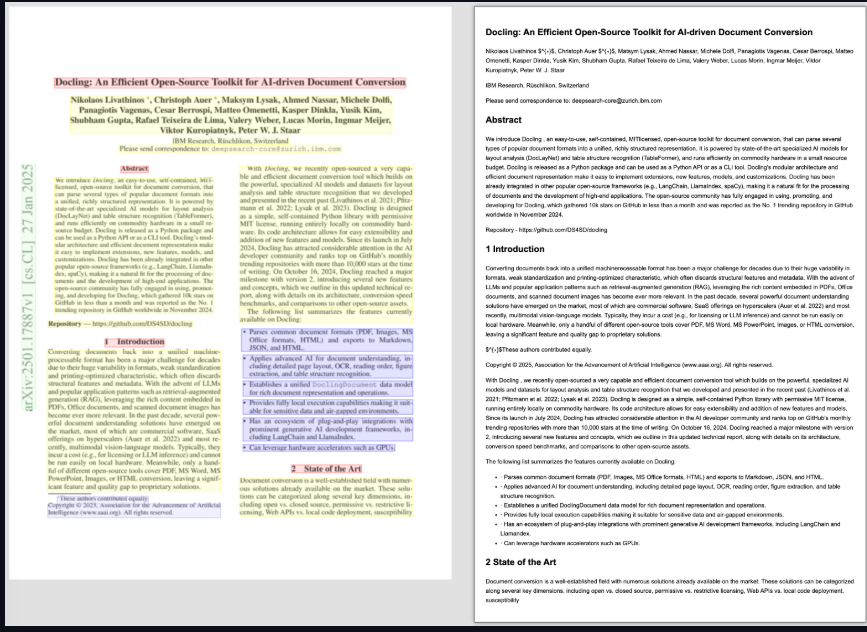
🖇️ IBM just released a tiny document VLM, Granite-Docling-258M.
- converts PDFs into structured text formats like HTML or Markdown while preserving layout
- accurately recognizes and format equations including inline math, handle tables, code blocks, and charts, support full-page or region-specific inference
- answer questions about a document’s structure such as section order or element presence, and even process content in English plus experimental Chinese, Japanese, and Arabic.
Ships under Apache 2.0, and plugs straight into the Docling toolchain.
It is a 258M parameter image+text to text model that outputs Docling’s structured markup so downstream tools can keep tables, code blocks, reading order, captions, and equations intact, rather than dumping lossy plain text, and IBM positions this as end-to-end document understanding, not a general vision system.
Under the hood it takes the IDEFICS3 recipe and swaps in siglip2-base-patch16-512 as the vision encoder plus a Granite 165M language model, connected by the same pixel-shuffle projector used in IDEFICS3, which explains how it stays small but layout aware.
The main key capability is layout-faithful conversion with enhanced equation and inline math recognition.
For usage it is already wired into Docling CLI and SDK, so you can run full-page or bbox-guided inference and export HTML, Markdown, or split-page HTML with layout overlays right from the terminal.
other words, human achievers are the opposite of statistical prediction machines. How many scientific discoveries were made through serendipity ?
The next great leap in AI will be made by "unprediction machines" that will have an equivalent of optimism and confirmation biases.
Optimism bias is a fundamental pillar of our civilization. If some of us were not biased to go against probabilities, who would create great technologies, make scientific breakthroughs ? The next leap in AI will happen when we stop thinking about LLMs as
beginning of his journey, we will see tremendous optimism and immense confirmation bias. The first is needed to go against statistics and disregard extremely low probability of success The second is needed to disregard multiple negative signals and only notice positive ones. In
Here's my conversation with Jack Weatherford all about Genghis Khan and the Mongol Empire. He is the author of Genghis Khan and the Making of the Modern World and many other books on the Mongol Empire. This was a truly fascinating conversation!
It's here on X in full and is up everywhere else (see comment).
Timestamps:
0:00 - Introduction
0:56 - Origin story of Genghis Khan
42:42 - Early battles & conquests
55:23 - Power
57:45 - Secret History
1:11:10 - Mongolian steppe
1:14:27 - Mounted archery and horse-riding
1:22:48 - Genghis Khan's army
1:39:00 - Military tactics and strategy
1:51:24 - Wars of conquest
1:55:48 - Dan Carlin
2:05:49 - Religious freedom
2:21:36 - Trade and the Silk Road
2:30:21 - Weapons innovation
2:31:52 - Kublai Khan and conquering China
3:13:43 - Fall of the Mongol Empire
3:40:38 - Genetic legacy
3:50:32 - Lessons from Genghis Khan
4:00:48 - Human nature
4:03:58 - Visiting Mongolia
4:23:27 - Lex: Dan Carlin
4:26:17 - Lex: Gaza
we've seen nothing yet! hosted a 9-13 yo vibe-coding event w. @robertkeus this w-e (h/t @antonosika@LovableBuild)
takeaway? AI is unleashing a generation of wildly creative builders beyond anything I'd have imagined
and they grow up *knowing* they can build anything!
An attempt to explain (current) ChatGPT versions.
I still run into many, many people who don't know that:
- o3 is the obvious best thing for important/hard things. It is a reasoning model that is much stronger than 4o and if you are using ChatGPT professionally and not using o3 you're ngmi.
- 4o is different from o4. Yes I know lol. 4o is a good "daily driver" for many easy-medium questions. o4 is only available as mini for now, and is not as good as o3, and I'm not super sure why it's out right now.
Example basic "router" in my own personal use:
- Any simple query (e.g. "what foods are high in fiber"?) => 4o (about ~40% of my use)
- Any hard/important enough query where I am willing to wait a bit (e.g. "help me understand this tax thing...") => o3 (about ~40% of my use)
- I am vibe coding (e.g. "change this code so that...") => 4.1 (about ~10% of my use)
- I want to deeply understand one topic - I want GPT to go off for 10 minutes, look at many, many links and summarize a topic for me. (e.g. "help me understand the rise and fall of Luminar"). => Deep Research (about ~10% of my use). Note that Deep Research is not a model version to be picked from the model picker (!!!), it is a toggle inside the Tools. Under the hood it is based on o3, but I believe is not fully equivalent of just asking o3 the same query, but I am not sure.
All of this is only within the ChatGPT universe of models. In practice my use is more complicated because I like to bounce between all of ChatGPT, Claude, Gemini, Grok and Perplexity depending on the task and out of research interest.
Check out my latest article: Optimizing Security for Apps Built with No-Code Platforms like Replit: A Guide for Non-Technical Creators https://t.co/DfKlPs45yT via @LinkedIn