RWX now supports mapping SSO identity provider groups to RWX groups via SCIM. Both SSO and directory sync can be configured in your organization authentication settings. https://t.co/3Q2IVFVzYZ
DBOS now integrates with the Vercel AI SDK!
This integration makes your AI SDK agents durable, backed by your Postgres database.
It checkpoints every action (model and tool call) your agents take in Postgres, so if your agent is interrupted, it automatically uses those checkpoints to recover from where it left off.
This lets you build long-running agents with a human in the loop, or agents performing sensitive or critical tasks, without worrying about what happens when models or infrastructure fail.
Check it out! 👇
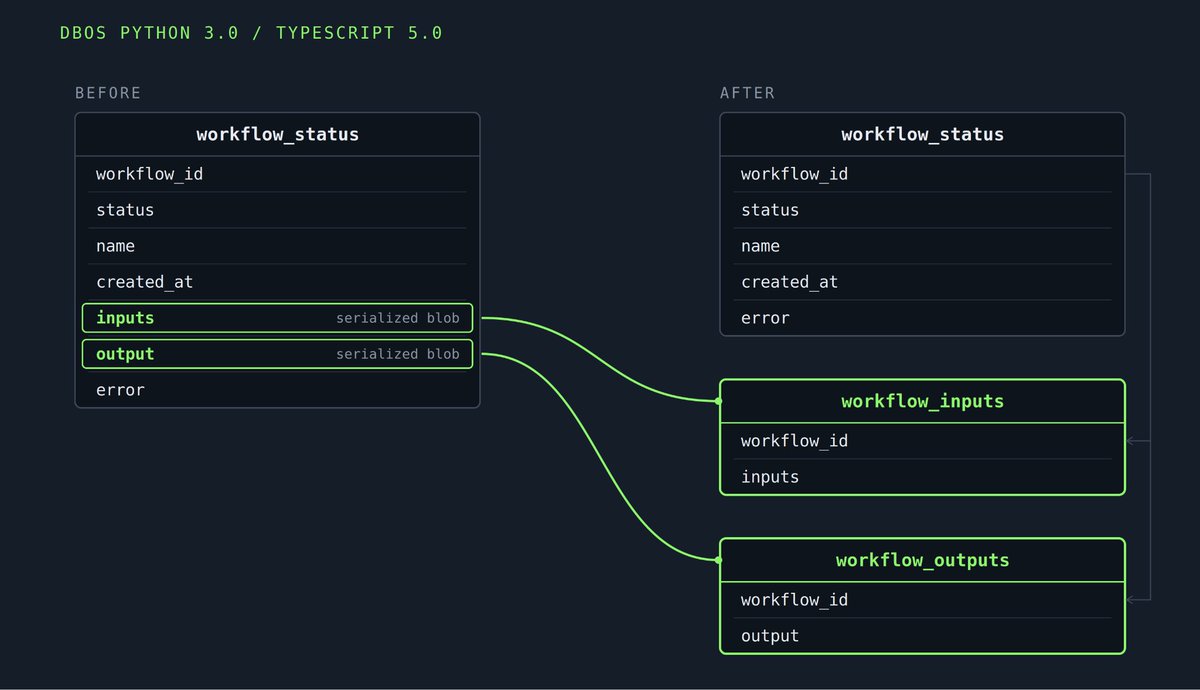
We’ve just released new major versions of DBOS Python (3.0) and TS (5.0)!
The headline features are schema changes (namely, splitting workflow inputs and outputs into their own tables) that should substantially improve performance at scale, especially when workflow data volumes are large.
We’re also releasing large optimizations to workflow retention policies. More on that later in future posts…
As major versions, these remove some deprecated/legacy interfaces. We’ve published upgrade guides to help you migrate away from these if you’re still using them.
Check out the release notes 👇
Want to know how we built durable execution in Rust on top of Postgres?
Check out this video for a first look at DBOS Rust, where Harry walks through how it works under the hood and demos what building durable Rust applications with DBOS looks like.
Recorded at the DBOS User Group Meeting on September 10, 2026. Feedback is much appreciated!
https://t.co/hhny5dTJhn
RWX CLI v3.28.0 now supports authentication via Claude's agent proxy (https://t.co/cGbDavPpuP). If you have a Pro or Max Claude subscription, you can use our documentation (https://t.co/xdeAh4dGF5) to set it up.
What is intelligence? Memory? Just a bunch of facts used at the right time?
I’ve spent a lot of time thinking about agent memory. Tulving’s 1972 work on episodic vs semantic memory is surpisingly still very relevant - how does human memory work - referenced by lots of much more recent papers on agentic memory.
At @HeyHelixAI we use our own custom relational data store plus @zep_ai Graphiti + @falkordb - storage is the relatively easy bit; context is a bigger challenge. Retrieving the right memory, in the right context, at the right time, efficiently, and ensuring the agent has acces to retrieve more if necessary (tools etc.)
If I ask for a hotel in the Le Marais neighbourhood twice, is that now a preference? Just for Paris? Does it decay? Should the agent ask before assuming? What would a human do?
Such a fascinating challenge... @MillaJovovich thinks so too (didn't use @mempalaceai for this tho).
Anybody else working on interesting memory challenges? Keen to share notes.
Check out this new tutorial video. Harry demonstrates the new DBOS Conductor CLI tool, dbosctl, for managing durable workflow execution.
See how you can inspect and manage workflows directly from the terminal, making it easier to operate DBOS applications from local and CI/CD environments.
This demo is from the DBOS User Group Meeting on September 10, 2026.
https://t.co/cmCIQhK9xz
We've worked with the team at @cursor_ai to build and launch a first-class integration between Cursor Origin and @rwx
Origin’s landing page says, "Code is moving faster than any infrastructure was built to handle. Origin was designed for this moment."
Similarly, RWX is the CI platform uniquely built for this moment.
2x the builds, half the duration — that's what @honeycombio saw after switching from CircleCI to RWX in March 2026.
@lizthegrey (Technical Fellow at Honeycomb) included the exhibit below in the company's blog post, "AI Amplifies Your Existing Practices: Lessons from Our Shift to an AI-First Strategy."
As Liz puts it: "Fast CI is no longer a nice-to-have. It's now a precondition for AI throughput to be worth anything at all."
Read Honeycomb’s full post: https://t.co/SGCToc1GXw
Really enjoyed this write-up from @getpostman on how they built Fern Agent.
It's a good example of durable agents with DBOS in action: checkpointing model and tool calls in the same Postgres database the agent already uses, then picking up where it left off after crashes or deploys.
https://t.co/4TVCfbgzld
It's been another busy summer month for the DBOS team. I wrote a new blog post covering what's new, including:
- 10x faster partitioned queues
- DBOS Golang 1.0
- Interoperability across applications and languages
- The new dbosctl CLI
- OpenMetrics preview page
…and much more.
It's exciting to see teams using these capabilities to build reliable applications and AI agents at scale. Let us know what you'd like us to build next!
Seconded. But with content-based caching, you don't even need the attestations. If the agent loop ran CI, then when the PR is opened, the entire run will be a cache hit and finish in one second. That's how we do it with @rwx
I spend less time clicking around web UIs and more time in the terminal these days. CLI tools are often easier for agents to understand and use, and they're becoming easier for me too. I can type what I want, ask an agent to run it, or use them in CI/CD pipelines.
That's one reason we built dbosctl, a new open-source CLI for managing DBOS workflows, applications, and migrations. You can still use the web UI. But if you're like me, you can now stay in your terminal and avoid unnecessary context switching.
the team at https://t.co/9AklLXTPMl (with @qianl_cs ) have interesting & innovative ideas. worth taking a glance at what they are doing, if you haven't yet. and when they do a meetup - even if the product isn't a fit for you, it's always a great engineering discussion
DBOS Python just crossed 100K daily downloads for the first time, up >50% since the start of last month and >10x since the start of the year!
Really excited by this continued growth, but we won’t stop building: our goal is for every complex application to be durable by default, the same way databases make all data durable by default.