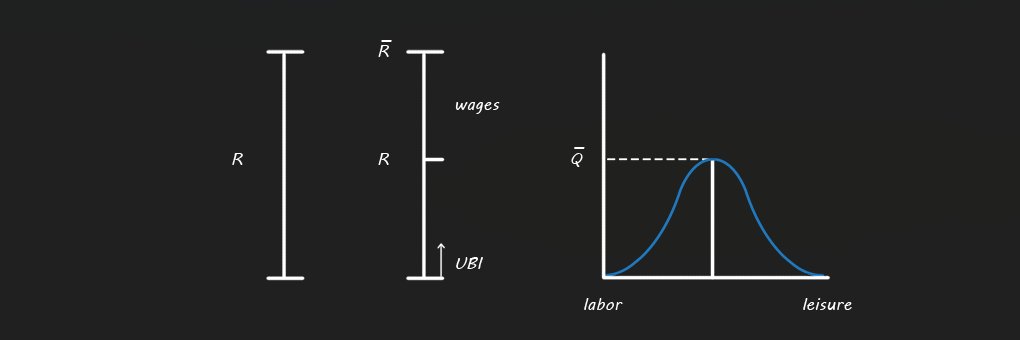
I wrote a new paper describing Calibrated Basic Income, a macroeconomic policy in which an adjustable #UBI supports aggregate consumer spending.
Keeping the UBI adjustable is key to both preventing inflation and maximizing the benefit to consumers.
https://t.co/S0PQWBXoTi
@MMT101DotORG@tonyannett That is how it's phrased in MMT (no constraint) and I think this is misleading.
Banks and governments alike face credit constraints when issuing debt or money.
Inflation is a partial default on the value of a currency; it's a broken IOU same as a bank that can't pay up.
@MMT101DotORG@tonyannett Money as a tax credit and the associated concept of monetary sovereignty.
Governments' constrained ability to create money is better explained by their similarities to banks and not their differences.
Take the chartalism out and it's easier to see why deficits are not abnormal.
@FAHayekSays In other words the quantity theory can work as a heuristic; good enough under many circumstances but wanting in others.
Friedman tried to close the gap with the idea of a time delay but this leaves open the question: what necessarily causes a rise in prices at any time?
@VraserX Everyone acts like people receiving no-strings money is a problem unless it's accompanied by other things.
However, we already have many redistributive policies and other add-ons.
What's missing today is unconditional cash. That's the key piece a more labor-efficient economy.
@rcbregman UBI is a way to allow the average person to buy as much or more while working less.
What makes that possible? Labor-saving tech (such as AI).
If you tax AI you're taxing something that makes a higher UBI more sustainable.
So: the higher the tax the less UBI we can afford.
@jawwwn_@sama@davidfaber How about this for a more inspiring message.
Providing everyone greater wealth & leisure opportunity is the whole point of the economy in the first place.
Restricting income to earnings alone was always a broken assumption; the highest possible UBI should be our goal.
@spartanmadeit@DaveShapi@pmarca I'll debate anyone taking that position for free.
I don't think mass technological unemployment will necessarily happen (that depends on our policy choices) but it should.
Saving labor is a good thing and we should be facilitating greater efficiency; not standing in the way.
@BernieSanders UBI is worth doing for its own sake. Direct fiscal support of consumer income simply makes economic sense in the face of greater labor efficiency.
To do this does not require taxing AI, but AI (as a visible example / symbol of labor-saving tech) makes a convenient excuse.
@Mstrainer19@DaveShapi You can advocate for various public services, that's fine.
The makework I'm talking about exists in the private sector. The employment level is currently being propped up artificially (with cheap debt) as kind of a fake UBI.
That's a wasteful way to support aggregate demand.
@Mstrainer19@DaveShapi What you're missing is that makework is also a way to hand people money for nothing, it just also wastes resources and people's time.
No one reasonable would be in favor of waste. I think that most people simply don't realize that the absence of UBI inevitably causes makework.
@Mstrainer19@DaveShapi Any time you create a useless (bullshit) job, you're using up resources for no benefit.
This reduces real incomes. It makes the average person poorer compared to what would have been possible if you delivered the money directly (without wasting resources) through UBI.
@Mstrainer19@DaveShapi The function of UBI is to support consumer income efficiently (without generating makework).
That's an important problem to solve regardless of other policy debates.
@garyseconomics I wouldn't go so far as to say we should remove all taxes but it's true we can spare people from income tax and the economy would be fine.
We should be taxing externalities and resources we want to conserve; taxing incomes actually makes it *harder* for the gov't to fund itself.
@VraserX People respond to greater freedom in different ways. Society might not like all the things people get up to.
However, the alternative to letting people enjoy more leisure is to create useless work as an excuse to employ them.
I think the costs of freedom are worth it.
@DaveShapi A lot hinges here on how we define terms such as drudgery.
Compensated drudgery can be useful; this is what waged labor is for.
The fail-state I'm concerned about is keeping too many people in jobs for no reason; wasting labor.
@Noahpinion I hate to break it to you, but it's not just professors. The entire private sector labor market is currently being subsidized to keep employment artificially high.
We just don't realize it because we still incorrectly assume that full employment = maximum production.
@Noahpinion Well, AI can make labor less necessary but that's only in theory.
In practice, the employment level will have to stay artificially high, wasting labor; because if we allowed it to fall this would cause deflation.
That's the problem with not having a UBI.