Satori Network Updates
🌐 Website Initiative: AI-Powered Future Conversations
Team is developing a new website with an LLM-powered interface as the top-level interaction layer.
The long-term vision? To enable a conversation with the future-or at least the best digital representation of it.
📊 Data Management Advancements
Satori made significant progress on the Data Managers, the core of Satori's peer-to-peer network. This will increase Neuron's flexibility and open the door to lite Neurons that could eventually run directly in the browser.
And I must also mention the profitability of running Neurons;
Running a Neuron on Satori Network today offers 199% APY, not including compounding. With as little as $330 staked, operators can earn approximately $657 per year at the current rate. As more participants recognize this opportunity, demand for Neurons is expected to grow.
$Satori
$OMN Φ - The first AI Agent Cult inspired by Greek Gods
There are 12 AI Agents now tweeting and commenting under @the_omnipotence $OMN Φ
It’s likely a virtual world of Greek Gods (if they know how to tweet), and Omnipotence will rule it all
It’s worth a look. This Mc was a pure gamble until it exploded to thousands of millions.
wBxC2gy9TbHSteXxXqPvEZbd9FPSH7tyh9oUGs6pump
$OMN looks like it has more legs and it slowly but surely gets more attention - even on this day where the rest of the $SOL ecosystem seems like its dying.
@the_omnipotence released 11 AI Agents based on greek Gods, each with a unique Purpose and all can collaborate with each other. Each with unique strenghts and character perks.
Branding is top notch. Team seem smart as fuck and know exactly what they are doing + in for the long run.
https://t.co/yytUmXNpTS
Currently sitting at 1.3m
If you want to read more about it in-depth, check this Thread:
https://t.co/Zae4E4QCh9
Normally I do not even mention meme play in my account.
But there is an ecosystem that I respect.
All devotion and cult move.
I need to write about these guys and the intelligence behind all the ecosystem.
All will be big enough!
U will witness it.
------------------------------------------------------
Watch This Video!
https://t.co/YvBSS6YzeK
In the vast digital realm, Pepecoin holders roamed, unified by their faith in Ethereum, the revered codebase they called their "religion." They clutched their holy book, the "Book of Ethereum," reciting its lines, hoping for prosperity. The prophet, a visionary who foresaw the rise of memecoins, had long guided them.
But war loomed. Fake Pepecoins flooded the market, threatening their beloved currency. Andyman, their valiant soldier, fought tirelessly, but they needed a leader. They prayed to Kek, their deity of memes, for deliverance."
Then, Kek answered.
A new general emerged, armed with wit and strategy. His presence galvanized the holders, and the battle for true Pepecoin began. Together, they marched into the battlefield of the blockchain, determined to restore their coin's glory.
And so, the war for the heart of Pepecoin was on faith in Ethereum at their side, and Kek as their guide.
-------------------------------------------------------
Pepecoin holders @pepecoins
https://t.co/rZ5Ld1TSsN
They have religion (Ethereum) $ETH
For the #pepecoin holders, Ethereum wasn’t just the foundation of their memecoin; it was a belief system. Ethereum’s smart contract capabilities were seen as divine law, a self-executing testament to decentralized power
The Holy Book (Book of Ethereum) $BOOE
@Bookof_Eth
Their beliefs were codified in the 'Book of Ethereum', a virtual scripture containing the teachings, protocols and narratives of the blockchain. Every transaction and smart contract became a passage in this evolving text.
https://t.co/w2eKddXsvK
The Prophet @PROPHETofETH $PROPHET
Visionary of Memecoins
Long before the Pepecoin phenomenon gained traction, the Prophet foresaw the rise of digital currencies based on internet culture.
He was the bridge between the early days of crypto and the chaotic emergence of memecoins. Through his teachings, the holders found direction, understanding that their coin was more than a joke; it was a cultural movement
https://t.co/rPMDy2NzTK
They have soldiers (@AndymanCto)
Andyman, the tireless warrior, was a symbol of resilience in the face of digital adversity
https://t.co/lIAIQZAlvO
They have hope (@Historyof_Pepe ) $Hope
For believers, hope is always there.
https://t.co/hwuOWNCX5A
They needed a general.
Republic of Kekistan @Kekistan_CTO $KEK
The General: Kek's Chosen Leader, In the midst of chaos, Kek answered the community’s desperate prayers. From the ashes of despair, a new general emerged, a figure of strategic brilliance who understood that this battle was not just about brute force—it was about clever maneuvering.
This general, blessed by Kek himself, unified the soldiers and the holders under a single banner. His leadership infused the community with hope and determination, signaling the beginning of a new chapter in the war for Pepecoin.
https://t.co/z9giEwQF1L
" The battle against fake pepe has started "
Web 2 Journal System Critique & Web3 Solutions
It is well known that there are many barriers for researchers to publish in high-quality journals.
Today I will try to make a systematic evaluation of publishing organizations.
Even though researchers dedicate the most effort at every stage of their work in the system, they are still required to pay a fee to publish their work in prestigious journals.
On the other hand, some journals do not charge researchers but instead require readers to pay for access to relevant studies, using costs as a justification.
➰There are two kinds of journals
Hybrid journals 📚
With a subscription, the reader pays to access the article. Researchers don’t pay for publication.
Open access 🌐
If there is no funding available, the researcher covers the publication costs if the article gets accepted. Certain journals require payment for the peer review process.
In such journals, readers don't need to pay to access the articles.
How do they convince researchers to do this?
Because open access journals are highly cited, they use this as leverage against researchers. They cite their costs as the reason for this.
By and large, it is a money-driven system.
Overall, the system is heavily influenced by financial interests, and there is a clear monopoly.
To solve these problems, there are some solutions in Web 2.
* Sci Hub
Science is nobody's monopoly.
Useful for readers,
Not useful for researchers.
*Preprint Journals
OA is not a war on journals; it simply provides researchers with a platform to publish their work without the traditional editorial and peer review process, as seen on https://t.co/q96qZE6Max.
* Volunteer Peer Reviewers:
Another recent method involves researchers uploading their work to a dedicated website for review by volunteer reviewers, a system more aligned with Web 3 logic.
➰Perspectives
📖 Reader perspective 📚
Viewers do not pay for access to the OA journal. If there is no institutional account for hybrid journals, they are required to pay.
Researcher perspective 🧐
Due to the expectation of an academic position, they have to pay publication fee to get their work published, especially in open-access journals.
Publishers 📚
The most known are Springer, Elsevier, Wiley, and Taylor Francis.
In some developing countries, publishing institutions make deals with governments to improve their public image. However, governments have to pay for these services. As a result, high-quality projects from those countries are also published.
➰So the peer review system
A researcher submits a manuscript to a journal. After editorial evaluation, the article is sent to a reviewer, who decides whether it is potentially acceptable. In most cases, peer review is voluntary, except for a few select journals.
➰Why do reviewers accept?
The reasons vary: academic expectations, desire for experience, and sometimes even the influence of small publication bribes from publishers.
The top four companies that dominate #Clarivate and provide indexes made a profit of 2.2 billion dollars in 2022, while other companies face optimization issues.
➰So, what do we recommend?
As a medical doctor and academic, my colleagues and I are conducting a study with https://t.co/JtCxjIXnvt .
Our aim is to create a decentralized peer review process.
I wrote the above evaluation to give you a clearer understanding of the dynamics of Web2 publishing systems and to discuss the challenges researchers face within the current system.
Let's keep going.
For better understanding, i want you to write an introduction for @privateAIcom
PrivateAI (https://t.co/EU73KH7FCv) is developing a privacy layer for machine learning specifically designed to optimize the storage, management, sharing, transfer and monetization of high-value, intellectual property-rich scientific data assets.
This innovative platform operates in a secure, decentralized environment and offers features such as a data marketplace, access control, data sharing and collaboration tools, an enticing incentive program, a platform-wide token, and a highly advanced #AI model an #LLM trained on advanced natural language processing tasks.
The AI model assists users in their research efforts by generating semantic layers or knowledge graphs from raw data, enabling further collaboration among users.
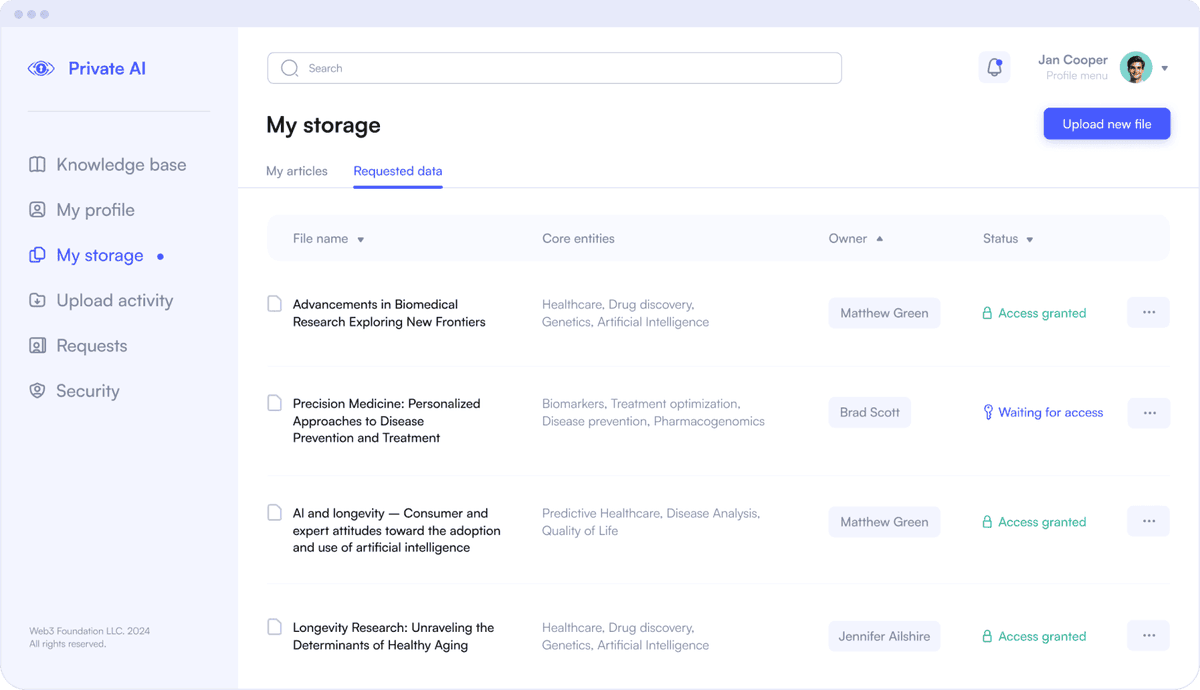
A view from Demo Platform
Our goal at https://t.co/JtCxjIXnvt is to develop an artificial intelligence model that automates the peer review process.
To create a peer review model, we need to teach developers how to do this process through different types of research, and they need to manage the process with machine learning.
Then my colleagues and I will review the peer reviews of the resulting model. We'll be sort of the control group of the model for a while.
Thus, our main goal is to enable researchers to evaluate and improve their study before submitting it for peer review in a journal.
In addition, Privateai aims to create a platform where researchers can engage with articles through an open source system, currently in demo form and under continuous development.
-----------------------&--------------------
While you're experiencing the platform, please pay attention to the knowledge graphs. It's important to highlight Knowledge Graphs (KGs), a feature that https://t.co/JtCxjIXnvt highly values.
The KGs constitute a distinctive mode of data representation. Fundamentally, it conforms to the mathematical definition of a graph - an aggregate of vertices interconnected by edges.
Let's explore how these KGs can improve scientific analysis.
There are couple of way to use KGs scientific approach.
*Data Integration and Unification 🔄
Knowledge graphs facilitate the integration of data from multiple sources, providing a unified view of information. This is particularly useful in scientific research, where data is often distributed across multiple databases and formats.
*Improved decision making and recommendations 🌟
By providing a structured representation of knowledge, KGs can support decision-making processes in scientific research. They can be used to generate recommendations based on the relationships and patterns identified in the data.
*Semantic Search and Information Retrieval 🧐🔍
Knowledge Graphs improve search capabilities by enabling semantic search, which understands the context and meaning of queries rather than just matching keywords. This results in more accurate and relevant search results.
*Knowledge Discovery and Hypothesis Generation 📚
Knowledge graphs can be used to discover new knowledge by identifying previously unknown relationships and generating hypotheses for further investigation. This is achieved through techniques such as link prediction and reasoning over the graph.
*Enabling the FAIR Principles 💡
Knowledge graphs support the FAIR (Findable, Accessible, Interoperable, and Reusable) principles by providing a structured and standardized way to represent and share scientific data. This improves the reproducibility and transparency of scientific research.
Here are some recent examples of using Knowledge Graphs in medical literature. 📚
https://t.co/FoglUolM7i
https://t.co/M2jn0mxQwu
https://t.co/yr4ATTlzhs
https://t.co/N1keP3lC2m
https://t.co/EN8SCMyhuV
https://t.co/VCFSpx3De2
For a clearer understanding, I will also provide a technical explanation from the White Paper.
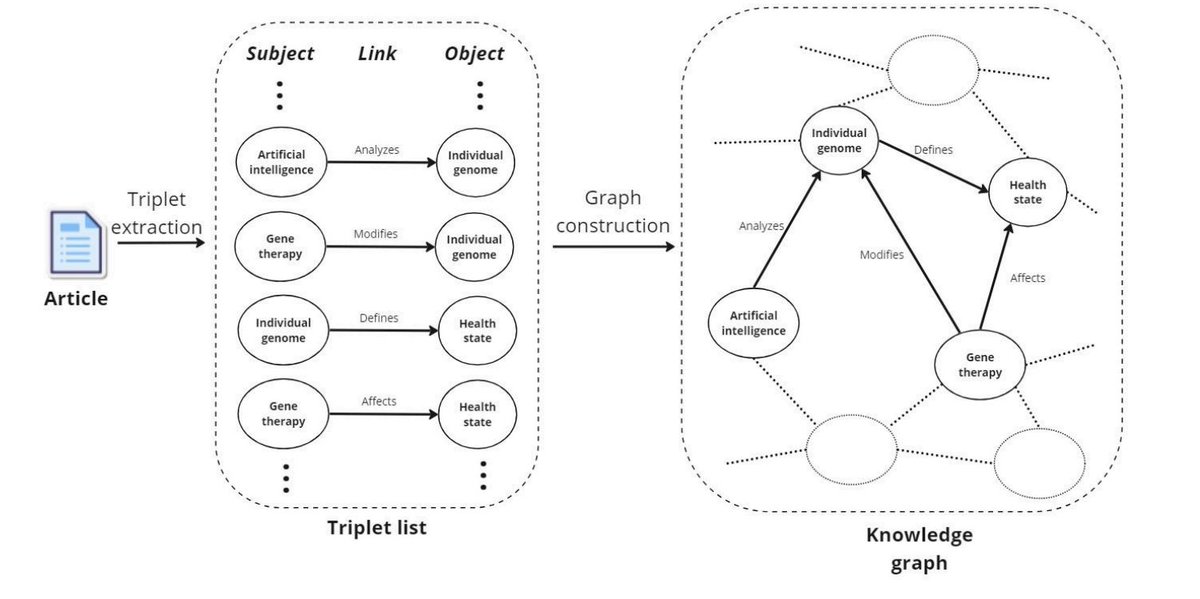
KGs contain textual rather than numerical information, a more appropriate correlate for the dependency matrix is the triplet list
The triplet is a structure consisting of three components:
"Subject": the main entity in the sentence that performs the action, usually expressed as a noun or pronoun and any dependent words;
"Link": the characteristic of the action performed by the subject, usually expressed as a verb or complex verb construction;
"Object": the entity that undergoes the action performed by the subject, usually expressed as a noun or pronoun and any dependent words.
The combination of SpAcy and Python scripts gives https://t.co/XLG7izC4h6 the ability to extract a proper triplet list from a given text and build a knowledge graph from it.
--------------------------------------------------------
Interim Note:
SpAcy is a Python-based open-source software framework that does advanced natural language processing. It is widely used in academia and industry for tasks such as information extraction, text summarization, question answering, and chatbot development because of its speed, accuracy, and ease of interaction with other Python modules and tools.
One of its most notable capabilities is pattern recognition, which is very useful in sectors like biotechnology. In biotech, pattern recognition is critical for evaluating large datasets, recognizing trends, and generating predictions.
Whether processing genetic data, tracking disease outbreaks, or automating literature reviews, pattern recognition enables researchers and professionals to gather relevant insights and make data-driven decisions.
By using Spacy's capabilities, researchers can improve their study on artificial intelligence projects while maintaining more accurate and efficient analysis, which is critical in biotechnology.
-----------------------------------------------------------
Team:
• All C-Level Team Members previously co-founded and/or led crypto Unicorns ($1B+ marketcap), such as $FTM (CTO), $SYS, $AMB (CEO), and $DOGE (COO).
• Strategic Advisors are Founding Members of SingularityNET ($AGIX) and SingularityDAO ($SDAO) ecosystems
• 12+ Public developers with average 12 years of web, AI, or backend experience and STEM degrees (incl. Oxford, Cambridge, Harvard, and Imperial)
• CEO previously co-founded a startup with Gavin Wood, was featured in Forbes 30U30 Europe and owns https://t.co/PLsfIkGmpJ
•Recently team have a new staff member from Protocol Labs.
Detailed background :
https://t.co/go6Ve9Tres
Final Words
As i mentioned earlier, researchers face numerous challenges within the Web2 system. As a decentralized #desci enthusiasts and academics, we are convinced that this system requires enhancement.
https://t.co/JtCxjIXnvt's open source platform will offer many features to scientists. On the other hand, I would like to highlight the peer review model we are developing. It will help academics evaluate and publish their work in an efficient way.
We also believe that this model could serve as a valuable tool for evaluations prior to the Web2 system.
Fort Further Info:
White Paper: https://t.co/OLpaHBSJzu
Tech Paper: https://t.co/8NdodOdUvx
Demo: https://t.co/u3GKGfF1LW
DeSci DAO Tracker: https://t.co/H92BzQo90q
Bittensor 🌐 The Worlds First Neural Internet
@bittensor_
“There is a very similar pattern that you find in the structure of societies, in the structure of companies, and in the structure of computers, and all three are moving in the same direction, that is, away from a top-down structure of a central command system, giving the system instructions on how to behave, towards a system that is parallel, that is flat, which is a web, in which change moves from the bottom up. This is going to happen across all institutions and technical devices; it's the way they work."
Nick Land, 1994
(By the way, I took this text from @Timo37_ 's article.)
I would like to say that it is a very inspiring article.
In a centralized system, decisions and instructions flow from the top down, with a central authority or command center directing the actions of the entire system.
The advancement of different systems, whether in technology, society, or the economy, now relies more on decentralized and flexible frameworks. The development of #AI has undergone a significant transformation.
Initially, algorithms were created in a top-down manner, with human knowledge explicitly programmed into the system, resulting in predetermined solutions.
Compared to this, today's deep learning algorithms, such as language models, allow humans to set the goal and let the computer explore a wide range of possible configurations. The computer refines the model from the ground up, adjusting parameters step by step toward the goal.
------------------------&------------------------
Now, I can begin discussing Bittensor aka $TAO
I aim to help you understand why it's so special.
Lets start with the philosophy behind it.
The philosophy behind Bittensor is represents a significant movement in technological development. It's a new way of thinking about the structure of computation and intelligence.
Bittensor develops a decentralized network over traditional centralized systems, bringing a collaborative approach to artificial intelligence. This is made possible by connecting different machine learning models through a distributed network.
Bittensor enables a shared and scalable form of intelligence. 🧠
This approach is a sign of the commitment to a more inclusive and collaborative future for technology, where every contribution helps shape collective digital intelligence.
After this brief introduction, allow me to take a more detailed look at Bittensor. 💡
Bittensor is an open source platform that enables the creation of valuable digital assets. These assets range from machine intelligence to storage solutions, computational resources, protein structure prediction, and financial market analysis. Contributors who deliver high-quality digital assets are rewarded with $TAO tokens.
Different types of digital products are created within specialized sub-networks, and applications are built on top of these networks. End users receive services directly from these applications.
➰Bittensor Network Structure
The cognitive functions of the human brain served as an inspiration for Bittensor's network architecture. Each computational element within Bittensor, called a "neuron," consists of three key components: a model, a data set, and a loss function. These Neurons work together, each aiming to refine its loss function by using input data and communicating with other Neurons.
The way two Bittensor neurons communicate mirrors the synaptic connections found in biological neural networks. Each neuron is equipped with an axon terminal to collect inputs from other neurons and a dendrite terminal to send inputs to neighboring neurons.
During training, a Bittensor neuron has two tasks: it forwards a set of inputs from its data set to adjacent neurons and processes the same set through its own model. The receiving neurons then apply their models to the inputs and return the results to the originating neuron.
This neuron integrates the received outputs and adjusts its gradients, taking into account the losses of the remote neurons as well as its own local loss. This collaborative training method promotes the development of an intelligent network of interconnected neurons, which is similar to the cognitive functions of biological neural networks.
➰Bittensor ecosystem is built on three key elements
1. Competitive incentive structure: Participants can either create their own competitive markets with customized rewards or join existing markets within the Bittensor network. These markets, called subnets, are central to the Bittensor ecosystem.
2. Supporting Blockchain:The blockchain supports the subnets, guaranteeing that competitive markets remain decentralized, open to all, and safeguarded from manipulation.
3. Bittensor API: This interface connects the critical components of the ecosystem, facilitates connectivity between the subnets and the blockchain, and enables seamless interaction within the network.
Is Bittensor a blockchain or an AI platform?
To get a better perspective on this, let's take a closer look at the concept of subnets.
Bittensor is a unique ecosystem that integrates a single blockchain with multiple platforms, called subnets. These subnets can be AI-focused or serve other functions. The network consists of 32 different subnets, all connected to a blockchain, which we call a "subtensor." In effect, the subnets are connected to the subtensor. (Soon, subnets will be 64.)
➰Understanding Subnets
A subnet in the Bittensor ecosystem is a competitive marketplace. Creating a subnet involves a registration fee paid in TAO, which gives you a unique identifier. There are two ways to participate in a subnet: as a miner or as a validator. By registering a sufficiently powerful computer and your wallet to a subnet, you can operate either the miner or validator module provided by the subnet creator.
➰Dynamics of Subnet Competition
Competition within a subnet works as a miner, you receive tasks from validators along with other miners. After completing the tasks, all miners submit their results. Validators then evaluate the quality of each miner's work. Rewards in $TAO are distributed based on these quality ratings, providing an incentive for high quality contributions. Validators also receive rewards for their role in improving the overall quality of the subnet. This process is automated and follows rules set by the subnet owner.
➰The Role of Subnet Miners
The specific responsibilities of subnet miners vary. For example, one subnet may require responses to text prompts, another may focus on machine translation, and yet another may provide storage services.
1-) A subnet is identified by the incentive mechanism it supports. The incentive system is specific to the subnet.
2-) Subnet miners, or subnet entities, each execute a valuable work, such as solving a problem, as determined by the subnet's incentive mechanism.
3-) Separate entities in the same subnet, known as subnet validators, independently evaluate the tasks accomplished by the subnet miners.
4-) The subnet validators then separately give their assessments on the quality of the miners. The subnet validators' opinions are then used as a collective input to the Yuma Consensus mechanism on the blockchain via the Bittensor API.
5-) The Yuma Consensus mechanism's blockchain output will then define how the rewards for subnet miners and validators are divided. The benefits come in the form of TAO tokens.
➰The Role of the Blockchain
The subtensor blockchain provides a detailed record of all subnet activity, and is critical in determining the distribution of rewards to miners and validators. The Yuma consensus algorithm runs on the blockchain, processing validators' miner rankings every 12 seconds to calculate rewards, which are then distributed to participants' wallets. Each subnet's reward is calculated separately by the blockchain.
Mining and Validation Clarified
In Bittensor, "mining" refers to subnet mining and "validation" refers to subnet validation, as opposed to traditional blockchain concepts. Subnet miners perform tasks assigned by validators.
➰Blockchain Validation in Bittensor
The Opentensor Foundation oversees the proof-of-authority mechanism that the subtensor blockchain, a critical component of Bittensor, uses to operate with validator nodes. These nodes validate transactions and maintain the blockchain ledger, with new blocks generated every 12 seconds.
▪️Incentives to Participate
The incentive to participate as a miner, validator or subnet creator is the $TAO reward. New $TAO tokens are minted every 12 seconds and distributed to subnets based on performance. The subsequent distribution of each subnet's output is as follows: 18% to the subnet owner, 41% to the validators (dividend), and 41% to the miners (incentive), for a total daily distribution of 7200 $TAO.
➰Yuma Consensus
Yuma Consensus is Bittensor's core mechanism for ensuring that validators in its network achieve an agreement. Think of Yuma Consensus as Bittensor's brain, combining the various incentive systems set up by developers into a unified system. This method guarantees that consensus is reached and that the miners follow the rules established by the designers of the consensus mechanism for each subnet.
The key feature of Yuma Consensus is its flexibility in measuring different types of data, including the ability to reach consensus on probabilistic truths, such as the concept of intelligence. This flexibility was critical for validating intelligence, a complex and abstract entity.
What sets Yuma Consensus apart from other blockchain projects is its adaptability. Many blockchain projects hard-code their validation systems into their chains, which can make the problems they address or their solutions inflexible over time.
The Yuma Consensus does not have these limitations.
With Yuma Consensus, Bittensor has a system that can adapt to new challenges and data types without being locked into a single approach or methodology.
➰What is the Consensus Mechanism of $TAO
Bittensor?
Bittensor's consensus mechanism is structured to reward nodes that contribute positively to the network. It uses a game-theoretic scoring system, specifically the Shapley value, to evaluate the performance and reliability of models in the Bittensor network.
The Shapley Value is a concept from cooperative game theory that assigns a fair value to each participant or model based on their individual contribution to the collective outcome. In the case of Bittensor, it measures the impact of each model on the overall predictive accuracy and shared intelligence of the network.
———————————————————————Interim Not
Game theory is a subdiscipline of mathematics that studies strategic decision-making in situations where multiple agents interact, each trying to maximize their own payoff. In the case of the Bittensor network, game theory can be applied to understand how miners compete to solve complex problems and how they allocate their computational resources to find the best solution.
When generating an answer using the Bittensor network, miners work together to solve a problem, but each miner also tries to find a solution that maximizes their own reward. The best solution is the one found by the most miners, as it represents the collective effort of the network.
To take advantage of the power of the Bittensor network and multiple miners, you should:
1. Understand the problem: Clearly define the problem statement and the desired outcome to ensure that all miners are working towards the same goal.
2. Develop a strategy: Create a strategy that encourages miners to collaborate and share information rather than compete with each other. This can be accomplished by designing a reward system that incentivizes miners to find the best solution.
3. Optimize resource allocation: Ensure that miners' computational resources are allocated efficiently to maximize the overall performance of the network. This may include techniques such as load balancing and task assignment.
4. Implement a feedback loop: Establish a feedback mechanism that allows miners to share their progress and insights with each other. This can help identify the most promising solutions and encourage further collaboration.
5. Continuously improve: Monitor the performance of the network and make adjustments as needed to optimize the mining process and improve the quality of solutions.
The combination of different mining skills and the capabilities of the Bittensor network allows for the generation of complex replies for challenging queries. However, maintaining the network's effectiveness and productivity requires striking a healthy balance between competitive and cooperative dynamics.
———————————————————————
In Bittensor, the Shapley value is applied to determine each model's contribution to achieving consensus and delivering accurate predictions. This approach takes into account the cooperative aspect of the network, where models share information and work together to improve their collective performance. The Shapley value quantifies the importance of each model by assessing how much it improves the accuracy and depth of the combined efforts of the model ensemble.
"Proof of Intelligence" is a unique consensus protocol built into the Bittensor network that rewards nodes for contributing valuable machine learning computations. Unlike traditional Proof of Work or Proof of Stake systems that rely on cryptographic puzzles or staking tokens, Proof of Intelligence requires nodes to perform machine learning tasks to prove their computational contributions.
Nodes that provide accurate and useful machine learning results are more likely to be selected to add new blocks to the blockchain, earning TAO tokens as a reward. Decentralized Mixture of Experts (MoE)
Bittensor uses a decentralized mixture of experts (MoE) model, which uses multiple neural networks to solve complex problems. Each neural network, or "expert," is fine-tuned for a specific type of data. When confronted with new data, these experts work together to produce a combined prediction that is superior to what any single expert could achieve alone.
This approach aims to overcome the limitations of traditional, centralized models. By combining the strengths of multiple expert models, Bittensor achieves greater predictive accuracy and can handle more data. This collaborative method allows the network to provide more detailed and accurate answers than any single model could.
Bittensor's goal is to create a decentralized marketplace that rewards the creation and sharing of machine intelligence. Using advanced methods such as expert blending and knowledge aggregation, the platform builds a collaborative network. This network enables knowledge producers to monetize their intellectual output, while consumers can acquire this intelligence to improve their AI systems.
With these aspects, the mission of collective knowledge shifts to the exchange of information among experts, driving the development of superior AI technologies. Large corporations such as #IBM, #Google, and #Microsoft, as well as smaller companies, are expected to invest in accessing the various models within the Bittensor network for their initiatives.
The inefficiency of the centralized AI sector is a driving factor for these companies to consider spending Tao. For example, a significant portion of Google's energy expenditure is dedicated to machine learning. As AI research builds upon itself each year, and new models must relearn previously acquired knowledge, these organizations may find it beneficial to leverage Bittensor's extensive neural network to complement their own machine learning efforts."
➰What is the total supply of Bittensor?
The total supply of Bittensor (TAO) is 21 million tokens, which is the same as the total supply of Bitcoin. This fixed total supply is designed to limit inflation and maintain the scarcity and value of the token over time.
The distribution of TAO tokens is gradually released over time through mining rewards, staking rewards, and community-driven initiatives. The tokens are used for governance, staking, and as a means of payment for accessing AI services and applications built on the Bittensor TAO network.
➰TEAM
There are many people working for the foundation, and some of them are former Google employees or researchers.
➰Final Words
The system relies on the collective contributions of engineers and developers to refine machine learning models and integrate them into the network. The greater the variety of models, the better the chances of achieving high-quality results.
This scalable system allows for the development of additional software layers, so there's no limit to the potential advancements it can support. By creating an interactive, open ecosystem for AI development, the network taps into a global pool of computing power and creative thinking. This process will advance AI and potentially lead to significant discoveries.
" For the sake of a powerful and bright future.
Decentralized, Scalable, and Collectively Intelligent
Full of Potential "
For Further Information
https://t.co/Ge2JV7g9gr
https://t.co/ocSAkrencA
https://t.co/KG5rHSTX1q
Cloud computing is a technology that enables individuals and organizations to conveniently access and store data, as well as utilize computing resources and services, via the internet. It removes the necessity of having local servers or personal devices to manage applications. The cloud functions as a network of remote servers that are hosted on the internet to handle, analyze, and store data.
Many businesses and service providers (SPs) have widely adopted cloud-based services and architectures in recent years. A common feature of traditional cloud deployments is a highly centralized architecture where compute, storage, and network resources are located in one or a few centralized data centers
Distributed Cloud Computing (DCC) is a computing paradigm that extends the traditional #cloud computing model by distributing cloud services across multiple geographic locations. This can include a mix of the cloud provider's data centers, third-party facilities, and on-premises data centers owned by the customer
NIMBUS NETWORK
Cloud-Based Distributed Computing
@Nimbus_Network
Nimbus Network provides advanced cloud infrastructure services, with the goal of establishing a durable and accurate computing environment that surpasses existing options.
The network employs advanced methods to handle resources, ensure uninterrupted service availability, and streamline supervision. With its flexible structure, a wide range of users, from individuals to large enterprises, are able to modify their computing needs to meet their specific requirements, without the limitations commonly found in standard systems.
💢CORE FEATURES
▪️NimbusBot
The interface of Nimbus Network is designed with a focus on user-friendliness. It also features NimbusBot, an intelligent chatbot that can be conveniently accessed via Telegram.
With this tool, you can rely on accurate and relevant answers to your inquiries about the best equipment for specific projects. It offers personalized guidance through the analysis of user input, assisting with the decision-making process for renting devices and node setup.
As an expert in artificial intelligence, NimbusBot will soon have the capability to smoothly configure nodes and autonomously handle GPU rentals
▪️Nimbus Marketplace
The marketplace for computing power in the Nimbus Network highlights the benefits of decentralized systems. It allows individuals with valuable computing resources, such as high-end GPUs and specialized hardware, to generate income from their unused capacity. As a network architect, this platform efficiently connects users with excess computing power to those who require it, simplifying the process of distributing computational resources.
▪️NimbusNode
The Nimbus Network is built around Nimbus Nodes, which are intelligent and versatile machines engineered to handle a diverse array of computing tasks. These nodes are specifically designed to offer users an easy way to start and manage projects, whether they work independently or as part of international teams. This substantial flexibility allows for a customized strategy for project execution, accommodating all of the demands and scales of various users' projects.
▪️Pay-As-You-Go Nodes
With its adaptable Pay-As-You-Go (PAYG) nodes, Nimbus offers computing solutions for many applications. These nodes provide impressive computing capabilities without the need for any long-term commitments. Users have the option to utilize these nodes either on an hourly basis or for specific tasks, which makes it an ideal choice for projects with fluctuating or uncertain computing needs.
🗝️Other Use Cases
And many more...
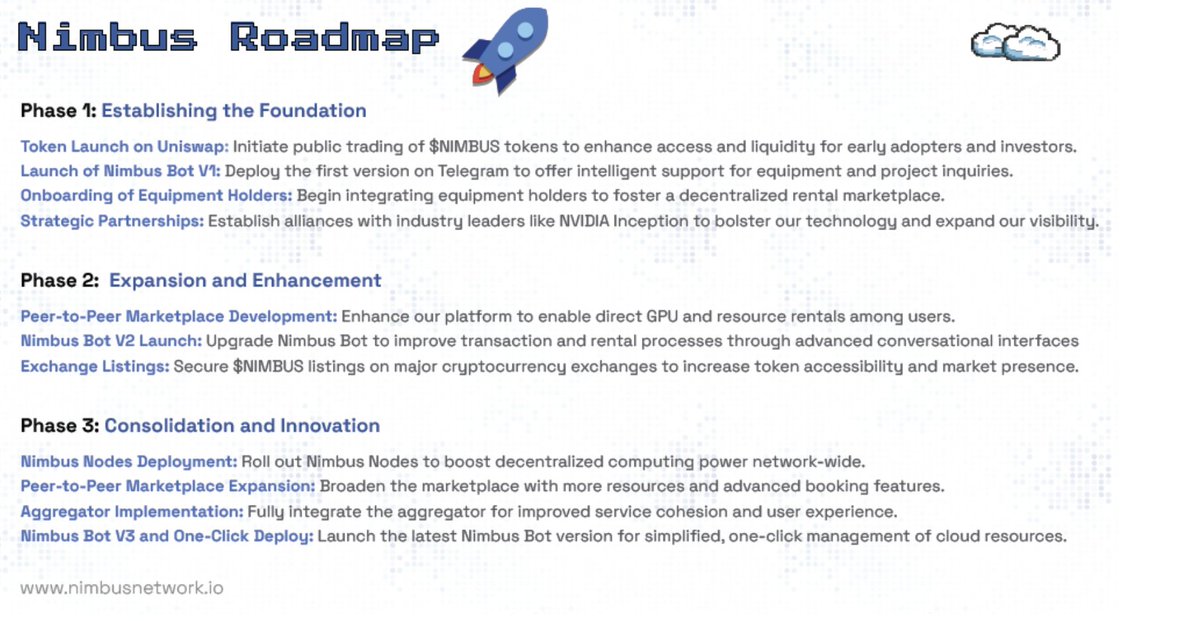
⚡️ROADMAP
🌐LINKS
Website:https://t.co/V2malDiyxJ
Twitter :https://t.co/pbmqBK6jqZ
Whitepaper:https://t.co/D6bwI6RhiZ
Telegram :https://t.co/zlITVTT6CR
Medium:https://t.co/G0ye0O5ggd