🚨 Online now!
📰Haploinsufficiency of ZFHX3, encoding a key player in neuronal development, causes syndromic intellectual disability
🧑🤝🧑@SVergult@CallewaertBert & colleagues
https://t.co/52xqismeQU
🙌 Congratulations to Roosmarijn Vandenbroucke (@vdb_roos@Vdb_lab@UGent) for receiving an @ERC_Research Consolidator grant! With this grant, she will explore new ways to get medication from the blood to the brain. #ERCCoG
👉 https://t.co/kyhagSaN5Y
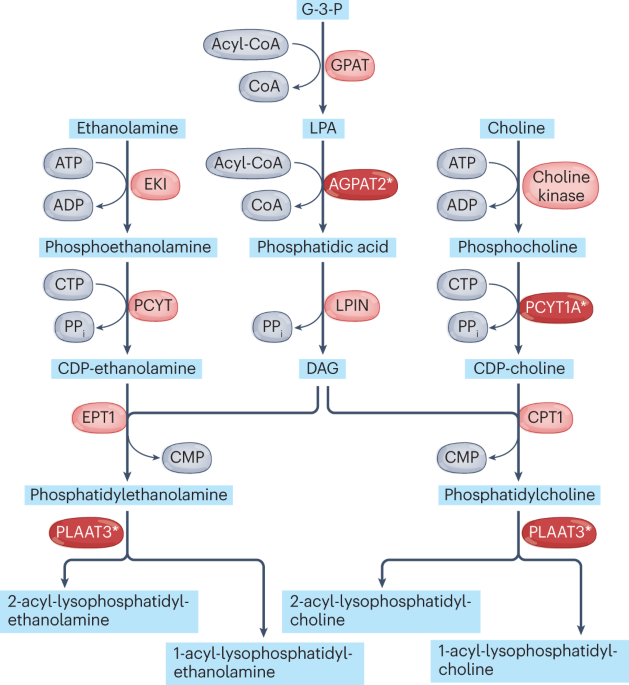
Happy to the share full-text links to our PLAAT3/lipodystrophy paper @NatureGenet : https://t.co/PZ6VmHrFkH (article), https://t.co/ZaPPxd5Zz4 (summary). Thank you to all collaborators!!
@CZZ_PrOZA @Solve_RD
A > 25-year genetic puzzle is finally solved, thanks to long-read sequencing technology.
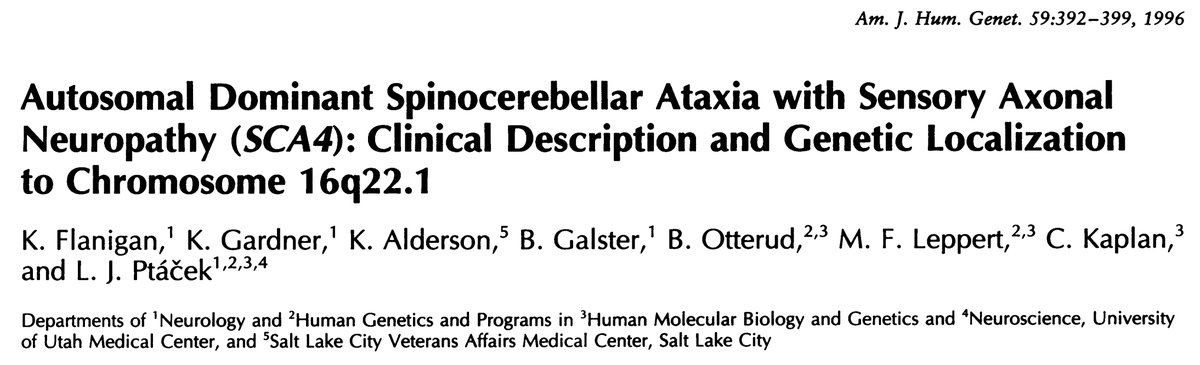
Spinocerebellar ataxia type 4 (SCA4) was first described in 1996 in a five-generation pedigree from the US state of Utah with late-onset autosomal dominant cerebellar ataxia with prominent neuropathy. Linkage analysis revealed the disease-causing gene is located somewhere within 16q22.1 (https://t.co/Awy0M2LXhc).
The authors of the 1996 paper were hopeful that they would hunt the causative gene very soon, having no idea of how complex of a genomic locus they were dealing with. Little did they know that this puzzle would not remain unsolved for the next 25 years.
The locus 16q22.1 is unusually complex with GC-rich sequenced, segmental duplications and pseudogenes rendering the segment impossible to resolve using short read sequencing. After the discovery of the linkage region, many tried to identify the causal gene using exome and targeted sequencing but failed to find a causative mutation (https://t.co/Lq2GpIZBep).
In the current preprint, the authors took up this case again to see if they could solve it using long-read sequencing. Voilà, there it is! A GGC repeat mutation within the exon 10 of ZFHX3, where expanded alleles segregate beautifully in the affected family members.
ZFHX3 codes for a large protein with 3,703 amino acids that function as a transcription factor. Loss of function caused neurodevelopmental disorder. The repeat expansion causes a gain-of-function pathology via toxic aggregation of poly-glycine tract-containing proteins that could be reversed in vitro by siRNA-mediated knockdown of ZFHX3.
Fascinating work by Figueroa, Pulst et al. medRxiv
https://t.co/RaFw6UdvpV
Some recent posts:
1. The origin story of Regeneron Genetics Center (https://t.co/Zd5LldnfAo)
2. Germline mutations masquerading as somatic mutations in the brain (https://t.co/KzrsHGP6Lb)
2. A single amino acid evolutionary change explains the stark difference in telomere lengths between two mice species (https://t.co/PBhxlgU8Va)
New manuscript, based on huge effort by our PhD candidate @SteyaertWouter! He built a tool “Chameleolyzer” to better analyze homologous sequences from massive short-read exome data, validated by long-read sequencing. https://t.co/Q89kncMLJc
Deeply grateful for all the donations and legacies from patients and families supporting our research into Alzheimer's and related inherited neurodegenerative diseases! @ugent@ugent_fge@uzgent @CZZ_PrOZA
More information at https://t.co/F4U8tHkfQB
📢Calling all computational genomics enthusiasts! 🧬Join the Functional Genomics lab at Ghent University as a PhD researcher to delve into the fascinating world of organoids and gene regulation during early brain development. @ResearchUGent@ugent_fge https://t.co/v4dPmWLXVF