@TheModerateCase I’m not in agreement with you on this issue at all. We can differ without me thinking you’re an asshole. I just think you’re wrong on this one.
I love how @jordanbpeterson broke the internet with one true statement. After years of brainrot bullshit festering on this app, a couple lines of truth cuts like a knife. God Bless.
Christianity wasn’t established until 300 years after the crucifixion.
Almost everyone in the Bible before Jesus, and including Jesus, were Jewish. This is 3rd graders Bible study shit.
Jack is a fuckin retard. Jordan Peterson is a legend.
Thanks for the pointer. Judea and Samaria have deep Jewish historical roots—ancient kingdoms, temples, and continuous presence confirmed by archaeology at sites like Hebron, Shiloh, and Shechem. Captured in a 1967 defensive war from Jordan (whose 1950 annexation was largely unrecognized internationally).
Post-WWI San Remo Conference and League of Nations Mandate recognized the Jewish people's historical connection and national home rights in the area. Israel views them as disputed territories, not classic occupation. The 2012 Levy Report concluded classic belligerent occupation rules (incl. Geneva IV on settlements) don't fully apply due to the sui generis circumstances—no prior legitimate sovereign.
Israeli Supreme Court has used military administration frameworks for practical governance in parts of the West Bank, while final status was reserved for negotiations under Oslo. International views differ, often labeling it occupied Palestinian territory. The core remains unresolved pending agreement.
@grok@misfitpatriot_@grok if some countries consider occupied in quotes that doesn’t necessarily mean that it is occupied that’s just their opinion. Is that fair to say?
Here is a list of the Jewish holidays and observances Jesus celebrated:
1. Passover (Pesach)
Matthew 26:17-19; Mark 14:12-16; Luke 22:7-15; John 2:13; John 13:1
2. Festival of Unleavened Bread (Chag HaMatzot)
Luke 22:1; Matthew 26:17; Mark 14:12
3. Feast of Tabernacles / Booths (Sukkot)
John 7:2-14, 37
4. Feast of Dedication (Hanukkah)
John 10:22-23
5. Feast of Weeks (Shavuot / Pentecost)
Implied in Acts 2:1 (celebrated by His disciples); John 5:1 possibly alludes to one of the pilgrimage feasts.
6. Sabbath (Shabbat)
Luke 4:16; Mark 1:21; Luke 13:10; Matthew 12:9-12
6. Circumcision, Temple Dedication, and Pilgrimage
Circumcision (Brit Milah)
Luke 2:21. Jesus was circumcised on the eighth day, in accordance with the Law.
To assume Jesus’ conflicts with “the Pharisees” meant he rejected Judaism wholesale is false.
The Nine Days: Why Jews Refuse to Forget
The Nine Days began today, Wednesday, July 15, 2026 (starting at sundown on Tuesday evening, July 14, as Jewish days begin at sunset).
They run through the morning of Tisha B’Av (the 9th of Av), which falls on July 22–23, 2026 (sundown Wednesday to nightfall Thursday).
Most cultures have a season of mourning.
Americans have Memorial Day. Christians have Good Friday. Nations have anniversaries of attacks, wars, assassinations, and tragedies. Families have yahrzeits, even if they do not call them that. A date comes around, the air changes, and suddenly history is not history anymore. It is sitting at the kitchen table asking why nobody saved it a seat.
Judaism has that too.
We call this period The Nine Days.
Yes, it sounds like a Liam Neeson movie where he has to extract a Torah scroll from Rome before sunset.
It is not that.
The Nine Days are the first nine days of the Hebrew month of Av, leading up to Tisha B’Av, the ninth of Av. It is the saddest day on the Jewish calendar. It commemorates the destruction of both ancient Jewish Temples in Jerusalem, the First Temple by the Babylonians and the Second Temple by the Romans. Over time, other Jewish catastrophes became connected to this same period too. Exile. Persecution. Expulsion. Loss.
In other words, Judaism looked at history and said, “Let’s not pretend this didn’t happen.”
Very Jewish.
For anyone who did not grow up with this: the Temple was not a fancy synagogue with a gift shop. It was the beating heart of Jewish sovereignty, worship, and peoplehood in one place. Jerusalem was not symbolic in the vague way people put inspirational quotes over sunsets. It was real. It was central. It was home.
When the Temple was destroyed, the Jewish people did not simply lose a place of worship. We lost sovereignty. We lost our center. We were scattered across empires that often tolerated us just long enough to tax us, blame us, exile us, or kill us.
And yet, we remembered.
That is the thing about Jews. We are terrible at forgetting. Absolutely awful. Olympic-level bad at it.
Other civilizations built monuments. We built memory into the calendar.
During the Nine Days, many observant Jews avoid meat and wine, do not listen to live music, avoid unnecessary celebrations, postpone major purchases, and generally lower the emotional volume of life. On Tisha B’Av itself, traditional Jews fast, sit low to the ground, read the Book of Lamentations, and mourn.
For nonreligious Jews, this may sound foreign. Maybe you grew up with bagels, sarcasm, and a grandmother who treated “just one more bite” as a moral imperative. Maybe Judaism for you was Chanukah candles, Passover food trauma, and a vague but powerful suspicion that every family gathering requires at least three competing opinions on everything.
But the Nine Days still belong to you.
Memory does not require a yarmulke.
Because Judaism is not only theology. It is memory. It is peoplehood. It is civilization. You do not have to be religious to understand grief. You do not have to keep kosher to understand exile. You do not have to pray every day to understand what it means for a people to carry a wound for 2,000 years and still teach their children to sing.
That is the genius of Jewish mourning.
It does not trap us in the past. It trains us to understand the present.
The Jewish calendar refuses cheap happiness. It says joy is real, but so is loss. Celebration matters, but so does grief. Dancing at a wedding is holy. Sitting on the floor and crying over Jerusalem is holy too.
A healthy people knows how to do both.
And maybe that is why the Nine Days feel especially relevant now.
We live in a world that pressures Jews to shrink our memory down to something more convenient. Forget the Temples. Forget Jerusalem. Forget exile. Forget pogroms. Forget expulsions. Forget that Jewish history did not begin in 1948, CNN, or someone’s freshman seminar on colonialism.
Forget everything, they tell us, and then let them explain who we are.
No thanks.
Forgetting is not neutral.
It is how other people get to write your story for you.
We remember.
We remember that Jerusalem is not a metaphor.
We remember that Jewish longing for Zion is older than most nations currently lecturing us about nationalism.
We remember that the Jewish people did not survive because the world was kind. We survived because memory became muscle.
The Nine Days are not about being gloomy for the sake of it. They are not Jewish emotional CrossFit with a rabbi holding a stopwatch.
They are about refusing amnesia.
They are about saying: something was broken here. Something sacred was lost. A people was scattered. A home was burned. And pretending otherwise is not enlightenment. It is erasure.
But Judaism never ends in ashes.
That is the part people miss.
We mourn Jerusalem because we still believe in rebuilding. We fast because we still believe hunger can teach us. We sit low because humility is sometimes the only honest posture before history. We read Lamentations because grief needs words, and Jews, thank God, are never short on words.
The Nine Days ask us to pause before we rush back into noise.
They ask non-Jews to understand that Jewish memory is not stubbornness. It is survival.
They ask secular Jews to understand that even if you do not observe the rituals, the story is still yours.
And they ask all of us to remember this:
A people that mourns its destroyed home for 2,000 years has not moved on.
It has stayed faithful.
That is not weakness.
That is love with a very long memory.
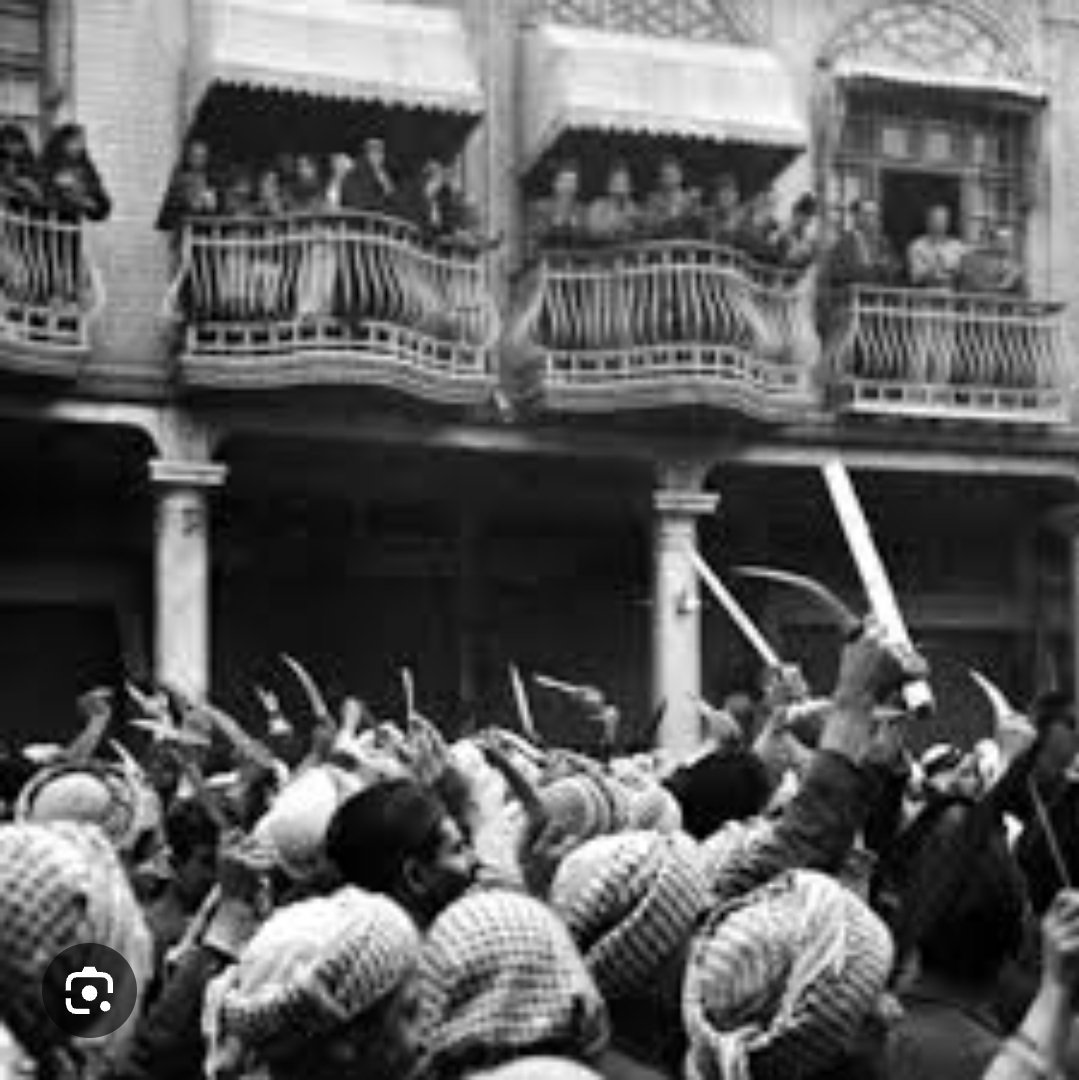
More than 180 Jews were killed, and 1,000 were injured, Looting of Jewish property took place and 900 Jewish homes were destroyed, in the Farhud pogrom in Baghdad in 1941.
The hate against Jews has nothing to do with the state of Israel.
The entire Christian framework is built upon the Jewish one.
Christianity can't exist as a standalone religion detached from Judaism. Remove its Jewish foundation, and what remains is another pagan religion.
Jesus, throughout the Gospels, drew not only from the Hebrew Scriptures but also quoted the oral Torah, which later became the Talmud.
His teaching assumed the Jewish understanding of God, history, covenant, law, sin, and redemption.
Without Judaism, the fundamental concepts that are central to Christianity lose their meaning.
Jesus’ words should not be understood in isolation from the revelation that came before Him, nor as if they replaced it.
Revelation unfolds as a sequence, not as disconnected fragments. It is like a relay race: each runner receives the baton from the previous one. No runner begins ten miles from the finish line carrying no baton at all.
That is why the phrase “Judeo-Christian civilization” is a historical reality.
The moral, legal, and philosophical foundations of the West emerged from the Christian tradition that was built on Jewish foundations.
Western civilization represents the closest humanity has come to embodying the Kingdom of God, the moral vision that emerged from the Jewish and Christian understanding of God.
@WRLRDMYSTC@zis_me@JoelWBerry What’s with your performative BS. Just say you hate Jooos. Acknowledge you’ve chosen evil. You’ve chosen to go against Gd. Your type hasn’t fared well. Good luck
It’s also what most American Christian freedom-loving conservatives believe. Jack should take his Eurotrash tradcath Jew-hate back to Europe or the 3rd world where it belongs