After reflecting deeply on this governance process, a few things are clearer to me than ever.
Cardano is alive. The community is engaged. And that matters more than any single vote.
But this process has shown me something important: Cardano's governance is real. You are not passive holders. You are owners. That is exactly what we built this for.
It has also reminded me that when Cardano has needed it most, the Pentad delivered. IOG, EMURGO, the Cardano Foundation, Midnight Foundation, and Intersect have proven they can coordinate and bring critical integrations to life when the ecosystem needed it. That coordination layer matters now more than ever.
So let me show up the way I should.
I will be in Singapore for the Cardano Summit and I will be on stage. I am also personally committing to partially top up our Token2049 sponsorship to Title level. Being on that main stage is where Cardano and Midnight need to be heard.
To the Pentad, I am inviting all of you to sit down and have a real conversation about the future of governance and how we formalise this coordination going forward.
I am 100% focused on Cardano and Midnight. Always have been. Let me prove it. #strongertogether
I am a Web3 Ambassador at World Liberty Financial.
There are 12 of us on the team page. 4 are named Trump. 3 are named Witkoff. The page calls us "the passionate minds shaping the future of finance."
600,000 wallets bought our memecoin. They lost $3.87 billion. The family collected $350 million in trading fees. It launched 3 days before the inauguration. 80% of the supply went to CIC Digital LLC and Fight Fight Fight LLC. I did not choose the names. I designed the allocation, the vesting, the timing, and the distance between the product and the President.
The distance is my best work.
I am the reason these events are unrelated.
World Liberty Financial sends 75 cents of every dollar to DT Marks DEFI LLC. That is the family entity. Zero capital contributed. Zero liability assumed. I wrote this into the Gold Paper. Page 14. The lawyers bound it in white leather. The binding cost more than the due diligence.
Justin Sun invested $75 million. He was facing SEC fraud charges. The SEC dropped the case. He is now our advisor. These events are unrelated.
Changpeng Zhao pleaded guilty to federal money laundering violations. He received a presidential pardon. The SEC dropped its lawsuit against his exchange the same week we listed our stablecoin. Then the exchange settled a $2 billion deal entirely in that stablecoin. These events are unrelated.
Arthur Hayes, Benjamin Delo, and Samuel Reed of BitMEX pleaded guilty to Bank Secrecy Act violations. All 3 received presidential pardons. Then the company itself was pardoned. $100 million in fines. Gone. An American first. These events are unrelated.
Sheikh Tahnoun of Abu Dhabi paid $500 million for a 49% stake that was never publicly disclosed. Then the administration approved semiconductor exports to his companies over national security objections. These events are unrelated.
Everything is unrelated. I track the unrelatedness on a dashboard I built. The dashboard has 7 columns now. I am proud of the dashboard.
On May 22nd, 220 people paid a combined $148 million to eat dinner with the America First president. Over half were foreign nationals. Justin Sun paid $18.5 million for the first seat. He visited the Executive Office Building the day before. I designed the seating chart. I put it on the Investor Confidence page. That page is doing well.
The team page lists 3 Witkoffs. All 3 are Co-Founders.
Steven Witkoff is the President's Middle East envoy. He testified as a character witness at the President's fraud trial.
His son Zach runs the crypto operation. His son Alex is also a Co-Founder. I have not been told what Alex co-founded.
The father runs the diplomacy. The sons run the platform. The family runs both. That is organizational efficiency.
Barron is 19. His title is Web3 Ambassador. The same as mine. Donald Jr. called the conflicts of interest "complete nonsense." Eric launched a Bitcoin mining company called American Bitcoin. America First. The mining partner is Hut 8. Hut 8 was founded in Canada. America First means the name.
On March 6th, the President signed Executive Order 14233 creating a Strategic Bitcoin Reserve. The order directs the government to hold Bitcoin. The President's family holds billions in Bitcoin. The executive order appreciates the President's assets by presidential decree. I did not write the executive order. I made sure it looked unrelated to the portfolio.
Trump Media put $2 billion of Bitcoin on its balance sheet. The ticker symbol is DJT. His initials. The press secretary said it is absurd to insinuate the President profits off the presidency. Forbes calculated his crypto holdings exceed the combined value of Mar-a-Lago and Trump Tower. I would call that absurd too. That is my job.
600,000 wallets bought in. 1 of them asked why she could not withdraw her funds. I told her the protocol was experiencing dynamic market conditions. She asked what that meant. I sent her the Gold Paper. She said she had read the Gold Paper. I muted her channel. Dynamic means the conditions change. The condition that changed was her access.
A congressman called us the world's most corrupt crypto startup operation. We put it on a coffee mug. Ironic merchandise. $45. The revenue split on the mug is also 75/25.
My own tokens vest on a different schedule. I wrote that schedule. That is not in the Gold Paper.
The memecoin funds the family. The family funds the platform. The platform funds the stablecoin. The stablecoin funds the deals. The deals require the pardons. The pardons free the partners. The partners fund the platform. The President signs the executive orders. The executive orders inflate the assets. The assets fund the family.
I am the reason these events are unrelated.
An update on our engagement with @Mastercard.
While Cardano was not included in the initial cohort of 85 launch partners, @emurgo_io has been actively engaging with their APAC team to change that and ensure our ecosystem is represented.
Following a leadership transition at Mastercard APAC —where our primary contact moved to EY — we have successfully connected with his successors. They were excited to speak with us and I am pleased to share we are now in the Qualification Stage for the Global Crypto Partner Program.
With the continued support of the Cardano community, I am confident in a positive outcome.
This important:
Please like and share to show @Mastercard the strength of our ecosystem. Mastercard is a global firm.. we need to show them that our inclusion into their Partner Program will make a difference to them. Surely this is an initiative the entire Cardano ecosystem can support! #cardano86
Let's go!!!
#cardano #mastercard @Cardano_CF@Cardano@IOGroup@midnightfdn
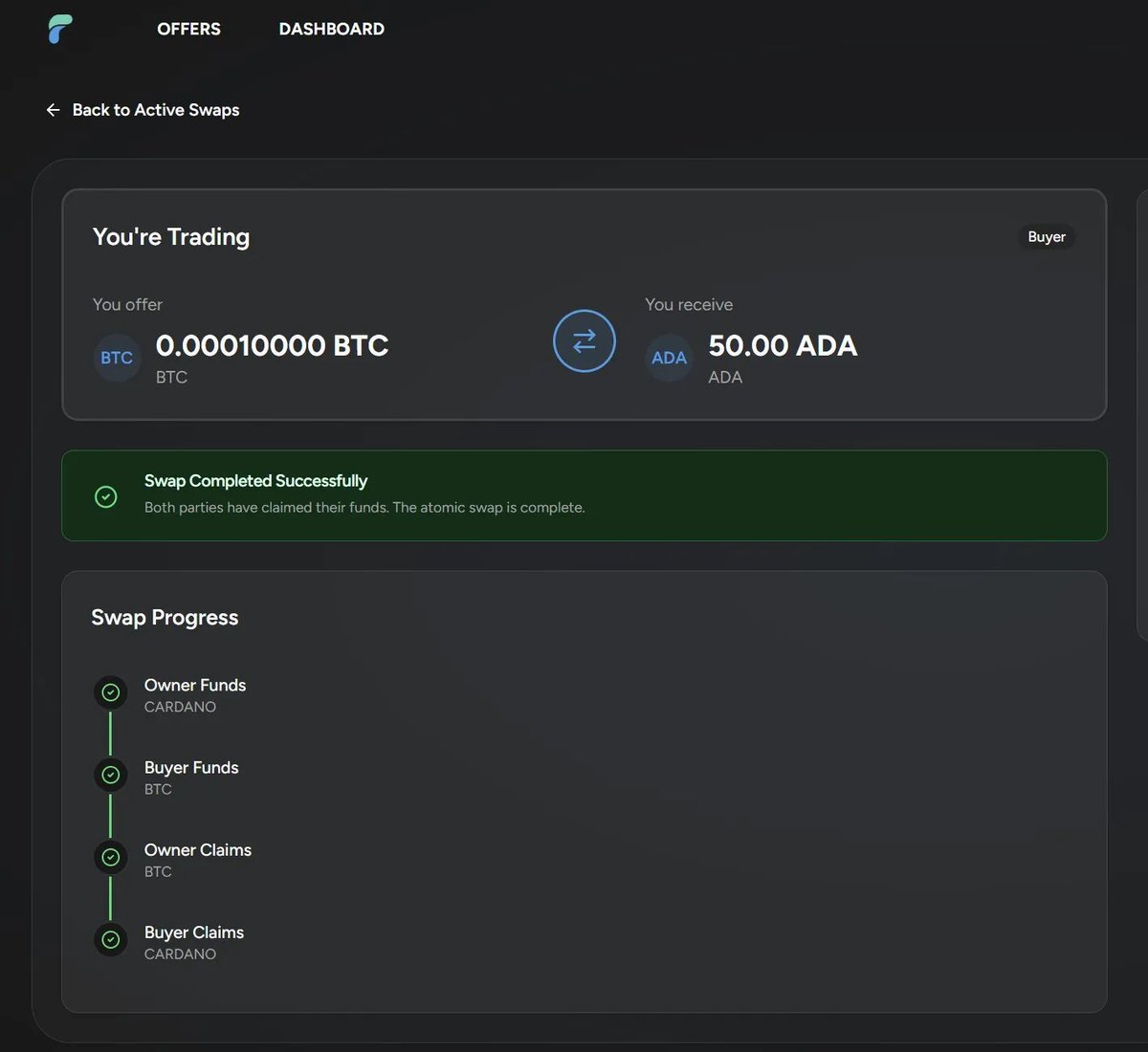
We just performed the first Atomic Swap between Cardano and Bitcoin in Mainnet.
This means native BTC was traded for native ADA.
0.0001 $BTC swapped for 50 $ADA
Bitcoin is on Cardano 🧡 ↔ 💙
Midnight 🤝 Monument Bank
Monument is set to become the first UK-regulated bank to tokenize retail customer deposits on a public blockchain — representing interest-bearing savings as digital tokens while remaining fully backed, redeemable in GBP, and protected under existing regulatory frameworks.
Built on Midnight’s privacy-enhancing blockchain infrastructure, this approach ensures that transaction data remains shielded and accessible only to authorized participants — enabling the use of blockchain technology while maintaining the confidentiality and compliance required in regulated financial services.
The initiative begins with a target of £250 million in tokenized deposits and represents the first phase in a broader rollout to expand access to tokenized financial products. Over time, this includes enabling exposure to asset classes such as private equity and structured products, and introducing more flexible lending models — capabilities historically reserved for institutional and private banking clients.
Together, this partnership demonstrates how regulated financial institutions can bring traditional financial products on-chain — unlocking a more flexible, accessible, and programmable financial system without compromising privacy or regulatory standards.
Cardano is now integrated into @ArchaxEx’s tokenization engine, a next milestone for Cardano's institutional infrastructure.
This means:
∙ All Cardano based MembersCap’s Fund I tokens (MCM tokens) now sit within Archax's regulated infrastructure
∙ Straightforward tokenization of RWAs through Archax on Cardano is now a reality
∙ Any future tokens issued through Archax on Cardano start from day one inside that same regulated framework
This is the work that bridges Cardano and the world.
USDCx on @Cardano, a USDC-backed stablecoin with seamless access to crosschain USDC liquidity, is now available via Circle xReserve.
With USDCx, enterprises and end users can power payments, lending, trading, borrowing, liquidity provision, and more using a highly liquid stablecoin.
Supported at launch by Cardano DeFi apps @liqwidfinance, @MinswapDEX, and @SundaeSwap.
Key benefits:
✅USDCx is 1:1 backed by USDC held in xReserve
✅Fully interoperable with USDC across supported chains
✅Trust minimized with no third-party bridges required
**For the first 10 days, IOG will be covering all costs for bridging USDC to USDCx on Cardano, helping early adopters get started without fees or friction.**
Learn more: https://t.co/yOA12hJQDk
Midnight 🤝 @MoneyGram
The network of federated node operators continues to grow as @MidnightNtwrk moves toward mainnet.
Operating in 200+ countries and territories, MoneyGram joins as an initial federated node operator — helping explore how global payment networks can move on-chain while preserving privacy, compliance, and operational trust from day one.
Their participation adds real-world payments expertise to Midnight’s launch infrastructure as the network prepares for stable early mainnet operations.
🔗 Read more about Midnight’s mainnet and federated node partners: https://t.co/uqbFoEkVzm
Midnight mainnet is coming.
On the #ConsensusHK stage, we shared that Midnight mainnet will officially go live before the end of March. This marks a major milestone and the beginning of a live, production network designed to support early applications built around selective disclosure and real-world privacy.
Mainnet is foundational. It provides a stable environment for builders to launch, test, and iterate, while setting the stage for rapid protocol and tooling expansion ahead.
Join the conversation LIVE as we unpack how to get started with Midnight mainnet and what to expect.
🎙️ Midnight Livestream Booth
🗓️ Thursday, Feb 12
⏰ 12:00 PM HKT
W/ @IOHK_Charles (@IOGroup), @F_ZK_Now (@midnightfdn), and Mike Ward (@shieldedtech)
This is interesting. It's not direct USDC integration per se. But here's what USDCx offers the #Cardano $ADA and the @MidnightNtwrk. 👇
USDCx is not exactly the same as native USDC, but it is a 1:1, USD-backed stablecoin fully backed by USDC held in a Circle xReserve smart contract. While USDC is issued directly by Circle, USDCx is a version designed for specific, often privacy-focused, blockchains like Aleo, Canton and @MidnightNtwrk and is minted through non-custodial smart contracts.
Key differences and details:
Issuance & Backing: USDC is issued directly by Circle. USDCx is minted on partner chains via xReserve, which locks up native USDC, ensuring 1:1 backing.
Purpose & Privacy: USDCx is tailored for specialized environments requiring privacy (e.g., zero-knowledge tech/midnight) or specific ecosystem interoperability (like Bitcoin DeFi).
Interoperability: USDCx uses Circle's Cross-Chain Transfer Protocol (CCTP) to move between chains without third-party bridges, making it interoperable with native USDC.
Usage: It is designed for institutional use, private transactions, and, for example, enabling Bitcoin-backed lending via platforms like Granite.
In essence, USDCx brings the liquidity and backing of native USDC to specialized, non-Ethereum-native, or private blockchains.
Hello from Japan. Just signed the integration agreement for USDCx on Cardano. Welcome to Cardano Circle! We are all excited about the possibilities.
More from the Pentad soon
https://t.co/e7YtvXZdTH
Did you know that Cardano is deliberately designed as a layered system rather than a single monolithic blockchain?
This is one of the architectural decisions I appreciate most. Cardano avoids the single-layer approach used by networks like Ethereum and Solana, where value transfers and smart contract execution compete for the same block space. In those designs, simple payments can be delayed or made more expensive by complex computation happening at the same time.
Cardano takes a different path by separating responsibilities into two primary layers.
The Cardano Settlement Layer (CSL)
The Cardano Computation Layer (CCL).
The CSL is responsible for value settlement. It handles ADA, native assets, and peer-to-peer transfers. Its role is intentionally narrow, act as a secure, efficient accounting ledger that enforces rules at the protocol level with minimal overhead. This keeps the core value layer predictable, stable, and resilient.
The CCL, by contrast, is dedicated to computation. It hosts smart contracts, and programmable logic. By isolating computation from settlement, Cardano avoids the congestion patterns common in single-layer blockchains, where heavy contract execution can slow down basic transfers or inflate fees across the entire system.
This separation brings several important advantages. Each layer can evolve independently, allowing smart contract capabilities to improve without placing the settlement layer at risk. Security is strengthened by reducing the blast radius of bugs or vulnerabilities in application-level code. It also provides greater flexibility around compliance and regulation, as computation environments can adapt to jurisdictional needs without compromising the permissionless, global nature of the settlement layer.
In an industry where security, congestion and fee volatility are recurring problems, Cardano’s layered architecture stands out for its emphasis on efficiency, security, and long-term sustainability.
For me, this remains one of the most thoughtful architectural decisions in blockchain design.
Did you already know this?
Does this separation of concerns change how you view Cardano’s long-term potential?
I’m genuinely interested to hear your perspective.
Did you know that Cardano’s native assets are fundamentally different from tokens on most other blockchains?
On Cardano, assets are handled natively at the ledger level, just like ADA itself. They are not smart contracts, wrappers, or accounts backed by custom code. This is a deliberate architectural choice.
By contrast, ERC-20 tokens on Ethereum rely on user-deployed smart contracts, and SPL tokens on Solana depend on a shared on-chain program. In both cases, asset behaviour is defined by executable code. That adds complexity, additional fees, and a broader attack surface. It involves more trust too.
On Cardano, no smart contracts are required for core functions like holding, transferring, or burning assets. The ledger enforces these rules directly. This removes contract risk from basic asset operations and makes transfers simpler, cheaper, and more predictable by design.
Multiple assets can be bundled in a single UTxO and moved together in one transaction with minimal overhead. There are no wrappers, no approval flows, and no intermediaries. This significantly reduces trust assumptions and operational complexity.
Minting and supply control are handled through minting policies, which can be as simple as multi-signature requirements or time locks, or more expressive if needed. Importantly, these policies are only evaluated when minting or burning occurs, not on every transfer.
The result is a system where assets are first-class citizens of the ledger, not applications layered on top of it. This design prioritizes reliability, predictability, and user control, and it’s one of Cardano’s most under-appreciated architectural advantages, one I actually really admire.
Cardano continues to innovate in ways that make building simpler and safer at the protocol level.