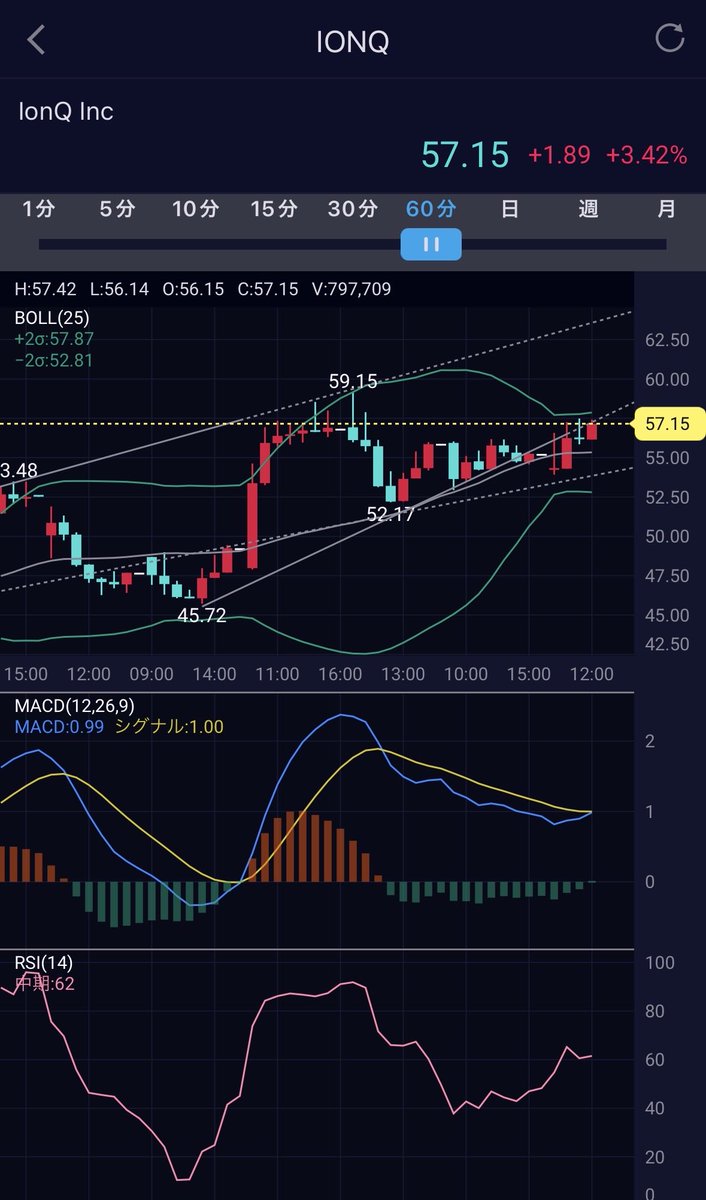
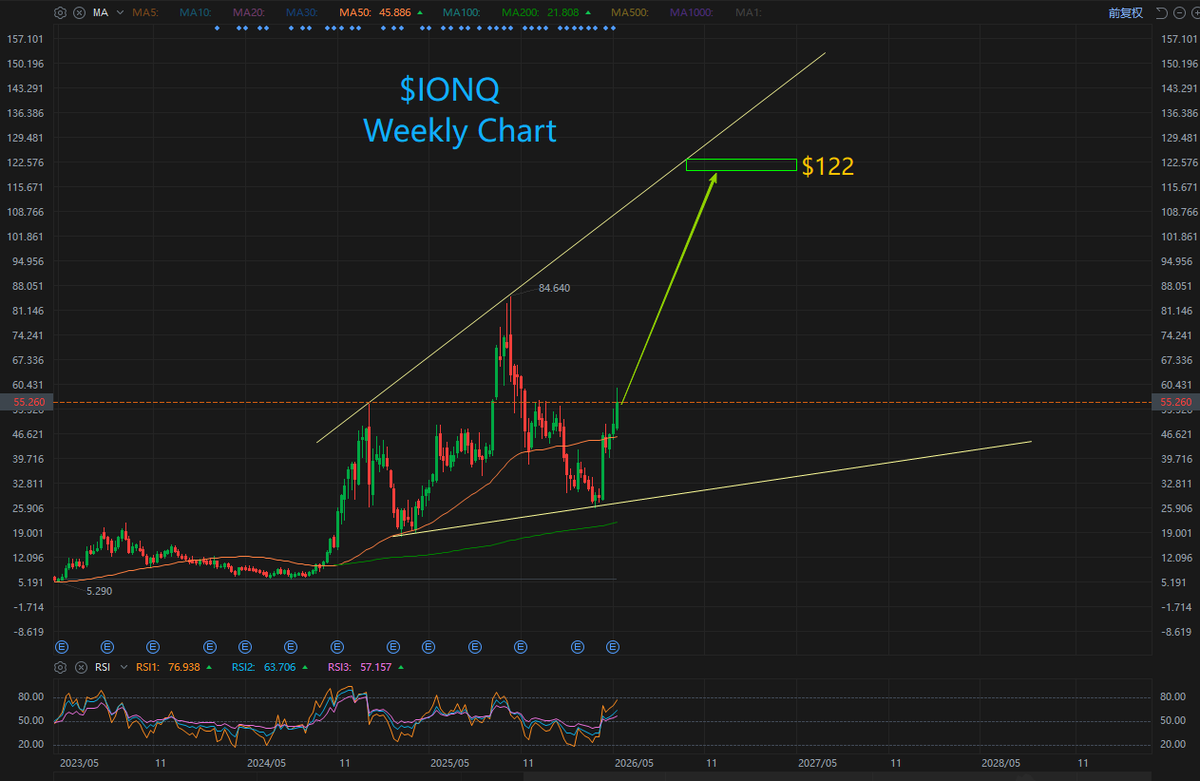
$IONQ ---- I’m extremely bullish on IONQ’s long‑term outlook. As a global leader in trapped‑ion quantum computing, it operates the IonQ Quantum Cloud platform, serving sectors including quantum computing, networking, sensing, and cybersecurity.
1.Explosive revenue growth:
Q1 revenue hit $64.7 million, surging 755% year‑over‑year and beating expectations. Full‑year guidance was raised to $260–$270 million, with RPO jumping 554% to $470 million.
2.Key commercialization milestones:
Its first 256‑qubit system was sold to the University of Cambridge. The SkyWater acquisition advances vertical integration, accelerating defense, international, and multi‑product order momentum.
3.Robust cash position:
Cash plus investments reached $3.1 billion at quarter‑end, providing solid financial backing for long‑term R&D and scaling.
$IONQ
150 to 250 logical qubits. By 2028. Issued from Oak Ridge.
The DOE Office of Science just published an RFI under the internal title "Quantum Supercomputer Request for Information." Full official label: "Scientifically Relevant Fault-Tolerant Quantum Computing Systems." Notice ID 892431-26-RFI-0001. Deadline: June 9. Open to all bidders, no set-aside.
Before getting to the targets, read the vocabulary.
Direct citations from the document:
→ "computing capabilities for science and national security"
→ "in concert with High-Performance Computing and Artificial Intelligence"
→ "uniquely suited, optimized, or codesigned for DOE's science mission, as opposed to generic quantum computation"
→ "unit costs for smaller, fully functional quantum computing modules"
→ "activities that may not already be on a vendor's plan of record"
→ "time-to-solution or total cost of ownership"
That last phrase is the title of IonQ's 2026 commercial campaign. Rolls-Royce, Einride, LG Electronics, KISTI Korea all packaged under "Time to Solution." The DOE's procurement language and IonQ's commercial language have merged.
The 2028 targets:
→ 150–250 logical qubits
→ Universal instruction set
→ 10⁵ hard operations (T / Toffoli)
→ 10⁻⁸ logical error rate per operation
Mid-2030s scale-up in the same document: O(10⁹) hard gates on 1000+ logical qubits, applied to chemistry, materials, plasma physics, high energy physics.
The HPC + Quantum + AI triptych the RFI emphasizes also sits at the heart of the Genesis Mission, launched by the DOE and White House OSTP on January 16 $293M for AI × science breakthroughs. This RFI is the fault-tolerant leg of that mission moving from policy to procurement design.
Three weeks before this RFI, IonQ published the Walking Cat blueprint on arXiv (2604.19481): 2,514 physical qubits for hundreds of logical ones, every hardware component already demonstrated in the labs. Modular by design exactly the architecture the RFI invites to be priced "in smaller, fully functional quantum computing modules."
IonQ's own 2028 target, in the annual report signed by De Masi two weeks ago: 8,000 logical qubits and 200,000 physical qubits. 32x the upper end of the DOE ask. Backed by a 99.99% two-qubit gate fidelity the world record needed to approach the 10⁻⁸ logical error rate the RFI requires.
The contracting office sits at PO BOX E, Oak Ridge, TN 37831:
→ IonQ has been an industry partner of the Oak Ridge QSC Phase II program ($125M, 2025–2030) from day one.
→ The Discovery supercomputer lands at Oak Ridge in 2028 the same year as the RFI target.
→ IonQ's Director of Quantum Applications, Martin Suchara, joined from Argonne National Lab where he co-founded DOE Q-NEXT, one of the five DOE National QIS Centers under the same Office of Science that just issued this RFI.
The RFI asks for modules. Beyond DOE, IonQ is also the only commercial winner of DARPA HARQ the federal quantum interconnect program that makes those modules talk to each other. On April 14, AFRL demonstrated entanglement between two commercial IonQ systems, validating the modular interconnect any scaled FTQC will require.
The RFI also encourages respondents to "use external expertise to complement their core capabilities" exactly the ecosystem IonQ has been building all year with NVIDIA, the Dell Federal cohort, and the National Lab complex.
And it asks each respondent how their system is "uniquely suited" to DOE's mission, "as opposed to generic quantum computation." That language is not accidental.
An RFI is not a contract. But this one reads like the procurement design phase for a machine someone has already specified out loud.
The DOE asked the market a question yesterday. Three weeks ago, IonQ had already published the answer from the same campus where IonQ already works.
🔗 https://t.co/fHnNFK2Ssw
$IONQ #IonQ #Quantum #DOE