Writing code using AI alone, what people call “vibe coding” is fundamentally wrong. If you don’t truly understand what the code is doing, you’re not programming, you’re just prompting. You might ship faster, but you’re building on sand. The harsh reality hits in production when
the system breaks, when a critical bug appears, or worse, when a serious security vulnerability gets exploited. At that point, AI can’t reliably debug it, secure it, or fix the root cause always, because you never understood the foundation in the first place.
Writing code using AI alone, what people call “vibe coding” is fundamentally wrong. If you don’t truly understand what the code is doing, you’re not programming, you’re just prompting. You might ship faster, but you’re building on sand. The harsh reality hits in production when
the more I use opus 4.5 to build personal apps locally, the stronger I feel this will NEVER replace good developers.
the code and practices it creates on its own, without supervision, is basically garbage that works.
Once, anyone could learn to code and build freely.
Now, dependence on AI models means every line of code ties you to Big Tech,
sharing your creations with them too.
Is this progress, or a new kind of lock‑in?
@unusual_whales bullshit
more hype = more money to make for them
AI Coding is Frustrating.
It creates the illusion of doing things quickly instead it slows you down plus the frustration of making you do the same thing over and over again that AI keep breaking while doing another.
@_adityaa21 Build your own startup or side project, become an entrepreneur.
It's the only future where you're in control of your own success, no employer will decide on your behalf.
@_adityaa21
I'm using Gemini 3 Pro and Flash for a few months now.
And honestly, AI is making me do the same thing that're already completed,
it's more often than tolerable, AI is breaking the working part of my app while doing a new thing,
It felt like it's wasting more time than saves.
All my new code will be closed-source from now on. I've contributed millions of lines of carefully written OSS code over the past decade, spent thousands of hours helping other people. If you want to use my libraries (1M+ downloads/month) in the future, you have to pay.
I made good money funneling people through my OSS and being recognized as expert in several fields. This was entirely based on HUMANS knowing and seeing me by USING and INTERACTING with my code. No humans will ever read my docs again when coding agents do it in seconds. Nobody will even know it's me who built it.
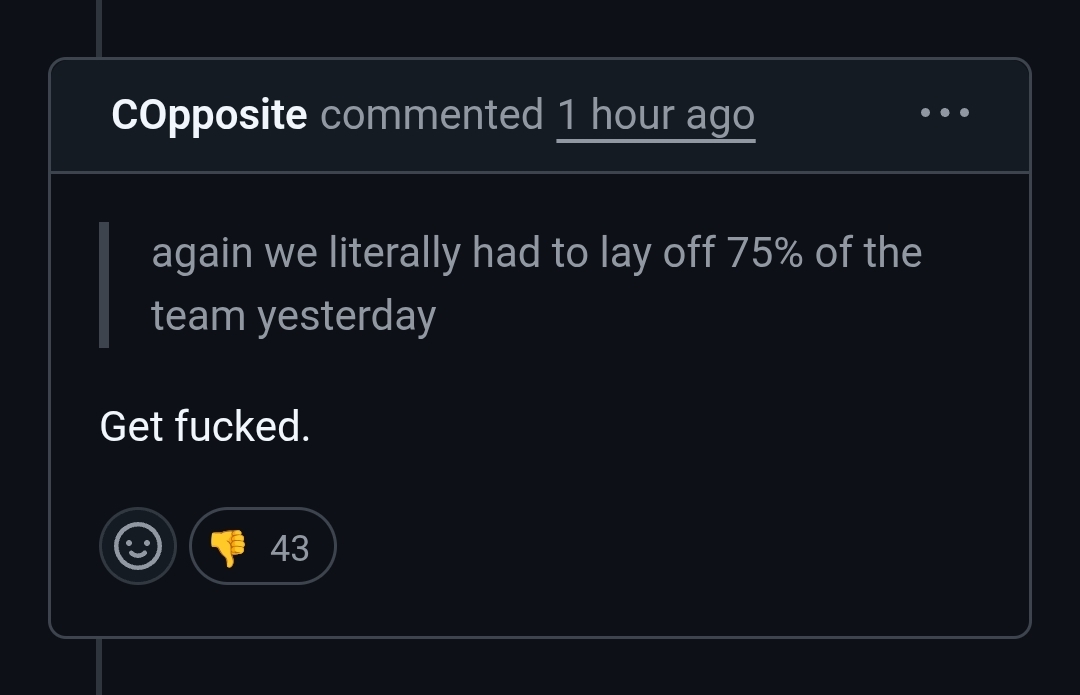
Look at Tailwind: 75 million downloads/month, more popular than ever, revenue down 80%, docs traffic down 40%, 75% of engineering team laid off. Someone submitted a PR to add LLM-optimized docs and Wathan had to decline - optimizing for agents accelerates his business's death. He's being asked to build the infrastructure for his own obsolescence.
Two of the most common OSS business models:
- Open Core: Give away the library, sell premium once you reach critical mass (Tailwind UI, Prisma Accelerate, Supabase Cloud...)
- Expertise Moat: Be THE expert in your library - consulting gigs, speaking, higher salary
Tailwind just proved the first one is dying. Agents bypass the documentation funnel. They don't see your premium tier. Every project relying on docs-to-premium conversion will face the same pressure: Prisma, Drizzle, MikroORM, Strapi, and many more.
The core insight: OSS monetization was always about attention. Human eyeballs on your docs, brand, expertise. That attention has literally moved into attention layers. Your docs trained the models that now make visiting you unnecessary. Human attention paid. Artificial attention doesn't.
Some OSS will keep going - wealthy devs doing it for fun or education. That's not a system, that's charity. Most popular OSS runs on economic incentives. Destroy them, they stop playing.
Why go closed-source? When the monetization funnel is broken, you move payment to the only point that still exists: access. OSS gave away access hoping to monetize attention downstream. Agents broke downstream. Closed-source gates access directly.
The final irony: OSS trained the models now killing it. We built our own replacement.
My prediction: a new marketplace emerges, built for agents. Want your agent to use Tailwind? Prisma? Pay per access. Libraries become APIs with meters. The old model: free code -> human attention -> monetization. The new model: pay at the gate or your agent doesn't get in.
@MarcJSchmidt is it an option to give the docs access only after authentication and user's email verification, in return give the users a better docs experience and filter out the AI bots from getting access to the docs? @MarcJSchmidt
@svpino AI is breaking whole ecosystems that're working for years, but suddenly all feels worthless, the excitement to code, OSS, learning new things and all.
Only a handful of people will be the Net Beneficiaries from everyone else's destructions.
Open source isn't dying because of AI.
It's dying because we all fucking suck.
Users. Maintainers. The whole ecosystem. All of us.
We fucking suck as users.
We use OSS to do our jobs. To build products. To make money. Our employers depend on it. Our startups run on it.
But the second a maintainer mentions compensation? We lose our fucking minds. "It should be free." "That's not the open source way."
Meanwhile we're extracting value from someone's unpaid labor every single day.
We file issues like we paid for a support contract. We demand timelines. We get snippy when our bug isn't the priority.
We're not customers. We're guests. Start acting like it.
We fucking suck as maintainers.
We wanted the GitHub stars. The conference talks. The Twitter followers. We wanted to be the person who "owns" that thing everyone depends on.
But now people actually depend on it and we're annoyed.
"Talk is cheap, show me the code."
So someone does. They spend hours on a PR. We ignore it for months. Close it with no explanation. Or we screenshot their issue and mock them publicly for not reading our minds about what we actually wanted.
We invited contributions then punished people for contributing.
We don't want to maintain projects. We want to be admired for maintaining them. Not the same thing.
We suck at this together.
Both sides want the benefits without the responsibilities.
As users we want free, maintained, high quality software but won't contribute a damn thing. Not money. Not code. Not even basic respect.
As maintainers we want the status of running critical infrastructure but won't communicate, won't collaborate, won't treat people like humans.
We all know this shit doesn't work. And yet here we are.
Okay Josh, what do you suggest then?
If we use OSS and profit from it, we contribute something. Anything. Money, docs, triage, kindness. We stop expecting infinite free labor.
If we maintain OSS and we're burnt out, we say so. Archive it. Hand it off. Ghosting is worse than walking away.
And if we can't treat each other with basic respect? We don't get to participate. Full stop.
Open source runs on people. On us.
None of us owe each other a god damn thing. But we could choose to stop being assholes and do better anyway.
I'll say it again, I think this AI cycle we are in is a net negative on society
A man/team that has made the web significantly more pleasant as a platform for many people and spent years doing so for free has AI effectively destroy the business model by first taking his work
And this is how a member of the community responds. Real sad times
IP theft is real and I personally think that the C-suite of these current companies deserve jail time for the level of theft they enabled
In other words, Rust isn’t just the present and future, it’s the foundation for building systems that can scale securely and perform at the edge without compromise.
@matthewjgl Finally, someone said it. Nothing beats a dev who actually understands the 'why' behind the code instead of just hitting 'generate.' I’m interested;
here's a demo video of a project I built, 100% hand coded, before AI coding even a thing: https://t.co/KiUTPOx3Mv