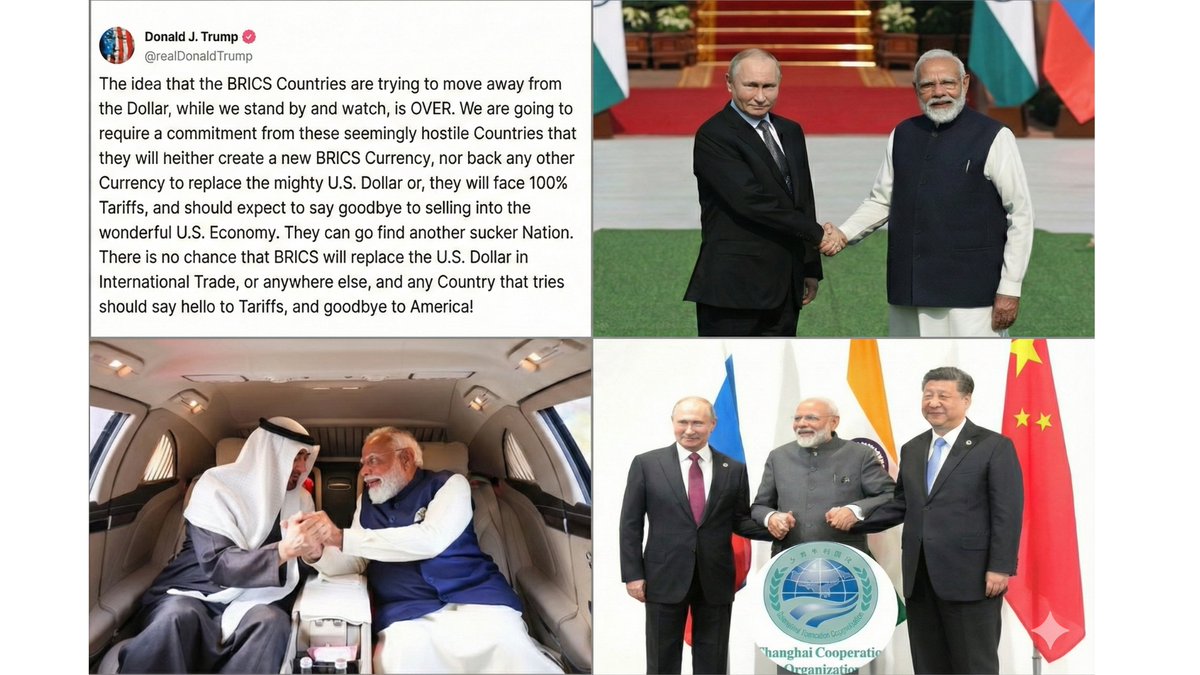
If only Indian twitterati and commentariat werent such snowflakes they would realise that China's rise was its own doing. It's rise was not an American gift. The Chinese planned well, worked well, their engineers didnt sell soap, coke or maggi or join the IAS or worse IRS. They innovated, they built, they invested, they educated their people. The Chinese miracle is of their own making. Similarly whether India will rise or not is in Indian hands. If India rises it wont be because the Americans or Europeans allowed us to or gifted it to us. And we will never rise as long as our first talking point with other countries is "transfer of tech". This is the height of imagination and profoundity of the Indian bureaucrat and techno-crat. Big powers will never allow anyone to equal them. That is a no brainer. If India has to rise, we will on our own genius or not at all. And we will have to find our own way to rise. We cant copy someone else. We must learn from others (assuming we understand we are not the repository of all wisdom in the world and get off our hobbyhorse of being vishvaguru) but we must find our own way to the top because every country has to find its own path.
Every employee who is the only one active on Twitter among his friends and colleagues, is super pissed at how other people are not caring much, while he has taken the weight of all the wars on his shoulders.
“How can you ask me to submit this report today, when the Kuwaiti air defence has just shot down 3 US F-15s??”
NVIDIA is cooked, OpenAI is cooked, Cursor is cooked, TCS is cooked, Bollywood is cooked, Google is cooked
I don't think anybody on any side of the AI trade is left to be cooked, implying that we are living in a narrative universe with no basis
Nobody knows anything
WARNING
Massive AI hype being built in a sudden burst
(and most of it fake)
1) A scary article: I was surprised to read a long article on Twitter (X) claiming it's just 6-12 months before a Covid-like event changes this world. It claims this will be the AI-event, where most white-collar jobs worldwide would be gone, because AI is that good now. That article got 100 M plus views. Clearly, people are spooked (naturally). So the psy-op has worked.
(and I saw other similar dark articles too)
2) Suddenly many influencers are pushing the same narrative, and it so turns out that media reported many are being paid heavy sums by AI firms to push their story (that AI singularity is arriving). But if AI is "revolutionary", does it need an influencer push? No. This should be a clear signal it's hyped.
3) A correction in IT stocks' and SaaS stock's prices is suddenly creating a doom scenario about these companies dying any moment now, with second- and third-order effects on entire economy. Stock investors who haven't studied AI technicals are automatically assuming it's all over, dead, gone, finished. WRONG. NO.
4) What is the truth, and what's most likely to happen?
In my opinion, based on years of observing AI trends, reading and learning AI technology, and doing AI at various levels, my take is as follows. I urge you to read this, and preserve your sanity. Please don't panic, nothing catastrophic is happening anytime soon.
A) IPO pressure: AI firms are going crazy pushing their God-narrative, as many giant IPOs are lined up soon. They need public to buy their paid subscriptions or else the story goes kaput. So they are creating a false hype. It's shameful, anti-social and deeply hurtful.
(Almost all AI firms released doom-scenarios just before their next funding rounds; investors who haven't learnt technology fall for it; pure FOMO. This playbook is so repetitive it's comical)
B) OpenAI is spooked: Sam Altman has lost the lead he temporarily managed to build against Google and others, and now his loss-making enterprise isn't the darling of any investor any more. He's terrified.
C) Elon Musk's Grok does not have the traction in consumer space anyway near what's needed to make it a profit-making entity. So with many other capex-heavy AI firms. But the GPU / TPU hungry AI ops need more capex each day, not less. It's a dead-end for most except cash rich Googles.
D) Enterprise AI is patchy, lagging, slow, choppy: Anyone who has ever built a company, or run a large department, or consulted a business enterprise knows how random, undefined, tacit, and unstructured most of the real world work actually is. No way is AI ever going to replace humans doing those very complex things on a daily basis. No way. Not tomorrow, not in 10 years. NO.
(I am not even beginning to get into 'regulated' industries' needs)
E) Consumer AI is cool, but has limits: The more AI regular humans (of all ages) use, the more the artificiality of it becomes apparent to anyone. The novelty cannot sustain the commercial numbers needed to make AI (foundation models) profitable. OpenAI and Perplexity would never have given free tiers for most Indians otherwise. They desperately need folks to stick to this opium.
F) LLMs aren't solved, Hallucinations aren't zero: The structure of any LLM is such that it will ALWAYS hallucinate, no matter how much fine-tuning humans do. In most sensitive business operations, you cannot allow LLMs to control the core data at all. Can you run an airline with a Generative AI system (LLM-based) that's 98% accurate? Can you run a precision-mfg. operation at 97% accuracy? Can you run a financial services firm with 95% accuracy? NO. NEVER. So the deterministic, old-fashioned computer software ERP will go nowhere. Nowhere at all. LLMs will be good as a top layer on those ERPs to glean insights, nothing more.
[ None can 'train away' hallucinations in a probabilistic LLM model, using larger datasets. You are actually claiming I'll build a dice that lands a 4, or a 6, each time ]
G) Agents aren't magical, humans aren't going anywhere: Multi-step agentic AI is being touted as the final solution where one founder sitting alone can run 100 agents and build an empire. Try doing that once, experience the frequent breakdowns, see the regular edges and new complexities, and you will realize that other than the most mundane of tasks, nothing else will be seamless. Yes, Voice AI agents are good, and many in the developing world are now deploying those, but that's hardly a cutting-edge technology that'll replace all humans.
H) IT and SaaS firms are going nowhere: Ironically, the more AI happens in enterprises, the more will be the need for humans to supervised and orchestrate those bits and pieces of AI, to ensure nothing flies off the rails. The complex software code that Claude and Codex can write only changes the nature of work for the human coders who now have to check the AI code thoroughly for the many edge cases in real world. The nature of IT and SaaS work will change, some companies that can't innovate and adapt will vanish, but many new ones will emerge in their place. (Yes, there'll will be some much-deserved disruption in short-term, and the non-innovating IT firms will have deserved every bit of it)
I) If IT and SaaS are dead, why are AI firms hyping: Ask this simple question - if AI is indeed killing IT and SaaS, then why are AI firms spending massive sums hyping their wares? They need spend nothing and still earn the spoils. But they know the truth.
J) The China angle: Models from China - many of them open-sourced - are getting better and more competitive. Many of them are cheaper, or free (for now). OpenAI complained recently that they are stealing from American models (via "distillation"). Imagine, just imagine - OpenAI that stole entire internet work of creative work is complaining the Chinese are stealing from it. A dacoit crying that thieves broke into his house. Rich. You think these are signs of singularity? Ha! The judicial backlash on stolen content and profiteering off of it hasn't even begun in most jurisdictions.
(now imagine what happens to American LLM-makers when Chinese models gain traction everywhere)
K) Downside of mindless AI already visible: Take just one example: In education everywhere, students, parents and teachers are all realizing that mindless AI use is harming the process of learning, not aiding it. The sensible, guarded and limited way AI should be brought into pedagogy hasn't even been given a proper thought. Students are just doing "cognitive offloading", and turning into non-thinking beings. This is bound to collapse sooner than later. Humans as species don't learn this way - it's a long, tortuous and slow process, always.
L) AI is normal technology: Serious researchers from the AI field have for years argued that AI is being hyped unnecessarily out of proportion, turned into Snake Oil like propositions, and most of AI's predictive powers are anyway not better than that of astrology. AI's ability to talk to use like humans has totally stumped normal people, and anthropomorphism has kicked in. Since no ERP talked to use like a human would, the computer revolution came about without the singularity fears.
M) AI in law and judiciary: The impact will be on the grunt work. It will be cut down substantially. But no judge will outsource their cognition to AI, now will any lawyer. The fact that an LLM can read a complex document fast and summarise it means nothing if it hallucinates. And LLMs will forever hallucinate; that's their structure. (so you'll need humans to sign off on LLM outputs)
N) Enterprise AI's lessons: Every company that has mindlessly gone in on AI has learnt that employees just stopped using it if it didn't adapt to the existing workflows. AI cannot magically alter anything: it can speed things up (with hallucinations), it can generate beautiful stuff (needed or not) and it can help save some time, but the company-to-company needs are so different, it cannot be force-fit on all in one shot. (that is what foundation LLM firms are trying to do). Remember: Enterprise work is not just code. It’s messy data, old legacy systems, compliance needs, multiple integrations, business context, human complexities, and more. Services firms are going nowhere.
O) AI has no solutions for the human situation: Fertility rates everywhere are dropping. Humans are being converted into permanently marketable selves. Consumption comfort has made us soft, and our morality is totally adrift. AI doesn't solve any of this, it just force-multiplies most of it. We built it. It reflects what we are.
5) So what should you do?
a) Read up on AI. Its technical side. How LLMs are created. What they just cannot do. What they can. Why they aren't superhuman at all. Why AI is a good but normal set of technologies.
b) Think why regulated industries (at least 25) cannot hand over their future to AI, LLMs, and GenAI.
c) Check the history of Indian IT and how it kept rebooting itself to suit a new era (from Y2K, to outsourcing, to SaaS backend support, to much more).
d) Check how human societies eventually revolt when artificiality starts overpowering natural human interactions.
e) Be prepared for more hype and nonsense. Sadly, the AI firms won't stop at it at all. They need more humans to subscribe to their paid tiers, and fear seems to be the chosen weapon. Tragic.
[I am subscribed to more than 10 such paid AI tools currently, and know exactly what's good and what's not, and why no singularity is arriving]
f) Adapt your work, and bits of it, to AI tools that can adjust to the workflow well. Let your discretion be supreme.
g) If AI is the shiny new tap, IT is the plumbing behind it.
Remember:
Elon Musk's predictions have mostly gone wrong
Geoffrey Hinton's predictions have gone wrong
Mustafa Suleyman's predictions have gone bust
Yet they keep predicting.
Sad part:
We are living in an age of bullshit. And LLMs are excellent bullshitting machines. The reason the AI Bros are continuing doing so is no one is holding them accountable for their nonstop lies.
But what about AGI:
If AGI is ever built, it won't be by any one company. The technology diffuses rapidly each day. So multiple AGIs in multiple hands. Goes without saying governments will capture (claim) that technology almost immediately. If that day ever arrives, UBI is happening too.
Finally:
Your brain, running on just 20 watts, continues to outthink LLMs fueled by the energy of an entire planet. Never underestimate yourself. And stop falling prey to AI hype.
In the high-stakes theatre of international diplomacy, silence is rarely just silence. When U.S. Commerce Secretary Howard Lutnick announced this January that a landmark trade deal with India had stalled because Prime Minister Narendra Modi "did not call" President Trump to finalize the terms, the explanation was as convenient as it was implausible.
To the casual observer, it painted a picture of bureaucratic hesitation. But to those watching the flow of global capital, the silence on the phone line masked a thunderous shift in the global economic order. While Washington focused on tariffs and trade deficits, New Delhi quietly engineered a financial mechanism that the United States has historically treated as a red line: the ability to buy oil without the dollar.
A rigorous analysis of regulatory filings, central bank data, and geopolitical signalling reveals that the trade impasse of early 2026 is not about almonds or steel. It is the first major casualty of the "Petro-Rupee," a strategy that has placed the world’s oldest democracy and its largest democracy on a collision course over the future of financial sovereignty.
The "Red Line" and the Greenback
To understand the gravity of the rift, one must look past the current headlines to the foundation of American power. Since 1974, when the Nixon administration struck a pact with Saudi Arabia, the global oil trade has been denominated effectively exclusively in U.S. dollars. This "Petrodollar" system forces nations to hold vast dollar reserves, which are recycled back into U.S. Treasury bonds, financing American deficits and cementing the dollar's global supremacy. History has been unkind to those who challenge this arrangement. When Saddam Hussein switched Iraqi oil sales to the Euro in 2000, or when Muammar Gaddafi proposed a gold-backed African currency in 2011, the geopolitical consequences were severe. As former Federal Reserve Chairman Alan Greenspan candidly noted in his memoirs, the Iraq war was "largely about oil"—a resource inseparable from the currency used to buy it. So is the case with Venenzula and Iran today, which are pricing their oil outside the US dollar system.
For decades, this was a line no ally would cross. But in the shifting landscape of 2026, India has done just that.
The Smoking Gun: August 2025
Picture tells thousand words. The deterioration of economic relations can be traced precisely to mid-2025. While public attention was fixed on diplomatic pleasantries, the Reserve Bank of India (RBI) was dismantling the "Rupee Trap" that had hindered its trade with Russia in Rupee.
For months, Moscow had been accumulating billions in Indian Rupees from oil sales that it couldn't spend. Then, on August 12, 2025, the RBI issued a quiet but revolutionary circular. It authorized foreign holders of "Special Rupee Vostro Accounts" (SRVAs) to invest their surplus balances into Indian Government Securities and Treasury Bills. In a move that alarmed U.S. strategists even more, India and the UAE—two key American partners—began operationalizing a Local Currency Settlement system. The Indian Oil Corporation paid for a million barrels of Abu Dhabi crude in rupees, proving the concept worked. By 2025, this corridor had deepened, with the UAE pumping $22.84 billion in foreign direct investment into India to balance the currency flows, and the Abu Dhabi Investment Authority setting up shop in Gujarat's GIFT City.
This was the smoking gun. By allowing Russia to recycle its oil revenue directly into Indian sovereign debt, New Delhi created a closed-loop financial system. Russian oil profits were no longer chasing U.S. Treasuries; they were funding Indian infrastructure. The reaction from Washington was swift. Within weeks, the U.S. imposed tariffs of up to 50 percent on select Indian goods—a punitive strike that signal the partnership was in jeopardy.
By late 2025, this alternative financial architecture had expanded far beyond a wartime necessity for Russian oil. The RBI had permitted 123 correspondent banks from 30 countries—including the United Kingdom, Germany, Israel, and Singapore—to open 156 Special Rupee accounts.
The Last Straw: India Takes the Wheel at BRICS
While the "Petro-Rupee" laid the kindling, the spark that finally burned the bridge was India’s bold assumption of leadership within the BRICS currency project. As the host of the 2026 BRICS Summit, New Delhi has moved beyond passive participation to active architecture. The Reserve Bank of India has formally proposed linking the Central Bank Digital Currencies (CBDCs) of member nations—a project dubbed the "BRICS Bridge."
Building on the 2025 Rio de Janeiro declaration, India is pushing for a proprietary, interoperable payment rail that would allow Russia, China, India, other BRICS members to settle trade instantly in digital local currencies, completely bypassing the U.S. banking system. This is not merely a theoretical exercise; with the RBI actively pilot-testing the e-Rupee’s cross-border capabilities, India is effectively building a "digital SWIFT" immune to Western sanctions. For the Trump administration, this was the final provocation. It wasn't just evasion; it was replacement.
Conclusion: A Monetary Mutiny
This aggressive push for a parallel financial system became the veritable last straw on the camel's back for the stalled trade deal. In December 2024, President-elect Trump issued a blunt ultimatum: any move by BRICS nations to create a new currency or back an alternative to the dollar would be met with 100 percent tariffs.
Washington views India’s 2026 agenda not as economic modernization, but as a "monetary mutiny." The sages who studied the rise and fall of kingdoms would chuckle today, for the lesson is ancient: money is the hard-earned fruit of labor, while currency is merely the paper promise that it still tastes good. Money—like gold and silver—is the crystallized effort of real work. Currency, however, is its excitable younger cousin: useful for trade, but spoiled the moment rulers discover the printing press.
India has chosen to bear the cost of tariffs rather than surrender the sovereignty of its "crystallized effort." The trade deal may be officially "stalled" due to a missed phone call, but in reality, it lies buried under the foundation of the new BRICS financial architecture—a foundation India is now actively pouring concrete for better future.
Manish Bhandari, CIIA, founder of Vallum Capital Advisors, a Portfolio Management firm managing equity investments Based in Mumbai.
Full Article & Research Document Available Below
https://t.co/OsPJLHJ1Db
#Geopolitics #Macroeconomics #USIndiaTrade #BRICS2026 #GlobalEconomy #ForeignPolicy #TradeWar #DeDollarization #InternationalRelations
He is the right successor to Modi to become the PM of India.
The PM of any developing, modern country should look and act like a CEO dressed appropriately for the event, moderate and family-oriented, command on language, and sophisticated.
Btw, I got so much backlash a week ago when I said he is equipped to be the next PM, but I’m saying it again.
While the Marathas did lose the battle, their key objective of pushing back the invaders was successful. A weakened Abdalli, fearing a prospect of another battle with the advancing army of Nanasaheb Peshwa, went back to Afghanistan, never to return again to India.
#Panipat1761
I was in fifth grade when I learned to read my parents' silence.
They were talking in the kitchen, late at night, in that particular hush that parents use when they think children are asleep. I caught fragments. Bombay. Tests. Something about a doctor. The next morning, everything was normal. Chai, school, the shop. But I had heard the frequency shift.
It was 2004. My father was 39. We had just moved out of the room behind our kirana store—a chawl on the outskirts of Panaji—into a proper apartment. Our first EMI. Things were looking up in the way they do for Indian middle-class families who have spent years looking at the same ceiling: slowly, carefully, one calculated risk at a time.
Then the diagnosis. Stage 3 follicular lymphoma.
I didn't know what lymphoma meant. There was no internet to tell me, no Google to spiral into. Cancer was a word from movies—something that happened to people in cities, in dramatic hospital scenes with violins. Not to shopkeepers in Goa. Not to fathers who opened shutters at 7 AM and counted change at night.
They kept me in the dark. The logic was simple: don't disturb the boy's studies. So I went to school. I came home. I did homework. And in the margins of this ordinary life, my father was taking buses to Mumbai for chemotherapy.
I still don't fully understand how he did it. A biopsy, then a bus. Chemo, then the overnight journey back. Tata Memorial to Kadamba bus stand. The same man who winced when he cut his finger slicing onions was now traveling eight hours each way with poison in his veins, because what else was there to do? Goa didn't have the facilities. We didn't have the money for flights or hotels. So he sat on buses, probably in pain I can't imagine, probably next to someone complaining about the AC being too cold.
My mother ran the shop. Not "helped out"—ran it. Wholesale orders, inventory, customers, credit books, all while her husband was in the jaws of something that might kill him. New scans kept showing the cancer spreading. The word "spreading" did a lot of work in those days.
And I? I was a child. Which means I was selfish in the way only children can be—not out of cruelty, but out of not knowing. My father was alive and not going bald like he did so I assumed things were now fine. I was still in the dark.
I remember crying for days because I wanted a geared cycle. All my friends had them. The fancy ones with the grip shifters. I needed it for school, I argued. I needed it because everyone else had one. I remember my parents' faces when I wouldn't let it go—that particular exhaustion of people who cannot explain why they're saying no, because the explanation would break something.
Every rupee mattered. I didn't know that yet. I didn't know that they were borrowing money from friends, from family, sometimes from customers at the shop—the same aunties who haggled over soap prices were quietly lending us cash to keep my father alive. That's the thing about the Indian middle class: the safety net is made of relationships. Of people who've known you long enough to trust you'll pay them back, eventually. No paperwork. Just faith, and shame, and gratitude all mixed together.
My father then spent 40 days in Mumbai for radiation. He stayed with my aging grandparents in a small flat while I finished my exams and my mother kept the shop open. I don't know what those 40 days were like for him. He never talked about it. Men of that generation don't. They just endure, and then they come home, and life continues as if nothing happened.
The magnitude of what was happening to my family didn't hit me until years later. No health insurance, of course—it was unheard of for people like us. The treatment, the travel, the lost income from the shop, the interest on loans that weren't from banks. It drained us completely. Not metaphorically. Actually. The kind of drained where you stop going to movies. Where eating out becomes a memory. Where "vacation" is a word other families use.
Miraculously—and I use that word carefully—things stabilized. By 2007, the cancer was in remission. Whether it was the radiation, the medication, or the wheatgrass cow dung milk ayurvedic concoctions my mother sourced from god-knows-where, I don't know. Probably all of it. Probably none of it. Cancer does what cancer does, and we tell ourselves stories about why.
But remission doesn't mean freedom. It means waiting. It means every annual checkup is a held breath. It means the knife never really leaves—it just hangs higher for a while.
It took us until 2015 to recover financially. Eleven years. A whole decade of my adolescence spent in the aftermath of something that happened in three months. That's the part nobody tells you about illness: the medical crisis has a timeline, but the financial crater doesn't. It just sits there, and you fill it in slowly, one repaid loan at a time, one favor returned, one customer you finally pay back.
In 2012, I got admits to colleges abroad. Good ones. The kind of opportunity that I'd dream about for my children.
My mother sat me down and gently suggested I reconsider. She didn't say "we can't afford it." She said: "What if it comes back?"
The knife, always dangling.
She was right to think it. I knew she was right. So I gave the BITSAT, got into BITS Pilani with a generous scholarship from the Goa government, and made it through. It was the practical choice. The safe choice. The choice you make when you've learned that life can pivot on a diagnosis.
It did come back. In 2022, the lymphoma transformed—DLBCL this time, more aggressive—and everything we'd feared for eighteen years arrived all at once. My father went through treatment again. CAR-T therapy, a clinical trial. Brief remission. Then not.
He passed in 2023.
But the thing I think about now, the thing that connects that fifth-grade boy crying about a cycle to the man I became: when it came back, I was ready.
Not emotionally—you're never ready for that.
But financially. I could go all out. Best doctors. Best facilities. No borrowed money from customers. No buses to Mumbai. When the bill came, I could pay it.
The CAR-T didn't work. Cancer won anyway. But I sleep at night. I sleep because I know I did everything that could be done. There's no version of me lying awake wondering: what if I'd had more? What if I could have afforded that other treatment? That guilt would have eaten me alive. It would have been worse than grief.
I think about this when people ask me why I care so much about money. Why I write about financial security. Why I'm building what I'm building.
It's not ambition. It's not greed. It's not even wisdom.
It's trauma response.
The boy who cried about a geared cycle grew up to understand something about money that no finance book teaches: it's not about the stuff. It's about what happens when the phone rings and someone says the word "biopsy." It's about having options when you have no good choices. It's about not borrowing from the aunty who buys soap from your shop.
My father ran a kirana store. He woke up early. He counted change at night. He took buses to chemo because that's what was available to him. He never complained. He came home and opened the shop the next day.
I don't know what he would think about me writing this. He wasn't the type to share. But I think he'd understand why I'm sharing it: because somewhere, there's a family in a small town, getting a diagnosis, doing the math, realizing the numbers don't work.
I want them to know they're not alone. And I want the version of me that comes after them—the child who doesn't fully understand yet—to grow up in a world where this story is a little less common.
That's all. Now go, get some insurance and take your parents out for dinner while they're still around.
@sohamk52 That’s not the work done by @PMCPune ; it’s a municipal election and it only concerns sewage, water, cleanliness etc. for metro, people have already voted in state and center to 🪷
As municipal elections approach in Pune and across Maharashtra; remember this clearly:
आगामी पुणे व महाराष्ट्रातील महापालिका निवडणुकीच्या पार्श्वभूमीवर;
Vote for the underdogs.
Not out of sympathy; but to prove that in a democracy, citizens are more powerful than any leader or party.
अंडरडॉगला मतदान करा.
सहानुभूतीपोटी नाही;
तर लोकशाहीत नेते किंवा पक्ष नव्हे; नागरिकच सर्वात शक्तिशाली आहेत ह��� दाखवण्यासाठी.
No corporator; no MLA; no party flag will come to save you if your child is crushed under a dumper because footpaths were sold to hawkers and roads were surrendered to builders and contractors.
फुटपाथ विकून टाकले गेले;
रस्ते डंपर आणि बिल्डरांच्या ताब्यात दिले गेले;
आणि उद्या तुमच्या मुलावर डंपर चढला;
तेव्हा कोणताही नेता; कोणताही पक्ष; तुम्हाला वाचवायला येणार नाही.
No one will help you when you are buying water after paying a water bill; or when you are forced to cross drainage water because the system was never built.
पाणीपट्टी भरूनही पाणी विकत घ्यावे लागत असेल;
नाले ओलांडून चालावे लागत असेल;
तर समजा यंत्रणाच उभी राहिली नाही.
For religion and ideology; you have already voted at the Centre and the State.
धर्म आणि विचारसरणीसाठी तुम्ही
केंद्र आणि राज्यात आधीच मतदान केले आहे.
But your municipal corporation decides how you live every single day;
your roads; your footpaths; your water; your hospitals; your schools.
पण तुमचे रोजचे आयुष्य ठरवते ते महापालिका.
रस्ते; पाणी; स्वच्छता; दवाखाने; शाळा.
If you still doubt this;
visit the nearest government hospital; patients lying in corridors.
visit a municipal school; children studying under leaking or broken roofs.
अजून शंका असेल तर;
जवळचा सरकारी दवाखाना पाहा; रुग्ण कॉरिडॉरमध्ये पडलेले दिसतील.
महापालिकेची शाळा पाहा; मुले गळक्या छपराखाली शिकत असतील.
They travel in Fortuners;
your fortune does not move beyond a lal dabba.
ते फॉर्च्युनरमध्ये फिरतात;
आणि तुमचे फॉर्च्युन
लाल डब्यापलीकडे जात नाही.
This election is not about party loyalty;
it is about dignity; safety; and basic civic life.
ही निवडणूक पक्षाची नाही;
ही निवडणूक आहे सन्मान; सुरक्षितता; आणि मूलभूत नागरी जीवनाची.
Choose wisely; because local governance decides whether your city works for you or against you.
सुज्ञ मतदान करा;
कारण स्थानिक प्रशासनच ठरवते—
शहर तुमच्यासाठी चालेल की तुमच्यावर.
PS: Remember; the ones closest to you have cheated you the most. (लक्षात ठेवा; तुमच्या सर्वात जवळचेच लोक तुमची सर्वाधिक फसवणूक करतात.)
#PutAsStatus
Brutal truth about networking: Nobody wants to network with someone who needs something. Everyone wants to network with someone who has something. Build value before you build connections. Become interesting before you become interested. The best network strategy is being worth knowing.
Major cheat code for life: Become brutally honest with yourself. About your habits. Your effort. Your excuses. Your blind spots. Self-honesty is uncomfortable, but it'll save you years of wasted time. You can’t fix what you keep lying about.
Always carry yourself like your life matters. Because it does. Stand tall. Walk with confidence. Make eye contact. Take care of your body. Be present. Think independently. Listen before you speak. Bet on yourself. If you do that, the world will start bending to your will.
The Diplomacy of CoercionThe Cost in BloodThe Sovereignty IllusionWhat the World Never SawThat is what Dhurandhar missed…
Read the fully story Here... #DhurandharReview#Dhurandhar2
https://t.co/yDaBStjcmI
Patience is the supreme virtue of the gods, who have nothing but time. Everything good will happen-the grass will grow again, if you give it time & see several steps into the future.
Impatience, on the other hand, only makes you look weak. It's the principal impediment to power.