Climate Scientist | Faculty - IIT Kgp @IITKgp
Past: British Antarctic Survey | Climatic Research Unit | IIT Kgp |
Opinions my own | Retweets are not endorsement
Enhanced teleconnection from SPCZ and IPO phase shift in late 1990s led to an increasing trend in surface melt over West Antarctic ice shelves, mainly driven by increased anticyclonic blocking over the region: https://t.co/9M8XF5W6OV
@IITKgp@BAS_News@ByrdPolar@ARNABSE09936131
New results: We report Pacific Decadal Oscillation (PDO) as a major driver of winter snowfall variability over the Karakoram and Western Himalayas.
Check out our paper for a detailed explanation of the underlying mechanism: https://t.co/3MLJRNMa0R
@IITKgp@kieranmrhunt
Happy to share our new article published in the Atmospheric Research Journal.
The second publication from my PhD on extreme events over East Antarctica
https://t.co/pdgwL3o1kA
An extreme precipitation event over Dronning Maud Land, East Antarctic... https://t.co/LjSn0AnmLX
Our new paper is now online #QJRMS@RMetS. We investigated the IOD-Anatrctic teleconnection in reanalysis and a set of CMIP5 and CMIP6 models using a novel statistical technique named LRTM. Read the paper at: https://t.co/LdhfT54kO9
@devdeeep2388 @wcrpcmip @WCRP_climate@IITKgp
Congrats to Prof. Rintu Banerjee who has created a historical breakthrough by being the first woman to take over the charge of a Deputy Director of @IITKgp, the first IIT of the country.
Many Congrats!
https://t.co/AHTPxtM0U1
@EduMinOfIndia@dpradhanbjp@DrSukantaBJP@PMOIndia
Breaking News!
March came in at 1.68°C above the 1850-1900 pre-industrial baseline, making it the 10th consecutive month at an all time recorded high, and the 9th consecutive month breaking the Paris limit of 1.5°C.
NCPOR new study on the climatology of extreme events over Dronning Maud Land,#Antarctica reveals a rising trend in extreme precipitation events linked to shifts in the Atlantic sector of the Southern Ocean dynamics and Atmospheric Rivers.
https://t.co/ggmIJfhGKV
@moesgoi@TMeloth
Very interesting study!
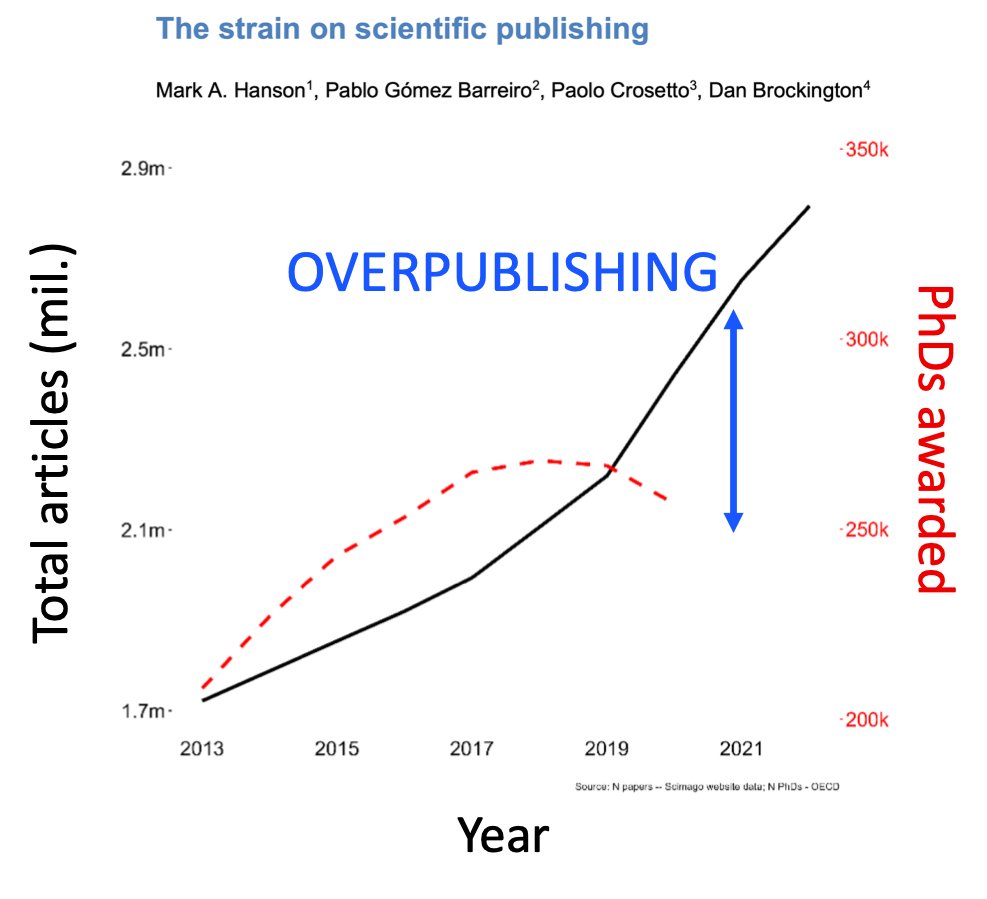
Overpublishing and reduced rate of rejection - the combination is bound to bring down the quality of published research papers.
Overpublishing puts enormous stress on students and PIs.
And brings tons of money to publishers in STEM.
A new study shows that the number of papers is increasing FASTER than the number of #PhD graduates.
It’s an amazing work with very useful statistics. Huge kudos to the authors!
▫️
Main outcomes:
1️⃣ In 2022 the number of articles is 47% higher than in 2016. The amount of writing, reviewing and editing workload per scientist is increased enormously.
2️⃣ “Special issues” is a strategy for publishing lots of papers with reduced review time. This is possible due to the “publish or perish” pressure and clearly benefits the publishers.
3️⃣ The publishing time varies widely!
MDPI = 37 days. Frontiers = 72 days. Elsevier = 134 days. Springer = 157 days. Nature = 185 days.
4️⃣ The article rejection rates do not seem to correlate with publisher growth. However, rejection rates decline with increased use of special issue publishing.
5️⃣ Certain for-profit gold-open-access publishers create an increasing number of special issues, with uniquely reduced turnaround times, and in specific cases, high impact inflation and reduced rejection rates.
6️⃣ The authors suggest a new metric - Impact Inflation, which is reflected in self-citation within the same journal. For example, MDPI has a high impact inflation due to excessive self-citation compared to other publishers.
Conclusions and my opinion:
- Scientists have to spend a lot more time on reviewing and writing than before (on average).
- The more papers are published, the more the quality is compromised.
- Scientific progress has become partially bound to the business models of publishers and their revenue (a sad reality today).
- There is a huge lack of transparency. Much of these data had to be ‘web-scraped’ from numerous sources in order to get a full picture. We clearly need regulators to mandate open access to publisher’s statistics.
- Reduce the number of special issues! Those typically have low standards.
▫️
Science, publishing and funding make a trio that is very hard to disentangle.
However, research quality is controlled by the community.
This is why preprint + community review can make a big difference.
#AcademicTwitter #AcademicChatter
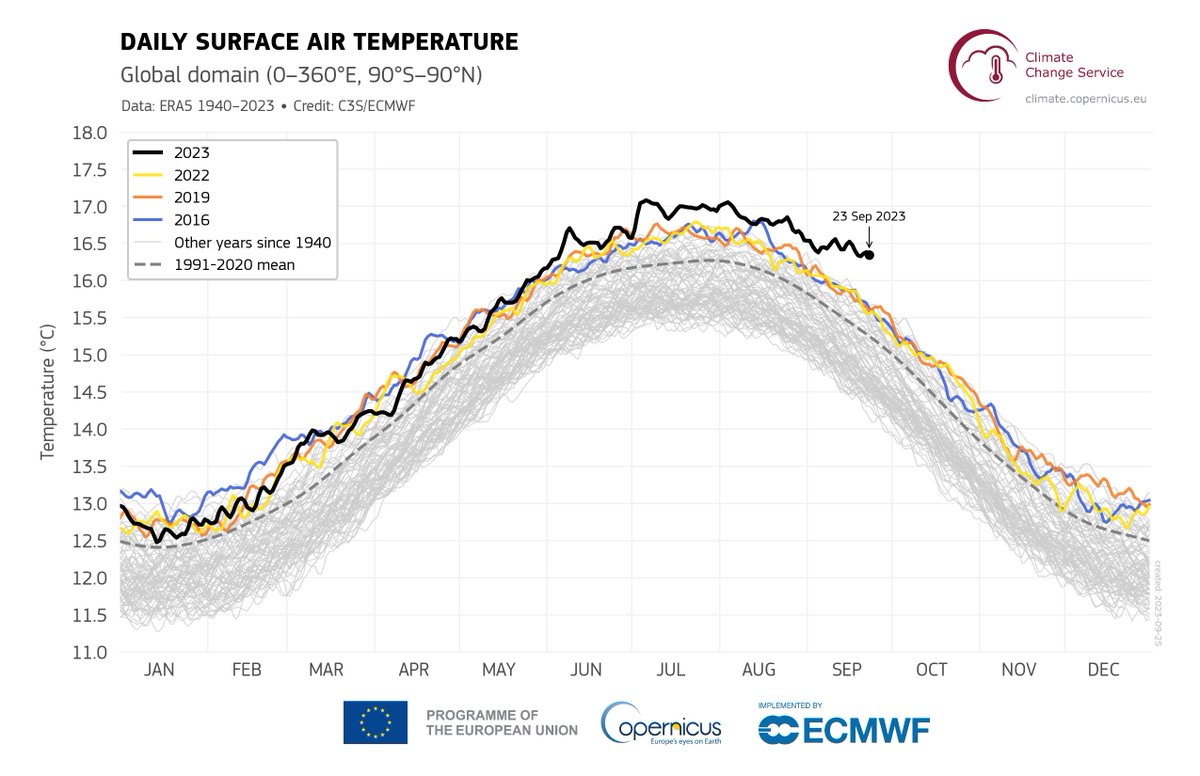
Global air temperatures remaining much higher than normal for the time of year.
And El Nino is only just starting.
We expect to see more devastating extreme weather events, especially in Australia, South America & Asia in the coming months.
Graphic: @CopernicusECMWF
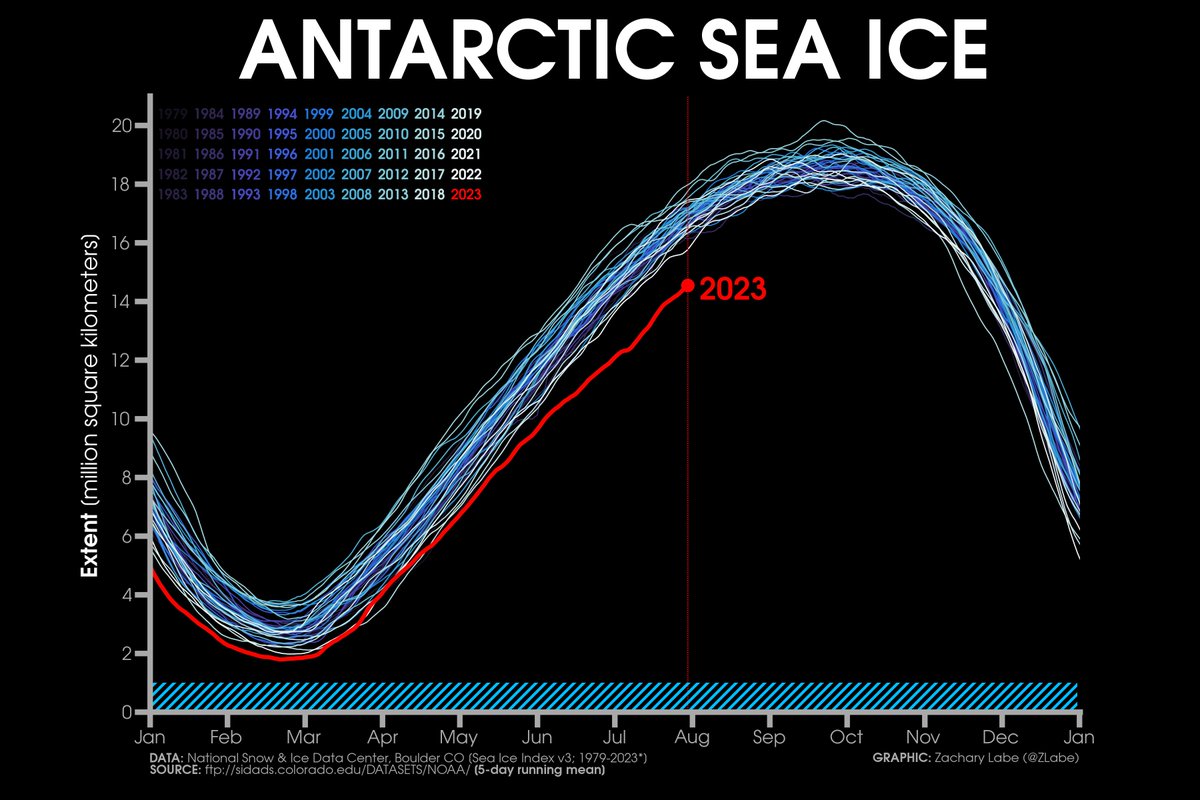
You’ve heard about Antarctic sea ice lows - well, here’s the consequences.
Over 9,000 emperor penguin chicks from colonies in the Bellingshausen Sea are thought to have died in November 2022.
The sea ice they lived on broke up early, before they'd developed waterproof feathers.
So: we're currently missing an area of Antarctic sea ice bigger than Greenland.
You might have seen this graph (thanks @ZLabe).
Our scientists have been pretty busy talking about this extreme event in the media. Here's what you need to know ⬇️
https://t.co/ybuve2fL7T
📢Last year, I was invited to work on a commentary about the obstacles of not having the 'right' passport in academia. This originated at @EuroGeosciences, were I talked about how I ended up working in geosciences. Today, it's finally out in @NatureGeosci!
https://t.co/eYkhEIXrD1