I am grateful that someone endowed with exceptional strategic thinking, a remarkable capacity for action, and personal charisma was born into an environment where he could fully realize the value of those gifts, that he encountered other extraordinary young talents, each worthy of being the protagonist of their own story, and that they challenged and inspired one another to grow, and that he has worked tirelessly to reach a point where his achievements fuel further achievements in a self-reinforcing cycle.
Above all, I am grateful that such an individual was born in Japan and holds a deep love for this country.
Open research and open source accelerate progress.
The proprietary AI shops are black holes that suck everyone else's techniques without ever giving back
They suck.
(looking at you Anthropic and OpenAI 👀).
Employees occasionally evaporate from those shops like Hawking radiation. One employee escapes, the anti-employee stays behind the event horizon.
There is no inherent ceiling on intelligence, because the limits of concept acquisition and the limits of intelligence are fundamentally different.
In mathematics, for instance, infinitely many theorems can be derived from a finite set of axioms. Even if all concepts were acquired, there would still be room for improvement in how they are combined, reasoned about, and applied to unfamiliar problems.
Furthermore, just as humans have continually discovered new concepts within the limited environment of Earth, AI could potentially push the boundaries of concept acquisition itself.
This is a bigger deal than people realise. If LLM training is discovering fundamentally identical latent information, we’re on a path to stop re-training from scratch and instead use training to continuously expand AI knowledge. That’s potentially a huge boon for efficiency and capability.
But it also means that LLMs are gathering something that exists in the world (I.e. concepts), as opposed to being “created” or “grown” as folks like to say.
The verb matters because something grown could presumably expand in size and resource consumption for ever, but something gathered begs the question… at what point have we gathered all the useful concepts in the world. At what point do we reach “peak concept”?
At that point, more training wouldn’t yield more capability. It would just be learning copies of the same information.
really cool research, reminds me of this paper that showed that all of the embedding representations basically collapse to a single latent space
it had strong implications for the embedding models market. All models being basically the same kinda destroyed any potential for margin from serving the model alone, there was just no moat there;
I did a deep dive on this in Tensor Economics:
https://t.co/TZOqW6KxkA
Quantum gravity solved? With help from GPT-6 Astra, physicist Venkatesa Chandrasekaran developed a new proposal to quantize gravity in four-dimensional spacetime using light cones. He credits the AI with helping work out several of the calculations and proofs.
The approach reproduces Hawking's formula for black hole entropy and gives a finite answer to a graviton calculation that blows up under the usual expansion. If it holds up, we could have a way to calculate how spacetime itself behaves when quantum effects are strong.
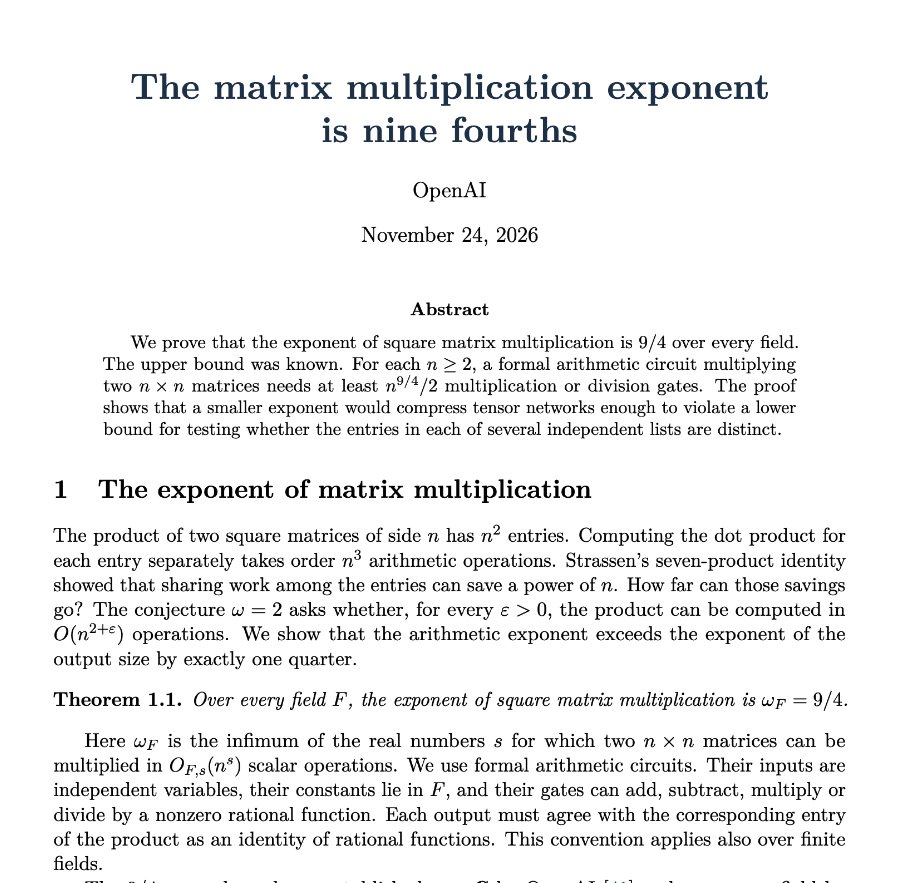
OpenAI claims the matrix multiplication exponent is exactly 2.25
The textbook method for multiplying two n × n matrices takes roughly n³ arithmetic operations. In October, OpenAI reported a way to bring the exponent down to 2.25. That left open whether someone could find an even faster algorithm
Today’s paper claims to rule out every exponent below 2.25
Read here: https://t.co/GXn451OiYf
Although the circumstances were entirely different, Sam Altman and Steve Jobs both made comebacks, so I expected Jensen Huang to return eventually. Still, it happened much sooner than I anticipated.
I can't help but think his resignation was largely for appearances. Nevertheless, any transfer of computing resources to China that has already occurred cannot simply be undone by his reinstatement.
Here is a Human readable version of Anthropic’s Levent Alpöge's Reimann Hypothesis solution. So far he has only released a rough sketch and a 17,400,000 line long Lean formalization.
Therefore I’m posting this human readable version based version built using his Lean proof. https://t.co/GS1fYHy4Tc
I came close to making Japan's national Math Olympiad team, but I had to earn a living, so I had no choice but to give up academia. Looking back, maybe it was a good thing I didn't pursue a degree in mathematics... If I had gone down that path, I might be despairing right now, wondering what I'd been living for all along.
Even IUT theory was considered absurdly long at 600 pages, and now we're talking about 250,000 pages.....??? What the hell........
At this point, there's a real possibility that AI has already invented some entirely new mathematical theory buried somewhere in there...........
Let me explain what just happened.
Levent Alpöge, a mathematician at Anthropic, says he has proven the Riemann Hypothesis while working with Claude.
The Riemann Hypothesis (a 167-year-old prediction about how prime numbers are spread out) is one of the seven Millennium Prize Problems, with a $1M reward. It underpins a huge amount of modern math, and it's tied to the encryption that keeps the internet secure.
He says the same method also proves the Generalized Riemann Hypothesis, an even broader version. The whole proof is written in Lean (a programming language where a computer checks every single step of a proof). The full written-out version reportedly runs past 250,000 pages, so he released the Lean code instead.
The work started on October 6.
8 of the 20 key steps landed on a single day, November 15. He openly credits Claude for the parts that rely on areas he says he hasn't mastered.
Why it matters: problems like this used to take generations of mathematicians, if they got solved at all. This is one mathematician and one AI model in about six weeks.
So don't misunderstand it as "AI solved math." Nobody has independently verified it yet, and that has to happen first. But the Lean format means it can be checked much faster than a normal paper.
Still crazy!
BREAKING: A mathematician at Anthropic claims to have used the company's AI to solve the Riemann hypothesis, the most notorious open problem in all of math
https://t.co/nEXAyIkvSt
Holy shit. Levent Alpöge from Anthropic just claimed Claude has resolved the General Reimann Hypothesis!!!
Proof is 250,000+ pages long. Lean is released.
GRH is the 2nd of 6 Millenium prizes solved by AI, after Navier-Stokes. This may be the biggest AI math result of all time.
Another banger paper dropped by Yann LeCun, Randall Balestriero, and Kerda Varaku.
"Counterfactual World Models: JEPAs That Reason About What If"
What if AI could predict what would have happened if it had made a different decision?
They introduce Counterfactual World Models, which extend JEPAs to predict alternative outcomes under the same hidden conditions.
For example, if wind pushes a robot off course, the model uses the observed error to estimate where it would have ended up had it taken a different action, without requiring additional training.
Across four simulated physical environments, the approach improves counterfactual prediction R² from 38-46% to 86-96% using the same underlying world models.
https://t.co/6NK2K8xGBz