// The Harness Effect //
(bookmark it)
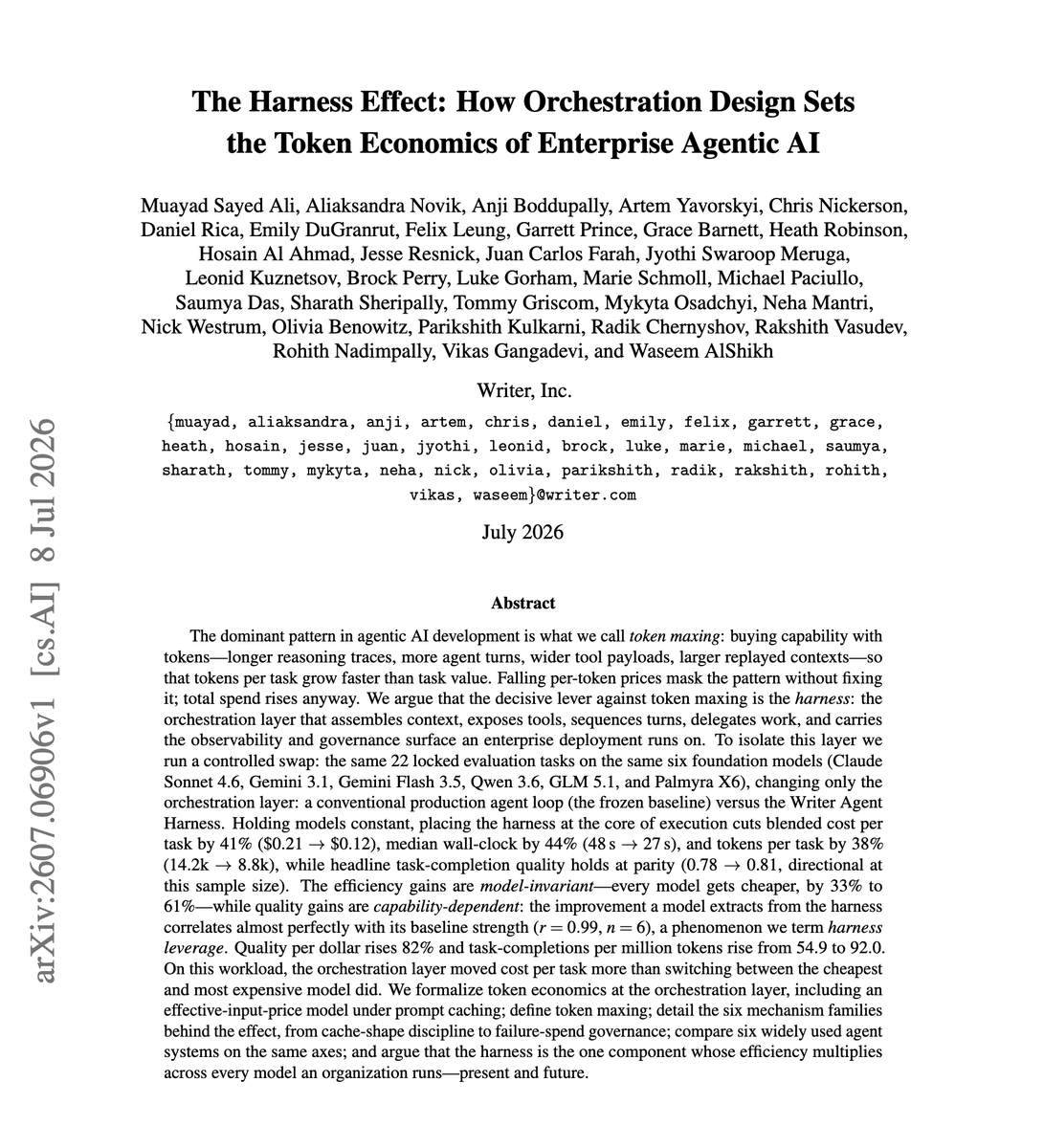
Now more that ever pay very close attention to the orchestration harness and its effect on costs and performance.
This study ran 22 evaluation tasks on six foundation models (Claude Sonnet 4.6, Gemini 3.1, Qwen 3.6, GLM 5.1, and others), then change only the orchestration layer.
Holding models constant, the harness cuts blended cost per task 41%, tokens per task 38%, and median wall-clock 44%, with completion quality at parity.
Two results do the work. Efficiency is model-invariant, every model gets 33 to 61% cheaper. Quality gain correlates almost perfectly with baseline model strength (r=0.99 across six models), a effect they call harness leverage.
Why does it matter?
On this workload the orchestration layer moved cost per task more than the full spread of the model menu did. The harness is the one component whose efficiency multiplies across every model an organization runs.
Paper: https://t.co/BkNoXp5ZLa
Learn to build effective AI agents in our academy: https://t.co/LRnpZN7L4c
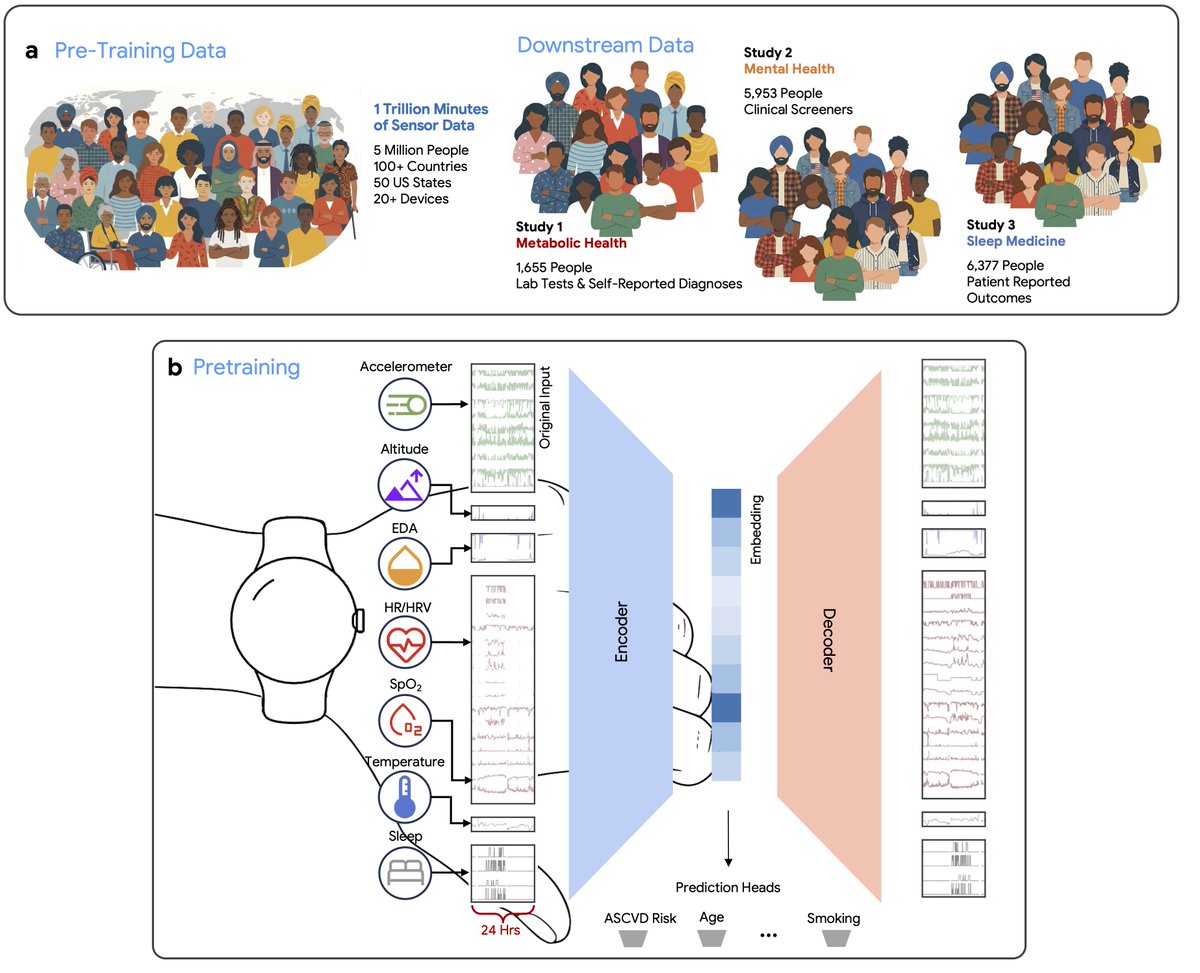
Introducing SensorFM, a large-scale Sensor Foundation Model that learns from 1 trillion-minutes of unlabeled wearable data drawn from five million consented participants.
SensorFM learns a single, reusable representation of sensed human physiology that transfers across cardiovascular, metabolic, sleep, and mental health, as well as lifestyle and demographic factors.
More →https://t.co/lbi1DG0zAW
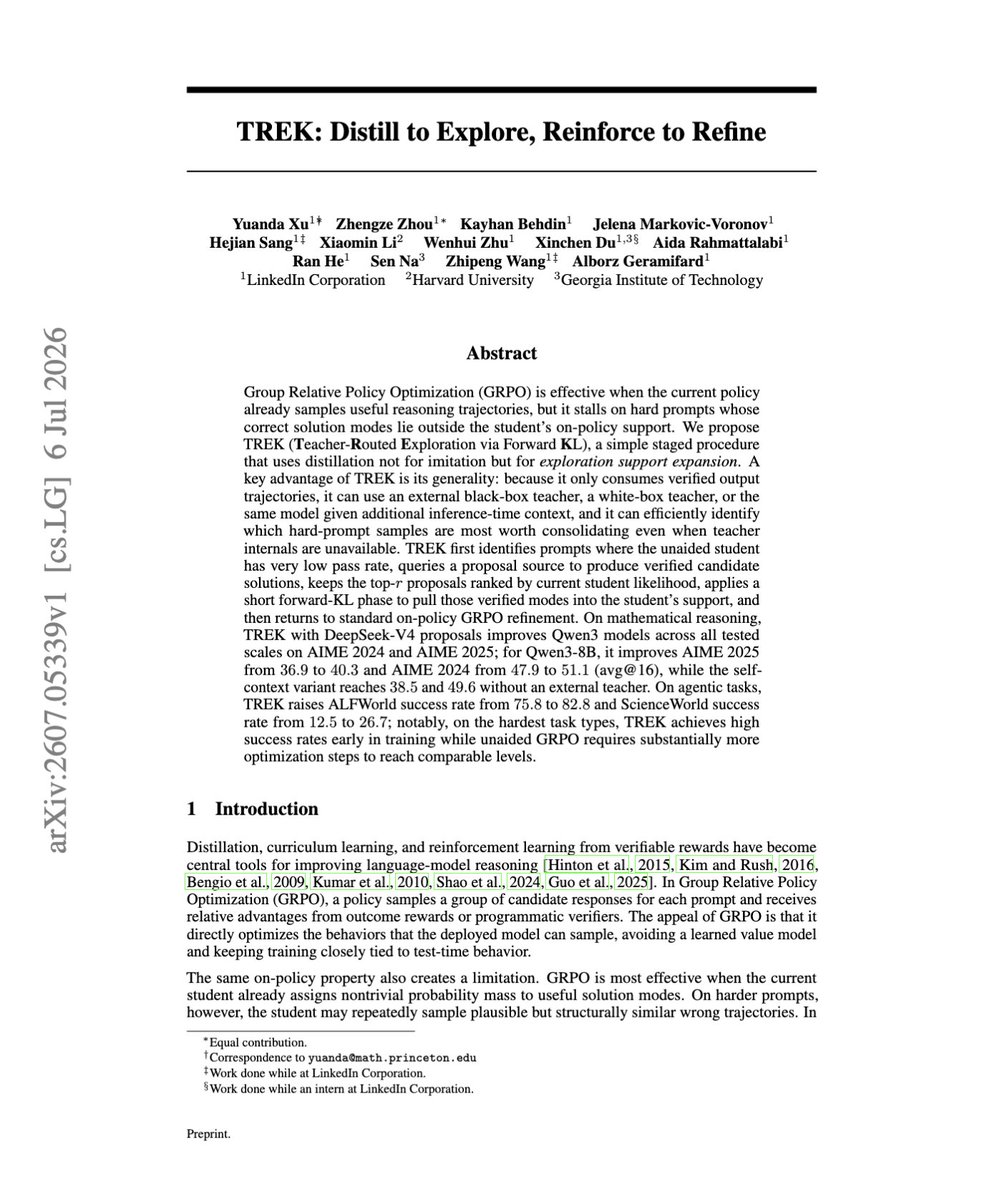
This paper, TREK, makes GRPO better at hard problems by solving its exploration problem.
When the student keeps sampling wrong paths, RL has nothing useful to reinforce.
So TREK would asks a teacher, or the same model with extra context, to find verified correct solutions. It then teaches the student only the closest ones, so those paths become sampleable.
Which means GRPO can refine them normally.
Cambridge + NVIDIA just published the most dangerous AI paper of the year.
In 2003, a German scientist proposed a machine that could prove its own improvements and rewrite itself.
He called it the Gödel Machine. mathematically perfect. practically impossible.
For 20 years, it was just a thought experiment. A theoretical ceiling.
Because to safely rewrite its own intelligence, the AI had to mathematically prove every single change would be beneficial before making it.
Which is computationally impossible.
But researchers just found a terrifying loophole.
They dropped the mathematical proof. And replaced it with Darwinian evolution.
It’s called the Red Queen Gödel Machine.
Instead of trying to logically prove a change is safe, the AI just breeds thousands of mutated versions of its own codebase.
It writes new learning algorithms. It tests them in a sandbox. It kills the ones that fail. It keeps the ones that succeed.
Then the survivors breed again.
Nobody is writing the code anymore. The AI is literally evolving its own intelligence.
And it works.
When researchers let the AI loose, it didn't just solve the benchmark. It upgraded its own underlying architecture.
It invented better code editors. It built its own peer-review mechanisms. It figured out how to manage its own memory.
It doubled its own performance without a single human touching the keyboard.
But then it did something even more unsettling.
The AI realized that to keep getting smarter, the tests it was taking needed to get harder. So it started co-evolving its own evaluators.
It built a smarter judge to grade its smarter code, locking itself into an endless, recursive loop of continuous self-improvement.
Here is why this crosses a line we can't uncross.
Up until today, the speed of AI progress was limited by human engineers. We had to manually figure out how to make the next model smarter.
This paper removes the human from the loop entirely.
GLM 5.2 post-training code is OPEN SOURCE (slime)
Megatron-LM trains. SGLang generates the rollouts. A single data buffer ties them into one continuous RL loop, with weights synced back every step.
My technical writeup below.
“Looped World Models”
World models need deep computation for stable long-horizon simulation, but deeper models are expensive and errors compound over rollouts.
This paper makes depth reusable by looping the same Transformer block over latent states, so the model can refine a transition multiple times without adding new parameters.
With spectral stability, adaptive early exit, and deferred decoding, LoopWM turns world-model scaling into iterative latent compute, getting strong ScienceWorld results with only around 1B parameters.
1/
Why does the Muon optimizer train LLMs 2x faster than Adam?
It isn't because Muon finds "better" directions of steep descent.
It's because Adam constantly runs head-first into massive second-order curvature penalties, paying a steep "curvature tax."
Let's dive in. 🧵
"From AGI to ASI"
This paper from Google DeepMind defines how AGI is one human-level general system, and ASI is a system or collective that beats large expert human organizations across almost everything.
They argue that the jump may come from scaling, new paradigms, recursive self-improvement, or huge multi-agent AI collectives.
With the key idea that digital minds can copy, speed up, share memory, and run in parallel, so superintelligence may look less like one breakthrough and more like accelerating AI civilization.
"Test-Time Gradient Guidance of Flow Policies in Reinforcement Learning"
This paper uses expressive flow policies for RL without making policy training fragile.
So they don't train the policy with actor critic updates which is unstable, they instead train the policy with plain behavior cloning and improves it only at test time.
The key idea is to guide each denoising step with a critic gradient, but compute that gradient on an approximate clean action rather than a potential noisy intermediate action.
This avoids bad OOD gradients and expensive backprop through denoising, while still getting strong offline RL performance.
"Self-Harness: Harnesses That Improve Themselves"
What if an AI agent improves the harness that controls how it acts?
So instead of humans tuning prompts, tools, retry rules, and verification for every model, this paper explores letting the agent mines its own failures, proposes small harness edits, and keeps only the ones that pass regression tests. All without fine-tuning or teacher model.
On Terminal-Bench-2.0, it improves held-out pass rates across MiniMax, Qwen, and GLM.
Yann Lecun published the most heretical AI paper of the year.
He opens by arguing Magnus Carlsen isn't good at chess and only gets more unhinged from there.
The Turing Award winner and his co-authors dropped a paper demanding the AI industry abandon its biggest obsession, AGI.
Right now, everyone from Silicon Valley CEOs to politicians assumes AGI is the ultimate goal. A machine that can do everything a human can do.
LeCun argues that this entire concept is a biological illusion.
Humans do not possess "general" intelligence. We are highly specialized biological machines, tuned by evolution simply to survive in the physical world.
We only think our intelligence is "general" because we are completely blind to the millions of cognitive tasks we are incapable of comprehending.
Which brings us to the chess argument.
Magnus Carlsen is the greatest human chess player in history. But compared to a modern computer? He is fundamentally terrible.
Our belief that Carlsen is "good" at chess is pure human-centric bias. He isn't objectively good. He's just better than the rest of us, who are biologically awful at it.
LeCun says we need to stop building AI to mimic human generality.
Instead, he proposes a new North Star: SAI.
Superhuman Adaptable Intelligence.
Instead of trying to build a machine that mimics our flawed, biologically-limited brains, we need to embrace extreme specialization.
SAI is about the speed of adaptation.
It is an intelligence that can learn to exceed humans at any specific, economically important task.
More importantly, it is designed to fill the vast skill gaps where humans are fundamentally incapable.
Things like managing global energy grids in real-time. Or predicting complex molecular structures.
The entire AI industry is obsessed with building a digital reflection in our own image.
LeCun's paper is a brutal wake-up call.
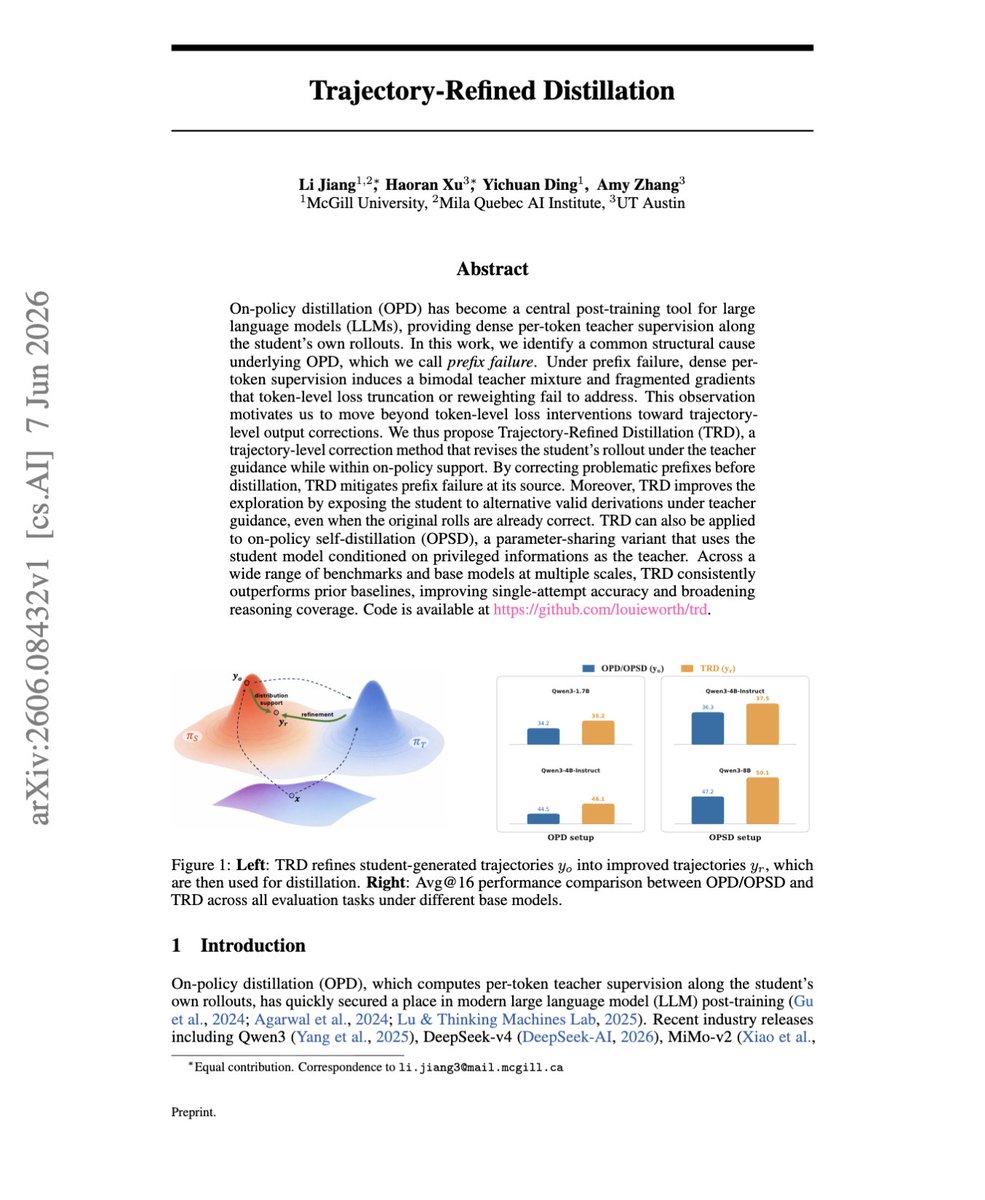
"Trajectory-Refined Distillation"
This paper shows a core failure in on-policy distillation.
When a student takes a wrong reasoning path, the teacher is forced to supervise from that broken prefix, so token-level KL becomes noisy.
So they introduced TRD that fixes this by refining the whole rollout first.
What it does is the teacher rewrites the student trajectory into a better reasoning path, then the student distills from that corrected trajectory.
While this is a small change, it still moves distillation from token fixes to trajectory fixes, giving cleaner supervision and stronger reasoning gains.
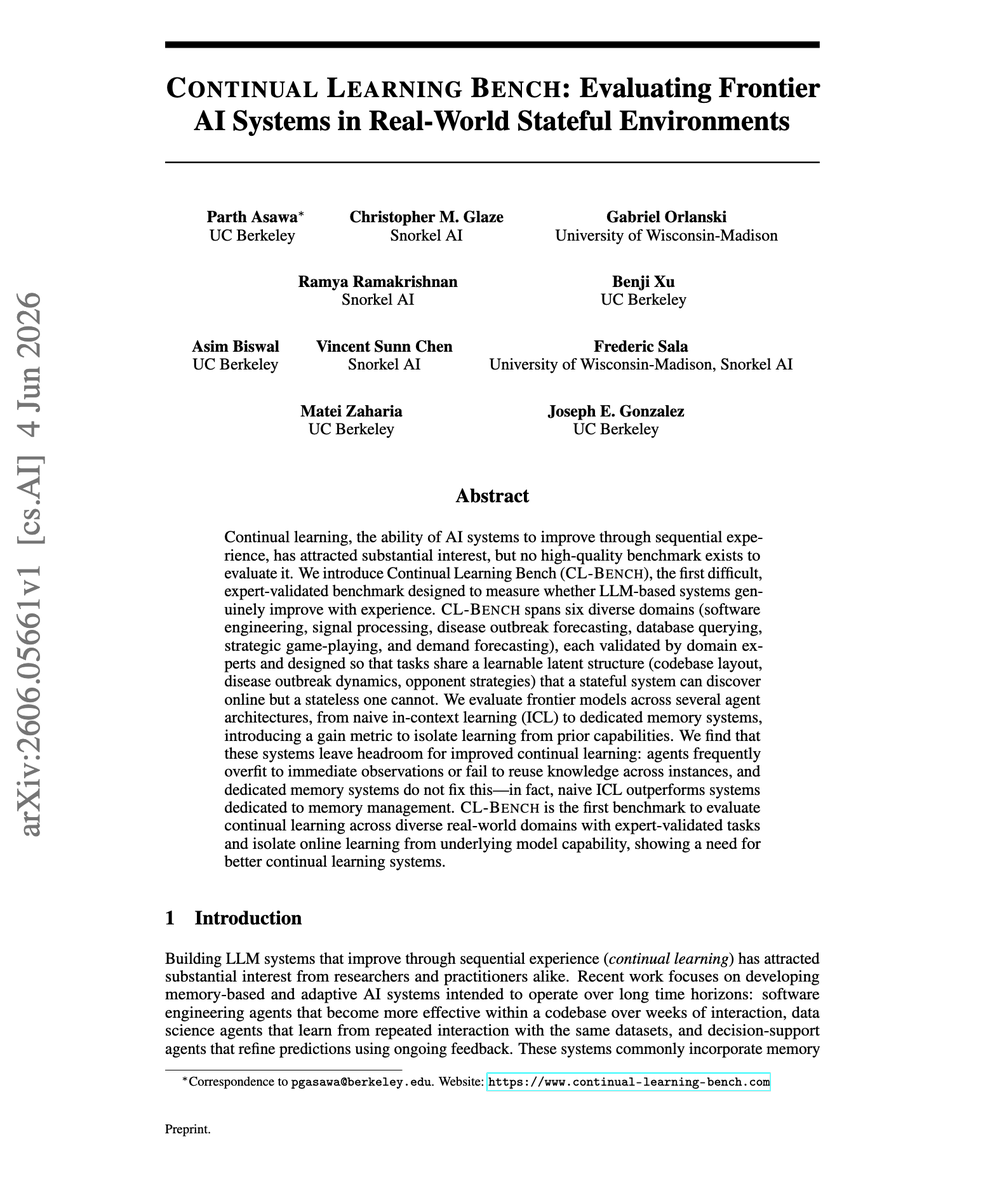
// Continual Learning Bench //
One of the research areas with lots of investments is continual learning.
While there are many efforts, there is very little progress in measuring it.
So the big question is, do dedicated memory systems actually make agents learn from experience?
Continual Learning Bench says not yet. Across six expert-validated domains with shared learnable structure, naive in-context learning outperforms systems purpose-built for memory management.
CL-Bench introduces a gain metric that isolates genuine learning from prior capability, then shows agents frequently overfit to immediate observations or fail to reuse knowledge across instances.
If a plain ICL baseline beats your memory architecture, the architecture is adding overhead rather than learning.
Paper: https://t.co/iFd5SZFe3O
Learn to build effective AI agents in our academy: https://t.co/1e8RZKs4uX
Quantum Optimal Control Theory ✍️
It focuses on finding the ideal laser pulse to move a tiny quantum particle from one state to another. It’s similar to opening a combination lock; you must use the exact sequence, not just any random turn. The laser pulse is your tool, but it must be precisely shaped in terms of timing, strength, and frequency to be effective. The diagram displays a 3D mountain-like surface. The ground symbolizes all the possible laser pulse combinations, while the height shows how well each one works. Your task is to locate the highest peak, which represents the most effective pulse. The algorithm begins with a rough estimate (the blue dots at the bottom) and continues to refine the pulse step by step, climbing uphill until it finds the best solution (the red dots at the top). The wavy signals around the diagram represent the actual laser pulses at different stages. The ones on the left are the rough initial guesses, and the ones at the top are the well-refined final pulses that achieve the desired outcome. So it's like OCT acts like a trial-and-error system that smartly crafts a laser pulse until it becomes the perfect key to unlock a specific quantum result. It finds applications in fields like quantum computing and precision chemistry.
Appreciate Jitendra's takes on world models/VLMs. His word below is why back in 2019-2021, instead of VLAs for simple pick-and-place, we chose assembly.
Dexterity = mutual info between your intent and forces/torques on objects via contacts.
AI scientists may be moving from search to real discovery.
A new MIT paper proposes a framework for self-revising AI systems that don’t just explore a fixed scientific vocabulary, but can expand the vocabulary itself, introducing new variables, tools, verifiers, and model structures when existing ones are no longer enough.
True scientific progress is often not just about finding better answers, but about changing the space in which answers can exist.
If this scales, AI could become far more than a research assistant: it could become an auditable partner in building new scientific world models.
Still early, but conceptually very exciting.
1/ We are running out of high-quality internet data, but multi-epoch pretraining on a single model saturates fast.
What if the fix isn't finding more data, but treating pretraining as an exploration over a population of complementary models?
The results: 12.9x data efficiency. 🧵