🚀 Big news for #Ethereum! Just wrapped phase-one research + PoC showing how Rust smart contracts (or any lang targeting RISC-V ISA) can run on a RISCV variant of the EVM! 🦀💻
🔍 Research: https://t.co/dMr5VhUWtL
💻 Rust PoC code: https://t.co/QFKx3Bybnp
Read the thread for a quick dive or check the links for full details! 🧵👇 #Blockchain #Rust #RISC_V
Nethermind's @svlachakis_ co-authored Frame Transactions (EIP-8141) for the Hegotá upgrade, planned for 2027.
What Frame Transactions change:
An app can pay a user’s fee and get paid back in a stablecoin like USDC. Smart wallets can let users sign with a phone passkey or change their key without moving funds. Wallets do this today with extra offchain services. With Frame Transactions, Ethereum supports this directly.
We’ve built them into the Nethermind Client. See how they work in the video below.
New from LayerZero Research: Aerie.
A new system capable of aggregating 32,000 post-quantum Falcon signatures in just 0.65 seconds on a MacBook Pro.
ML-DSA, NIST’s standardized default, is already working inside Aerie at high performance.
https://t.co/IXm2vLB00X
Introducing Magnetar from Microsoft Research, the first zkVM that is: (1) general-purpose (RV64), (2) post-quantum from standard hashes alone (no curves, no lattices, no Poseidon), and (3) built for recursion.
Despite its conservative security, it is the fastest zkVM: 7.2–8.7 MHz on a laptop, 10–39× faster than existing zkVMs across 15 workloads! An optimized version reaches 9.5–12.8 MHz.
Links in the thread below.
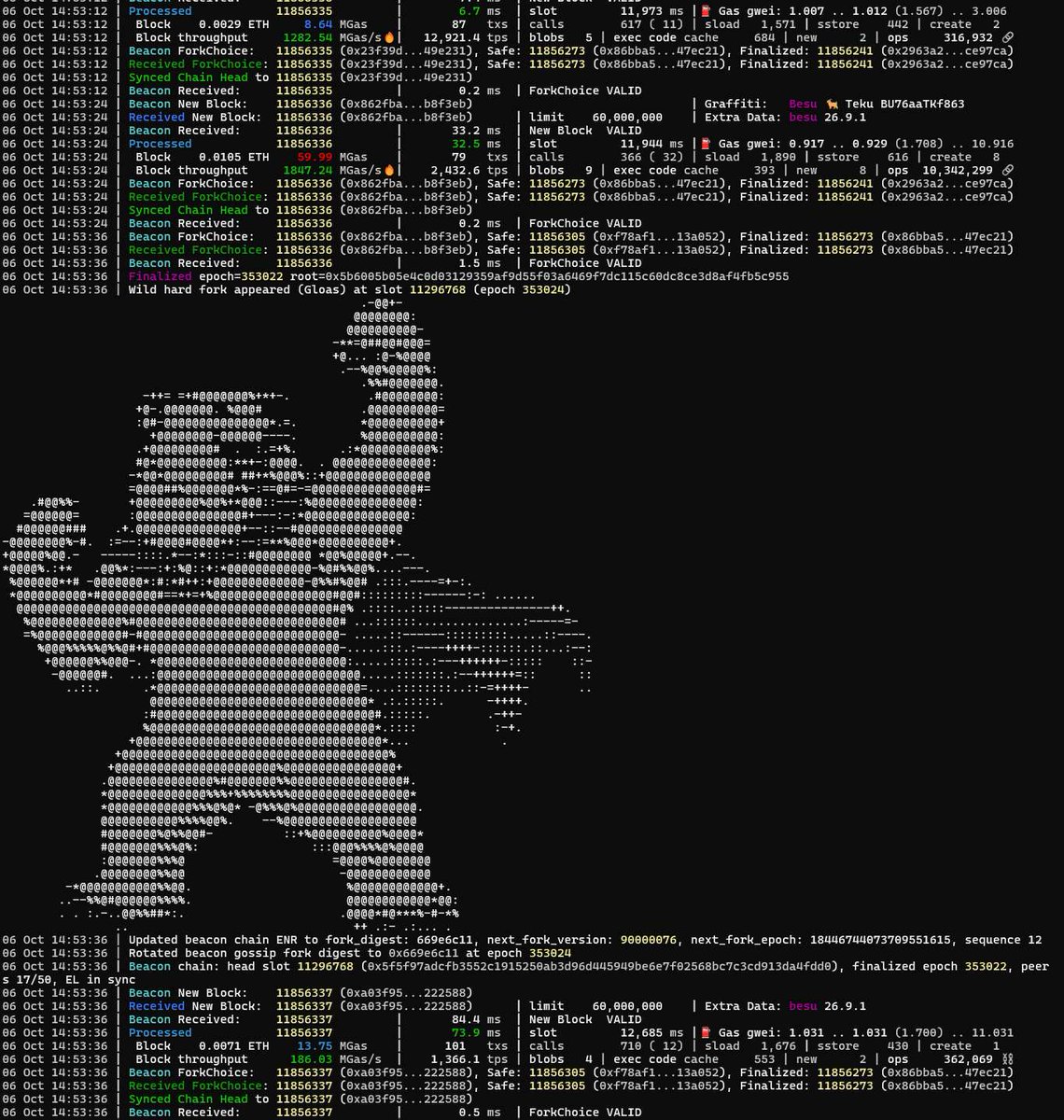
Glamsterdam just went live on Sepolia, bringing ePBS and block-level access lists one step closer to mainnet.
This Nethermind node is following it with no separate consensus client, using a beacon chain plugin we're still developing.
New on #HyperFX: OrderBook!
Orderbooks provide the best price discovery mechanism on open markets
LPs now set their own prices, and your swap fills at the best quote available. You also get to choose how your order fills, with Conservative or Best Returns pricing
Huge engineering achievement by the ZisK team.
Proving Ethereum blocks in real time with just 4 GPUs, while maintaining 128-bit security and post-quantum resistance, is an outstanding milestone.
Incredibly proud of what this team is building. 🚀
Over the past couple of months, we’ve been working on RAX, a RISC-V-to-x86-64 static binary translator.
It is designed to run RISC-V programs on x86-64 with as little overhead as possible and currently supports RV64IMA.
In this video, I use RAX to compile a RISC-V Ethereum stateless validation client into a native x86-64 executable. I then run it against Ethereum block #24,167,615.
The workload executes over 2.16 billion RISC-V instructions and completes in around 362ms on my machine.
That works out to almost 6 billion RISC-V instructions per second 🤯.
It has taken several iterations to get here:
Interpreter: 2m43s
Basic-block interpreter: 35s (~4.7x faster)
JIT compiler: 6s (27x faster)
AOT compiler: 362ms (450x faster)
RAX is still a work in progress, but we’re really excited to share what we’ve built so far.
GitHub: https://t.co/aDJGmFnsj8
Over the past few weeks we have re-audited every cryptographic dependency Hyperbridge relies on.
This has led to the discovery of even more critical vulnerabilities in our code, third-party libraries and even Polkadot itself.
All have been responsibly disclosed and patched. We’ll be publishing a detailed write-up on shortly on all our findings.
The root cause of the original incident was a missing single line of code that permitted proof forgery.
The vulnerable code in question dates to early Polytope Labs days and predates our current review & testing standards, which is why the re-audit was warranted and why it’s ongoing.
Alongside this, we’re launching a bug bounty which will help us work with whitehats on the continued security of the protocol.
EPF7 applications are open. Deadline is May 13.
If you want to work on core Ethereum protocol — client development, testing, specs, research — this is the program for you.
Introducing https://t.co/hCcz4pQCxZ,
A tool that allows you compute anything.
Think of how programming languages work. You are not restricted to a certain type of program rather you are given the building blocks to build whatever you want.
That's the goal for https://t.co/hCcz4pQCxZ. A turing-complete math platform that gives you the building blocks to calculate, experiment and build deep computational flows.
This is the first of many demos. Try it out and join me on this journey as I build the best math and computation platform.
Introducing strawmap, a strawman roadmap by EF Protocol.
Believe in something. Believe in an Ethereum strawmap.
Who is this for?
The document, available at strawmap[.]org, is intended for advanced readers. It is a dense and technical resource primarily for researchers, developers, and participants in Ethereum governance. Visit ethereum[.]org/roadmap for more introductory material. Accessible explainers unpacking the strawmap will follow soon™.
What is the strawmap?
The strawmap is an invitation to view L1 protocol upgrades through a holistic lens. By placing proposals on a single visual it provides a unified perspective on Ethereum L1 ambitions. The time horizon spans years, extending beyond the immediate focus of All Core Devs (ACD) and forkcast[.]org which typically cover only the next couple of forks.
What are some of the highlights?
The strawmap features five simple north stars, presented as black boxes on the right:
→ fast L1: fast UX, via short slots and finality in seconds
→ gigagas L1: 1 gigagas/sec (10K TPS), via zkEVMs and real-time proving
→ teragas L2: 1 gigabyte/sec (10M TPS), via data availability sampling
→ post quantum L1: durable cryptography, via hash-based schemes
→ private L1: first-class privacy, via shielded ETH transfers
What is the origin story?
The strawman roadmap originated as a discussion starter at an EF workshop in Jan 2026, partly motivated by a desire to integrate lean Ethereum with shorter-term initiatives. Upgrade dependencies and fork constraints became particularly effective at surfacing valuable discussion topics. The strawman is now shared publicly in a spirit of proactive transparency and accelerationism.
Why the "strawmap" name?
"Strawmap" is a portmanteau of "strawman" and "roadmap". The strawman qualifier is deliberate for two reasons:
1. It acknowledges the limits of drafting a roadmap in a highly decentralized ecosystem. An "official" roadmap reflecting all Ethereum stakeholders is effectively impossible. Rough consensus is fundamentally an emergent, continuous, and inherent uncertain process.
2. It underscores the document's status as a work-in-progress. Although it originated within the EF Protocol cluster, there are competing views held among its 100 members, not to mention a rich diversity of non-EFer views.
The strawmap is not a prediction. It is an accelerationist coordination tool, sketching one reasonably coherent path among millions of possible outcomes.
What is the strawmap time frame?
The strawmap focuses on forks extending through the end of the decade. It outlines seven forks by 2029 based on a rough cadence of one fork every six months. While grounded in current expectations, these timelines should be treated with healthy skepticism. The current draft assumes human-first development. AI-driven development and formal verification could significantly compress schedules.
What do the letters on top represent?
The strawmap is organized as a timeline, with forks progressing from left to right. Consensus layer forks follow a star-based naming scheme with incrementing first letters: Altair, Bellatrix, Capella, Deneb, Electra, Fulu, etc. Upcoming forks such as Glamsterdam and Hegotá have finalized names. Other forks, like I* and J*, have placeholder names (with I* pronounced "I star").
What do the colors and arrows represent?
Upgrades are grouped into three color-coded horizontal layers: consensus (CL), data (DL), execution (EL). Dark boxes denote headliners (see below), grey boxes indicate offchain upgrades, and black boxes represent north stars. An explanatory legend appears at the bottom.
Within each layer, upgrades are further organized by theme and sub-theme. Arrows signal hard technical dependencies or natural upgrade progressions. Underlined text in boxes links to relevant EIPs and write-ups.
What are headliners?
Headliners are particularly prominent and ambitious upgrades. To maintain a fast fork cadence, the modern ACD process limits itself to one consensus and one execution headliner per fork. For example, in Glamsterdam, these headliners are ePBS and BALs, respectively.
(L* is an exceptional fork, displaying two headliners tied to the bigger lean consensus fork. Lean consensus landing in L* would be a fateful coincidence.)
Will the strawmap evolve?
Yes, the strawmap is a living and malleable document. It will evolve alongside community feedback, R&D advancements, and governance. Expect at least quarterly updates, with the latest revision date noted on the document.
Can I share feedback?
Yes, feedback is actively encouraged. The EF Protocol strawmap is maintained by the EF Architecture team: @adietrichs, @barnabemonnot, @fradamt, @drakefjustin. Each has open DMs and can be reached at first.name@ethereum[.]org. General inquiries can be sent to strawmap@ethereum[.]org.
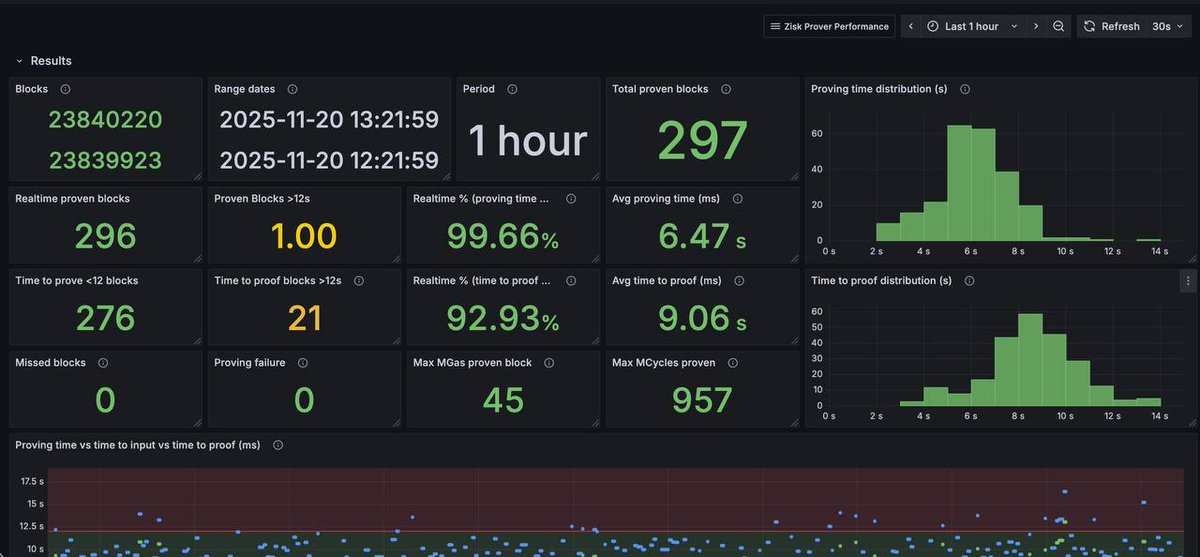
We promised it and we delivered it: realtime proving with @ziskvm!
💻 24x5090 GPUs
⏱️ 6.56s avg per proof
⚡️99.74% under 12s
🚀 9.7s avg time-to-proof
🥇86.36% under 12s
The future of proving is happening right now
@eth_proofs
Today, we are having a retreat for the alumni in celebrating @Web3Bridge 6th anniversary. We presently have @m_a_y_o_w_a talking about Pathways to continuous growth as a developer.
You can join the livestream here
https://t.co/fxjAdzW0lU
1/ New post: Jolt now proves RISC-V programs with 64-bit registers (RV64IMAC), at speeds exceeding those we previously reported for 32-bit.
1.5M cycles/sec on a 32-core CPU, 500k cycles/sec on a MacBook.
Here’s why this matters 🧵




![drakefjustin's tweet photo. Introducing strawmap, a strawman roadmap by EF Protocol.
Believe in something. Believe in an Ethereum strawmap.
Who is this for?
The document, available at strawmap[.]org, is intended for advanced readers. It is a dense and technical resource primarily for researchers, developers, and participants in Ethereum governance. Visit ethereum[.]org/roadmap for more introductory material. Accessible explainers unpacking the strawmap will follow soon™.
What is the strawmap?
The strawmap is an invitation to view L1 protocol upgrades through a holistic lens. By placing proposals on a single visual it provides a unified perspective on Ethereum L1 ambitions. The time horizon spans years, extending beyond the immediate focus of All Core Devs (ACD) and forkcast[.]org which typically cover only the next couple of forks.
What are some of the highlights?
The strawmap features five simple north stars, presented as black boxes on the right:
→ fast L1: fast UX, via short slots and finality in seconds
→ gigagas L1: 1 gigagas/sec (10K TPS), via zkEVMs and real-time proving
→ teragas L2: 1 gigabyte/sec (10M TPS), via data availability sampling
→ post quantum L1: durable cryptography, via hash-based schemes
→ private L1: first-class privacy, via shielded ETH transfers
What is the origin story?
The strawman roadmap originated as a discussion starter at an EF workshop in Jan 2026, partly motivated by a desire to integrate lean Ethereum with shorter-term initiatives. Upgrade dependencies and fork constraints became particularly effective at surfacing valuable discussion topics. The strawman is now shared publicly in a spirit of proactive transparency and accelerationism.
Why the "strawmap" name?
"Strawmap" is a portmanteau of "strawman" and "roadmap". The strawman qualifier is deliberate for two reasons:
1. It acknowledges the limits of drafting a roadmap in a highly decentralized ecosystem. An "official" roadmap reflecting all Ethereum stakeholders is effectively impossible. Rough consensus is fundamentally an emergent, continuous, and inherent uncertain process.
2. It underscores the document's status as a work-in-progress. Although it originated within the EF Protocol cluster, there are competing views held among its 100 members, not to mention a rich diversity of non-EFer views.
The strawmap is not a prediction. It is an accelerationist coordination tool, sketching one reasonably coherent path among millions of possible outcomes.
What is the strawmap time frame?
The strawmap focuses on forks extending through the end of the decade. It outlines seven forks by 2029 based on a rough cadence of one fork every six months. While grounded in current expectations, these timelines should be treated with healthy skepticism. The current draft assumes human-first development. AI-driven development and formal verification could significantly compress schedules.
What do the letters on top represent?
The strawmap is organized as a timeline, with forks progressing from left to right. Consensus layer forks follow a star-based naming scheme with incrementing first letters: Altair, Bellatrix, Capella, Deneb, Electra, Fulu, etc. Upcoming forks such as Glamsterdam and Hegotá have finalized names. Other forks, like I* and J*, have placeholder names (with I* pronounced "I star").
What do the colors and arrows represent?
Upgrades are grouped into three color-coded horizontal layers: consensus (CL), data (DL), execution (EL). Dark boxes denote headliners (see below), grey boxes indicate offchain upgrades, and black boxes represent north stars. An explanatory legend appears at the bottom.
Within each layer, upgrades are further organized by theme and sub-theme. Arrows signal hard technical dependencies or natural upgrade progressions. Underlined text in boxes links to relevant EIPs and write-ups.
What are headliners?
Headliners are particularly prominent and ambitious upgrades. To maintain a fast fork cadence, the modern ACD process limits itself to one consensus and one execution headliner per fork. For example, in Glamsterdam, these headliners are ePBS and BALs, respectively.
(L* is an exceptional fork, displaying two headliners tied to the bigger lean consensus fork. Lean consensus landing in L* would be a fateful coincidence.)
Will the strawmap evolve?
Yes, the strawmap is a living and malleable document. It will evolve alongside community feedback, R&D advancements, and governance. Expect at least quarterly updates, with the latest revision date noted on the document.
Can I share feedback?
Yes, feedback is actively encouraged. The EF Protocol strawmap is maintained by the EF Architecture team: @adietrichs, @barnabemonnot, @fradamt, @drakefjustin. Each has open DMs and can be reached at first.name@ethereum[.]org. General inquiries can be sent to strawmap@ethereum[.]org.](https://pbs.twimg.com/media/HCBwqPeWoAAC5Kj.jpg)


