The heliosphere is a vast region of space that surrounds our Sun and the solar system. It's essentially a "bubble" created by the solar wind, which is a stream of charged particles (mostly electrons and protons) that the Sun constantly emits.
The boundary where the solar wind slows down and becomes turbulent as it encounters the interstellar medium is called the heliopause. Beyond the heliopause lies the interstellar medium, the matter and radiation that exist in the space between stars in a galaxy.
Pre-production has officially begun:
BERSERK: The Black Swordsman
This series is very close to our hearts, we aim to create a proper 2D adaptation of the stories that have been neglected of this medium, starting from the beginning.
#BERSERK#Guts#Casca#Griffith #fananimation #indie_anime #eclypse
Francia detuvo durante 39 horas a la periodista Ariane Lavrilleux para que revelara sus fuentes, a lo que se ha negado. La noticia que había publicado implica a los franceses en asesinatos extrajudiciales de civiles en Egipto.
Pronto las "democracias" de la UE no tendrán este problema, y no se verán obligadas a realizar tediosos interrogatorios a periodistas, todo gracias a la futura Ley Europea de Libertad de los Medios de Comunicación.
Cuando sea aprobada, los Estados miembro podrán utilizar sus amplios recursos para espiar legalmente a periodistas, sus familias, y a redacciones enteras, para averiguar sus fuentes y otra información cuando así lo consideren oportuno.
Esto supondrá de facto el fin del periodismo de investigación más sensible y necesario, e imposibilitará las filtraciones acerca de las instituciones y figuras más poderosas del planeta.
Pero no te preocupes, es todo por tu seguridad y por tu bien. Tú mantente entretenido indignándote por la polémica de turno, que cuando te quieras dar cuenta, verás.
Noticia vía @VictorGGuerrero para @rtve
#freepablogonzalez
Esta es la lucha más importante de nuestra era, porque es indispensable para todas las demás.
Los poderes económicos, junto a los gobiernos y medios que controlan, vienen a por nuestra libertad de expresión e información en internet.
Russell Brand habla sobre su caso:
@EstralEsports Siento que R7 nos va a representar mejor xq están en su mejor nivel, pero no voy a mentir, se me arrugó el corazón al verlos fuera. <3 Go estral pal apertura!
The sad truth is that there are no great “social networks” right now.
We may fail, as so many have predicted, but we will try our best to make there be at least one.
Absolutely great question, involving some very fundamental core concept of Python
Ans is - c. None
The key concepts here are about Python's extended iterable unpacking feature. This feature allows you to unpack values from an iterable (in this case a list) into variables. And also the concept of nested data structures in Python.
Let's dive in
---------------------
👉 First, in the line `a,*b, c = ["Car", "Dog", "Tiger", "Lion"]` is doing the extended iterable unpacking.
👉 The syntax `*b` in the left side of the assignment statement is used for catching all remaining items from the iterable which are not assigned to other variables. In this case, `a` will be assigned the first item from the list, "Car", `c` will be assigned the last item, "Lion", and `*b` will catch the remaining items, ["Dog", "Tiger"].
👉 This is a very powerful feature of Python, especially useful when the exact length of the iterable is not known beforehand, or if you are only interested in some parts of the iterable.
👉 Now, the next line `item = b` is just assigning the list `b` to the variable `item`. So, `item` now contains the list ["Dog", "Tiger"].
👉 In the return statement `return "Lion" in [item] or None`, we are using the `in` operator to check if "Lion" is present in the list [item]. Here's where the confusion might lie.
👉 Remember that [item] is a list containing one element, the list `["Dog", "Tiger"]`. This makes [item] a nested list which is
`[['Dog', 'Tiger']]`
💡So, when Python checks for "Lion" in this list, it does not find it, because "Lion" is a string, and the list only contains another list, not the string "Lion".💡
NOTE HERE, Even if the problem was structured like below i.e. `a,*b, c = ["Car", "Dog", "Lion", "Tiger"]`
```py
def func():
a,*b, c = ["Car", "Dog", "Lion", "Tiger"]
item = b
return "Lion" in [item] or None
print(func()) # => None
```
Even in this case, when the variable `item` would be `[['Dog', 'Lion']]` => The Function will still produce `None` as the output, because the `in` operation will check the string 'Lion' with a list of lists `[['Dog', 'Lion']]`
Explaining the reason below.
--------------
👉🔥 This is a classic pitfall when working with nested data structures in Python. The `in` operator checks for element presence in a shallow way. It does not recursively check inner lists. For that, you would need to implement a more complex procedure.
👉 As the `in` statement returns `False`, Python moves to the right side of the `or` operator and returns `None`. Python's `or` operator works by returning the first truthy value it encounters, or the last value if none of them are truthy.
👉 This means that the provided code always returns `None`, because "Lion" is not in the list `[item]`, which is a list of a single item, another list ["Dog", "Tiger"].
If you wanted the function to return `True` when "Lion" is present in the list `item`, you could modify the return statement to `return "Lion" in item or None`. In this particular case, it would still return `None`, because "Lion" is not in `item`, but this would correctly check the contents of `item` for "Lion".
------------------
👉 If you enjoyed this explanation:
✅1. Give me a follow @rohanpaul_ai for more of this every day and
✅2. Like & Retweet this tweet:
✅3. Consider subscribing to my MachineLearning YouTube channel -
https://t.co/l5QgUF1Du5
#python #100daysofcode #softwareengineer #programming #coding #java #javascript #programmer #developer #html #coder #code #computerscience #technology #css #pythonprogramming #linux #php #software #reptilesofinstagram #webdevelopment #webdeveloper #tech #codinglife #algorithms #algorithm #datastructures #statistics #programmers #analytics #leetcode #MachineLearning #ArtificialIntelligence #datascience #nlp #reactjs #100daysofmlcode #nlp #textprocessing #programminglife #hacking #learntocode #softwaredeveloper #interview
This is incredible.
Students at Stanford built glasses that allow deaf people to see instantaneous transcriptions while talking to someone.
With enough focus, we can build solutions to any problem around us ❤️
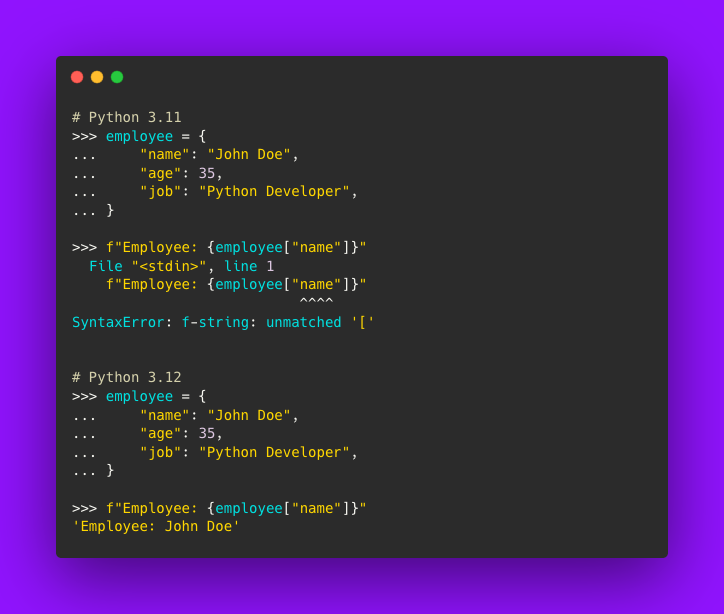
Python 3.12 will include a more intuitive and consistent f-strings.
Thanks to PEP-701, the goal is to guarantee that f-strings can include all valid Python expressions, including those with:
Backslashes
The same type of quote
Unicode escape sequences
Multiline expressions
No sé ustedes, pero lo de hoy me ha hecho ver un poco de lo que será la futura y cruel realidad; va a ser muy jodido cuando Faker se retire, no solo por lo que aporta al equipo, sino por lo que es como figura y lo que significa para los Esports.
Vuelve pronto Faker.




![rohanpaul_ai's tweet photo. Absolutely great question, involving some very fundamental core concept of Python
Ans is - c. None
The key concepts here are about Python's extended iterable unpacking feature. This feature allows you to unpack values from an iterable (in this case a list) into variables. And also the concept of nested data structures in Python.
Let's dive in
---------------------
👉 First, in the line `a,*b, c = ["Car", "Dog", "Tiger", "Lion"]` is doing the extended iterable unpacking.
👉 The syntax `*b` in the left side of the assignment statement is used for catching all remaining items from the iterable which are not assigned to other variables. In this case, `a` will be assigned the first item from the list, "Car", `c` will be assigned the last item, "Lion", and `*b` will catch the remaining items, ["Dog", "Tiger"].
👉 This is a very powerful feature of Python, especially useful when the exact length of the iterable is not known beforehand, or if you are only interested in some parts of the iterable.
👉 Now, the next line `item = b` is just assigning the list `b` to the variable `item`. So, `item` now contains the list ["Dog", "Tiger"].
👉 In the return statement `return "Lion" in [item] or None`, we are using the `in` operator to check if "Lion" is present in the list [item]. Here's where the confusion might lie.
👉 Remember that [item] is a list containing one element, the list `["Dog", "Tiger"]`. This makes [item] a nested list which is
`[['Dog', 'Tiger']]`
💡So, when Python checks for "Lion" in this list, it does not find it, because "Lion" is a string, and the list only contains another list, not the string "Lion".💡
NOTE HERE, Even if the problem was structured like below i.e. `a,*b, c = ["Car", "Dog", "Lion", "Tiger"]`
```py
def func():
a,*b, c = ["Car", "Dog", "Lion", "Tiger"]
item = b
return "Lion" in [item] or None
print(func()) # => None
```
Even in this case, when the variable `item` would be `[['Dog', 'Lion']]` => The Function will still produce `None` as the output, because the `in` operation will check the string 'Lion' with a list of lists `[['Dog', 'Lion']]`
Explaining the reason below.
--------------
👉🔥 This is a classic pitfall when working with nested data structures in Python. The `in` operator checks for element presence in a shallow way. It does not recursively check inner lists. For that, you would need to implement a more complex procedure.
👉 As the `in` statement returns `False`, Python moves to the right side of the `or` operator and returns `None`. Python's `or` operator works by returning the first truthy value it encounters, or the last value if none of them are truthy.
👉 This means that the provided code always returns `None`, because "Lion" is not in the list `[item]`, which is a list of a single item, another list ["Dog", "Tiger"].
If you wanted the function to return `True` when "Lion" is present in the list `item`, you could modify the return statement to `return "Lion" in item or None`. In this particular case, it would still return `None`, because "Lion" is not in `item`, but this would correctly check the contents of `item` for "Lion".
------------------
👉 If you enjoyed this explanation:
✅1. Give me a follow @rohanpaul_ai for more of this every day and
✅2. Like & Retweet this tweet:
✅3. Consider subscribing to my MachineLearning YouTube channel -
https://t.co/l5QgUF1Du5
#python #100daysofcode #softwareengineer #programming #coding #java #javascript #programmer #developer #html #coder #code #computerscience #technology #css #pythonprogramming #linux #php #software #reptilesofinstagram #webdevelopment #webdeveloper #tech #codinglife #algorithms #algorithm #datastructures #statistics #programmers #analytics #leetcode #MachineLearning #ArtificialIntelligence #datascience #nlp #reactjs #100daysofmlcode #nlp #textprocessing #programminglife #hacking #learntocode #softwaredeveloper #interview](https://pbs.twimg.com/media/F2DwUtYWAAY1irF.png)