Andrej Karpathy (OpenAI founding member):
"This isn't the year of agents - it's the decade of agents. Stop chasing full autonomy: the AI products that win keep the model on a tight leash and make human verification instant."
in a 10-minute talk, Karpathy breaks down why "partial autonomy" - not fully autonomous agents - is the design pattern that's actually winning right now, from Cursor to Perplexity.
he calls the core mechanic an "autonomy slider" - and there's one loop every ai product lives or dies by.
Watch the talk, then read the article below.
That’s worth more than a $800 course on agent engineering.
in @ycombinator they have a playbook on how to get customers ASAP for your startup.
if you follow this, you’ll brute force your way to 100 customers, almost no matter what your product is.
Here it is:
1/ launch-max.
product hunt, hackerNews, devhunt, betalist, peerlist, indie hackers, etc. YC tells you to launch 3 times MINIMUM
2/ pull your competitor’s strongest backlinks and get yourself listed in the same places.
whatever article they have listed, you make a better version and ask the site to replace it (or supplement) with yours.
3/ WARM OUTBOUND.
Everyone knows about building in public. but you still need to capitalize on the 99% of leads who see your content but don’t come inbound
scrape everyone who likes your posts on Linkedin each week, check if they fit your customer profile, and message them.
you set this up to fire automatically with @origamichat (i dropped a prompt in the comments)
4/ find 20 to 30 ugc creators on tiktok / instagram in your niche. ask them to create content about your product, ideally from a fresh account.
pay them a fixed fee ($15–$30 per video) plus performance incentives ($1k for 1 million views, etc).
you can use @sideshift_app (best creators imo) and line up 20+ of these creators in 1 day
5/ when building in public, a video is 10x better than an image/text - spam use cases of ur product on X/Linkedin
6/ figure out where your customers actually spend time.
which slack/discord groups are they in? what newsletters do they open? which podcasts and accounts do they follow? pay those people for shoutouts
7/ there's a fresh trend on x basically every week. jump on the relevant ones and fold your product in (like i’m doing right now).
To find trends i just use Origami & search “Lead Gen/GTM posts that are viral on X” to find the best posts every week in my niche
Then, I will reply to those, quote tweet them, and use the formats that work myself
(that’s the secret to why my account has high engagement BTW - you can do this too)
---------
if you are doing all this every single week and DO NOT GIVE UP (launching, posting demos, contacting new customers)
I guarantee you will hit your customer goals. Then the game becomes retention.
will be posting 2-3 more growth hacks every single week
Pieter Levels makes over $250,000 a month -> alone, from a laptop, with zero employees
no co-founder. no investors. no team. just him and a backpack, moving between countries
he started by daring himself to launch 12 startups in 12 months. then he kept going -> 70+ products over the years, and most of them flopped
he doesn't plan. no roadmaps, no polishing for months. he ships before it's "ready" and kills anything that gets no traction within weeks
one throwaway experiment -> an AI photo app he built the day after a tweet went viral -> hit $77,000/month within a year. today it does over $130,000/month on its own
he still writes everything in old-school PHP. every error gets piped straight to his Telegram. ~95% of the revenue is pure profit
even Andrej Karpathy said this is the model for the future: one person running multiple companies
the clip below is him explaining exactly how ↓
I have personally seen 6 brands restart growth using the "hudson method"
we are talking 5m a year brands to 100m a year brands.
the steps:
1- seed hundreds of creators on tik tok
small, new accounts, no one famous
2- pay them per video PLUS commission
BUT heavily incentives them to post LOTS of videos
bonuses for posting 100+ videos a month
3- take all the creative, load it into every ad channel
you just solved creative bottlenecks and unlocked infinite ad angles
4- scale ad spend on EVERYTHING, while still paying the creators commission on the ad sales
--
it isnt about tik tok shop sales.
it isnt about gmv max.
its all of it.
you get free cpms on tik tok.
you get unlimited content.
and it jump starts the whole business
more ads, more angles, more channels.
this is named after the legendary founder of comfrt, hudson. all hail the ugc king.
This is the exact order I’d test creatives if I took over your account right now 👇
1. Offer
2. Objection busters
3. FAQ-based hooks
4. Testimonials
5. Authority flexes
6. Faster/cheaper/more effective than other products
7. Faster/cheaper/more effective than other solutions
8. Solution-aware
9. Problem-aware
10. Unaware
Lesson in this.
This 2 hour lecture by Yann LeCun (Turing Award winner) will teach you why the next trillion dollar AI company won't be built on LLMs.
He trashes the $100 Billion LLM race, attacks Musk and Amodei, declares scaling dead.
Bookmark & watch tonight after work, skip to 7:00.
Jensen Huang said AI has 5 layers of value. India doesn't have a presence in any of them.
⚡ Layer 1 — Energy. A hyperscale AI campus now draws 1–2 gigawatts — a mid-sized nuclear reactor, for one building. China added nearly India's entire installed grid in new capacity last year.
💾 Layer 2 — Chips. The silicon brain and everything that makes it.
→ GPUs: Nvidia (US), AMD (US), Broadcom (US) design. TSMC (Taiwan) fabs at the cutting edge.
→ HBM, the high-speed memory beside every GPU: ~90% Korea.
→ ASML (Netherlands) has a monopoly on the one machine that prints the most advanced chips.
→ Silicon wafers ~60% Japan. Photoresist ~90% Japan.
🏭 Layer 3 — AI infrastructure. The data centre and everything around the chips.
→ Hyperscale cloud: AWS (US), Azure (US), GCP (US); Alibaba (China), Tencent (China).
→ Servers and AI-rack cooling: Supermicro (US), Vertiv (US), Schneider (France), Eaton (US).
→ Commodities: copper (Chile, Peru), niobium (~90% Brazil), rare earths (~85% processed in China).
🧠 Layer 4 — Models. Closed: OpenAI (US), Anthropic (US), Google (US), Meta (US). Open: DeepSeek (China), Qwen (China), Kimi (China).
💻 Layer 5 — Applications. ChatGPT (US), Copilot (US), Cursor (US), Claude Code (US), Agentforce (US). Mostly US. Increasingly Chinese.
China has a presence in all 5. Korea owns HBM. Taiwan owns the cutting-edge factory. Netherlands owns the machine that makes it possible.
India:
Layer 1 — grid stretched, industrial power expensive and patchy. 24/7 clean power is hard to deliver today.
Layer 2 — no frontier chip factory. Tata-PSMC (India-Taiwan) at ~28nm is a decade behind AI chips. India's chip design talent works for Nvidia (US), AMD (US), Qualcomm (US), Intel (US). Value flows to US balance sheets.
Layer 3 — India builds the data center buildings (Yotta, Adani, Reliance) and generic industrial power and cooling gear (BHEL, Crompton, Blue Star). But no hyperscale cloud, and no specialized AI-rack cooling or power shelves. Every Indian AI startup runs on AWS (US) or Azure (US).
Layer 4 — Sarvam, Krutrim (India). Real teams, orders of magnitude below the frontier.
Layer 5 — Zoho, Freshworks (India) are real SaaS businesses, but their AI features — like most Indian AI-app startups — are thin wrappers on OpenAI (US), Anthropic (US), Google (US). And not agentic. Agents are where the flywheel lives. India has no agentic platform at that scale.
This is a 30-year-old choice. India bet on services and not manufacturing. TCS, Infosys, Wipro, HCL (India) built a ~$250B export industry. It paid off. But services sit above the stack — they don't own any layer of it.
India's AI Mission is ~$1B. China's is in the hundreds of billions. That's not a gap to close — it defines the game.
This is the moment NVIDIA should be seriously worried.
In the next couple of weeks DeepSeek V4 will be launched. It’s a direct attack on the entire AI stack that American companies have spent years locking down. Full “de-NVIDIA-ization”, a complete shift away from CUDA into Huawei’s CANN ecosystem, running on Huawei Ascend chips. That means one thing, breaking the dependency that made NVIDIA untouchable.
35x faster inference vs early versions. Nearly 3x the performance of NVIDIA’s H20 on a single card. 40% less energy consumption. Over 95% CUDA compatibility with migration times collapsing from months to hours.
Even Jensen Huang has already admitted it. If this works at scale, it’s a “terrifying outcome” for US companies.
Because here’s the real problem, this isn’t happening in isolation.
Chinese tech giants like Alibaba, ByteDance, and Tencent are already ordering hundreds of thousands of Ascend chips. Market share is shifting fast, domestic chips now at 41%, NVIDIA slipping to 55% in China’s AI server market.
Additionally DeepSeek V4 is reportedly offering API costs at a fraction of US competitors. $300 for massive workloads that would cost $2,500+ on OpenAI models, or even $5,000 on Anthropic.
So this isn’t just about one model. It’s about China building a fully independent AI stack, chips, frameworks, models, and applications. Completely outside of US control.
NVIDIA doesn’t just lose sales. It loses its grip on the global AI standard.
Martin Picard published one of the most important papers in modern biology in 2025.
Almost no one outside a small circle of researchers has heard of it.
The Energy Resistance Principle may explain disease, aging & energy crashes — from first principles.
Here’s the framework:🧵
Easiest way to make money in Ecom:
1- sell services.
There is always an in demand service.
From 2015-2020 it was media buying.
You could be 18, dumb, but know Facebook ads and make $300,000 a year (this was me)
You start as a freelancer. You find one person to pay you.
Often, you work for free. You work hard, way over delivering.
But once you land one client, you can land 10.
Freelancer becomes agency.
Media buying is basically dead.
It got replaced by creative strategist.
Demand for that is dropping.
Now the most in demand service is ai enablement.
Come in, rebuild this workflows with ai.
Build them ads with ai.
Build data streams with ai.
Build them brand books.
That is the current In demand service.
2- make content.
Sponsorship dollars are real.
I’ve heard people get 5-10k for undisclosed saas ad tweets.
I’ve never done that, but my podcast makes millions a year.
Have a pov. Share a perspective. Help people learn and get better.
Would be very easy to make 300k a year full time podcasting in any B2b niche.
Just need to be good.
3- actually sell stuff.
This is low down the list because of how hard it is.
A $10,000,000 brand will cash flow you maybe a million.
Lots of money tied up in inventory.
“I’ll just drop ship”
You can drop ship to a million a year.
But the amount of people who can only drop ship and get to 8 figures is like seven.
You have to be best in class to do it.
And if you are so good- just build a real brand and buy inventory.
Can’t be a drop ship demon in Walmart and Amazon.
The cash constraints of Ecom are real.
I’ve built a great life doing it.
You can be a millionaire and make millions per year.
But I’m 10 years in. On one brand…
And I’m only good because I did the other two steps.
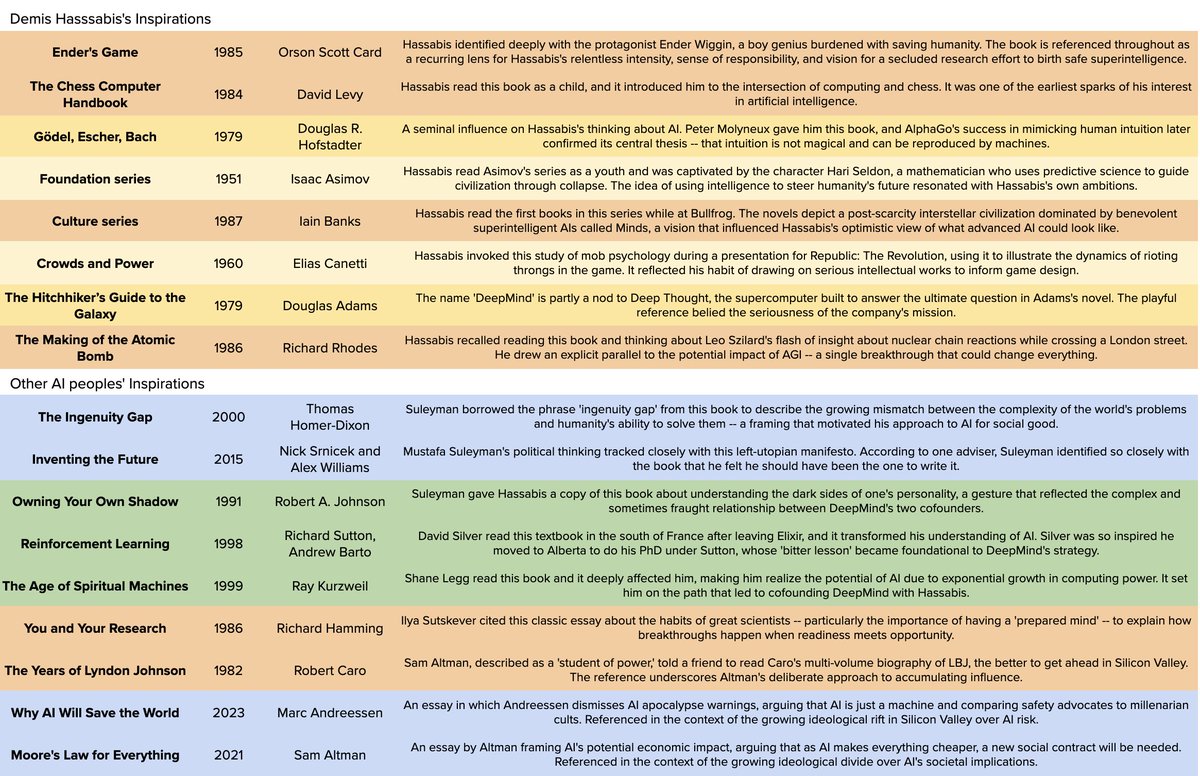
Every single book that influenced Demis Hassabis and DeepMind (and how it inspired them), from “Infinity Machine”.
Classics like GEB, Hitchhikers, Foundation series, Culture series and modern ones like the Altman influences.
Bookmark this. Required reading all technologists.