Level up your coding skills with the latest #GenAI tools and trends.
Get the https://t.co/go7lwJ4Tgg weekly newsletter, where we cut through the hype to deliver essential AI topics for software developers.
Sign up now at: https://t.co/C8Rr6eYUZR
Exciting news! There's a new course from @DeepLearningAI_.
Personally, I'm hooked on code copilots. I'm much more productive in programming languages outside my specialization. The LLM's autocomplete and explain feature bridge the knowledge gap for me.
https://t.co/7msyQQR1oV
When you factor in the dependencies, you're looking at a whole lot more code. Like, a million lines more. Yeah, that's right, a million.
Check out this quick guide detailing the tradeoffs of frameworks & how to pick the right one for your next app build.
https://t.co/ie2Q0hhsFD
So, you've probably seen those posts floating around;
Build a ChatGPT clone in 10 lines of code!
Sounds too good to be true, right? Well, it is.
The truth is, those 10 lines of code are just the tip of the iceberg.
The AWS blog recently shared an example architecture for tuning and deploying a generative model on Amazon EKS. They even provided a complete Terraform template, making it a great starting point for your specific requirements.
https://t.co/icgtxC7FQH
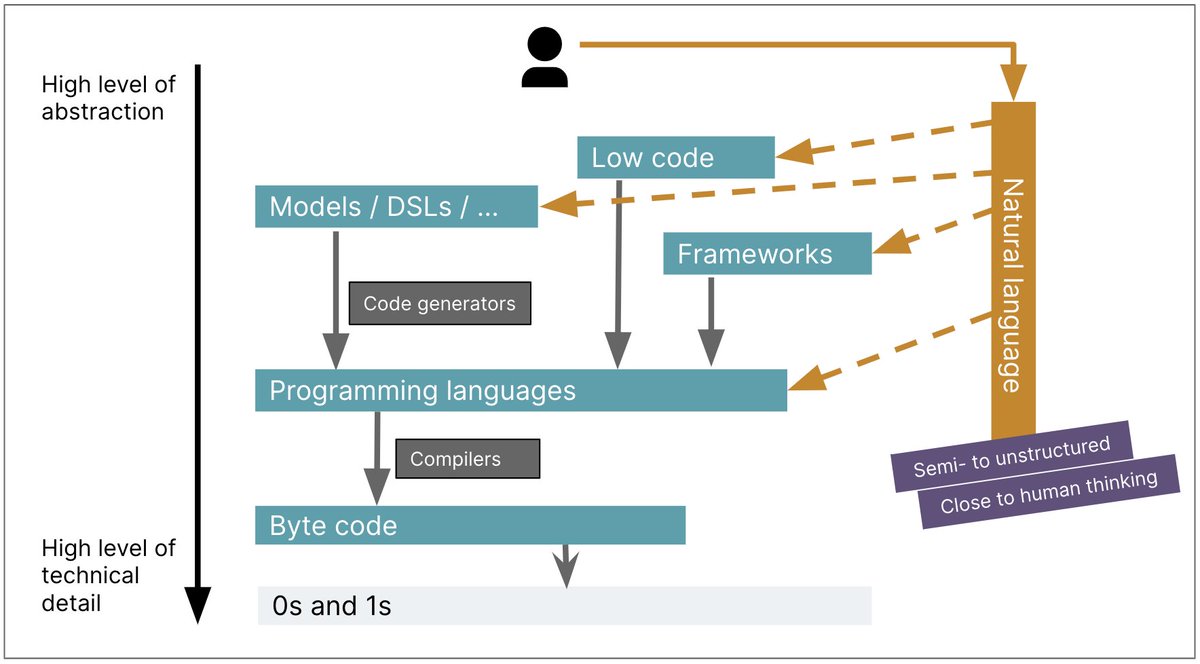
The GenAI approach has the benefit of enabling engagement at any level of abstraction vs traditional code-gen needing to continually raise the level of abstraction.
https://t.co/9IxhxbCFKK
Another interesting memo from @birgitta410's
Exploring Generative AI post on https://t.co/6fmCvldEDr.
What’s different about code generation with GenAI?
This speaks to the the altered approach GenAI brings to low-code frameworks.
What I appreciate the most is that it begins with model evaluation strategies, a topic that is often overlooked or omitted in similar articles.
https://t.co/D5Qf2sNqsL
If you're thinking of developing a production-ready app based on an LLM (Large Language Model), this write-up by @eugeneyan is an excellent starting point. It covers everything from the RAG (Retrieval Augmented Generation) itself to gathering user feedback.
What I appreciate the most is that it begins with model evaluation strategies, a topic that is often overlooked or omitted in similar articles.
https://t.co/D5Qf2sNqsL
I'm happy to be on the Time AI 100 list of influential people in AI, and thrilled that 8 others from my Stanford group or other teams I led are also named!
Congratulations to my former advisees and team members:
- Sam Altman @sama (as undergrad, interned with me on RL research at Stanford)
- Dario Amodei @Dario_Amodei (worked with me on DeepSpeech and scaling laws at Baidu)
- Alison Darcy @alisonmdarcy (AI+mental health at Stanford)
- Geoff Hinton @geoffreyhinton (member of my team at Google Brain)
- Lila Ibrahim @lilaibrahim (once my COO at Coursera)
- Neal Khosla @nealkhosla (undergrad advisee at Stanford)
- Richard Socher @RichardSocher (PhD advisee with Chris Manning)
- Ilya Sutskever @ilyasut (postdoc at Stanford)
It's thrilling to see the ongoing impact of everyone's work! ❤️
Mojo🔥 is now available for download locally to your machine! ❤️🔥🚀
Beyond a compiler, the Mojo SDK includes a full set of developer and IDE tools 🛠 that make it easy to build and iterate on Mojo applications. Let’s build the future together!🔥
https://t.co/KxmLvsxx5e
The @pinecone TypeScript SDK for Pinecone has reached version 1.0!
While I personally love Python, it's always exciting to see investments made in diversifying the ecosystem.
Check out the release here: [GitHub](https://t.co/TpB3WsTuZ9)
I'm excited about this one. I've been eager to try out Vertex AI, and this series of 1-hour courses from @DeepLearningAI_ has been fantastic.
https://t.co/SqpKiMCaSf
Nice in depth read from Forbes. Has a great explanation of transformers, including their shortcomings. Then goes on to discuss what could be the next leap to overcome these gaps in transformer capabilities.
https://t.co/ABe3yRloZd
I tried no-code solutions for a while.
People said it was supposed to be quicker than coding.
It was, but flexibility was so limited that it didn't work for me.
Anyone who swears by it?
@JorisTechTalk Agree with the sentiment here, the more "automatic" app creation is, the more opinionated that app building framework is and you are more likely to get to a point where those opinions diverge from how you need the app to function.
🤓re-reading this awesome guide on “what’s going on under the hood in a RAG pipeline” by @czue over coffee this morning ☕
a really thorough deep-dive for anyone that wants to really understand how domain-specific chatbots actually work
https://t.co/4vIyHgrvNh
I just finished reading an excellent writeup from @ScrivAI on Retrieval Augmented Generation (RAG). The article provides clear explanations & helpful diagrams, deconstructing the entire RAG process - from indexing a knowledge base to generating answers.
https://t.co/0gtzGp7osG
Great tutorial for building a Retrieval Augmented Generation (RAG). Built on AWS and leveraging @pinecone as the vector store. You can undertake it as a blog post or video.
https://t.co/d7xmQk6EQn


![devthinkai's tweet photo. Apparently AWS really has infinite compute ����
[not photoshopped]
#bedrock #AWS #LLM https://t.co/NLycZTvjzs](https://pbs.twimg.com/media/F7mYdqOaYAA4CwN.jpg)