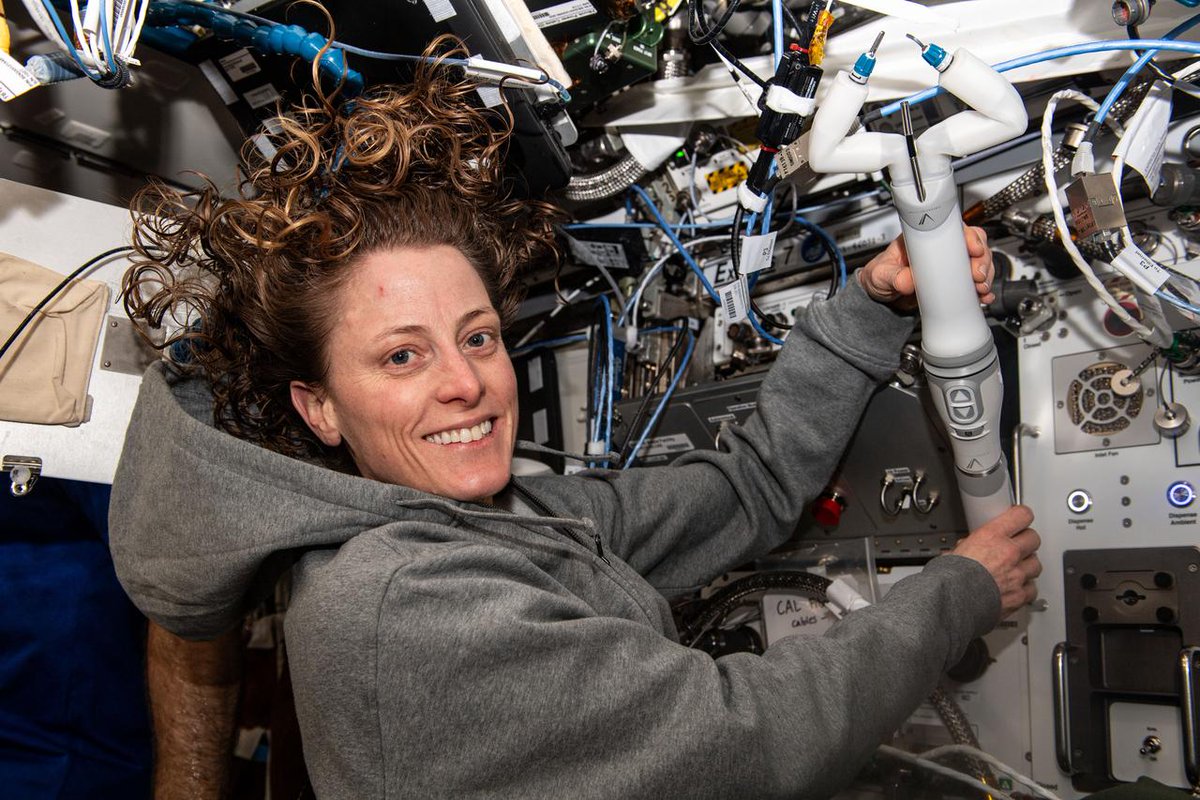
Crew-12 is heading home, shaped by a mission full of science 🔬
From advancing cancer treatments to refining quantum technologies, Crew-12 supported a range of research that benefits life on Earth and helps prepare humans for future exploration missions. https://t.co/kvGEK1sFJL
I finally have all 1.2 million raw image files from my latest mission to ISS! Here is a sample of one of my favorite Milky Way photos, taken from the Cupola with Nikon Z9, Arri Zeiss 15mm lens, T1.8 with custom sidereal drive that cancelled out star motion relative to our orbit.
A.I. Artificial Intelligence (2001) is one of the strangest studio miracles ever made. Spielberg directing Kubrick’s coldest idea as a fairy tale about abandonment, memory, and wanting to be loved.
25 scientific breakthroughs from 25 years of continuous human presence in space!
Grateful to share even a small part in this milestone and write about some of the science behind it.
https://t.co/fXLjgQJG2A
From low Earth orbit to around the moon.🌙 Organ chips have been used in dozens of experiments aboard space station and in labs on Earth. Now, these devices will continue their legacy on Artemis II, where they will be used for the first time beyond the Van Allen belts.
AVATARs for astronaut health are heading to deep space! 🧑🏽🚀
Organ chips containing @NASAArtemis II crew cells will fly side-by-side with astronauts around the Moon. The goal: understand the impacts of deep space radiation and microgravity on individual health. 🔗 https://t.co/3Je1d57j8R
NG-23 resupply is set to launch to the space station this month with science to fuel the future of space exploration and improve industry on Earth: from zapping germs with UV light to scaling up semiconductor production in space. 🔦💎
Read more: https://t.co/JSniwTWhna
A unique orbit means a unique view of our galaxy and beyond. 🔭💫
Space station provides a perfect perch for astrophysics instruments, helping us learn more about black holes, dark matter, and the very composition of our universe.
He came. He saw. He took great pictures.
Now, it’s time for him to come home. Watch live as @Astro_Pettit and two cosmonauts depart the @Space_Station aboard the Soyuz MS-26 spacecraft and return to Earth on Saturday, April 19. See the full schedule: https://t.co/aooEnloGRK
Live from space! Join our very first @Twitch stream directly from the @Space_Station on Feb. 12 to ask @Astro_Pettit about living and working in space.
We will also be joined by @DominickMatthew, who recently returned home from living aboard the station. https://t.co/LQiUToKogh
Remotely-operated robotic surgery
3D-printed steel samples
Over 630,000 Earth images
Bioprinted human heart tissue
2024 was one for the books! Learn about milestones @Space_Station research accomplished in the pursuit to improve lives on Earth and in space. https://t.co/gATRYInyo0
No tricks here! 👻 The Dragon spacecraft will carry several science treats for astronauts to conduct aboard @Space_Station. Studies include measuring solar winds, understanding radiation tolerance in moss, and testing cold-welding in space. https://t.co/J7mc7GpWl5
The comet’s tail is refracted by earth’s atmosphere right before orbital sunrise.
Canadarm2 is out of focus in the near field.
We were discussing the other day how lucky and grateful we are to have seen amazing aurora, a solar eclipse, and a comet in a single trip to the ISS.
200mm, f2, ISO 5000, 1/8s, de-noised